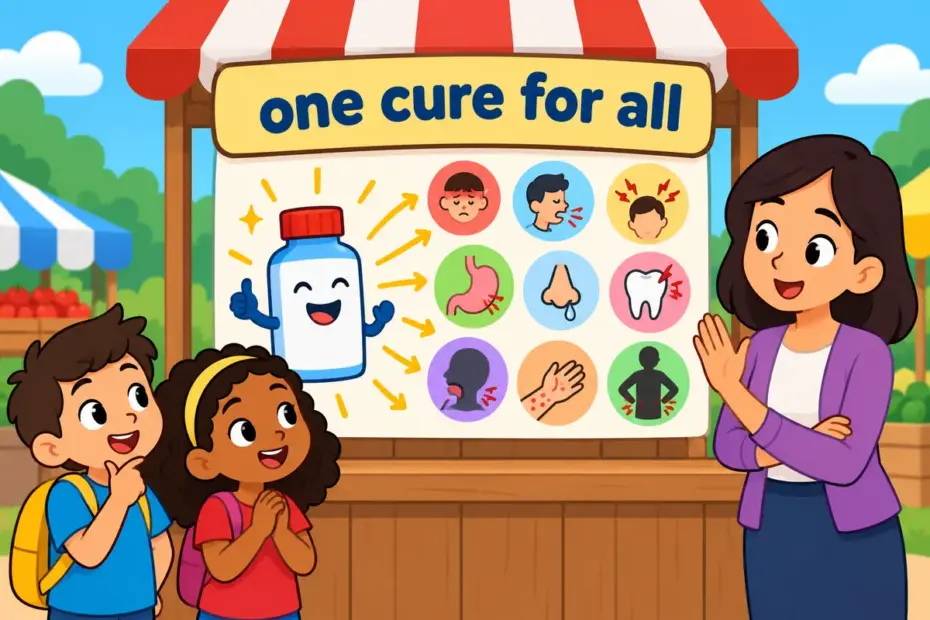
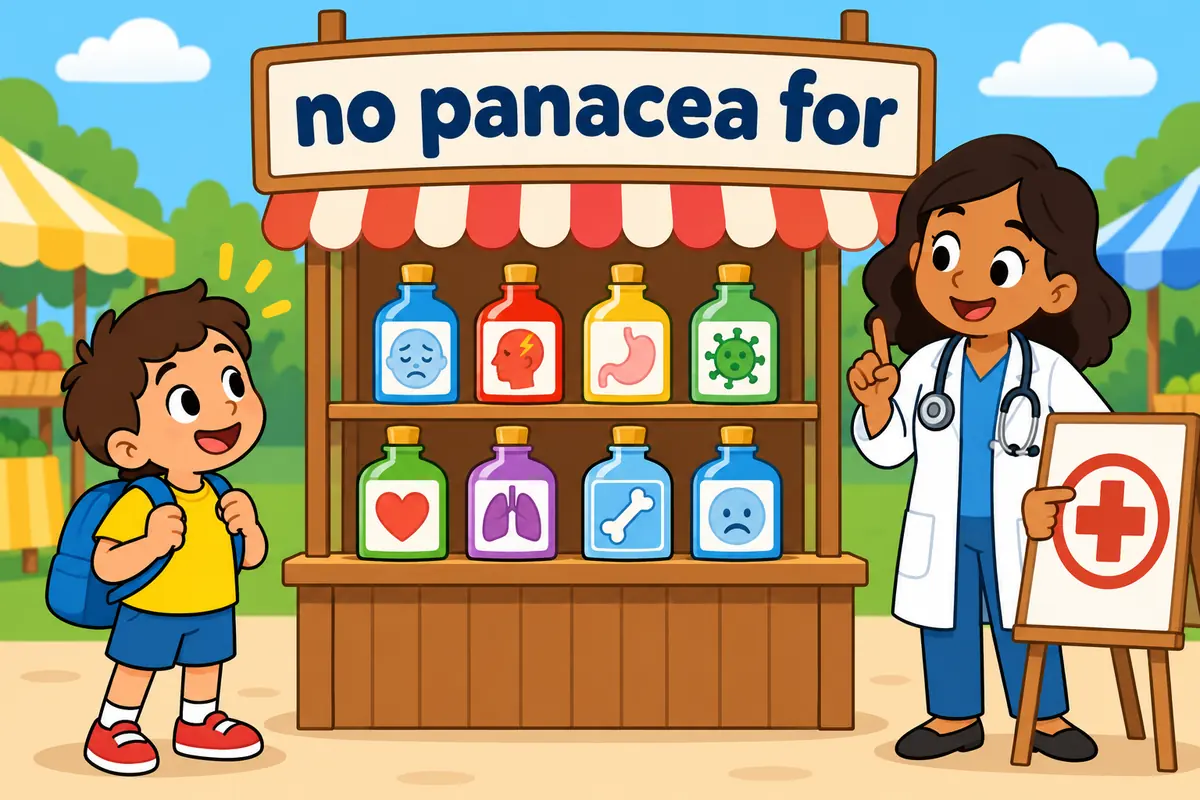
Panacea means a cure for every disease or a single solution for every problem, and writers almost always reach for it to deny that claim. To use panacea in a sentence, follow the frame is no panacea for: “Longer hours are no panacea for weak teaching.” The noun is countable, so it needs a determiner.
Panacea at a glance
- Panacea is a noun; the plural is panaceas, and the adjective panacean is rare.
- The literal sense is a remedy for all diseases; the common extended sense is a fix for every problem.
- The word lives in the frame is no panacea for, which warns against trusting one fix.
- It belongs to formal, medical and argumentative writing rather than casual chat.
- The commonest error is confusing panacea with panache, which means flair or style.
What does panacea mean?
Panacea is a noun meaning a remedy that cures every disease, and by extension a single solution that fixes every problem. The Cambridge entry for panacea keeps both senses. In ordinary use the second sense dominates and usually appears negated, because a claim that one fix solves everything invites doubt. A cautious writer reaches for a remedy when the fix is partial but real.
| Sense | Plain meaning | Example sentence |
|---|---|---|
| Literal | A remedy for all diseases | Medieval doctors searched in vain for a panacea. |
| Extended | A single fix for every problem | The new app is no panacea for poor study habits. |
One limitation is worth stating plainly. Panacea does not mean a helpful improvement; it means a complete and universal cure, which is why the word so often appears with no or not. Call a modest reform a panacea and a reader will read the claim as an exaggeration.
How do you use panacea in a sentence?
Panacea is countable and normally follows a negative frame. Five patterns cover almost every real sentence, and the first two carry nearly all the weight.
| Pattern | Example | What it signals |
|---|---|---|
| be no panacea for | Longer hours are no panacea for weak teaching. | The standard warning that a fix is partial. |
| not a panacea | The reform is welcome but not a panacea. | Concedes some value while limiting the claim. |
| a panacea for + noun | Some treat the drug as a panacea for ageing. | Reports an overreach, usually with doubt implied. |
| the panacea | No single method is the panacea. | Names an imaginary complete cure. |
| panacea + for + problem | Researchers doubt any panacea for the disease. | Keeps the literal medical sense. |
Panacea in a sentence: examples across contexts
Panacea stays formal wherever it goes, but the subject beneath it changes from medicine to policy to sport. The nine sentences below keep the universal-cure sense visible in every register.
| Context | Example sentence | Why this works |
|---|---|---|
| Medical writing | No panacea for the common cold has ever been found. | Keeps the literal sense and the no frame. |
| Classroom | Extra homework is no panacea for a weak lesson. | Applies the word to teaching, gently. |
| Workplace email | The new software is useful but not a panacea. | Concedes value before limiting the claim. |
| Political speech | Higher taxes are no panacea for failing services. | A rhetorical warning about one fix. |
| Science report | Investigators warn against treating the compound as a panacea. | Uses warn to mark the overreach. |
| Sports column | A new manager is no panacea for a squad low on talent. | Transfers the cure image to a team. |
| Technology review | Automation is no panacea for muddled processes. | The noun follows the no frame naturally. |
| Environmental writing | Trees are valuable but no panacea for rising emissions. | Balances praise with a clear limit. |
| Academic prose | The literature treats micro-credit as neither panacea nor fraud. | Pairs the noun with its opposite extreme. |
Notice that eight of the nine sentences are negative. That bias is not an accident: the word is a warning label as much as a noun.
Panacea vs panache
Panacea and panache sit one letter apart and share nothing else. Panacea names a universal cure; panache names confident flair or style. The pair catches learners because both are rare, formal-sounding nouns with a similar shape.
| Attribute | panacea | panache |
|---|---|---|
| Core meaning | A cure for everything | Dashing style or flair |
| Countability | Countable: a panacea | Uncountable: with panache |
| Typical frame | no panacea for | with great panache |
| Usual topic | Medicine, policy, reform | Performance, dress, sport |
| Register | Formal and cautionary | Approving and slightly literary |
Verdict: choose panacea only for an all-purpose cure or fix, and panache for style; if a sentence sounds like praise of elegance, panache is the word.
Word forms and grammar of panacea
Panacea inflects simply, but its neighbours in meaning are worth keeping straight. The noun cure names a real treatment, and the phrase magic bullet names a targeted solution, while panacea claims to cover everything.
| Form | Part of speech | Example |
|---|---|---|
| panacea | noun, singular | The tonic was sold as a panacea. |
| panaceas | noun, plural | History is full of failed panaceas. |
| panacean | adjective, rare | Nobody believed the panacean claim. |
| cure-all | noun, informal synonym | They pitched it as a cure-all. |
| elixir | noun, near synonym | Alchemists sought an elixir of life. |
The rare adjective panacean appears in formal prose, but the compound cure-all is the everyday substitute. An elixir leans magical, so it suits potions rather than policy.
Common mistakes with panacea
- Incorrect:
The plan was panacea for every shortage.Correct: The plan was a panacea for every shortage. Rule: The countable noun needs an article. - Incorrect:
She solved the case with panacea.Correct: She solved the case with panache. Rule: Panacea is a cure, while panache is style. - Incorrect:
There is a panacea of poverty.Correct: There is no panacea for poverty. Rule: The noun pairs with for, and the negative frame is the norm. - Incorrect:
The medicine was a panacea that cured his cough.Correct: The medicine was a remedy that cured his cough. Rule: Panacea claims to cure everything, so one illness is too small a claim. - Incorrect:
We need a panacea to the traffic problem.Correct: We need a solution to the traffic problem. Rule: A panacea is imaginary; for a real fix, use solution or remedy.
Practice using panacea
Work through the six items, then check the reason beside each answer.
- Fill the gap: No single policy is a ______ for unemployment.
- Choose the better word: She accepted the prize with (panacea / panache).
- Correct the error: The tablet advertised itself as panacea for all fevers.
- Build a sentence: use no panacea for about a new study app and poor sleep.
- Spot the register: which belongs in a medical report — no panacea for the disease has been found, or the wonder drug fixes everything?
- Rewrite with a plain word: The scheme is no panacea for the housing crisis. Use solution.
Answers
- panacea — the no frame marks the imaginary universal cure.
- panache — the sentence praises style, not a cure.
- The tablet advertised itself as a panacea for all fevers — add the article a.
- Model answer: The study app is no panacea for poor sleep habits.
- No panacea for the disease has been found — a report avoids the hype of fixes everything.
- The scheme is not a solution to the housing crisis — solution drops the all-purpose claim.
The bottom line
Use panacea in a sentence when you mean a cure for everything or a single fix for every problem, and keep the negative frame that the word invites. The two nuances that settle most sentences are these: panacea is countable, so it needs an article, and it pairs with for rather than to. If you simply mean a partial improvement, a solution is the safer choice.
Frequently asked questions about panacea
Is panacea always used negatively?
It is usually used negatively. The word promises a cure for everything, so a careful writer rarely states that promise as fact and instead writes is no panacea for. A positive use, as in the drug was hailed as a panacea, usually reports what other people claimed rather than what the writer believes.
What is the plural of panacea?
The plural is panaceas, as in history is full of failed panaceas. The word follows the ordinary noun rule and simply adds s. Because the singular already ends in a vowel sound, the plural is easy to say and needs no spelling change beyond the final s.
What is another word for panacea?
Cure-all is the everyday synonym, and elixir or magic bullet serve in more colourful writing. None of them carries exactly the same medical promise, since cure-all is informal and elixir suggests magic. In formal prose, remedy or solution is often the plainer and safer substitute.
How do you pronounce panacea?
Panacea has four syllables with the stress on the third: pan-uh-SEE-uh. The first two vowels are short, and the third is a long ee sound. The same stress pattern holds in the plural panaceas, where the stress stays on the same syllable and the ending simply adds a z sound.
Are you searching for a solution that can miraculously cure all of your problems? Look no further than the term “panacea.” Panacea refers to an ultimate remedy that promises to solve a range of difficulties or issues in one fell swoop.
Often described as a cure-all, a panacea is touted as the universal answer to various problems or ailments. This term encapsulates the idea of a singular, flawless solution that can bring resolution to a myriad of challenges.
7 Examples Of Panacea Used In a Sentence For Kids
- Panacea is a magical herb that can heal you.
- My grandma says honey is a panacea for a sore throat.
- Eating fruits and vegetables is like a panacea for staying healthy.
- When we are sad, a hug from a loved one can feel like a panacea.
- Smiling at someone can be a little panacea for making them happy.
- The sunshine outside is like a golden panacea for our mood.
- Reading a good book can sometimes be a panacea for boredom.
14 Sentences with Panacea Examples
- Panacea for nervousness before exams is proper preparation and practice.
- Finding a good study group can be a panacea for understanding complex concepts.
- Attending workshops and seminars can be a panacea for gaining practical knowledge.
- Panacea for a lack of motivation is setting clear goals and rewards for achieving them.
- Taking short breaks in between study sessions can be a panacea for combating fatigue.
- Time management skills are often seen as a panacea for balancing academics and extracurricular activities.
- Seeking guidance from seniors can be a panacea for navigating through the college experience.
- A balanced diet and regular exercise can be a panacea for maintaining good physical and mental health.
- Seeking help from counselors or therapists can be a panacea for managing stress and anxiety.
- Panacea for writer’s block is brainstorming ideas and taking breaks to refresh the mind.
- Learning to prioritize tasks effectively can be a panacea for meeting deadlines without feeling overwhelmed.
- Developing strong communication skills can be a panacea for networking and building professional relationships.
- Creating a study schedule and sticking to it can be a panacea for avoiding last-minute cramming.
- Building a strong support system of friends and classmates can be a panacea for staying motivated and inspired.
How To Use Panacea in Sentences?
Panacea is a noun that refers to a solution or remedy for all difficulties or diseases. When using Panacea in a sentence, it is essential to remember its meaning and context.
To use Panacea correctly in a sentence, follow these steps:
- Identify the problem or challenge you want to address in your sentence.
- Consider how Panacea can be applied as a solution to the problem or challenge.
- Integrate Panacea into your sentence by placing it in a position that clearly indicates its role as a universal remedy.
For example: “There is no Panacea for all the issues facing our society, but education comes close.”
In this sentence, Panacea is used to convey that education is a powerful and effective solution for many societal problems. By following this structure, you can effectively incorporate Panacea into your sentences for maximum impact.
Remember, Panacea is a versatile term that can be used in various contexts. Experiment with different sentence structures to find the best way to convey your intended meaning. With practice, using Panacea in a sentence will become second nature.
Conclusion
In conclusion, the use of the term “panacea” in sentences indicates a belief in a universal remedy or solution for all problems. While some may seek a single panacea to solve complex issues, it is important to recognize that challenges often require a multifaceted approach. Panaceas are often idealized, but in reality, addressing issues often necessitates a combination of strategies and interventions tailored to specific circumstances. It is essential to approach problems with an open mind and a willingness to explore various solutions, rather than expecting a single cure-all solution to be the answer.


