
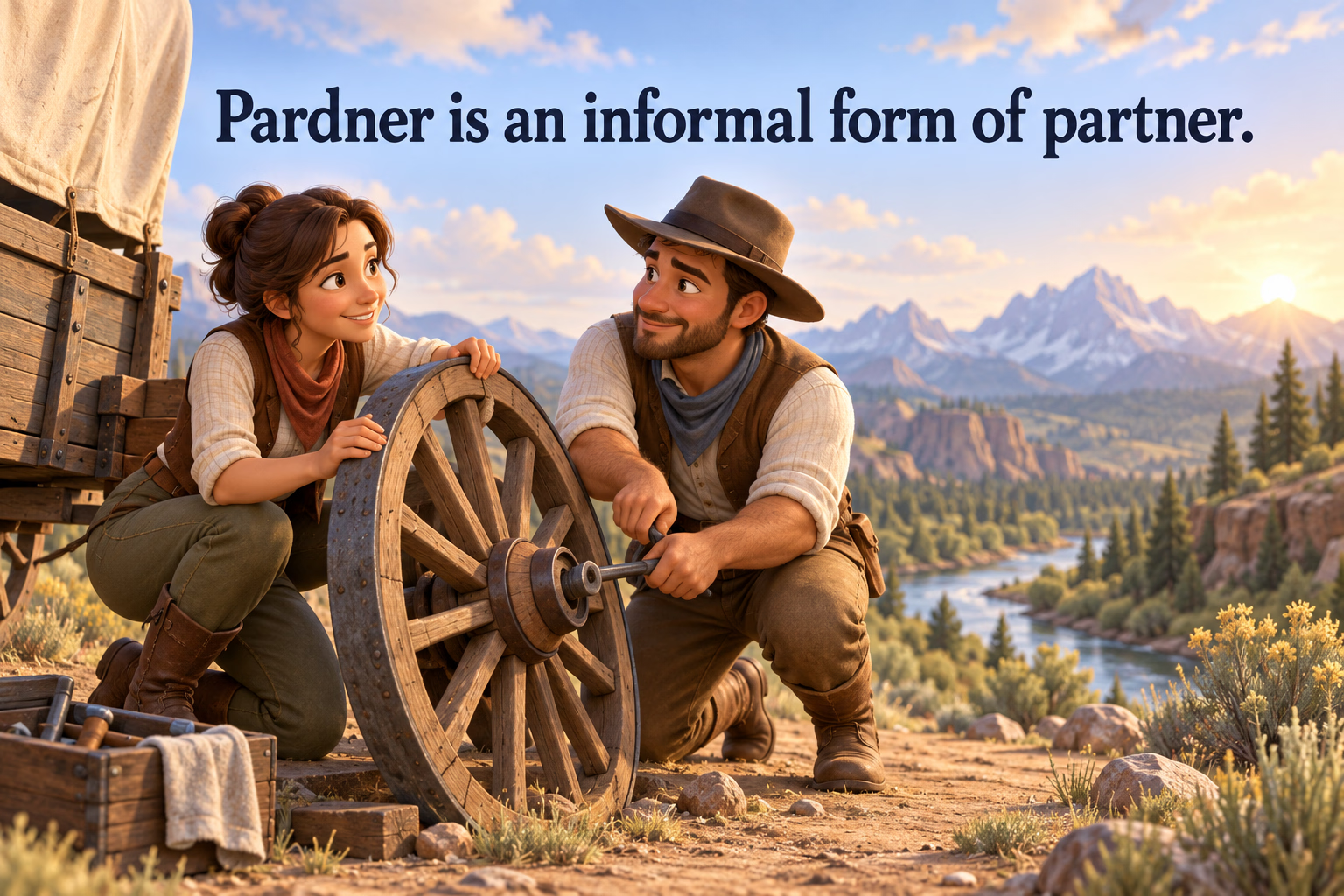
Pardner is an informal, nonstandard North American way of saying or writing partner. It can mean a companion or friend, and it is also used to address someone directly; in neutral or formal writing, use the standard spelling partner.
- Meaning: a partner, companion, or friend; also a familiar form of address.
- Register: informal and marked; the nonstandard spelling may sound playful or deliberately regional, depending on context.
- Grammar: a countable noun: “a pardner,” “two pardners.”
- Punctuation: set off a directly addressed person with a comma: “Howdy, pardner!”
- Standard spelling: use partner in ordinary professional and academic writing.

What does “pardner” mean?
Pardner means a partner, companion, or friend, and it may be used as a term of address. Oxford Learner’s Dictionaries labels it North American, informal, and nonstandard; The American Heritage Dictionary calls it a regional variant of partner. It is an alternate informal form, not the spelling to choose for every context.
Many readers may recognize the word from Western-themed dialogue. Dictionaries also record broader uses as informal address and as a partner or companion. A sentence can use it for playful voice or a deliberate regional flavor without claiming that every speaker from a region uses the term. Avoid writing a character’s entire dialect as a string of misspellings; a small, purposeful choice is often clearer and more respectful.
How do you use “pardner” in a sentence?
Use pardner as a countable noun for one companion or as a noun of direct address. As a countable noun it takes an article or plural form; as direct address, it names the person spoken to and is separated by a comma.
| Use | Example sentence | Grammar note |
|---|---|---|
| Subject | My pardner carried the map while I checked the trail. | “My” identifies one countable companion. |
| Object | We asked a pardner to help with the project. | Use “a” before the singular count noun. |
| Plural | The two pardners compared their notes. | Add “-s” for more than one companion. |
| Direct address | Thanks for the help, pardner. | At sentence end, put a comma immediately before the term of direct address. |
| Possessive | My pardner’s idea solved the problem. | Add apostrophe-s for a singular possessive. |
When should you choose “partner” instead?
Choose partner for standard spelling in school assignments, workplace writing, reports, and neutral conversation. Choose pardner when the informal or stylized voice is relevant—for example, a playful greeting, a quotation, or a fictional line with a deliberate colloquial tone. The spelling alone does not prove someone’s region, identity, or personality.
In a sentence such as “My partner reviewed the report,” the standard spelling works without calling attention to accent. In dialogue—“Howdy, pardner!”—the alternate spelling signals a particular informal voice. It can sound dated, joking, or stereotyped in some settings, so consider the audience and surrounding language.
Where does the comma go when you say “pardner”?
When pardner directly addresses someone, place a comma between the name of address and the rest of the sentence. The Language Portal of Canada gives the same direct-address rule for names and titles.
- At the beginning: “Pardner, can you hold the gate?”
- In the middle: “Could you, pardner, check the latch?”
- At the end: “I appreciate your help, pardner.”
Do not add a comma when pardner is a subject or object rather than direct address: “My pardner found the keys.” The comma marks who is being spoken to; it does not mark every appearance of the noun.
Frequently asked questions about pardner in a sentence
Is “pardner” a real word?
Yes. Major learner and general dictionaries record it as an informal or regional form related to partner. It is nonstandard, so it is not the usual spelling in formal writing.
Is “pardner” the same as “partner”?
It is a variant form of partner used informally, often for a companion or as direct address. The meaning overlaps, but the spelling carries a marked colloquial or stylized tone that standard partner does not.
Can “pardner” refer to a friend?
It can. Dictionaries include companion or friend among its meanings, and it also appears as a familiar form of address. Whether it sounds warm, humorous, or dated depends on the speaker, audience, and context.
Is “pardner” only used by cowboys?
No. Cowboy stories and popular Western imagery made the form especially recognizable, but dictionaries describe it more broadly as informal North American speech or a regional/dialect form. A single use does not establish that the speaker is a cowboy or belongs to a particular region.
What is the plural of “pardner”?
The usual plural is pardners: “The two pardners planned the trip.” In formal prose, write partners unless the informal spelling is intentional.
Should “pardner” be capitalized?
Capitalize it only at the beginning of a sentence or in a title. A direct-address use in the middle of a sentence stays lowercase: “Thanks, pardner.”
Note on the original examples: The source below is preserved unchanged. It presents pardner as broadly friendly, authentic cowboy/frontier language and omits commas in some direct-address examples. These examples are simplified, not claims about all speakers or regions; the spelling is informal and nonstandard, and can sound humorous, dated, or stereotyped. Follow the comma guidance above and use standard partner in neutral prose.
Howdy, pardner! In the Wild West, “pardner” is commonly used as a friendly term for a partner or friend. It reflects the camaraderie and solidarity often found among cowboys on the frontier.
Using “pardner” in a sentence adds a touch of old-time charm and authenticity to your language. So saddle up and join me on a linguistic journey exploring the versatile use of this term!
7 Examples Of Pardner Used In a Sentence For Kids
- Pardner, let’s play together in the sunshine!
- Can you be my pardner and help me pick up the toys?
- Pardner, will you be my friend and share your crayons?
- I love running and jumping with my pardner in the playground.
- Will you be my pardner and help me build a sandcastle?
- Let’s skip and sing with our pardners during playtime!
- My pardner and I like to dance and twirl in circles.
14 Sentences with Pardner Examples
- Hey pardner, did you understand that math problem?
- Let’s work on this project together, pardner.
- Can you lend me a hand with my assignment, pardner?
- We make a great team, pardner.
- I need your help studying for this exam, pardner.
- Have you heard about the upcoming college festival, pardner?
- Let’s grab some snacks and study together, pardner.
- Are you coming to the campus event tonight, pardner?
- Hey, pardner, do you know where the library is?
- We should join that club together, pardner.
- Can you believe how fast this semester is going by, pardner?
- Let’s collaborate on this research project, pardner.
- Do you want to join me for a study session, pardner?
- I appreciate your help with editing my essay, pardner.
How To Use Pardner in Sentences?
Pardner can be used in a sentence as a friendly term for a partner or companion. Here is a helpful guide on how to use this word effectively:
-
Introduction: Start your sentence by addressing or acknowledging someone as your pardner. For example, “Hey, pardner, do you want to go fishing with me?”
-
Informal Situations: Use pardner in casual conversations with friends or family to create a warm and welcoming atmosphere. For instance, “Thanks for helping me out, pardner.”
-
Western Influence: Embrace the Western influence of the term by using it in cowboy-themed settings or when talking about Western culture. You could say, “I reckon we make a good team, pardner.”
-
Express Gratitude: Show appreciation by addressing someone as your pardner, emphasizing the concept of teamwork and partnership. An example would be, “I couldn’t have done it without you, pardner.”
-
Friendly Tone: Use pardner to maintain a friendly and approachable tone in your sentence. This can help create a connection with the person you are talking to. For instance, “What do you say, pardner, want to grab a drink after work?”
By following these tips, you can effectively incorporate the word pardner into your sentences and conversations, adding a touch of warmth and camaraderie to your interactions.
Conclusion
In conclusion, the term “pardner” is a colloquial and informal way of referring to a partner or friend. It is commonly used in Westerns and cowboy literature to denote camaraderie or companionship. Sentences with “pardner” often evoke a sense of loyalty and mutual support between individuals who have a close relationship or work together closely, reflecting a sense of collaboration and unity.
Whether in a casual conversation or in storytelling, sentences with “pardner” bring forth a sense of warmth and familiarity, hinting at a bond that goes beyond just a simple acquaintance. This term is a reminder of the importance of having someone by your side, someone you can rely on and call your partner through thick and thin.


