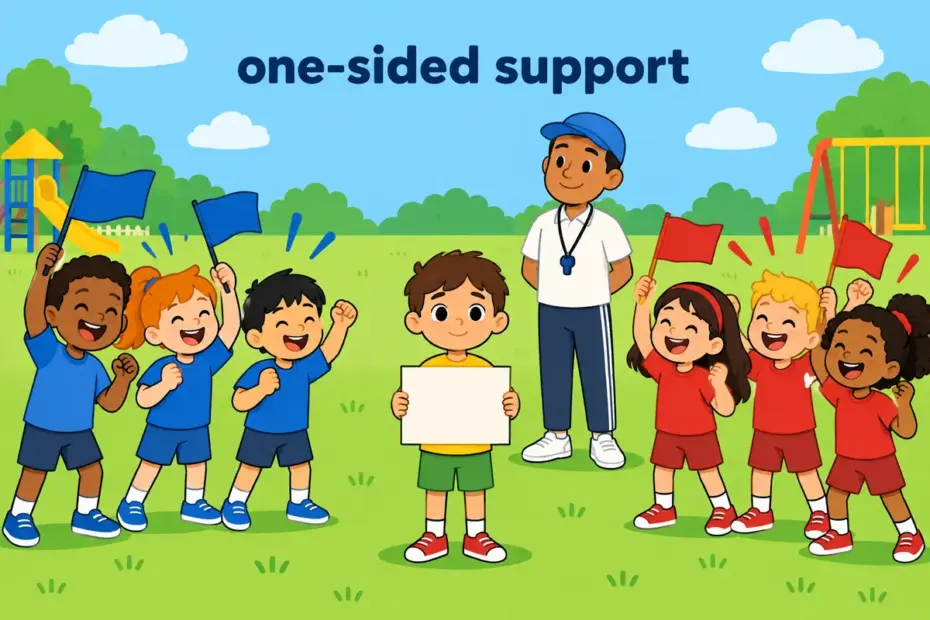
Partisan means a strong, often biased supporter of a party, cause or person, and as an adjective it means favouring one side. To use partisan in a sentence, decide which job it does: a partisan is a person, while partisan describes a judgement. The word almost always carries a hint of unfairness.
Partisan at a glance
- Partisan is both a noun, a supporter, and an adjective, biased toward one side.
- The noun forms are partisan and partisans, and the abstract noun is partisanship.
- As an adjective it usually sits before a noun, as in partisan politics.
- The usual noun pattern is a partisan of plus a cause or group.
- A third, historical sense means a member of an irregular fighting force.
- The commonest error is confusing partisan with artisan, a skilled craft worker.
What does partisan mean?
Partisan is a noun and an adjective. As a noun it means a strong supporter of a party, cause or person; as an adjective it means one-sided or biased. The Cambridge entry for partisan records both uses, and the adjective carries the sharper judgement, because it accuses a person or a report of favouring one side. The historical noun, a resistance fighter, survives mainly in history writing.
| Sense | Plain meaning | Example sentence |
|---|---|---|
| Strong supporter (noun) | A committed backer of a cause or party | She is a partisan of open data. |
| Biased (adjective) | Favouring one side unfairly | Partisan attacks filled the debate. |
| Irregular fighter (noun, historical) | A resistance fighter behind the lines | Partisans held the mountain road. |
Partisan is rarely a compliment. As an adjective it is almost always critical, suggesting that judgement has been bent by loyalty, so a writer who means only that a stance is one-sided can say biased toward one side or one-sided and stay nearer the facts. The approving opposites are impartial and bipartisan, which describe people or votes that take in both sides. Calling a fair-minded report partisan is therefore a serious charge, not a mild one.
How do you use partisan in a sentence?
Decide first whether the word is a noun or an adjective, because that choice fixes the grammar. Five patterns cover almost every real sentence, and only the noun takes of before a cause.
| Pattern | Example | What it signals |
|---|---|---|
| a partisan of + cause | He is a partisan of free trade. | Names the side the person backs. |
| partisan + noun | Partisan debate delayed the vote. | The adjective shows the biased quality of the thing. |
| fiercely partisan | The paper is fiercely partisan. | An intensifier for a strongly one-sided tone. |
| the partisans (historical) | The partisans held the bridge. | Irregular fighters in wartime. |
| bipartisan | The bill won bipartisan support. | Support from both sides, the approving opposite. |
The noun and the adjective share a meaning but not a shape. A partisan of a plan usually faces a determined opponent, whereas the adjective partisan describes the tone of the debate itself. Keeping those two jobs apart removes most errors before they happen.
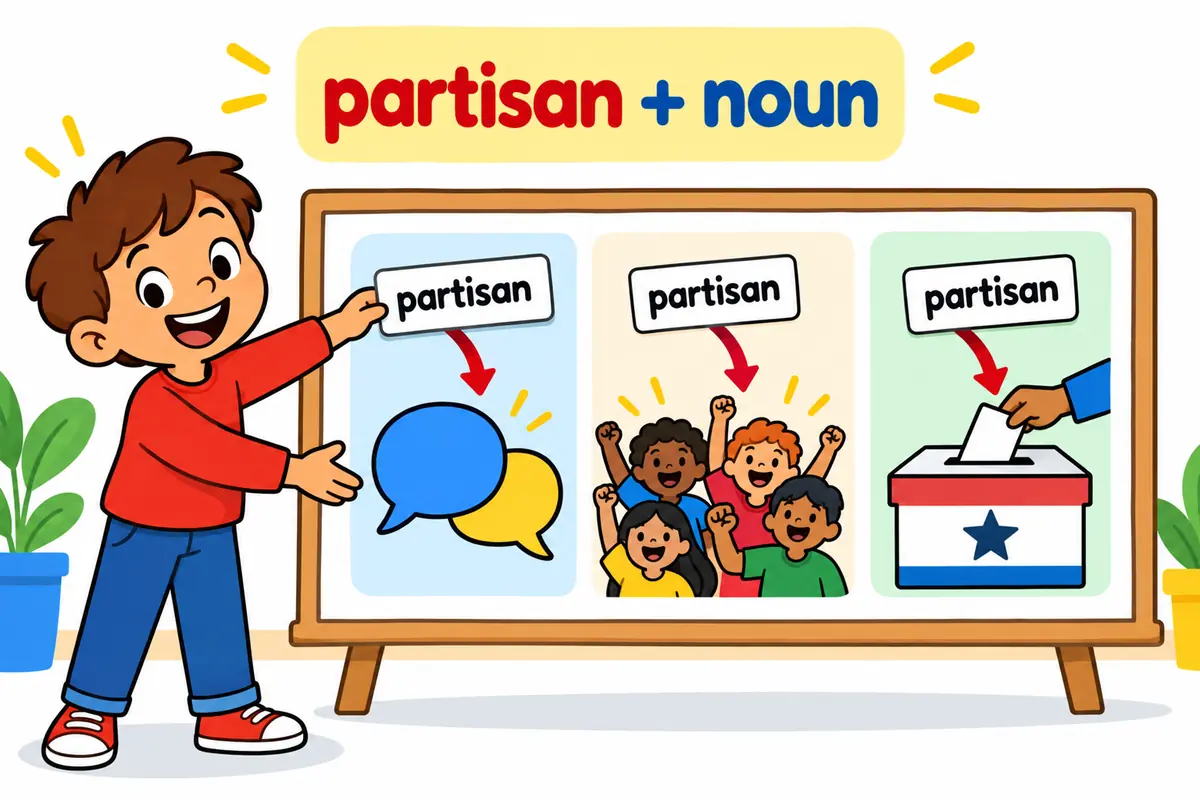
Partisan in a sentence: examples across contexts
The word changes force with its setting. The ten sentences below move from a newsroom to a history book, and each one shows whether the word names a person or judges a stance.
| Context | Example sentence | Why this works |
|---|---|---|
| News report | Critics called the inquiry a partisan exercise. | The adjective accuses the process of bias. |
| Politics | Partisan lines hardened before the vote. | The adjective describes a divided chamber. |
| History | Partisans ambushed the convoy at dusk. | The noun names irregular fighters. |
| Sports fandom | The crowd was partisan but good-humoured. | Shows the word used about a cheerful, one-sided crowd. |
| Workplace | She was a partisan of the new roster. | The noun takes of before the cause she backs. |
| Academic writing | A partisan account of the case cannot be trusted. | The adjective warns that evidence is skewed. |
| Opinion column | The writer makes no attempt to hide a partisan stance. | Names the bias openly. |
| Debate | Two partisans talked past each other for an hour. | The plural names committed supporters. |
| Conversation | Do not be so partisan about your own team. | The adjective works in speech with a mild rebuke. |
| Legal writing | A judge must not appear partisan. | A formal setting where the charge is serious. |
Only some rows would be neutral in tone. A newspaper can report a partisan crowd without blame, but a remain neutral judge or referee must avoid the label entirely, because for them it is a fault.
Partisan vs artisan
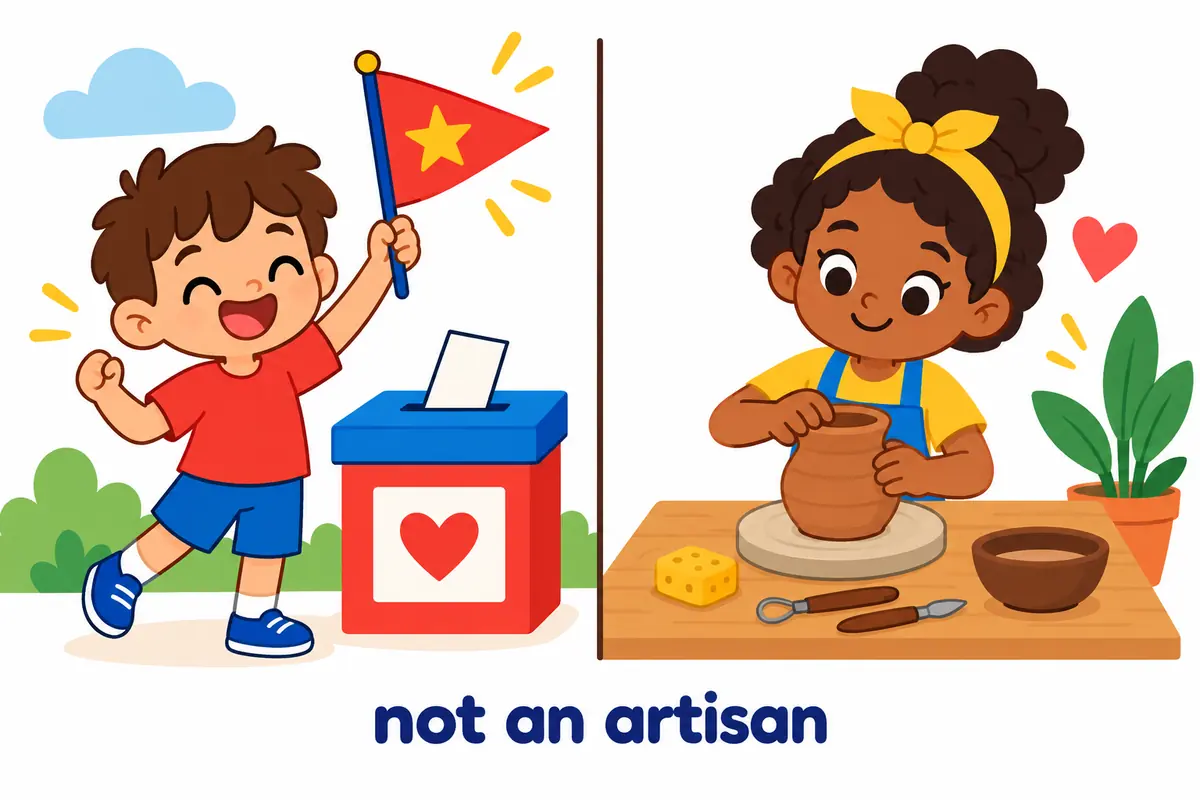
The usual confusion is with artisan a local craftsman, a word that differs by only two letters and shares no meaning at all. Partisan is about loyalty to a side, and artisan is about skill with the hands.
| Attribute | partisan | artisan |
|---|---|---|
| Meaning | A one-sided supporter; biased | A skilled craft worker |
| Part of speech | Noun and adjective | Noun only |
| Ending | -san after parti- | -san after arti- |
| Typical phrase | a partisan crowd | a local artisan |
| Register | Formal and political | Neutral, often about crafts |
| What it implies | Bias toward a side | Skill with materials |
Verdict: a partisan backs one side, and an artisan makes things by hand, so a misspelling turns a politician into a potter.
Word forms and grammar of partisan
Partisan is regular in both of its main jobs. The abstract noun adds -ship, and the approving prefix bi- creates its opposite. The last row shows a flat description that does not need the word at all.
| Form | Part of speech | Example |
|---|---|---|
| partisan | noun, singular | He is a partisan of the old system. |
| partisans | noun, plural | The partisans disagreed all evening. |
| partisan | adjective | Partisan feeling ran high. |
| partisanship | abstract noun | Partisanship stalled the committee. |
| bipartisan | adjective | The deal drew bipartisan praise. |
| partisan group | non-standard use for a flat club | Wrong here; no side is being backed. |
A partisan is best understood as a committed adherent of a cause, and partisanship is the quality that adherent shows. Loyalty is the root of the noun, and bias is the root of the adjective.
Common mistakes with partisan
- Incorrect:
The report was signed by an artisan supporter of the mayor.Correct: The report was signed by a partisan supporter of the mayor. Rule: An artisan is a craft worker, not a supporter. - Incorrect:
She is a partisan for the new library.Correct: She is a partisan of the new library. Rule: The noun takes of before the cause. - Incorrect:
The crowd was partisan of the home team.Correct: The crowd was partisan. Rule: As an adjective, partisan stands alone or before a noun. - Incorrect:
His support was called partisan and warmly praised.Correct: His support was called partisan and quietly criticized. Rule: Partisan carries a critical charge, so praise clashes with it. - Incorrect:
The partisan of the story was clear.Correct: The bias in the story was clear. Rule: The abstract noun is partisanship or bias, not partisan.
That last point matters most for essay writers. A critic who notes a flaw is not partisan; partisanship describes a preference that bends the judgement, not the act of judging at all.
Practice using partisan
Work through the six items, then read the answers for the reason behind each key.
- Fill the gap: The debate grew ______ as the vote approached.
- Choose the better word: The villagers bought bowls from a local (partisan / artisan).
- Correct the error: She is a partisan for the new rules.
- Build a sentence: use a partisan of about someone who backs a cause.
- Spot the register: which suits a court report — A judge must not appear partisan, or Everyone could tell whose side the judge was on?
- Rewrite with the abstract noun: The debate was marked by partisan feeling. Use partisanship.
Answers
- partisan — the adjective describes the divided, one-sided tone of the debate.
- artisan — a craft worker makes the bowls, so partisan is the wrong sense.
- She is a partisan of the new rules — the noun takes of, not for.
- Model answer: He is a partisan of free trade — the noun names the side the person backs.
- A judge must not appear partisan — a formal report keeps the neutral phrasing.
- Partisanship marked the debate — the abstract noun names the quality itself.
The bottom line
Use partisan in a sentence to name a one-sided supporter or to describe a one-sided judgement, and match the grammar to the job: the noun takes of before a cause, while the adjective sits before the thing it judges. The word is rarely neutral as an adjective, so a fair-minded writer reaches for biased or impartial when no accusation is meant. Two nuances decide most sentences: partisan and artisan differ by two letters and share no meaning, and bipartisan is the approving opposite that names support from both sides. For simple, unranked commitment, a devotee of the sport is the gentler noun.
Frequently asked questions about partisan
Is partisan a noun or an adjective?
Partisan is both. As a noun it means a strong supporter, as in she is a partisan of the plan. As an adjective it means one-sided or biased, as in a partisan crowd. The noun usually takes of before the cause, while the adjective sits directly before the noun it describes.
What does partisan mean in politics?
In politics, partisan describes support or conflict based on party loyalty rather than on the merits of an issue. A partisan vote splits along party lines, and partisan debate is driven by allegiance. The word is critical in this use, implying that judgement has given way to loyalty.
What is the difference between partisan and bipartisan?
Partisan means one-sided and tied to a single party or cause. Bipartisan means supported by both main parties, so it carries approval rather than criticism. A partisan bill passes with one side only, while a bipartisan bill wins votes from both, and the prefix bi- does all the work.
Is partisan the same as artisan?
No. The two words share a similar ending but nothing else. Partisan means a one-sided supporter or a biased stance, while artisan means a skilled craft worker such as a potter or carpenter. Because they differ by only two letters, the misspelling is common and worth checking.
Are you curious about the term “partisan” and its significance in political discourse? In a nutshell, a partisan refers to someone who is firmly aligned with a particular party, cause, or faction, often exhibiting strong bias or loyalty towards their chosen group.
This term often arises in discussions about divisive issues, elections, or policy debates where individuals may be labeled as partisans based on their unwavering support for a specific viewpoint or party. Understanding the concept of partisanship can shed light on how our beliefs and affiliations can influence our perspectives and actions in various contexts.
7 Examples Of Partisan Used In a Sentence For Kids
- Some people are very partisan about their favorite sports teams.
- My friend can be very partisan when it comes to choosing between ice cream flavors.
- Being partisan means having a strong preference for something.
- It’s okay to be partisan about things you like, as long as you respect others’ opinions too.
- I noticed my little sister is quite partisan when it comes to picking her favorite color.
- We should try to be fair and not let our partisan views prevent us from being kind to others.
- It’s fun to have different partisan opinions because it makes us all unique and interesting.
14 Sentences with Partisan Examples
- The college debate club is known for its partisan arguments.
- Students often engage in partisan discussions during election season.
- The sports teams have a partisan following on campus.
- The student government elections resulted in a partisan divide among the students.
- The campus newspaper published partisan articles about the upcoming student protests.
- The college political science classes often delve into partisan issues.
- The student union meeting turned into a partisan shouting match.
- The college’s cultural fest had a partisan divide between traditional and modern performances.
- The academic committee faced partisan disagreements on the new grading system.
- The campus diversity workshop addressed issues related to partisan beliefs.
- The college literary society had a partisan split over the choice of books for the semester.
- The college music concert attracted a partisan crowd of rock fans.
- The career fair had a partisan turn-out of students interested in technology companies.
- The campus food festival featured partisan preferences for regional cuisines.
How To Use Partisan in Sentences?
Partisan means showing a strong support for a particular party, group, or cause. When using Partisan in a sentence, it is important to remember that the word typically carries a negative connotation. Here is a guide on how to use Partisan in a sentence:
- Identify the group or party you are referring to in your sentence.
- Make sure the context of the sentence clearly shows the strong and biased support towards that group or party.
- Use Partisan to describe actions, behaviors, or beliefs that are biased or one-sided without considering other perspectives.
- Avoid using Partisan in a positive context, as it is commonly associated with being divisive or prejudiced.
For example, you can say, “The newspaper’s Partisan reporting on the election was evident in their constant praise of one candidate and their harsh criticism of the other.” In this sentence, the word Partisan emphasizes the biased and one-sided reporting by the newspaper.
By following these guidelines, you can effectively use Partisan in a sentence to convey a clear meaning of strong support for a specific party, group, or cause.
Conclusion
In conclusion, sentences with partisan bias show a clear favoritism towards a particular political party or ideology. These statements often lack objectivity and can be used to sway opinions rather than provide a balanced perspective. It is crucial to be mindful of the influence of partisan language and to seek out diverse sources of information to form a well-rounded understanding of complex issues. By critically evaluating the language used in sentences with partisan undertones, individuals can better navigate the political landscape and make informed decisions based on a range of perspectives.
Overall, recognizing and analyzing sentences with partisan leanings is essential for fostering a more informed and inclusive discourse. Developing the ability to identify and interpret such language can lead to a more nuanced understanding of political rhetoric and help promote constructive dialogue that transcends ideological divides.


