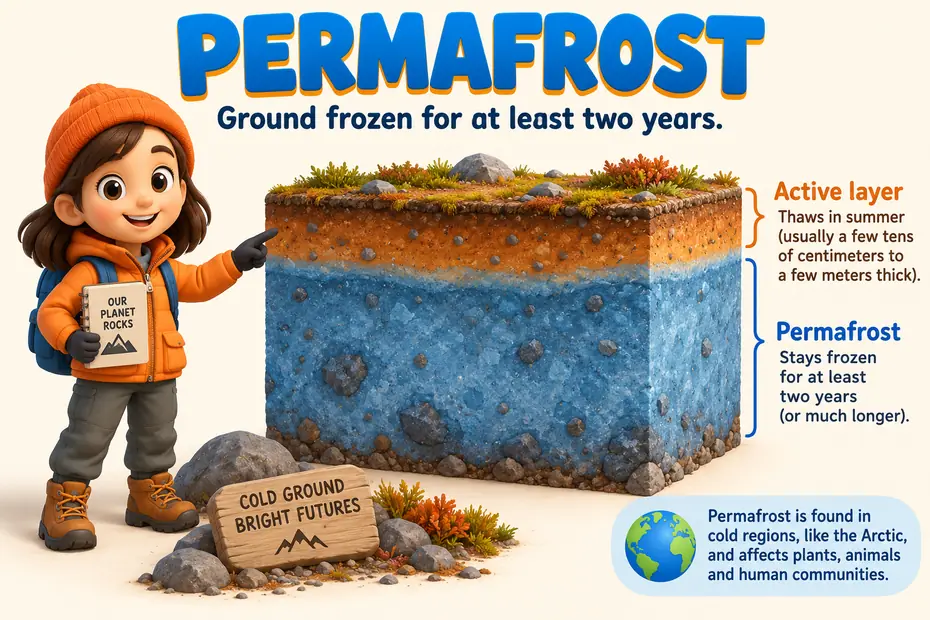
What does permafrost mean in a sentence?
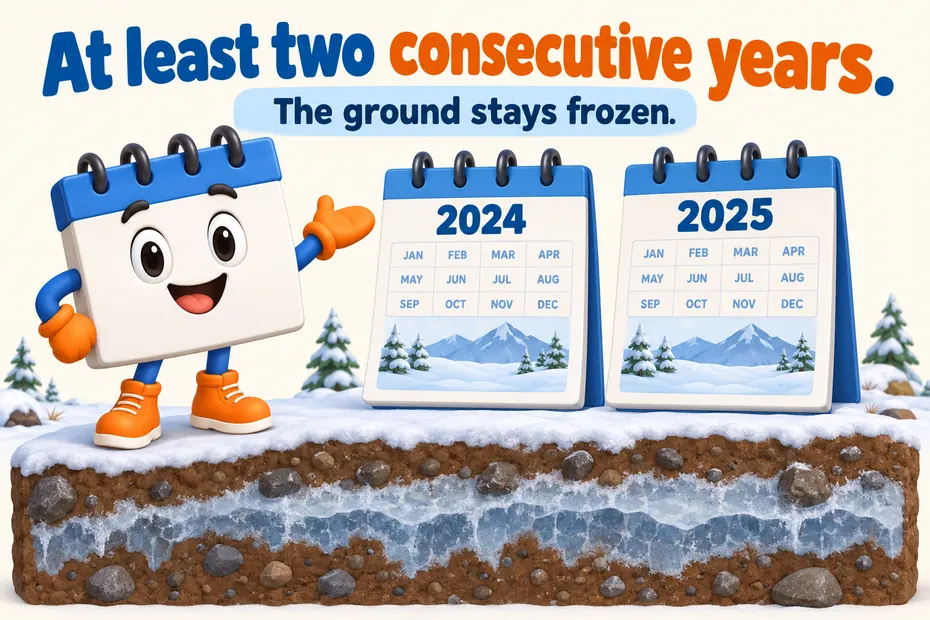
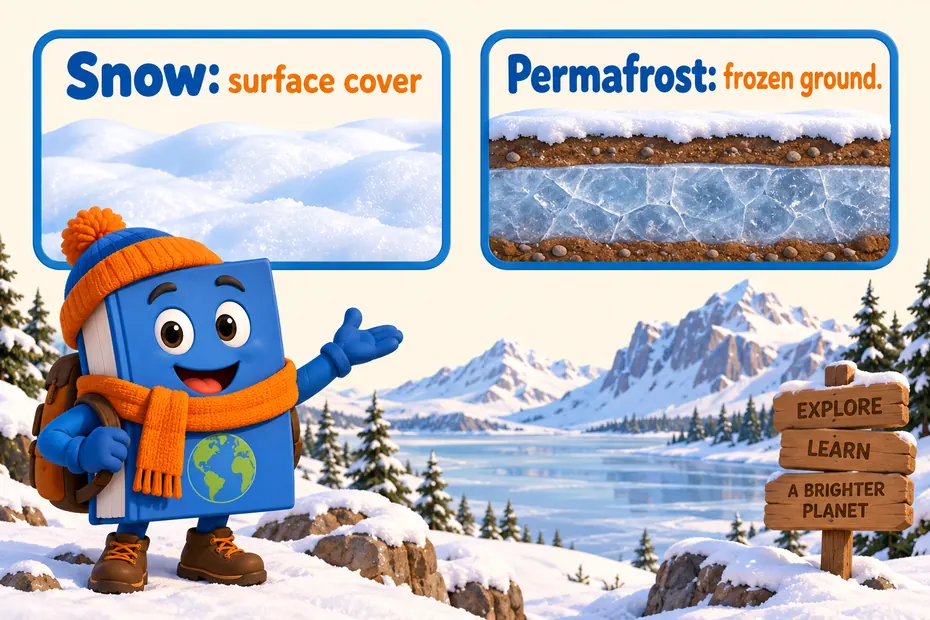
Permafrost is ground that remains at or below 0°C for at least two consecutive years. “The researchers measured the temperature of the permafrost” uses the word as a noun. The term can include soil, sediment, sand or rock; it does not simply mean a covering of snow. Its definition concerns ground temperature and duration. Use the technical meaning when selecting examples, rather than treating every winter landscape as permafrost.
Key facts for accurate vocabulary
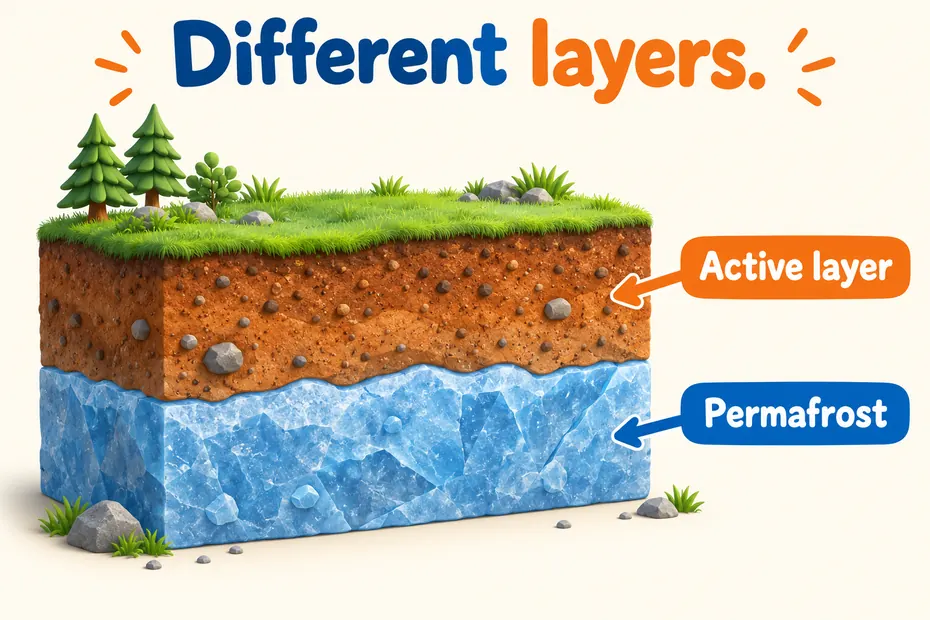
The National Snow and Ice Data Center’s explanation distinguishes permafrost from ground that freezes and thaws seasonally. The active layer above permafrost can thaw and refreeze each year. Permafrost occurs chiefly in Arctic areas, but also in Antarctica and high mountains. The term does not promise that ground will remain frozen forever: permafrost can thaw.
These facts correct the original examples below that say it “never melts” and compare it to an icy blanket covering the ground. A better beginner sentence is “Permafrost is frozen ground beneath the surface.” A snowy surface alone does not establish the presence of permafrost. For vocabulary work, distinguish the substance or layer being discussed from the scenery above it.
| Word or phrase | Example sentence | Writing focus |
|---|---|---|
| Permafrost | The team studied the permafrost. | Name the frozen ground. |
| Snow cover | Snow covered the field. | Describe the surface covering. |
| Active layer | The diagram labels the active layer. | Name a distinct layer. |
| Permafrost thaw | The report discusses permafrost thaw. | Name a change in the ground. |
How to build a sentence with permafrost
Permafrost is usually treated as a mass noun: “Permafrost underlies the site.” Use the when identifying particular ground: “The permafrost beneath the study site was monitored.” You do not normally need a plural ending in an introductory sentence. If you mean separate places, write “areas of permafrost” or “permafrost regions” rather than forcing a plural form.
The noun can be the subject: “Permafrost was the topic of the lesson.” It can also be an object: “The class studied permafrost.” A prepositional phrase can add location: “The report describes permafrost beneath the road.” Each structure lets you introduce the term without making unsupported claims about a specific real location.
You can also use permafrost before another noun: “permafrost research,” “permafrost conditions” or “permafrost thaw.” In “The students prepared a permafrost diagram,” the main noun is diagram. The preceding word tells readers what the diagram concerns. Compare that with “The diagram shows permafrost,” where permafrost is the object of shows.
Natural sentence examples
- The geography class learned the meaning of permafrost.
- The scientist placed the measurements in a permafrost report.
- Our diagram shows the active layer above the permafrost.
- The research team compared two areas of permafrost.
- The caption identifies frozen ground as permafrost.
- She asked how permafrost differs from seasonal frost.
- The article discusses changes in permafrost conditions.
- The teacher replaced the vague phrase with a precise permafrost definition.
These examples concentrate on wording and clear relationships. If you write about an actual research result, replace a generic subject such as the team with the relevant researchers and cite their report. A practice sentence is not a substitute for evidence about how much ground thawed, how quickly temperatures changed or what happened to a particular road.
Thaw, melt and precise descriptions
Merriam-Webster’s permafrost entry identifies it as a frozen layer. In scientific writing, thawing permafrost is a useful phrase for the transition of frozen ground. Melt can refer more specifically to ice turning into water. Saying that permafrost thaws avoids suggesting that all its rock or soil material turns into liquid.
Be equally careful with covering and underlies. “Snow covers the ground” gives a clear surface relationship. “Permafrost underlies the site” gives a subsurface relationship. “The site has permafrost” is less precise but can be useful at beginner level. Choose the wording that makes the spatial relationship understandable without adding details you have not verified.
Words such as thick, deep, widespread and rapidly need context when they describe real conditions. For a language exercise, “The report describes a thick layer of permafrost” demonstrates grammar. For a factual article, readers need to know what report, what location and what measurement supports thick. Replace vague emphasis with evidence when reporting research.
Capitalization and a quick editing exercise
Write permafrost in lowercase within an ordinary sentence. Capitalize it at the start: “Permafrost was shown in blue.” The word is not a proper name. In a heading, your chosen title style may capitalize it, but that does not require a capital letter in every sentence. The original formatting below sometimes capitalizes the term unnecessarily inside explanatory prose.
Revise “A permafrost never melts under every snowy place.” A useful correction is “Permafrost is frozen ground, and it can thaw.” The revision removes an unnatural article, an unsupported forever claim and a sweeping statement about all snowy places. Next revise “We studied permafrosts” to “We studied areas of permafrost.” This tests mass-noun usage separately from the scientific definition.
Frequently asked questions
Is permafrost a noun?
Yes. It names frozen ground, and it also modifies nouns in phrases such as permafrost research.
Does permafrost mean snow?
No. Snow is a surface covering, whereas permafrost refers to ground meeting a temperature-duration condition.
Should I write permafrost or the permafrost?
Use permafrost for the general concept and the permafrost when identifying particular ground already specified in context.
Does permanent mean it can never change?
Do not interpret the name that way. The two-year definition identifies its present condition, and the ground can subsequently thaw.

Have you ever wondered what lies beneath the frozen surface of the Arctic tundra? Permafrost is the answer. Permafrost refers to the layer of frozen soil, sediment, and rock that remains solidly frozen for at least two consecutive years.
This unique phenomenon is a critical component of the Arctic ecosystem, influencing everything from plant life to infrastructure stability. As temperatures rise due to climate change, permafrost is thawing at an alarming rate, leading to widespread ecological and environmental impacts.
7 Examples Of Permafrost Used In a Sentence For Kids
- The permafrost is a layer of frozen soil that never melts.
- Animals like polar bears and Arctic foxes live on top of the permafrost.
- In cold places like Antarctica, you can find lots of permafrost.
- When you touch the permafrost, it feels very cold and hard.
- Permafrost helps keep the ground frozen in cold places.
- Some plants can grow on top of the permafrost.
- The permafrost is like a giant icy blanket covering the ground in snowy areas.
14 Sentences with Permafrost Examples
- Permafrost is a common topic of study in geology classes at college.
- Melting permafrost can have serious implications for climate change, which is a concern for many students.
- Understanding the impact of permafrost thaw on ecosystems is a critical part of environmental science courses.
- Researching the effects of global warming on permafrost provides valuable insights for students pursuing degrees in Earth sciences.
- Fieldwork in regions with permafrost can offer hands-on learning experiences for college students in geography programs.
- Exploring the ways in which Indigenous communities adapt to living on permafrost is an important aspect of cultural studies at college.
- Engineering students may study how to build structures that can withstand the shifting of permafrost.
- The significance of permafrost in storing greenhouse gases is a key topic in climate change discussions at college.
- Analyzing the feedback loops between melting permafrost and climate change is a complex issue that students often explore in interdisciplinary courses.
- The potential release of methane from thawing permafrost is a pressing concern for students studying environmental policy.
- Understanding the role of permafrost in the Earth’s cryosphere is crucial for students in glaciology programs.
- Permafrost degradation can lead to landslides, a phenomenon that students in civil engineering must consider in their designs.
- Mapping regions with permafrost distribution can be a valuable skill for students studying remote sensing technologies.
- Learning about the history of permafrost in different regions can provide insights into past climate conditions for students in paleoclimatology courses.
How To Use Permafrost in Sentences?
Using Permafrost in a sentence is easy once you understand its meaning and how it functions grammatically. To begin, Permafrost is a noun that refers to a thick subsurface layer of soil that remains below freezing point for more than two consecutive years.
To use Permafrost in a sentence, you can follow this simple structure: “The region is covered in Permafrost that extends several feet below the surface.” In this sentence, Permafrost is used to describe the type of soil covering the region, highlighting its frozen nature.
Another example could be: “Construction on the new building had to be altered due to the presence of Permafrost beneath the ground.” Here, Permafrost is used to explain a challenge faced during construction, emphasizing the impact it had on the project.
Remember that Permafrost should be used as a noun and placed appropriately within the sentence to convey its meaning effectively. Practicing by incorporating Permafrost into various sentences will help you become more comfortable using this term in your writing.
Conclusion
In conclusion, permafrost is a layer of permanently frozen ground found in Arctic regions that plays a crucial role in global climate systems. As permafrost thaws due to rising temperatures, it releases greenhouse gases like methane, amplifying climate change. Conservation efforts are essential to prevent further degradation of permafrost and mitigate its impact on the environment.
Monitoring and studying permafrost is crucial for understanding its role in climate change and developing strategies to protect it. By implementing sustainable practices and reducing greenhouse gas emissions, we can work towards preserving these vulnerable areas and mitigating the detrimental effects of permafrost thaw on our planet’s ecosystems. It is essential to prioritize ongoing research and international cooperation to address the challenges posed by permafrost degradation effectively.


