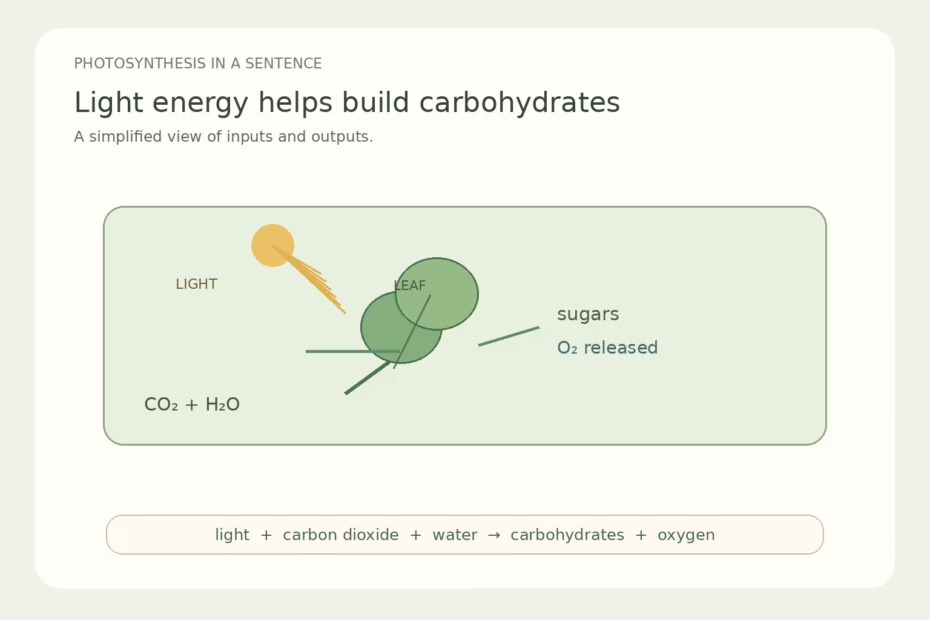
Photosynthesis is the process by which plants, algae, and some bacteria use light energy to build energy-rich carbohydrates from carbon dioxide and water. In a sentence, the word usually names the process itself: “Photosynthesis allows a bean plant to store energy from sunlight.” It is a noun, not a synonym for sunlight or plant growth.

How to use photosynthesis in a sentence
Photosynthesis is normally an uncountable noun, so it usually appears without a and takes a singular verb:
- “Photosynthesis occurs in the leaves of many plants.”
- “Light intensity can affect the rate of photosynthesis.”
- “The class observed photosynthesis in an aquatic plant.”
Useful patterns include the process of photosynthesis, photosynthesis in + organism, the rate of photosynthesis, and photosynthesis converts/uses/releases. Avoid “a photosynthesis” when you mean the general biological process. If you want to describe the organism, use photosynthetic (“photosynthetic algae”) or the verb photosynthesize (“some bacteria photosynthesize”).
Choose a sentence that matches the science
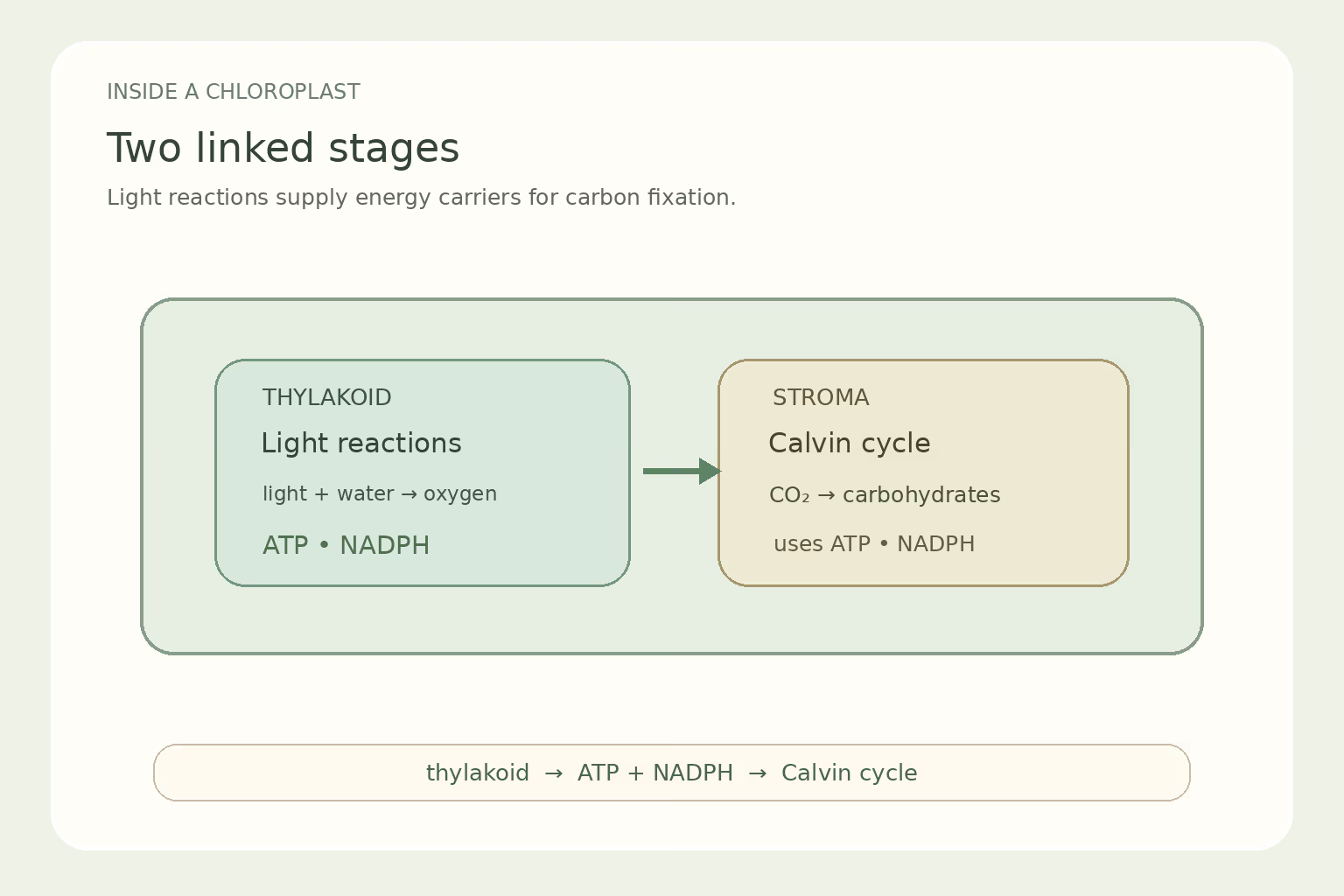
In plants and algae, chlorophyll and other pigments capture light energy in chloroplasts. The light-dependent reactions use that energy and split water, releasing oxygen and producing energy-carrying molecules. The Calvin cycle uses those molecules to incorporate carbon dioxide into small carbohydrate molecules, which can later be used to build sugars and other materials. The reactions depend on one another, so avoid describing light as if it simply turns directly into glucose.
A simplified overall equation is carbon dioxide + water + light energy → carbohydrate + oxygen. It summarizes the inputs and outputs, but leaves out the many intermediate steps. The oxygen released by oxygen-producing photosynthesis comes from water molecules, not from the carbon dioxide. Some bacteria use different forms of photosynthesis and do not release oxygen, so use “oxygen-producing photosynthesis” when the distinction matters.
These details help make examples accurate: “During photosynthesis, a leaf uses light energy to help build carbohydrates from carbon dioxide and water” is clearer than “A leaf turns sunlight into food.” The shorter sentence is acceptable for young readers, but “light energy” and “carbohydrates” are more precise in a science report.
Photosynthesis and related ideas
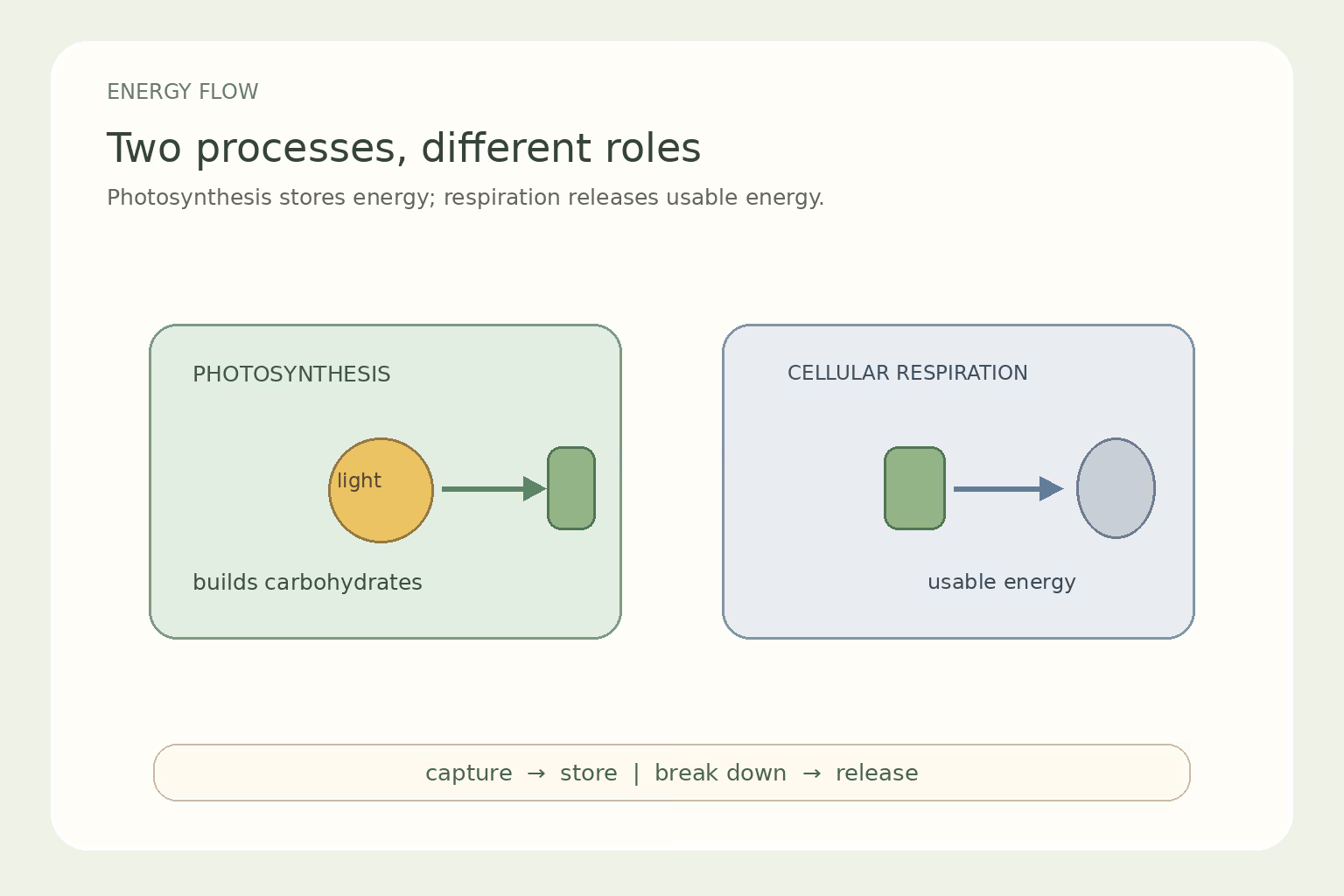
Photosynthesis stores captured energy in chemical bonds. Cellular respiration releases usable energy from molecules such as sugars inside cells; plants carry out respiration too. Photosynthesis also contributes to oxygen in the atmosphere and moves carbon from the air into living material, but an individual sentence should not imply that plants are the only source of oxygen or that they remove all atmospheric carbon dioxide.
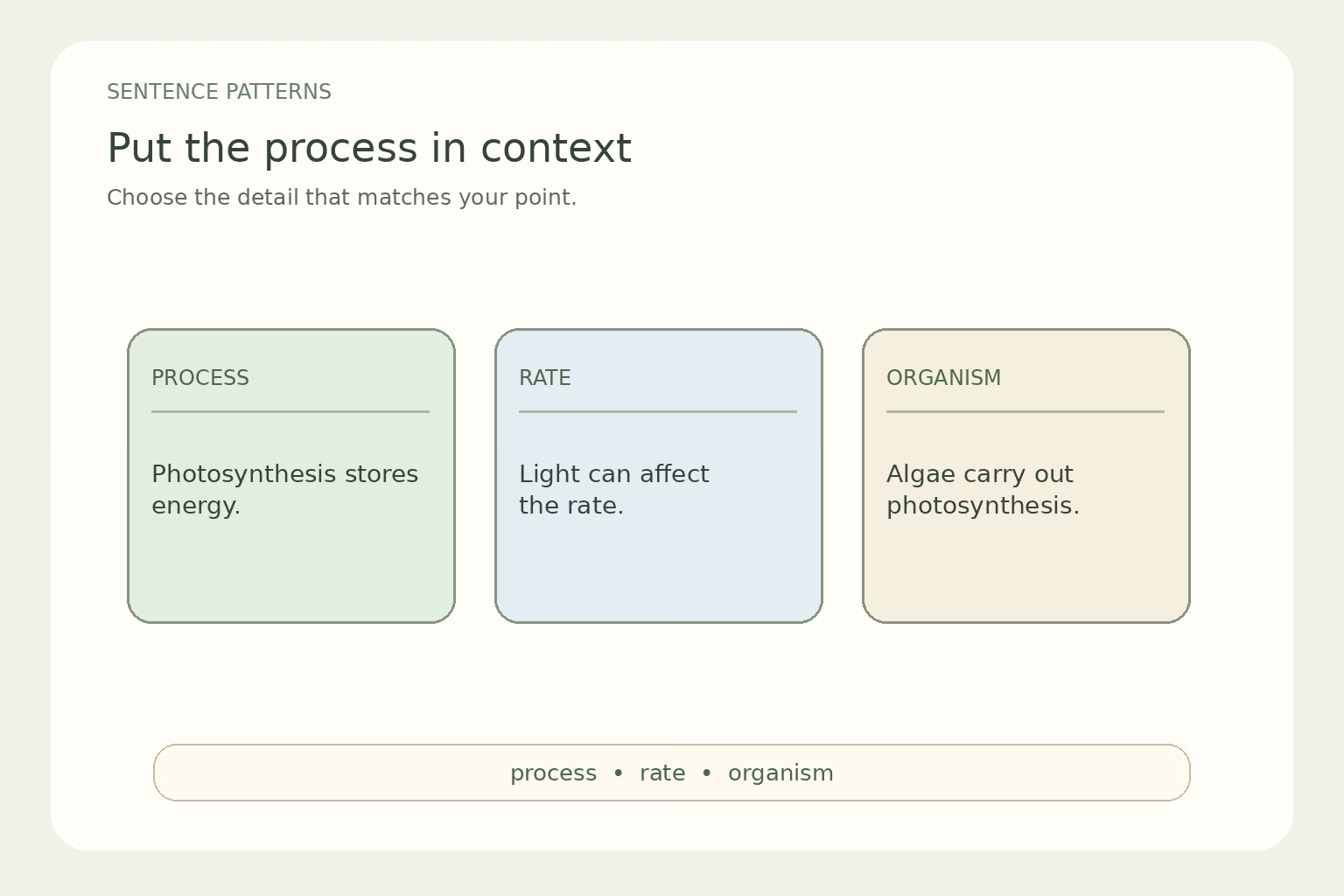
- Process: “Photosynthesis stores some of the energy captured by a plant’s pigments.”
- Rate: “Researchers measured the rate of photosynthesis under different light levels.”
- Organisms: “Algae and plants both carry out oxygen-producing photosynthesis.”
- Comparison: “Photosynthesis stores chemical energy, while cellular respiration releases usable energy from molecules.”
- Classroom example: “The students compared photosynthesis in a leaf kept in light with one kept in darkness.”
Capitalization and common mistakes
Write photosynthesis in lowercase in the middle of a sentence because it is a common noun: “Photosynthesis helps many organisms capture energy.” Capitalize it at the beginning of a sentence or in a title. The word itself is not plural in ordinary use, and the process is not performed only by green land plants; algae and certain bacteria also photosynthesize.
For a strong example sentence, name the organism or setting, then connect an accurate input or outcome to the process. “In bright conditions, the pond’s algae carried out photosynthesis and released oxygen” gives a concrete context without claiming that light is the only factor that affects the process. For younger readers, a simpler version works: “A plant uses photosynthesis to make sugars with energy from light.”
Have you ever wondered how plants are able to create their own food and oxygen? This incredible process is known as photosynthesis.
Photosynthesis is the biological process in which green plants, algae, and some bacteria convert light energy into chemical energy stored in glucose molecules, using carbon dioxide and water.
7 Examples Of Photosynthesis Used In a Sentence For Kids
- Plants use photosynthesis to make their own food.
- Photosynthesis helps plants grow and stay healthy.
- Sunlight is an important part of photosynthesis.
- Leaves are where photosynthesis mostly happens in plants.
- Without photosynthesis, plants would not be able to survive.
- Photosynthesis is like cooking for plants.
- We should thank photosynthesis for giving us oxygen to breathe.
14 Sentences with Photosynthesis Examples
- Photosynthesis is a crucial process that converts sunlight into chemical energy in plants.
- College students often study the process of photosynthesis in their biology classes.
- Understanding the role of chlorophyll in photosynthesis is essential for grasping the concept.
- The impact of environmental factors on photosynthesis is a common research topic for students interested in botany.
- To observe photosynthesis in action, one can conduct experiments using leaf disks and carbon dioxide.
- Learning about the Calvin cycle is vital for comprehending the biochemical pathways involved in photosynthesis.
- The overall efficiency of photosynthesis can be affected by factors like light intensity and temperature.
- To quantify the rate of photosynthesis, students often measure the production of oxygen or glucose in plants.
- Under stressful conditions, plants might exhibit adaptations to optimize their photosynthesis process.
- Studying the evolution of photosynthesis provides valuable insights into the history of life on Earth.
- College students can explore the relationship between climate change and photosynthesis in their research projects.
- Examining different types of photosynthetic pigments can offer a deeper understanding of the variety of organisms capable of photosynthesis.
- The discovery of C4 and CAM pathways has expanded our knowledge of the diversity of mechanisms employed in photosynthesis.
- Engaging in discussions about the ethical implications of genetically modifying plants to enhance photosynthesis can foster critical thinking among students.
How To Use Photosynthesis in Sentences?
Photosynthesis is the process by which plants, algae, and some bacteria convert light energy into chemical energy to produce food. When using photosynthesis in a sentence, it is important to highlight the key components: light energy, chemical energy, and food production.
Here is an example sentence using photosynthesis: “Plants rely on the process of photosynthesis to convert sunlight into glucose, which is used as an energy source to fuel their growth and development.”
When incorporating photosynthesis into a sentence, make sure to mention how it is a crucial process for plants and other photosynthetic organisms to survive. Additionally, emphasize the role of sunlight in providing the necessary energy for photosynthesis to occur.
To enhance your sentence, you can also explain the significance of photosynthesis in the ecosystem and how it contributes to the oxygen production and carbon cycle on Earth. This will offer a broader perspective on the importance of photosynthesis beyond just food production.
In summary, when using photosynthesis in a sentence, remember to focus on its role in converting light energy into chemical energy for food production in plants, and consider mentioning its broader impact on the environment and ecosystem.
Conclusion
In conclusion, photosynthesis is a vital process through which plants use sunlight to convert carbon dioxide and water into glucose and oxygen. This process is essential for the survival of plants and the equilibrium of our planet’s atmosphere. Through the process of photosynthesis, plants are able to produce their own food, serving as the foundation of the food chain and sustaining life on Earth. By capturing sunlight and transforming it into chemical energy, plants play a critical role in maintaining a healthy environment and providing oxygen for other living organisms.
Furthermore, understanding the intricate process of photosynthesis is crucial for scientists and researchers in fields such as agriculture and climate change. By studying and enhancing photosynthesis, we can potentially develop more efficient crop yields and contribute to the fight against global warming. Overall, the significance of photosynthesis in the natural world highlights its importance in sustaining life and fostering a harmonious ecosystem.


