Please Turn Over in a Sentence: Meaning & Use
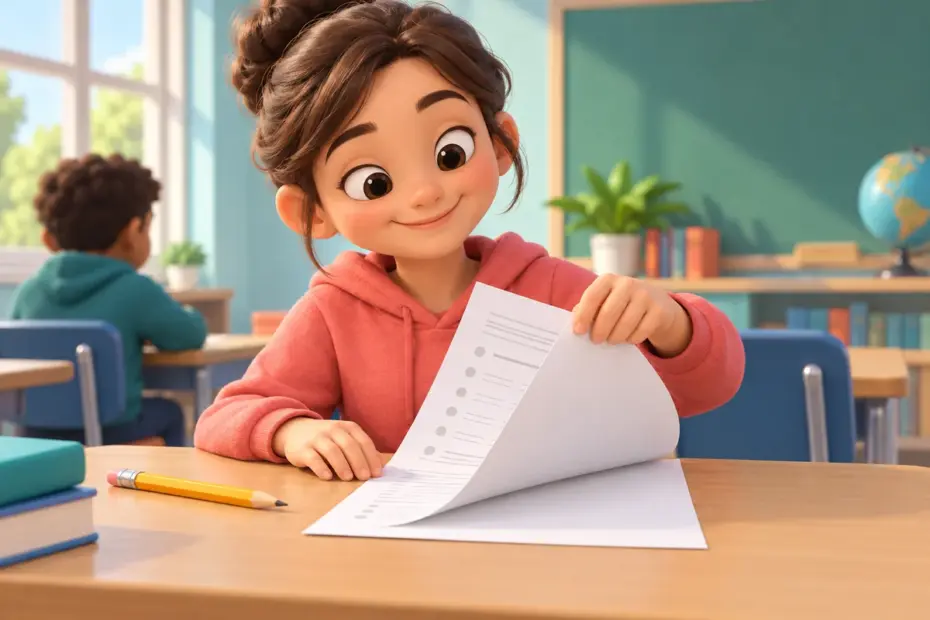
A please turn over in a sentence example usually gives a polite instruction to flip a page, sheet, card, or object so its other side can be seen. In “Please turn over your worksheet and answer question six,” the phrasal verb names the action and the object makes the direction explicit.
- Please turn over is a polite imperative telling someone to flip something.
- The object may be omitted when a page or paper is obvious from context.
- Use turn over for the physical movement; use turn to page 6 for a page number.
- Please softens an instruction, but tone and context still shape how it sounds.
- The phrasal verb has other meanings, so nearby words can change its sense.
Please turn over in a sentence
In a classroom, form, or printed document, please turn over means “please flip the page or sheet to its reverse side.” Cambridge Dictionary describes turn over as moving something so the top and bottom sides switch; context tells readers which object the instruction refers to.
Writers can include the object for precision: “Please turn over the card.” They can also leave it understood when a printed instruction appears at the bottom of a page: “Please turn over.” In an exam, the instruction usually means the next questions continue on the back, not that the reader should turn to another numbered page.
| Instruction | Likely action | When it fits |
|---|---|---|
| Please turn over your paper. | Flip the sheet to its reverse side. | Exam or two-sided form |
| Please turn the card over. | Show the opposite face of a card. | Game or demonstration |
| Please turn to page 6. | Open the book at page 6. | Book, manual, or agenda |
| Please turn over the keys. | Hand the keys to someone, in some contexts. | Transfer of possession |
Writing the instruction politely
Put please before the imperative for a neutral written instruction: “Please turn over the page.” A period is enough in ordinary directions; an exclamation mark can make the sentence sound urgent or unusually emphatic.
For a more explicit version, name what to flip and where to continue: “Please turn over the sheet and read the next paragraph on the back.” If the reader must rotate an object rather than a page, give a direction such as “Please turn the model over to inspect its base.”

When the object can be left out
The object can be understood from context when the instruction is printed on or beside the item to be flipped. At the bottom of a worksheet, “Please turn over” is concise because the paper is obvious; in a conversation with several objects nearby, name the page, card, or sheet.
In formal directions, clarity is more useful than brevity. “Please turn over the form and complete Section B” tells readers both what to move and what to do next. If the next side is blank or the document is digital, replace the phrase with the actual action, such as “scroll down” or “open the next page.”

Turn over and related phrases
Turn over can describe several actions, so its object and context matter. With a page or small object, it often means flip to the other side. With a business, it can refer to sales or rate of sales; with turn something over to someone, it can mean hand control or possession to that person.
Use these clues before interpreting the phrase:
- turn over a page or card: expose its other side;
- turn to a page: open a book at a numbered page;
- turn an idea over in your mind: consider it carefully;
- turn a document over to a colleague: hand it to that person.
For a simple instruction on a two-sided sheet, please turn over is conventional and concise. If there is any risk of confusion, add the object and next step.
Common instruction mistakes
Common problems come from leaving the object unclear or using over when the intended direction is different. State the required movement if the reader could reasonably interpret the phrase in more than one way.
- Page number: write “turn to page 4,” not “turn over to page 4,” when the instruction is to locate a numbered page.
- Reverse side: “turn over the worksheet” asks the reader to flip the sheet, not necessarily to turn a page in a book.
- Digital document: use “scroll down” or “select Next” if no physical page has a reverse side.
- Tone: Please is courteous wording, but a blunt layout or all-caps text can still feel abrupt.
More example sentences
Have you ever come across a page that ends with the mysterious instruction “Please turn over”? This directive is commonly used in documents, puzzles, and exercises to prompt the reader to continue reading on the other side. It serves as a signal to flip the page and discover what lies beyond.
“Please turn over” is a phrase often found at the end of a page or document, prompting the reader to flip to the next side for more information or instructions. It creates suspense and intrigue, enticing the reader to continue exploring what comes next.
7 Examples Of Please Turn Over Used In a Sentence For Kids
- Draw a big circle please turn over
- Color the sun yellow please turn over
- Count the apples in the basket please turn over
- Write your name at the top please turn over
- Draw a line from the cat to the mouse please turn over
- Circle all the triangles please turn over
- Trace the numbers 1 to 10 please turn over
14 Sentences with Please Turn Over Examples
- Please turn over the exam paper and begin answering the questions.
- Remember to please turn over your notebook pages to complete the next exercise.
- After completing the front side of the worksheet, don’t forget to please turn over for more questions.
- Make sure to please turn over the handout to read the additional information on the back.
- To find the answer to the bonus question, please turn over the last page of the assignment.
- The instructions for the group project are located on the back, so please turn over.
- If you missed any important details in the lecture slides, please turn over for additional information.
- Don’t get caught off guard during the presentation, so please turn over the cue cards for your notes.
- For the next step in the experiment, please turn over to the next page in the lab manual.
- To access the reference list for the research paper, please turn over to the bibliography section.
- As a reminder, please turn over your textbook to continue reading chapter five.
- The solutions to the math problems can be found on the back, so please turn over.
- To read the list of recommended readings for the course, please turn over the syllabus.
- In order to continue with the tutorial, please turn over to the next set of instructions.
How To Use Please Turn Over in Sentences?
When using ” Please Turn Over ” in a sentence, it is important to understand its correct use. This phrase is typically written on the bottom of a page to indicate to the reader that there is more information on the other side.
For example, if you are writing a letter and want to continue your message on the back of the page, you can write ” Please Turn Over ” at the bottom to instruct the recipient to flip the page and read the rest of the letter.
In a similar manner, if you are filling out a form that requires information on both sides, you can write ” Please Turn Over ” after completing the first side to prompt the reviewer to look at the other side for more details.
Additionally, this phrase is commonly used in printed materials such as worksheets, exams, or brochures to guide the reader to flip the page and continue reading or answering the questions on the other side.
Remember, when using ” Please Turn Over ” in a sentence, it is essential to place it at the appropriate location on the page to ensure that the reader understands the instruction clearly and can follow it without confusion.
Conclusion
In conclusion, the phrase “please turn over” is commonly used to indicate that there is more content on the back side of a page or object that should be viewed. This simple instruction is often found on forms, documents, or packaging materials to ensure that all information is fully reviewed and understood. Remembering to follow this direction can prevent overlooking important details or instructions that may be crucial to the overall comprehension of the material.
Therefore, when encountering the words “please turn over,” it is essential to make sure that both sides are read and considered to gain a complete understanding of the information being presented. By adhering to this straightforward request, individuals can ensure they are fully informed and equipped to make informed decisions based on all the content provided.
Conclusion: A please turn over in a sentence instruction politely asks someone to flip an object, most often a page or sheet. Name the object when context does not make it obvious, and choose turn to when the reader needs a specific page number.
Frequently Asked Questions About Please Turn Over
Is “please turn over” a complete sentence?
Yes. It is an imperative sentence with an understood subject, you, and an understood object supplied by context. A worksheet can simply say “Please turn over” if the reader knows the sheet is the object. Add a noun when several objects could be turned.
Should please turn over have a comma?
Usually not. Write “Please turn over the page” without a comma because please begins the request and does not interrupt the sentence. A comma may appear when please is added parenthetically or at the end, as in “Turn the page, please.”
Does “turn over” mean flip a page or change pages?
For a loose sheet or the reverse side of a page, turn over means flip it so its other side faces up. For a numbered page in a book, turn to page 8 is the clearer instruction. The object determines which meaning readers infer.
Can “please turn over” sound rude?
The word please usually makes a direct instruction more courteous, but tone depends on context, formatting, and relationship. A clear classroom or form instruction is neutral. In conversation, a softer request such as “Could you turn the page over?” may sound less abrupt.