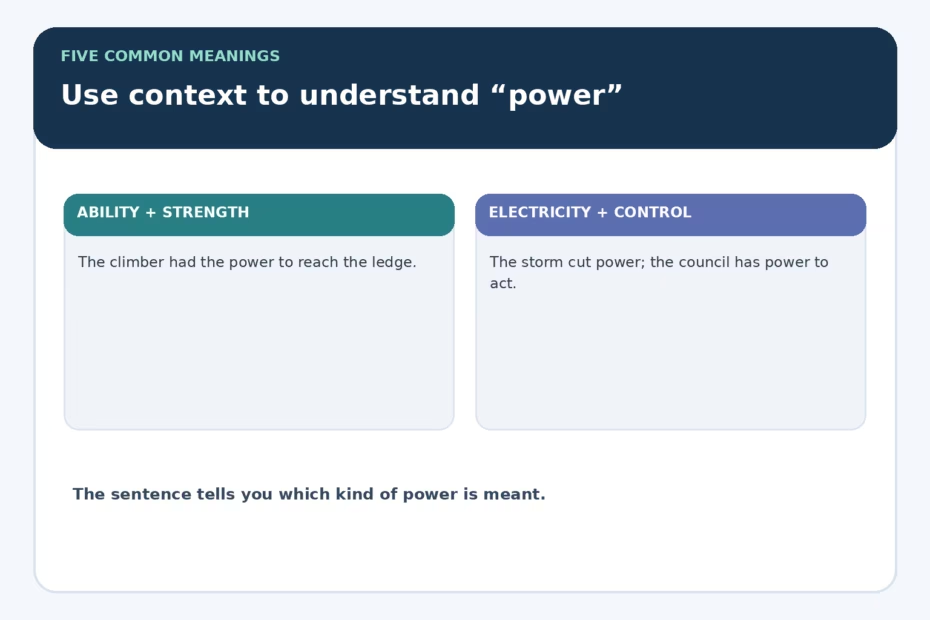
What does “power” mean?
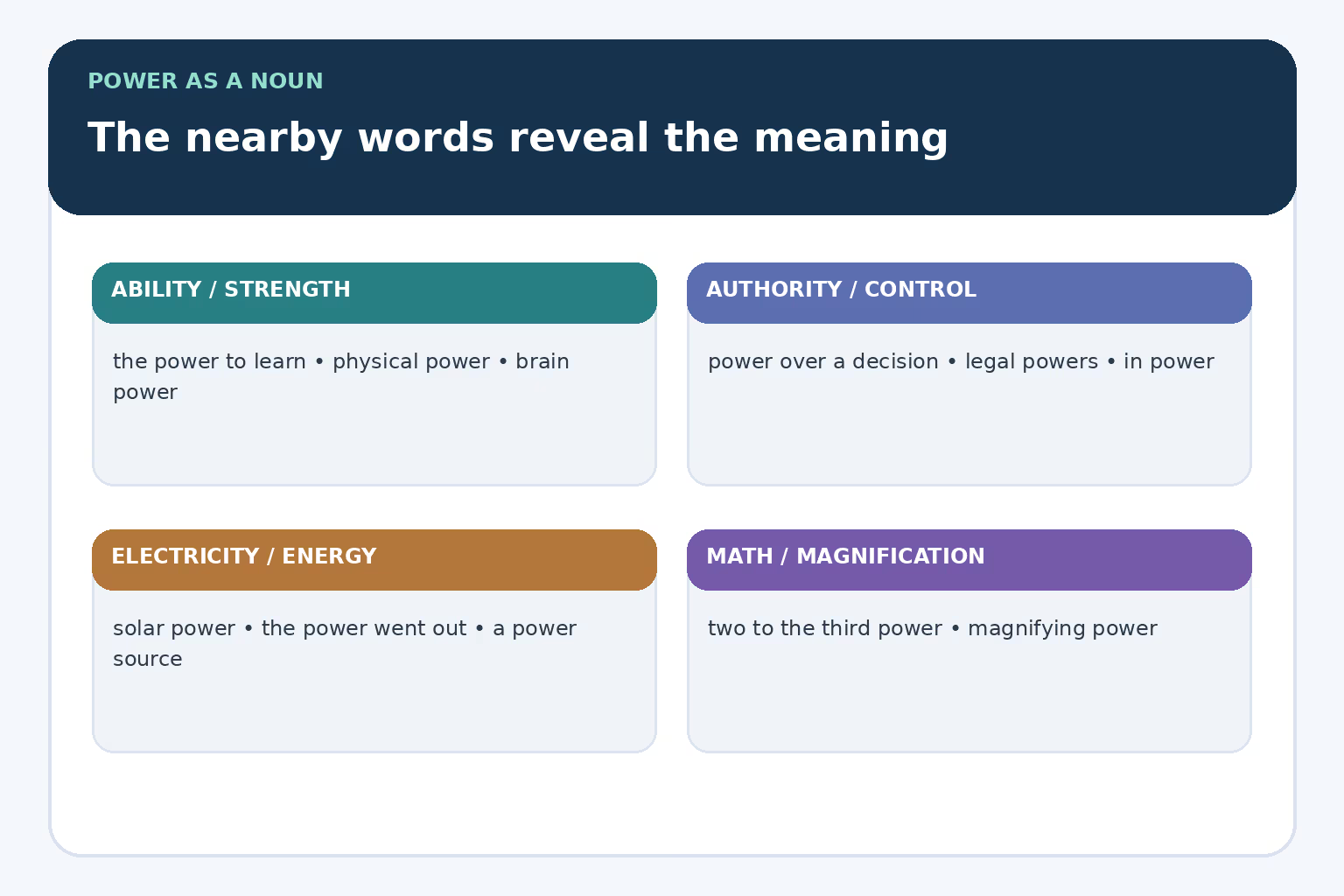
Power is a flexible word. As a noun, it can refer to control or authority, an ability, physical force, electricity or another energy source, or the rate at which energy is used in physics. It can also name a country or group with significant influence, as in a world power. As a verb, to power can mean to provide a machine or system with energy, or to move with force. Cambridge Dictionary lists these distinct noun and verb senses, so the surrounding words are essential for understanding which meaning a sentence uses. Cambridge Dictionary: power.
Examples of “power” in a sentence
Compare the context in these examples:
- The child had the power to open the heavy door.
- Good coaches help young athletes develop strength and power.
- The mayor has the power to approve the emergency plan.
- The new policy limits the agency’s power over local decisions.
- Solar power supplies electricity to the remote cabin.
- A fallen tree left the neighborhood without power for several hours.
- Two to the fourth power is sixteen.
- The microscope’s magnifying power made the tiny cells easier to see.
- She used the power of speech to persuade the committee.
- The country became a regional power through trade and diplomacy.
- It is not in my power to change the train schedule.
- The whole team did everything in its power to finish the project.
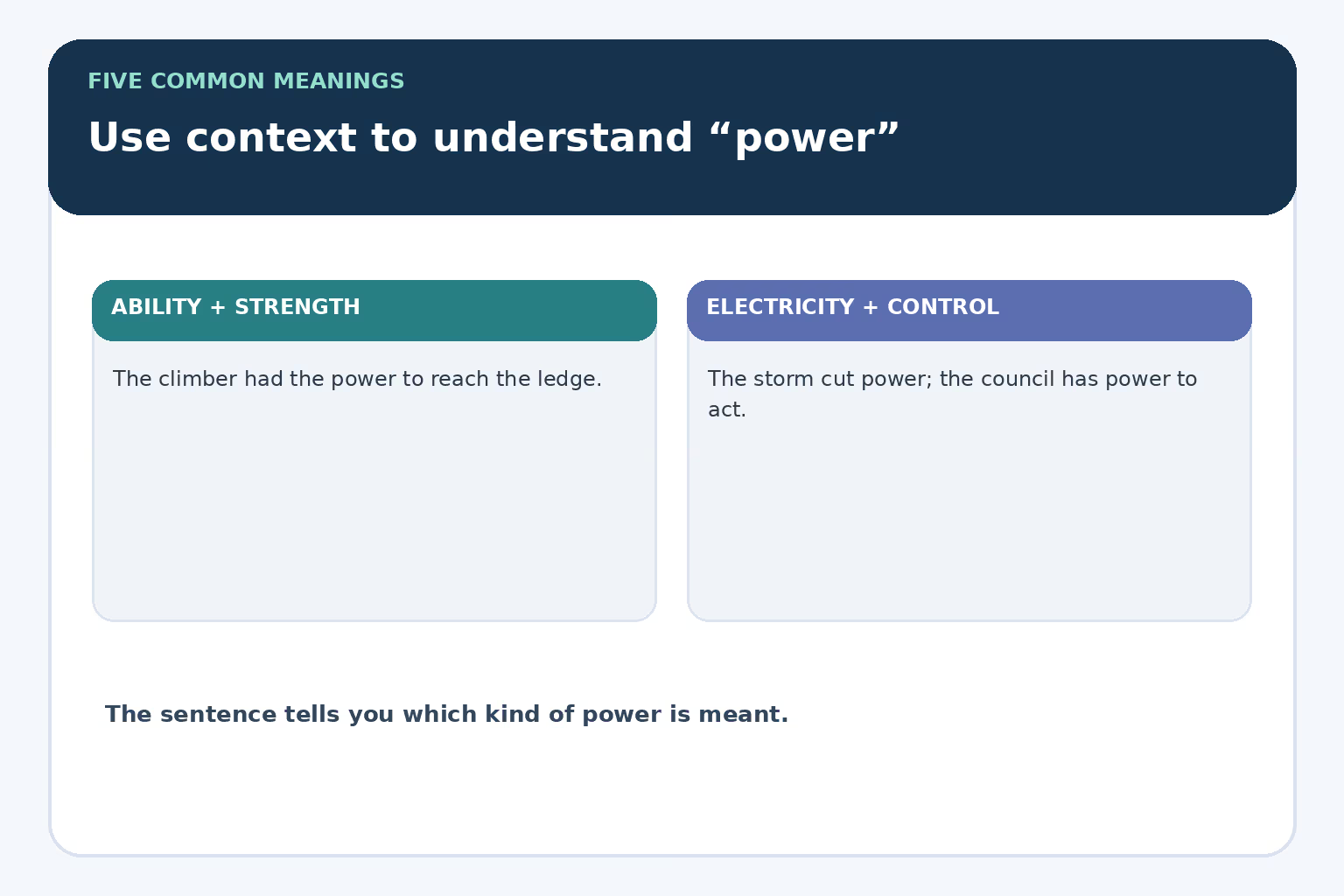
These meanings are related to strength, ability, or influence, but they do not all mean the same thing. “The storm’s power” may refer to its force; “the power went out” means electricity stopped; “the judge has power to decide” means legal authority.
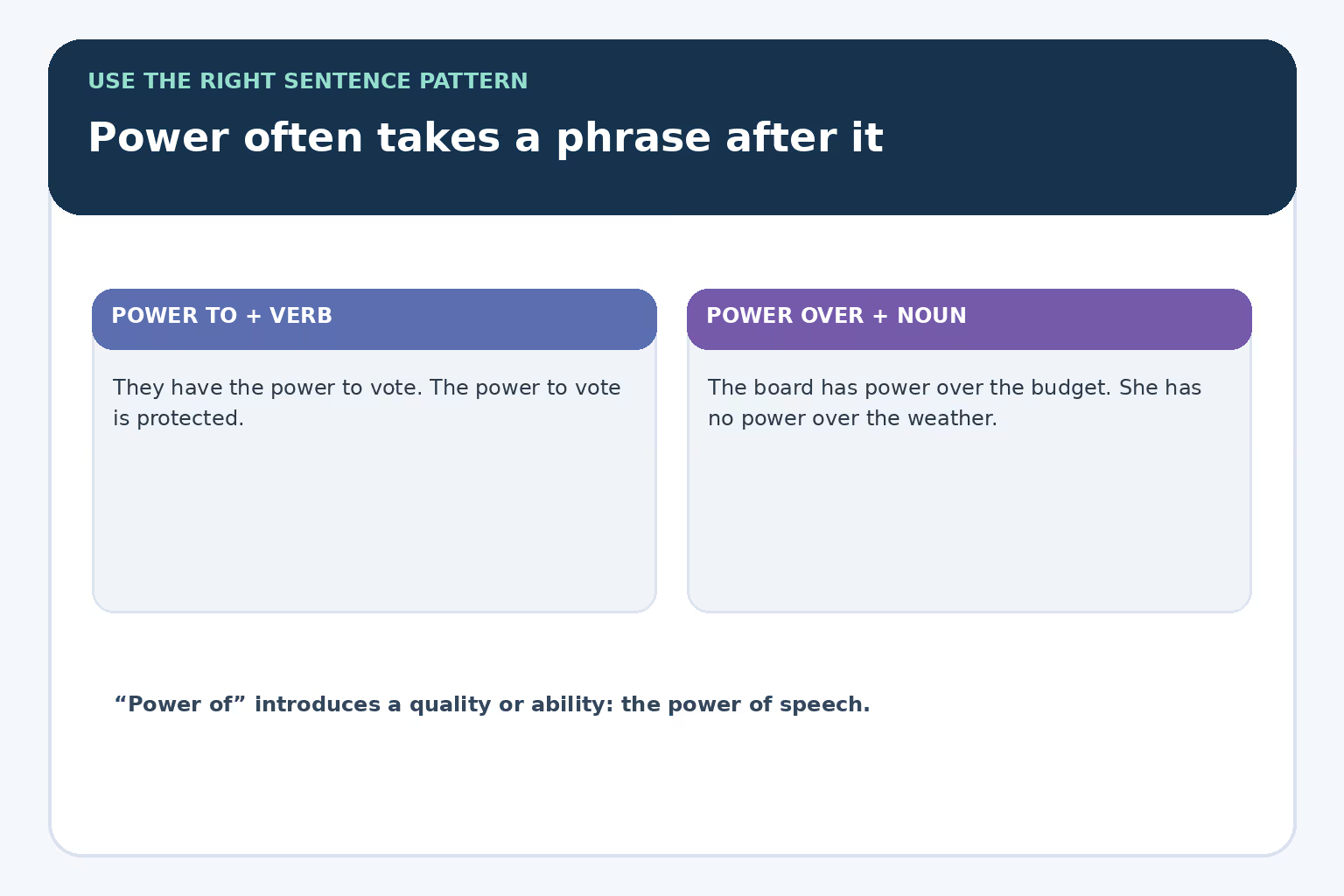
Common patterns with the noun “power”
The words that follow power often indicate its meaning:
| Pattern | Use | Example |
|---|---|---|
| the power to + verb | Ability or official right to act | Residents have the power to elect their representatives. |
| power over + person/thing | Control or influence | The captain has power over the ship’s route. |
| the power of + noun | Ability, force, or effect | They discussed the power of language. |
| in power | Holding political control | The party has been in power for two years. |
| within someone’s power | Possible for someone to do | I will help in any way within my power. |
In its electricity and energy senses, power is usually uncountable: we say “the power is back,” not usually “a power is back.” But a power can mean an influential person or country, and powers can mean abilities or official rights: “the agency’s powers.”
“Power” as a verb
Use the verb power when something supplies energy or moves forcefully. It takes an object when it means “supply with energy”: “A battery powers the flashlight.” The passive pattern be powered by names the energy source: “The ferry is powered by electricity.” The forms are power, powers, powered, and powering.
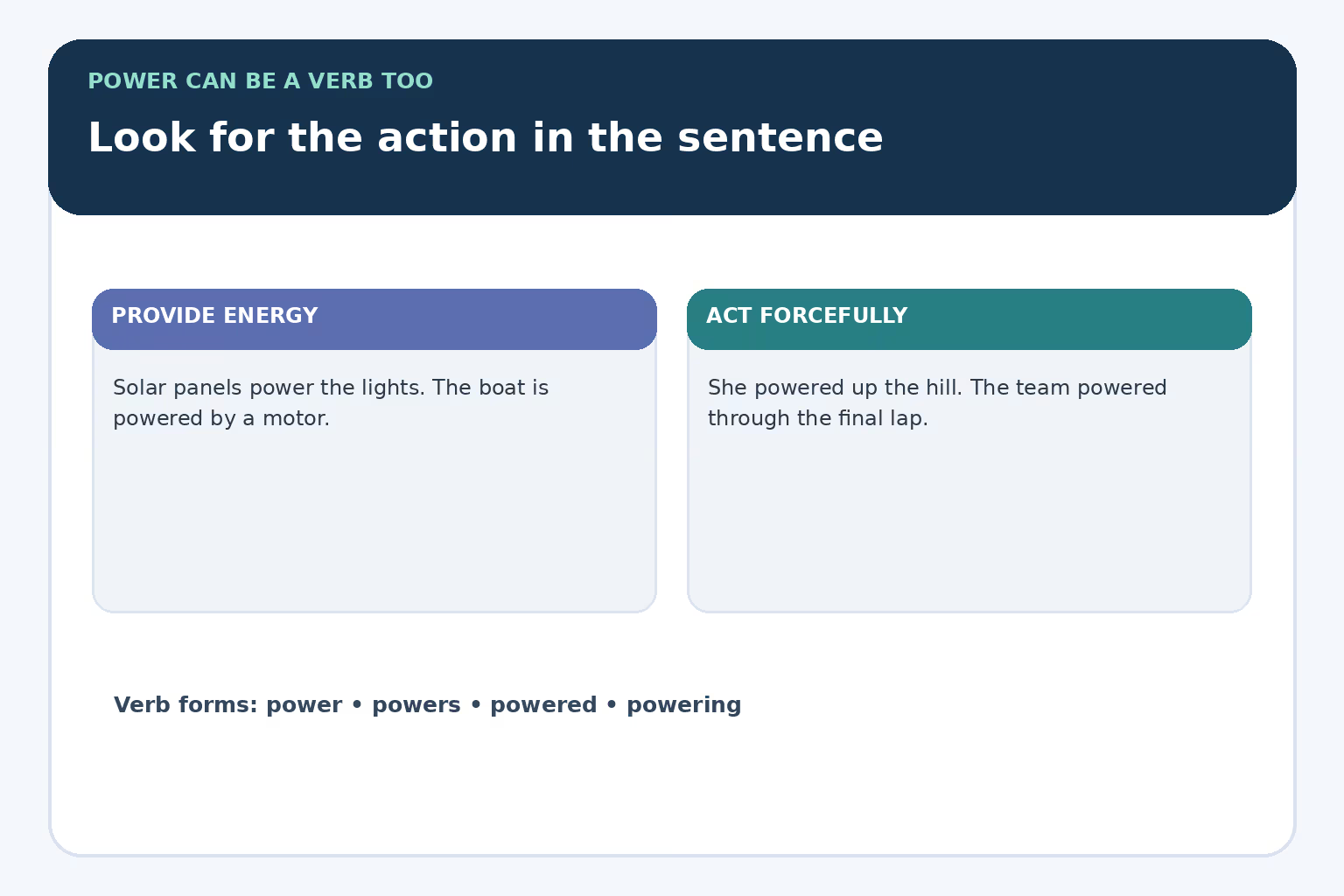
In power through, the subject continues or finishes something with determined effort: “The runners powered through the final lap.” The subject must be the person or thing making that effort. One original example below says, “finding a good study group can power through tough times.” That wording makes the group itself sound as if it is pressing forward. A clearer version would be “A good study group can help students power through tough times” or “Students can power through tough assignments with a study group.”
“Power” in science and math
In everyday science, power can mean electricity or energy supplied to a device: “Disconnect the power before opening the appliance.” In physics, power has a more specific meaning: the rate at which energy is transferred or work is done, and it is measured in watts. In mathematics, a power is an exponent: in “three to the fourth power,” the fourth power of three is 3 × 3 × 3 × 3. These technical meanings need their subject-area context; they are not interchangeable with authority or personal strength.
How to choose the right meaning
- Find the grammatical role. Is power naming a thing or ability (noun), or showing an action such as supplying energy (verb)?
- Look at nearby words. Power over often signals control; power line signals electricity; power through signals determined action.
- Check the subject and object. A machine or energy source can power a device; a person can power through a difficult task.
- If the meaning could still be unclear, choose a more precise word such as authority, strength, or electricity.
Frequently asked questions
Is power a noun or a verb?
It can be both. In “The power returned,” it is a noun meaning electricity. In “Solar cells power the lights,” it is a verb meaning supply with energy.
What does “power over” mean?
It means the ability or authority to control or influence a person, group, decision, or event: “The manager has power over the schedule.”
What does “in my power” mean?
Something “within my power” is something I am able or authorized to do. “I’ll do everything in my power to help” means I’ll use all the means available to me.
What does “power through” mean?
It means to continue or finish something with effort or determination, often despite difficulty: “They powered through the last mile.”
What is the plural of power?
Powers commonly means abilities or official rights, as in “the powers of the court.” Electricity and physical strength usually use the uncountable noun power.
Sources
The original examples are preserved below. This added guide distinguishes common noun and verb meanings, explains useful patterns, and corrects one unclear example involving “power through.”
Have you ever wondered how words possess the remarkable power to influence, persuade, and inspire others? The term “power” in language refers to the ability of words to impact people’s thoughts, emotions, and actions.
Whether it’s through compelling storytelling, persuasive rhetoric, or uplifting motivational speeches, the power of language lies in its capacity to evoke strong responses and shape perceptions. When wielded effectively, words have the potential to provoke change, ignite passions, and leave a lasting impact on those who hear or read them.
7 Examples Of Power Used In a Sentence For Kids
- Power comes from the sun and helps us stay warm.
- We use power to turn on the lights in our house.
- Wind and water have power too! They can help us generate electricity.
- Superheroes have special powers that help them save the day.
- The king has a lot of power in his kingdom.
- The teacher has the power to help us learn new things.
- It’s important to use our power for good and to help others.

14 Sentences with Power Examples
- College students in India often struggle to balance their academics with extracurricular activities, but finding a good study group can power through tough times.
- Utilizing time management skills can give students the power to efficiently complete their assignments and projects.
- Access to online resources and study materials can provide students with the power to enhance their learning experience.
- Having a positive attitude can give students the power to overcome challenges and setbacks in their academic journey.
- Joining student clubs and organizations can help students find their power in building strong networks and connections.
- A healthy lifestyle, including proper nutrition and exercise, can give students the power to stay focused and energized throughout the day.
- Attending workshops and seminars can provide students with the power to develop new skills and expand their knowledge.
- Taking breaks and allowing themselves time to relax can give students the power to avoid burnout and maintain their mental well-being.
- Developing effective communication skills can give students the power to express their ideas and thoughts confidently in academic settings.
- Properly citing sources and avoiding plagiarism can give students the power to maintain academic integrity in their work.
- Building a strong support system of friends and mentors can give students the power to navigate the challenges of college life.
- Embracing diversity and learning from different perspectives can give students the power to become more open-minded and inclusive individuals.
- Setting SMART goals and creating a clear plan of action can give students the power to stay motivated and achieve success in their academic pursuits.
- Participating in community service and volunteer activities can give students the power to make a positive impact in society and contribute to their personal growth.

How To Use Power in Sentences?
To use Power in a sentence, start by identifying a situation where the word “power” can be applied. Consider scenarios where someone has control or influence over others, or situations involving strength, energy, or authority.
For example, you could say, “The president wields great power in shaping national policies.” In this sentence, “power” is used to describe the president’s authority and influence in making decisions that affect the country.
Another way to use “power” in a sentence is to talk about physical strength. You could say, “She demonstrated her power by lifting the heavy weight with ease.” Here, “power” refers to the person’s physical strength and ability to lift a heavy object.

You can also use “power” to describe energy or electricity. For instance, you could say, “The storm knocked out the electricity, leaving the town without power for days.” In this context, “power” refers to the electrical energy needed to operate lights and appliances.
In summary, to use “power” in a sentence, think about how the word can relate to control, influence, strength, energy, or authority in a given situation. By practicing using “power” in different contexts, you can become more comfortable incorporating it into your vocabulary.
Conclusion
In writing, sentences with power are those that deliver a strong impact on the reader. They are concise, direct, and pack a punch with their message. These sentences grab attention, convey information effectively, and leave a lasting impression. By using sentences with power, writers can effectively communicate their ideas and engage their audience.
Crafting sentences with power is a skill that can elevate the quality of writing, making it more engaging and impactful. Whether in literature, marketing, or everyday communication, incorporating powerful sentences can enhance the overall effectiveness of the message being delivered. By mastering the art of constructing sentences with power, writers can create compelling narratives that resonate with readers and drive home the intended message.


