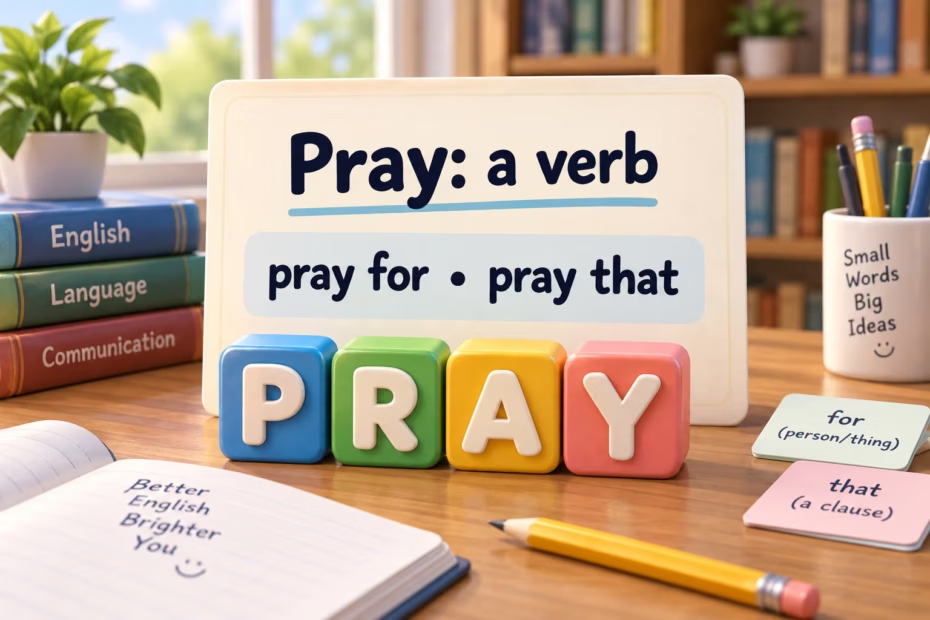
Pray is a verb that commonly means to address a deity or sacred power, often to express thanks or make a request. In English, it appears in patterns such as pray for a person or thing and pray (that) a clause; it can also mean to hope intensely for an outcome.
Key points
- Pray is a verb; its common forms are pray, prays, prayed, and praying.
- Use pray for before a person or thing: “They pray for peace.”
- Use pray (that) before a complete clause: “I pray that everyone arrives safely.”
- Pray and prey sound alike; praise has a final /z/ sound and a different meaning.
- Prayer traditions and personal beliefs differ. These examples explain English usage and do not prescribe a practice.
What Does “Pray” Mean?
Pray usually describes speaking or directing thoughts to a deity or sacred power, for example to give thanks or ask for help. The details of prayer vary across religions, communities, and individuals; an English usage example does not imply that every reader shares the same beliefs.
The verb also has a figurative sense: to hope very much that something will happen. “We prayed the rain would stop before the match” can express intense hope without describing a religious act. Context tells readers which sense is intended.

How Do You Use “Pray” in a Sentence?
Choose the pattern that matches the rest of the sentence. Oxford Learner’s Dictionaries records several common complements of pray, including for + a person or thing, to + a recipient, and (that) + a clause.
| Pattern | What follows | New example |
|---|---|---|
| pray (no object) | The sentence is complete without naming a request. | “The family prayed quietly.” |
| pray for + noun phrase | A person, group, thing, or outcome. | “Some residents prayed for the missing hikers.” |
| pray to + recipient | The person or sacred figure addressed. | “In the story, the sailor prayed to the sea goddess for help.” |
| pray to + recipient + for + noun phrase | Both the addressee and request. | “She prayed to God for courage.” |
| pray (that) + clause | A subject and verb stating a hope or request. | “We pray that the roads stay clear.” |
| pray to + base verb | An infinitive expressing a request or hope. | “He prayed to be forgiven.” |
In pray (that) clauses, that is often optional: “I pray that she feels better” and “I pray she feels better” are both grammatical. Keep a subject after that; “I pray that for peace” mixes two patterns and is not standard. Use “I pray for peace” or “I pray that we find peace.”

Which Verb Form of “Pray” Is Correct?
The subject and time determine the form. In the present tense, add -s with a third-person singular subject; use prayed for the simple past and past participle, and praying for the -ing form.
| Form | Example |
|---|---|
| Base / present: pray | “I pray for my neighbors.” |
| Third-person singular: prays | “He prays in private.” |
| Simple past / past participle: prayed | “They prayed before the journey.” / “She has prayed for them.” |
| Present participle / gerund: praying | “We are praying for a safe trip.” / “Praying is part of her routine.” |
For spelling, pray keeps its y in prayed because the letter before y is a vowel: a. It also keeps the y in praying. Compare a consonant before y in try → tried.
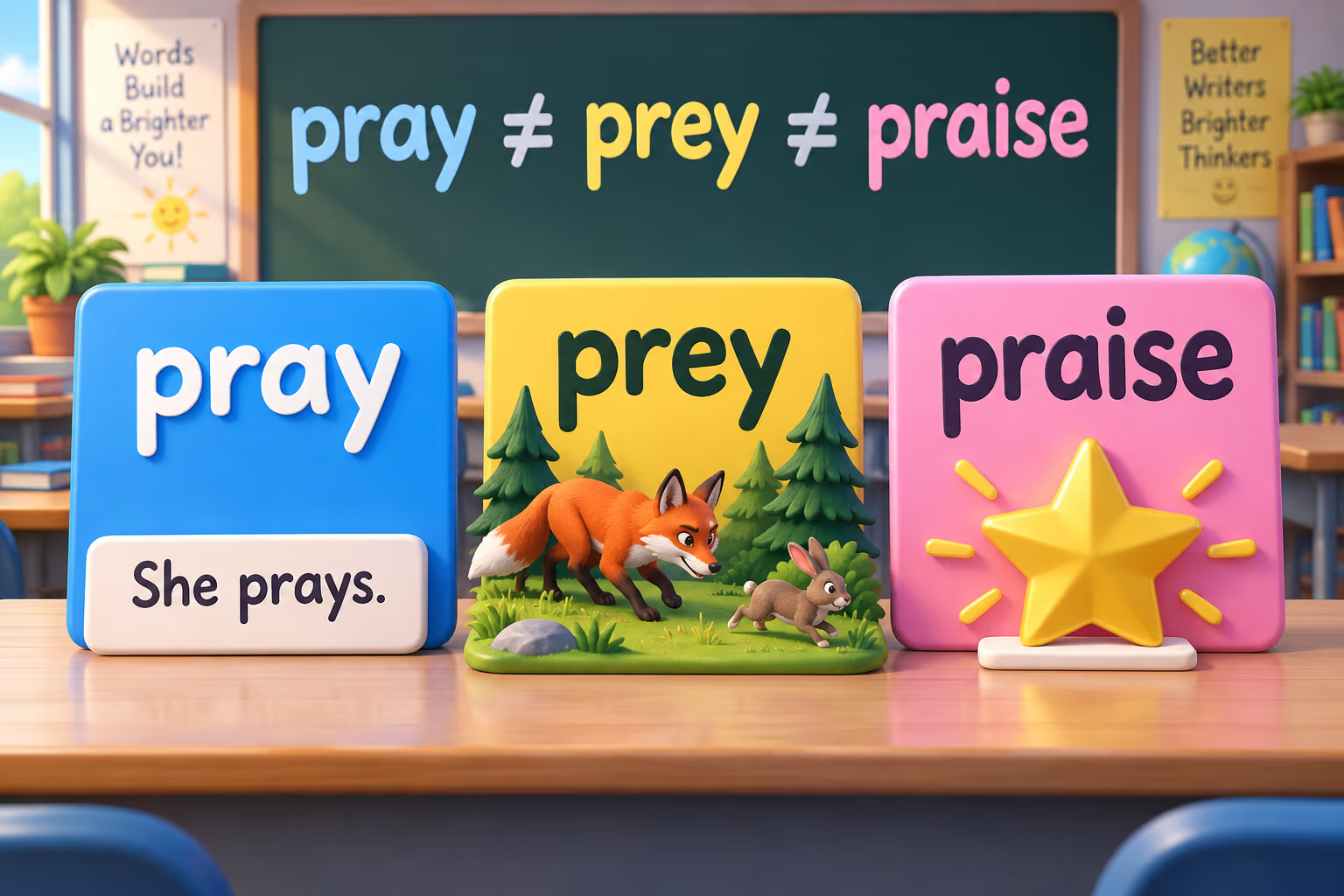
Is “Pray” the Same as “Prey” or “Praise”?
No. Pray concerns prayer or intense hope; prey is an animal hunted by another animal, or a verb meaning to hunt or exploit; praise means to express approval. Pray and prey are homophones, so context and spelling distinguish them. Prays is the verb form used with he, she, or it.
- “The group may pray for the community.”
- “The owl hunts its prey at night.”
- “The coach will praise the team’s effort.”
- “She prays for patience.”
How Should “Pray” Be Punctuated?
Punctuation follows the sentence structure rather than the verb itself. Use quotation marks around spoken words when needed, and put a period or question mark at the end of a complete sentence: “They pray for peace.” A that-clause usually needs no comma between the verb and the clause: “I pray that the plan works.”
When pray introduces quoted speech, place the comma according to the quotation style being used: “Please help us,” she prayed. In formal writing, avoid using a comma to join two complete sentences just because one contains pray.
How Can You Write a Clear Sentence With “Pray”?
- Choose the meaning. Decide whether pray describes a religious act or intense hope.
- Choose a pattern. Add for plus a noun phrase, that plus a clause, or to plus a recipient or infinitive.
- Match the verb to the subject and time. Write “I pray,” “she prays,” or “they prayed.”
- Check the spelling and sentence boundary. Distinguish pray from prey and praise, then punctuate the full sentence normally.
For example, “Before the storm, Maya prayed for the families nearby” uses prayed for with a noun phrase. “Maya prayed that everyone would reach shelter” uses prayed that with a subject and verb. Both are grammatical; they frame the request differently.
Frequently Asked Questions About “Pray”
Can “pray” be used without naming a deity?
Yes. A sentence can simply say that someone “prayed,” leaving the addressee understood or unstated. The figurative sense can also mean hoping intensely, as in “I pray the weather improves.”
Should I write “pray for” or “pray that”?
Use pray for before a noun phrase (“pray for peace”) and pray that before a clause (“pray that peace returns”). You can omit that in many clauses: “pray peace returns.”
Is “prayed” or “pray’ed” correct?
Prayed is the standard past-tense and past-participle spelling. Do not add an apostrophe: apostrophes do not form the past tense of regular verbs.
What does “pray tell” mean?
Pray tell is a formal or old-fashioned expression meaning “please tell” or “do tell.” Here pray functions as a polite request, not necessarily as a reference to religious prayer.
Sources and Further Reading
Oxford Advanced Learner’s Dictionary: pray lists the verb forms, meanings, and patterns such as pray for, pray to, and pray (that). Cambridge Dictionary: pray gives a complementary learner-friendly definition.
About the examples: Prayer is understood and practiced differently. The original examples below are preserved as language material; they are not instructions or claims about what readers should believe or do.

Have you ever wondered about the meaning of the word “pray”? Pray, in its simplest form, entails communicating with a higher power or deity through words or thoughts, often seeking guidance, blessings, or expressing gratitude.
Praying can take various forms, such as reciting memorized verses, spontaneous conversations, or silent contemplation. This practice is prevalent across different religions and cultures, serving as a way to connect individuals with their spirituality and beliefs.
7 Examples Of Pray Used In a Sentence For Kids
- Pray before you go to bed.
- Let’s pray together for our friends.
- We should pray for those in need.
- It’s nice to pray before a meal.
- Pray for your family’s health and happiness.
- We can always pray for peace in the world.
- Remember to pray for good things to happen.

14 Sentences with Pray Examples
- Pray for good grades before every exam.
- Before a presentation, take a moment to pray for confidence and calmness.
- Pray for success before submitting important project reports.
- When feeling overwhelmed with assignments, pray for strength and focus.
- Before starting a group study session, pray for productive and fruitful discussions.
- Pray for understanding and clarity before attending difficult lectures.
- Pray for guidance when faced with tough decisions about your academic path.
- Before a sports competition representing your college, pray for strength and determination.
- Pray for patience and perseverance when dealing with difficult professors.
- Before an internship interview, pray for confidence and a clear mind to articulate your thoughts.
- When feeling homesick, pray for comfort and a sense of belonging within your college community.
- Pray for good health and well-being during the stressful exam period.
- Before joining a new club or organization in college, pray for new friendships and meaningful experiences.
- Pray for opportunities to grow, learn, and make a positive impact within your college environment.
How To Use Pray in Sentences?
To use the word Pray in a sentence, start by thinking about what you want to communicate. Pray is often used to refer to communicating with a higher power, expressing gratitude, asking for guidance, or seeking blessings.
For example, you can use “Pray” in a sentence like this: “I pray every night before going to bed for peace and happiness.” In this sentence, pray is used to convey the act of communicating with a higher power.

Another way to use “Pray” in a sentence is to express a request or hope for something. For instance, “I pray that everything will be okay.” Here, pray is used to show a desire for a positive outcome.
Additionally, you can use “Pray” in a sentence to express gratitude or thankfulness. For example, “I pray to give thanks for all the blessings in my life.” In this sentence, pray is used to convey expressing gratitude.
Remember, pray can be used in various contexts to convey different meanings, so it’s important to choose your words carefully based on the message you want to convey. Practice incorporating Pray into your sentences to become more comfortable and confident in using it in your everyday communication.
Conclusion
In conclusion, praying is a powerful and comforting practice for many individuals around the world. From seeking guidance and strength to expressing gratitude and finding peace, prayers can be a source of solace in times of need. Each sentence with the keyword “pray” highlighted the different ways people incorporate prayer into their lives, showing the diverse ways in which individuals connect with their spirituality.
Whether it’s a simple prayer before a meal or a heartfelt plea during difficult times, the act of praying is deeply personal and meaningful. Through prayer, individuals can find a sense of comfort, hope, and connection with something greater than themselves, making it a significant part of many belief systems and cultures worldwide.


