
What Does “Price Ceiling” Mean?
A price ceiling is a legal maximum price a seller may charge for a product or service. It sets an upper limit; it does not require every seller to charge that amount. Governments generally use ceilings to keep goods or services considered essential within reach. Rent limits are a familiar example, while temporary rules may cover other necessities during an emergency.
The key economic question is where the limit sits compared with the price that would balance buyers and sellers. A ceiling above that market-clearing price usually changes little because sellers could already charge less. Economists call it nonbinding. A ceiling below the balancing price is binding: it restricts the price and changes the choices made by buyers and suppliers.

Binding and Nonbinding Price Ceilings
To see the difference, imagine a room rental market where the typical market-clearing monthly rent is $1,200. A legal maximum of $1,400 is nonbinding in this simplified example: the usual market rent is already lower than the cap. A maximum of $1,000 is binding because an owner cannot charge the $1,200 price that would otherwise balance supply and demand. At the lower legal price, more renters may seek a room while some owners may offer fewer rooms.
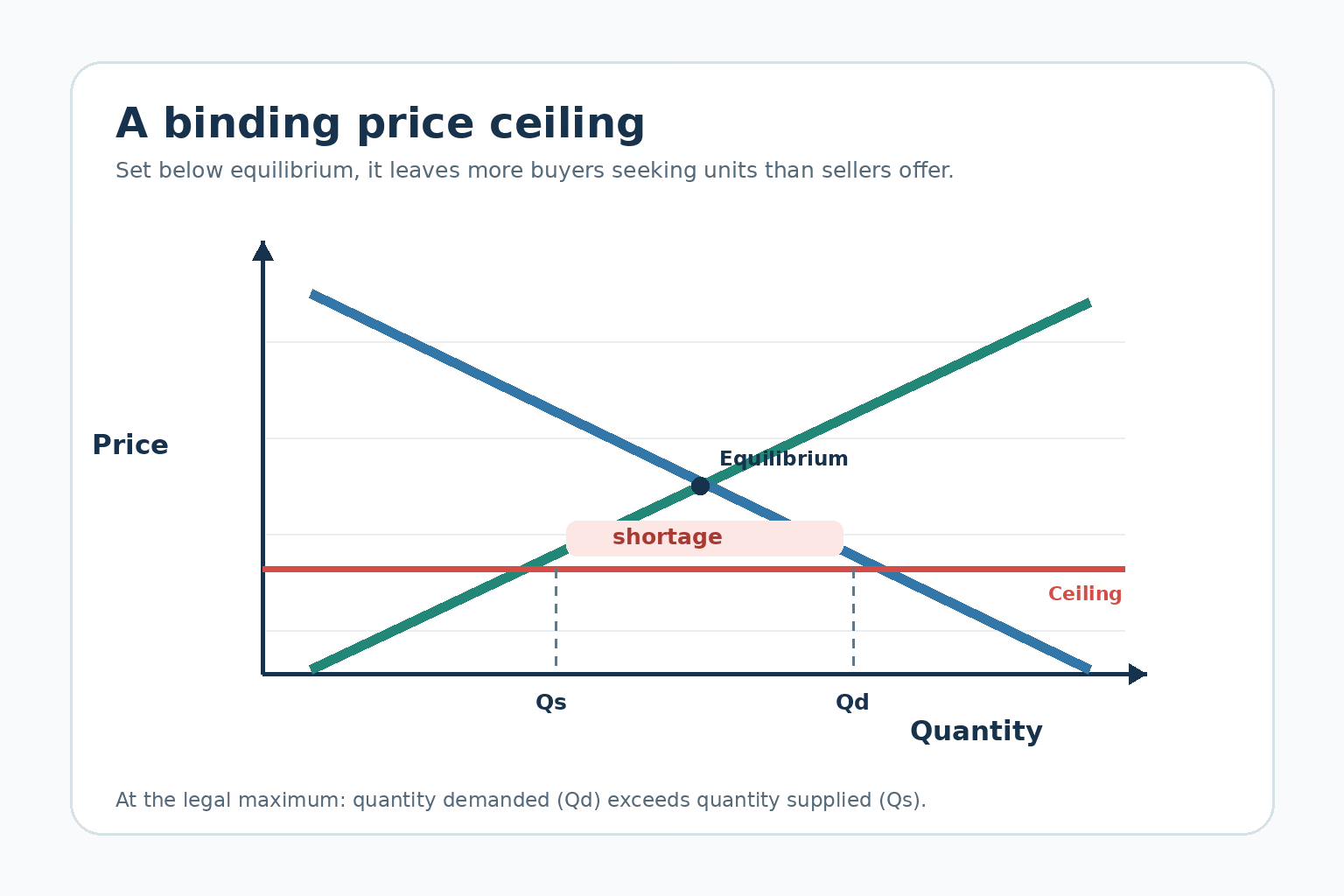
In the standard supply-and-demand model, a binding price ceiling therefore creates excess demand: the quantity people want to buy is greater than the quantity sellers want to provide at the controlled price. The gap is called a shortage. This is a model outcome, not a prediction that every real policy produces the same result. The size and duration of a shortage depend on market conditions, enforcement, exemptions, and how the policy is designed.
A Simple Numerical Example
Suppose that at a market-clearing price of $10, buyers purchase 100 units each week and sellers provide 100. Now imagine a binding ceiling of $8. In a hypothetical schedule, buyers might want 120 units at $8, while sellers offer 80. The shortage is 40 units: 120 demanded minus 80 supplied. The figures are made up to demonstrate the calculation, not to describe a particular city or product.
Notice that the legal maximum is not the same as the number of units sold. The price limit tells sellers the highest permitted price; it does not, by itself, produce more units or determine which buyers receive the 80 available units. A program that aims to increase access may pair a ceiling with other steps, such as public funding, direct supply, targeted assistance, or rules for allocating scarce units.
Why a Price Ceiling Can Lead to Waiting or Screening
When a posted price cannot adjust to balance the market, other ways of deciding who gets a limited product may matter more. A landlord might use a waiting list or eligibility rules. A store could set purchase limits. Buyers may spend time searching, join a queue, enter a lottery, or compete through non-price features such as credit history, timing, or personal connections. These methods can make access costly in ways that do not appear on the price tag.

A ceiling can also affect sellers’ incentives. If the allowed price does not cover the cost of supplying or maintaining a product, some providers may reduce service, defer upkeep, change what they offer, or leave the market. Those are possible responses, not automatic consequences. If demand and supply conditions change or a policy includes allowances for costs and new construction, the outcome can differ. It is more accurate to say that a binding ceiling can create pressure on availability and quality than to say that every ceiling always causes the same result.
Everyday Examples and Important Limits
Rent control is a common classroom example because a city may limit how quickly covered rents can rise. The details vary: rules may apply only to certain homes, may allow specified increases, and may exempt new construction or particular kinds of rentals. Therefore, “rent control” does not describe one identical policy everywhere. In a sentence about a real city, name the law and explain its coverage rather than assuming every rent is subject to the same maximum.
Price limits can also appear in conversations about essential goods, utilities, or emergency supplies. A shortage during an emergency does not on its own prove that a ceiling caused it; a storm, supply-chain disruption, or sudden demand increase may also be involved. To make a careful argument, distinguish the policy rule from the other conditions affecting supply and demand.

Use “Price Ceiling” in a Sentence
Use price ceiling as a noun phrase. It commonly follows a preposition such as under, with, or below, or acts as the subject of a sentence. The phrase is usually written as two words and is often lowercased in running text. It can be singular (a price ceiling) or plural (price ceilings).
- Definition: “A price ceiling is the highest price a seller is legally allowed to charge.”
- Binding example: “Because the price ceiling was below the usual market rent, more families applied than there were apartments available.”
- Nonbinding example: “The proposed price ceiling had no immediate effect because stores were already charging less than the limit.”
- Policy discussion: “The council paired its price ceiling with a housing grant to help more residents find an apartment.”
- Careful qualification: “Economists warned that a binding price ceiling could reduce rental supply over time if owners could not cover operating costs.”
- Question: “Would the price ceiling still bind if the market price fell below the legal maximum?”
These sentences show how the term fits into an explanation. When you discuss effects, add the condition that matters: whether the ceiling binds, which goods or sellers it covers, and what happens to quantity supplied and demanded. Avoid claiming that a ceiling always makes every item affordable or always creates a shortage. In a sentence about a model, specify that a binding ceiling below equilibrium creates excess demand under the stated assumptions.
Price Ceiling vs. Price Floor
A price ceiling is a maximum; a price floor is a minimum. The words provide a useful memory cue: a ceiling limits how high a price can go, while a floor prevents it from dropping below a level. In the basic market model, a binding ceiling below equilibrium tends toward a shortage, while a binding floor above equilibrium tends toward a surplus. Do not use the two terms interchangeably.
Quick Check
Question: If the equilibrium price is $25 and a legal maximum is $30, is the ceiling binding in the basic model?
Answer: No. The ceiling is above equilibrium, so it is nonbinding under those conditions. If the equilibrium price later rises above $30, the same legal maximum could become binding.
Question: If 75 units are offered and 110 are wanted at a binding ceiling, how large is the shortage?
Answer: 35 units (110 minus 75). The difference between quantity demanded and quantity supplied is the shortage.
Further Reading
For a standard supply-and-demand explanation of binding and nonbinding ceilings, see OpenStax, “Price Ceilings and Price Floors.”
In Brief
A price ceiling is a legal maximum price. Whether it affects the market depends on whether it is binding. When a binding ceiling holds a price below equilibrium in the standard supply-and-demand model, buyers want more than sellers offer, so a shortage may result. Real outcomes depend on policy details and market conditions. Use the phrase in a sentence by naming the good or service, stating whether the ceiling binds, and describing its effect precisely.

Are you curious about the concept of price ceilings? Well, a price ceiling is a government-mandated maximum price that can be charged for a good or service. It is designed to protect consumers from being charged excessively high prices by suppliers.
Price ceilings can have various impacts on a market, influencing supply, demand, and overall pricing dynamics. Understanding how price ceilings work and their effects is crucial for both consumers and businesses operating within regulated markets. Let’s delve deeper into the concept of price ceilings and explore their real-world implications.
7 Examples Of Price Ceiling Used In a Sentence For Kids
- Price ceiling is the highest price we can pay.
- We cannot buy things above the price ceiling.
- Price ceiling helps us save money.
- It is important to follow the price ceiling rules.
- The shop has a price ceiling for toys.
- We should always check the price ceiling before buying.
- Let’s find items that are below the price ceiling.
14 Sentences with Price Ceiling Examples
- Price ceiling on textbooks would greatly benefit college students struggling to afford their academic materials.
- With a price ceiling on rent, more students would have access to affordable off-campus housing options.
- Implementing a price ceiling on food in college cafeterias could help alleviate financial strain on students.
- A price ceiling on public transportation passes can make commuting to college more affordable for students.
- The government should consider imposing a price ceiling on stationery items to assist college students with tight budgets.
- Having a price ceiling on healthcare services would ensure that students can access medical treatment without financial burden.
- Students would greatly appreciate a price ceiling on software licenses for their academic requirements.
- A price ceiling on gym memberships would make fitness facilities more accessible to college students.
- It would be beneficial to have a price ceiling on technology gadgets to aid students in purchasing necessary devices.
- A price ceiling on recreational activities could enhance the social life of college students without straining their finances.
- Implementing a price ceiling on workshop fees can encourage more students to participate in practical learning experiences.
- A price ceiling on online courses would enable students to enhance their skills affordably.
- Academic conferences could be more inclusive with a price ceiling on registration fees for students.
- A price ceiling on parking permits would ease the financial burden on students who commute to college.
How To Use Price Ceiling in Sentences?
Price Ceiling is a term used in economics to refer to a maximum price that can be charged for a particular good or service. It is set by the government to protect consumers and ensure affordability of essential products.
To use Price Ceiling in a sentence, start by identifying the product or service you want to discuss. For example, “The government implemented a price ceiling on rental rates to help low-income families afford housing.”
Next, describe the impact of the Price Ceiling. You can say, “As a result of the price ceiling, landlords were not able to increase rent beyond the set limit, making housing more affordable for many people.”
It is important to note that while Price Ceilings can benefit consumers by keeping prices low, they can also lead to shortages and reduce the quality of goods or services. For instance, “The price ceiling on gasoline led to long lines at gas stations and limited fuel availability during the fuel crisis.”
In summary, when using Price Ceiling in a sentence, be sure to clearly state the product or service, explain the impact of the maximum price restriction, and consider both the benefits and drawbacks of its implementation.
Conclusion
In summary, price ceilings are government-imposed limits on how high prices can rise for certain goods or services. These restrictions are intended to protect consumers from steep price increases and ensure affordability. However, while price ceilings may seem beneficial at first glance, they can lead to unintended consequences such as shortages, reduced quality, and inefficient allocation of resources.
It is important for policymakers to carefully weigh the pros and cons of implementing price ceilings, considering the potential impact on market dynamics and consumer welfare. Finding a balance between maintaining affordability for consumers and ensuring a sustainable market equilibrium is crucial when considering the use of price ceilings.


