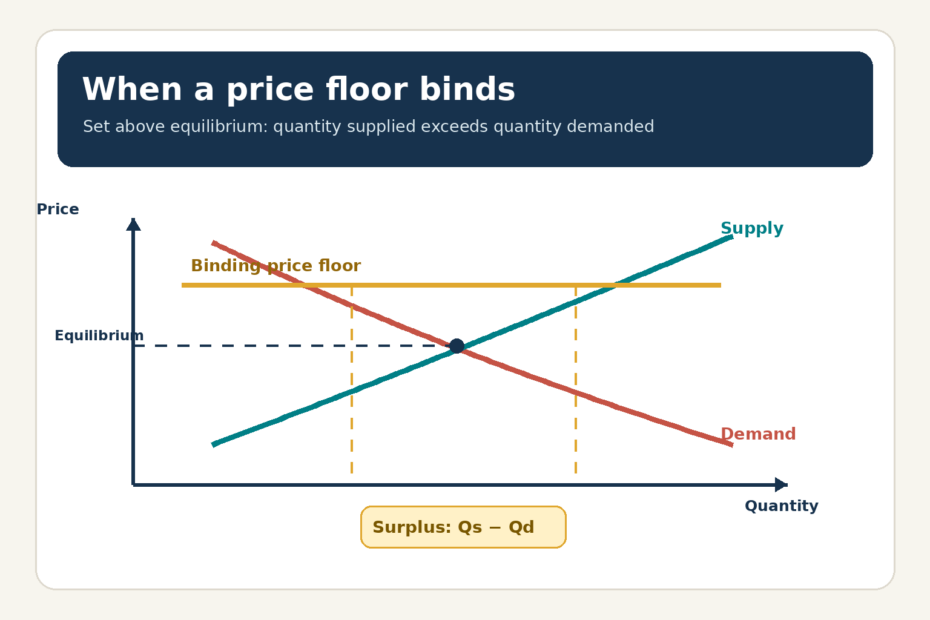
A price floor is a legal minimum price: sellers may not charge less than the stated amount. In a basic supply-and-demand model, the rule changes the market outcome only when it is set above the price that would otherwise balance buyers and sellers. That distinction is what makes a floor binding or nonbinding.
For example, if a market would clear at $8 per unit and a rule sets a minimum of $10, buyers want fewer units at $10 while sellers are willing to offer more. The difference between quantity supplied (Qs) and quantity demanded (Qd) is a surplus. If the legal minimum were $6 instead, the $8 market price could still be used, so the floor would not constrain the transaction.
What does price floor mean in economics?
A price floor sets the lowest permitted price for a good, service, or unit of labor. It is a form of price control. A floor does not mean that every seller must charge exactly that amount; sellers may charge more when buyers are willing to pay. The rule places a lower boundary on the price.
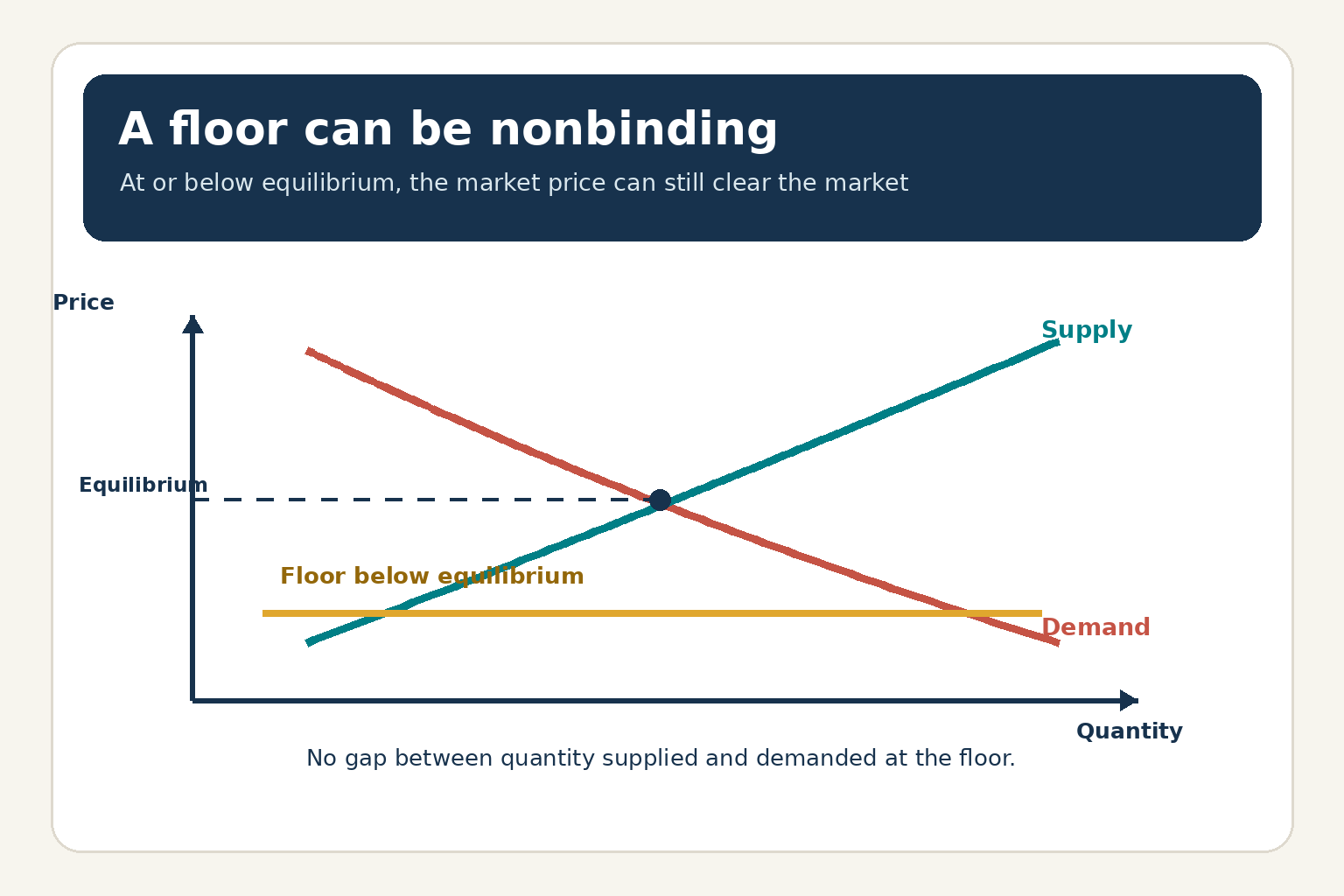
Economists compare a floor with the equilibrium price, the price at which the quantity buyers plan to purchase equals the quantity sellers plan to provide. This comparison predicts whether the rule is binding in the simple model. A floor below equilibrium has no direct effect; one above equilibrium prevents the market from returning to that clearing price.
When is a price floor binding?
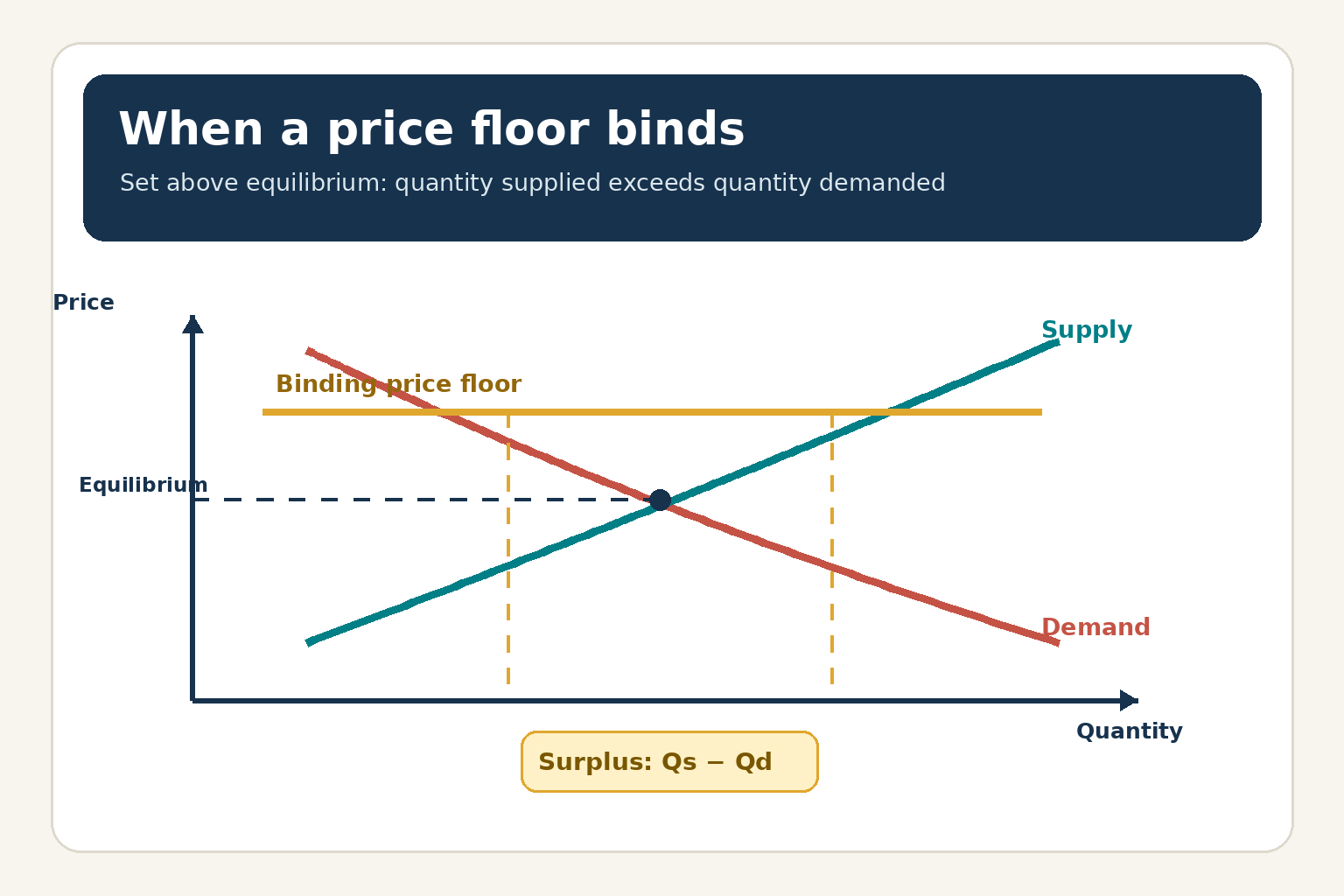
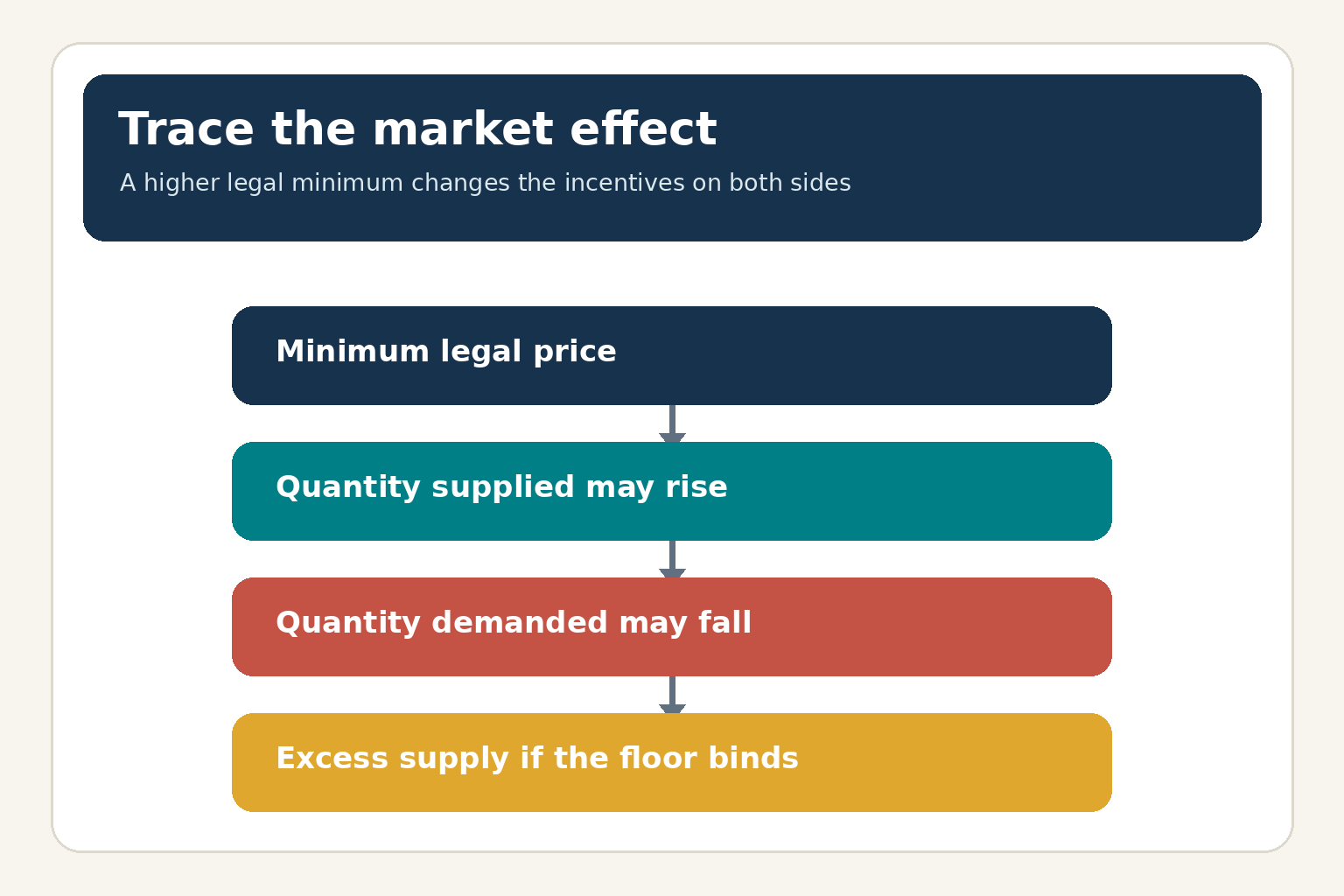
A price floor is binding when it is set above the market-clearing price and is enforced. At the higher price, producers generally have an incentive to supply more, while consumers generally have an incentive to purchase less. If those responses occur, Qs is greater than Qd and the unsold or unmatched amount is called excess supply, or a surplus.
A nonbinding floor is at or below equilibrium. Because the market can already trade above the minimum, the rule does not determine the actual price or quantity. In real markets, a stated floor may still influence expectations or contract choices, but that broader effect is not the basic textbook definition of binding.
What happens when the floor creates a surplus?
The gap between Qs and Qd shows that some planned sales cannot be matched with planned purchases at the controlled price. What happens next depends on the policy and the market. Products might remain unsold, be stored, be redirected to another market, or be purchased by a public agency. Storage, administration, and public buying can create costs; those outcomes do not follow automatically from the price rule alone.
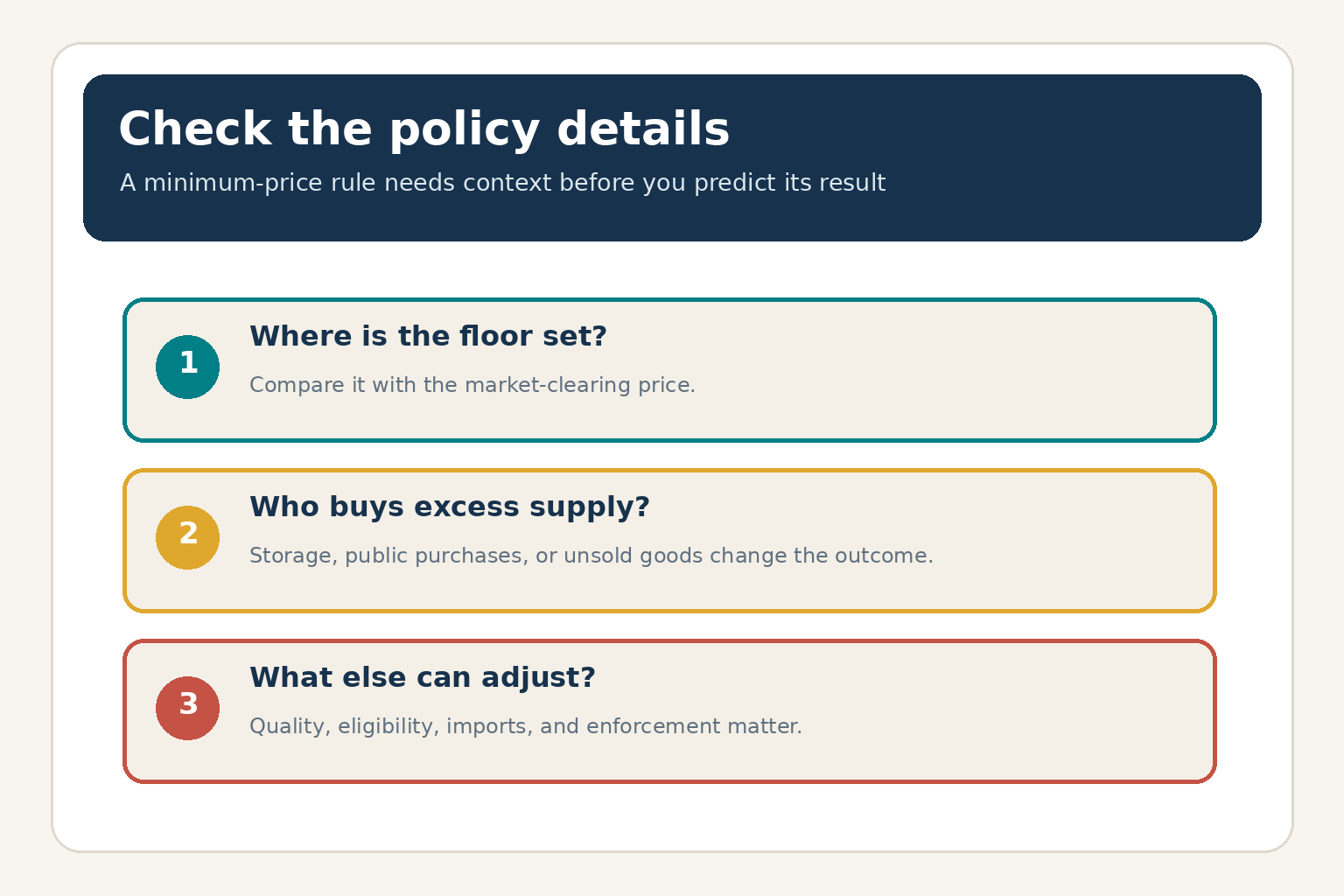
The graph is a simplified snapshot. It assumes other conditions—such as income, production costs, product quality, and the number of buyers and sellers—do not change during the comparison. In practice, people can adjust over time. Sellers may change production or quality, buyers may choose substitutes, and businesses may use non-price terms such as eligibility rules or package sizes. These responses can affect how a policy works, but they do not erase the initial distinction between a binding and a nonbinding floor.
Examples of price floors
| Example | How to interpret the floor | Important context |
|---|---|---|
| Agricultural support price | A government may announce a minimum price for an eligible crop. If it exceeds the price that would otherwise clear the market, more is offered than private buyers want at that price. | A purchase or storage program can affect where the surplus goes and who pays its costs. Eligibility, quality, and program rules matter. |
| Minimum wage | A minimum wage is often taught as a floor in the labor market: the wage is the price of labor. | The simple model predicts a labor surplus when the minimum is above equilibrium. Real employment effects are an empirical question and depend on market conditions and how employers and workers adjust. |
| A guaranteed resale price | A policy or contract may set a minimum acceptable price for a defined product. | A floor applies only to the covered transaction; it does not guarantee that every unit will sell at that price. |
These examples show why a price-floor analysis should identify the market, the relevant equilibrium, who is covered, and what happens to excess supply. Saying “the price floor raises prices” is incomplete: it may set a higher minimum for covered transactions, but a nonbinding floor has no direct effect, and the consequences beyond the market price depend on design and enforcement.
How to use “price floor” in a sentence
Use price floor as a noun phrase for the minimum permitted price. The phrase is usually lowercase unless it begins a sentence or appears in a title. For a clear economics sentence, name the market and explain whether the floor is above or below equilibrium. For example: “Because the price floor was set above equilibrium, the model predicts a surplus of wheat.”
The phrase also works in general explanations: “A nonbinding price floor does not change the market-clearing price.” Avoid using it as a synonym for any price that happens to be low, or for a price ceiling. A price ceiling is a maximum permitted price; a floor is a minimum.
Price floor vs. price ceiling
The terms point in opposite directions. A floor prohibits prices below a minimum, while a ceiling prohibits prices above a maximum. In the standard model, a binding floor is above equilibrium and can create excess supply; a binding ceiling is below equilibrium and can create excess demand. The effects depend on whether the restriction actually prevents the market from reaching its equilibrium.
Common mistakes to avoid
- Assuming every floor changes the market. Check the floor against equilibrium first; a floor below equilibrium is nonbinding in the standard model.
- Calling a surplus a guaranteed pile of inventory. The model identifies quantity supplied in excess of quantity demanded. Storage, public purchases, or other responses depend on the actual policy.
- Confusing a floor with a ceiling. A floor is a minimum; a ceiling is a maximum.
- Treating a model prediction as a universal empirical result. A supply-and-demand diagram clarifies a mechanism. Measuring an actual policy’s effects requires evidence about the market and its institutions.
Frequently asked questions
What is a price floor in simple words?
It is a rule that sets the lowest legal price for a covered good, service, or type of labor. Sellers can charge more, but cannot legally charge less within the rule’s scope.
Does a price floor always cause a surplus?
No. In the standard supply-and-demand model, a surplus occurs when a binding floor is set above equilibrium: quantity supplied exceeds quantity demanded. A floor below equilibrium is nonbinding and does not create this modeled gap.
What is one example of a price floor?
A minimum wage is a familiar example used in economics lessons because it establishes a minimum price for labor. Agricultural support prices are another example. The details and real-world effects vary with the policy and market.
How is a price floor different from a price ceiling?
A floor sets a minimum; a ceiling sets a maximum. A binding floor is above equilibrium in the standard model, whereas a binding ceiling is below it.
Sources and further reading
- OpenStax, Principles of Economics 2e, “Price Ceilings and Price Floors” — definitions, graphs, and the standard supply-and-demand analysis.
- OpenStax, Principles of Microeconomics 3e, “Demand and Supply at Work in Labor Markets” — minimum wage as a labor-market price floor and the distinction between binding and nonbinding rules.
Original sentence examples

7 Examples Of Price Floor Used In a Sentence For Kids
- Farmers are happy when there is a price floor for their crops.
- A price floor helps make sure farmers get a good amount of money for their hard work.
- The government sets a price floor to protect farmers from getting paid too less.
- When there is a price floor, it means the price cannot go below a certain level.
- The price floor is like a safety net for farmers to earn a fair amount of money.
- Farmers can rely on the price floor to keep their profits stable.
- With a price floor in place, farmers feel more secure about selling their crops.
14 Sentences with Price Floor Examples
- Price floor set by the government may affect the availability of affordable textbooks for college students.
- The introduction of a price floor on food items could lead to increased expenses for college students living in hostels.
- Students might struggle to sell their old electronics if there is a price floor on second-hand goods.
- Due to the price floor on public transport, college students may opt for cheaper options like cycling or carpooling.
- The implementation of a price floor on stationery items may force students to cut down on unnecessary purchases.
- College students searching for affordable housing may face challenges if there is a price floor in the real estate market.
- The imposition of a price floor on cafeteria meals could impact the dining choices of students with limited budgets.
- With a price floor on event tickets, students may miss out on attending concerts or shows they were looking forward to.
- Campus vendors might face difficulties if there is a sudden increase in the price floor for selling their products.
- The establishment of a price floor on clothing items may prompt students to explore thrift stores for more affordable options.
- Students planning fundraising events may need to reconsider their pricing strategy if there is a price floor on tickets or merchandise.
- The presence of a price floor on technology gadgets may influence students to look for discounts or promotional offers.
- Clubs and societies on campus might struggle to organize events if there is a price floor on venue rentals.
- If a price floor is enforced on gym memberships, students may seek alternative ways to stay active and fit on a budget.
How To Use Price Floor in Sentences?
Price Floor is the minimum price set by the government or a seller for a particular product or service. It is designed to prevent prices from falling below a certain level.
To use Price Floor in a sentence, simply identify the product or service you want to apply the price floor to, and then state the minimum price that must be met. For example, “The government established a price floor of $10 per unit for wheat to support farmers.”
When considering implementing a price floor, it is important to ensure that it is set at a level that will not be too high to cause surpluses. It should strike a balance between protecting producers and ensuring that consumers can still afford the product.
Another key point to remember is that a price floor is only effective when it is enforced. Make sure that those involved in the market are aware of the minimum price and adhere to it.
In conclusion, using Price Floor in a sentence is as simple as stating the minimum price required for a product or service. Remember to consider the implications of setting a price floor and ensure that it is enforced to achieve its desired effects.
Conclusion In conclusion, price floors are government-mandated minimum prices set above the equilibrium price in a market. These policies aim to protect producers and ensure they receive a fair income for their goods or services. However, price floors can lead to surpluses as higher prices decrease consumer demand and decrease the quantity of goods sold. Implementing a price floor can have both positive and negative impacts on the market, depending on the specific circumstances. It is crucial for policymakers to carefully consider the consequences of setting a price floor, as it can distort market equilibrium and potentially lead to unintended consequences such as surpluses and deadweight loss.

