Propaganda in a Sentence: Meaning and 21 Examples
Propaganda is communication that spreads ideas or information to influence an audience in support of a person, group, or cause. Use it as a noun in sentences about a message, campaign, source, or technique; the word often suggests bias, but propaganda is not simply another word for a lie.
- Word class: propaganda is a noun, usually uncountable.
- Common verbs: spread, broadcast, produce, counter, or study propaganda.
- Useful phrases: propaganda about or against a topic; a propaganda campaign.
- Meaning: communication intended to influence an audience, often with a one-sided or biased presentation.
- Key distinction: propaganda can selectively present true information; disinformation specifically involves deliberate false or misleading information.

What does “propaganda” mean?
Propaganda refers to ideas, claims, images, or messages circulated to influence what an audience thinks or does. Oxford Learner’s Dictionaries marks the noun as uncountable and usually disapproving; Cambridge Dictionary describes information or ideas spread with the intention of influencing opinions. In everyday writing, the word often signals a one-sided or biased message, but context matters.
A message does not become propaganda solely because it tries to persuade. The label is more precise when the communication advances a particular cause or agenda through selective facts, slogans, emotionally charged language, or a narrow presentation of the issue. Purdue OWL notes that propaganda can use pieces of true information selectively, so a true detail by itself does not settle how a message functions.
How do you use propaganda in a sentence?
Use propaganda where a noun belongs: as a subject, an object, or after a preposition. Because the word is usually uncountable, it normally takes a singular verb and no indefinite article when referring to the general practice or material.
| Sentence pattern | Example | Why it works |
|---|---|---|
| Propaganda + singular verb | Propaganda can shape how an audience interprets a campaign. | The noun is the subject and takes a singular verb. |
| Verb + propaganda | The historian studied propaganda from several periods. | The noun is the object of “studied.” |
| propaganda about/against + topic | The lesson examines propaganda about the proposed policy. | The preposition identifies the subject. |
| a piece of propaganda | The archive preserved a piece of propaganda as a primary source. | “Piece” supplies a countable unit. |
| propaganda campaign | The article analyzes a propaganda campaign and its slogans. | The noun modifies “campaign.” |
Prefer “The pamphlet spread propaganda” or “The pamphlet was propaganda” over “a propaganda” when you mean the broad material or practice. For one item, use “a piece of propaganda,” “a propaganda message,” or “a propaganda poster.” The related noun propagandist names a person who creates or spreads propaganda; propagandistic is an adjective.
Is propaganda the same as misinformation or disinformation?
No. Propaganda describes communication used to influence an audience, often through a biased or selective presentation. UNESCO distinguishes disinformation by deliberate dissemination of false or misleading information intended to deceive; misinformation is often distinguished by the absence of that deceptive intent. The categories can overlap, but they are not synonyms.
- Propaganda: a campaign repeats selected information to advance a cause; some individual facts may still be accurate.
- Disinformation: a source deliberately circulates false or misleading claims to deceive.
- Misinformation: false or misleading information is shared without the deliberate intent to deceive, in UNESCO’s common usage.
- Persuasion: an attempt to change an audience’s view; it is not automatically propaganda or deception.
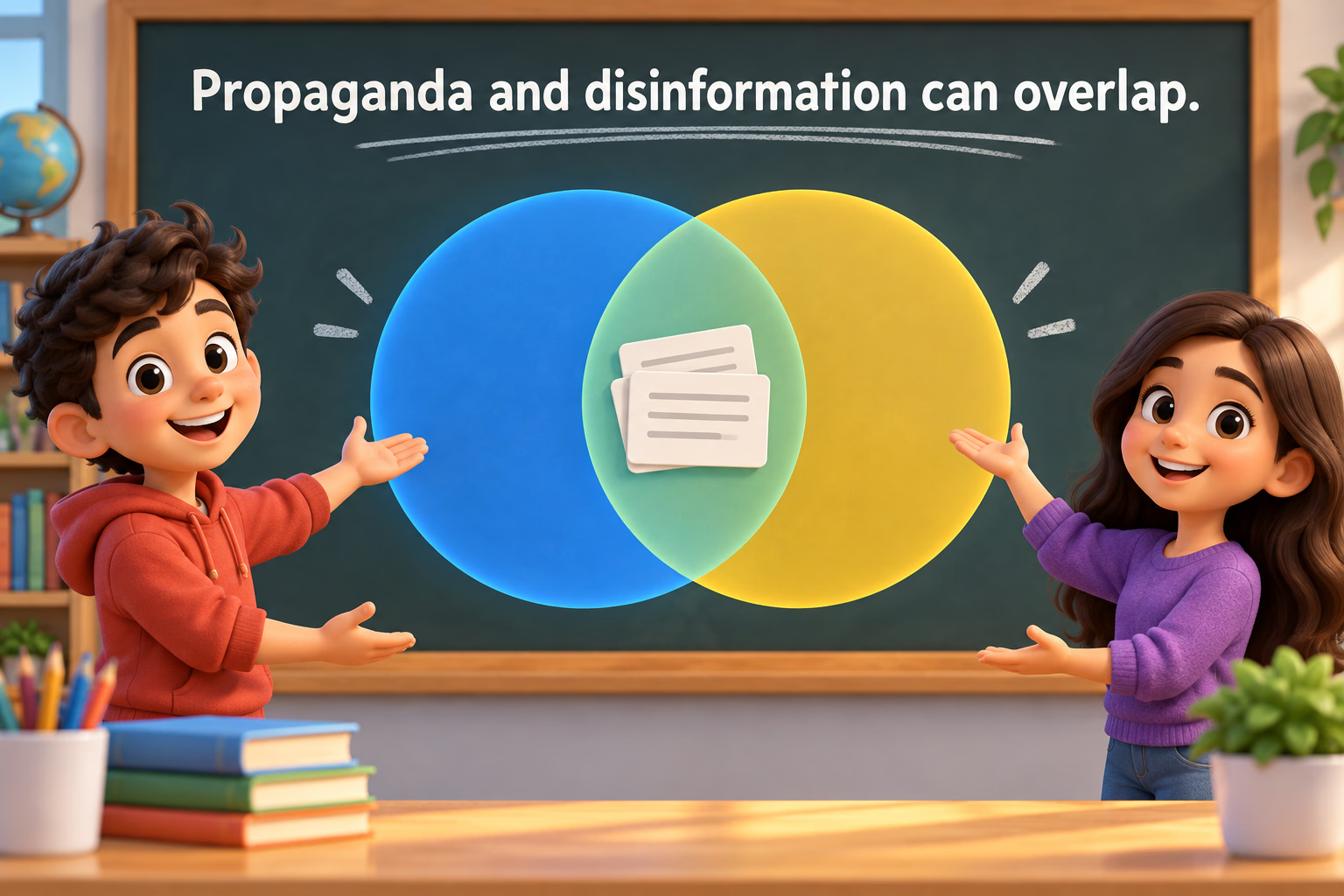
When using the word in an essay or report, identify the evidence behind the label. Explain what is selective, misleading, emotionally framed, or tied to an agenda instead of treating “propaganda” as a substitute for disagreement.
How can you write a clear example sentence?
- Name the message or source: a speech, poster, video, leaflet, or campaign.
- Use a precise verb such as spread, publish, study, or counter.
- Explain the purpose or feature that makes the example relevant, such as one-sided claims or an appeal to emotion.
- Avoid calling a claim propaganda just because you disagree with it; describe the evidence and context.
For example, “The media-literacy class analyzed the poster’s slogan and selective evidence before calling it propaganda” names both the judgment and the reason for it. A shorter sentence—“The poster was propaganda”—may be grammatically correct, but it leaves the reader without evidence or context.
Frequently asked questions about propaganda in a sentence
Should I write “propaganda is” or “propaganda are”?
Use propaganda is when the word means persuasive material or communication generally. Learner dictionaries mark the noun uncountable, so it normally takes a singular verb: “The propaganda is easy to recognize.”
Can I say “a propaganda”?
Usually not when referring to the general material. Use “propaganda,” “a piece of propaganda,” or a countable phrase such as “a propaganda message” or “a propaganda campaign.”
Can propaganda include true facts?
Yes. A message can use accurate facts selectively while leaving out relevant context or opposing evidence. Purdue OWL specifically cautions readers to notice when true information is arranged to mislead an audience.
Is every persuasive advertisement propaganda?
No. Advertising is persuasive, but calling a particular ad propaganda requires more context about its purpose and presentation. The term usually implies a one-sided message advanced for a cause or agenda, often with bias or manipulative framing.
What prepositions commonly follow propaganda?
Common patterns include propaganda about a topic and propaganda against a person or idea. Writers also use spread propaganda, counter propaganda, and a propaganda campaign.
What is the adjective form of propaganda?
Propagandistic means relating to or characteristic of propaganda. For example, “The reviewer described the film’s one-sided argument as propagandistic.” The related noun propagandist refers to a person who produces or spreads propaganda.
Propaganda, a term often associated with influencing beliefs and attitudes through various forms of communication, has long been a powerful tool in shaping public opinion. This persuasive technique aims to spread biased or misleading information to promote a specific agenda or ideology.
In today’s digital age, propaganda can easily spread through social media platforms, advertisements, and news outlets, making it crucial for individuals to critically analyze the information they encounter. Understanding the tactics used in propaganda can help people decipher between factual information and manipulative messaging.
7 Examples Of Propaganda Used In a Sentence For Kids
- Propaganda is information that tries to make people believe something.
- Some people use propaganda to spread false ideas.
- It’s important to think critically about propaganda messages.
- We should always question the messages we see in propaganda.
- Don’t believe everything you hear in propaganda.
- Propaganda can sometimes be used to manipulate people’s thoughts.
- Let’s be smart and aware of propaganda around us.
14 Sentences with Propaganda Examples
- PROPAGANDA is often used by political parties to sway public opinion in their favor.
- In a democracy, it is crucial for college students to critically analyze PROPAGANDA before forming their opinions.
- Some organizations use PROPAGANDA to spread misinformation and manipulate people’s beliefs.
- College students should be aware of the impact PROPAGANDA can have on their decision-making process.
- Professors often discuss the harmful effects of PROPAGANDA in media and advertisements in their lectures.
- It is important for college students to fact-check information they come across to avoid falling for PROPAGANDA.
- PROPAGANDA can be found in various forms such as posters, social media, and speeches.
- College students can take courses on media literacy to learn how to identify and counteract PROPAGANDA.
- It is important for students to engage in open discussions and debates to counteract the effects of PROPAGANDA.
- Understanding the techniques used in PROPAGANDA helps students become more discerning consumers of information.
- In a competitive job market, being able to distinguish between facts and PROPAGANDA is a valuable skill for college students.
- Students should be cautious of PROPAGANDA that aims to divide communities based on false narratives.
- By educating themselves on PROPAGANDA, college students can become more empowered to question authority and hold leaders accountable.
- College campuses should host workshops and seminars on PROPAGANDA to help students develop critical thinking skills.
How To Use Propaganda in Sentences?
Propaganda is the dissemination of information, ideas, or rumors to help or hurt a particular cause, individual, or group. Here’s how you can use it in a sentence:
- Identify the propaganda technique being used in the advertisement.
- The politician’s speeches are full of propaganda to sway voters to support his campaign.
- We must be critical thinkers and not easily swayed by propaganda tactics in the media.
- The government used propaganda to promote unity during times of war.
- It is important to be able to distinguish between facts and propaganda.
Incorporating propaganda into your sentences can help you better understand how information can be used to influence people’s beliefs or actions. By familiarizing yourself with examples and different ways propaganda can be used, you can improve your ability to recognize and evaluate persuasive messaging in various forms of communication. Remember to always approach information critically and consider the source and intent behind the messaging.
Conclusion
In conclusion, the examples of sentences with propaganda provided in this article showcase how this powerful tool can be used to manipulate opinions and beliefs. By distorting information, presenting facts selectively, or appealing to emotions, propaganda can shape public perception and influence decision-making. Recognizing and critically analyzing such sentences is crucial in order to avoid being swayed by biased or false narratives.
It is essential for individuals to be aware of propaganda techniques and be able to discern propaganda from factual information. By fostering a critical mindset and actively questioning the content presented to us, we can guard against falling victim to manipulative tactics. Ultimately, staying informed, seeking out diverse perspectives, and verifying sources are key practices to counteract the influence of propaganda in the media and society.


