How do you use protagonist in a sentence?
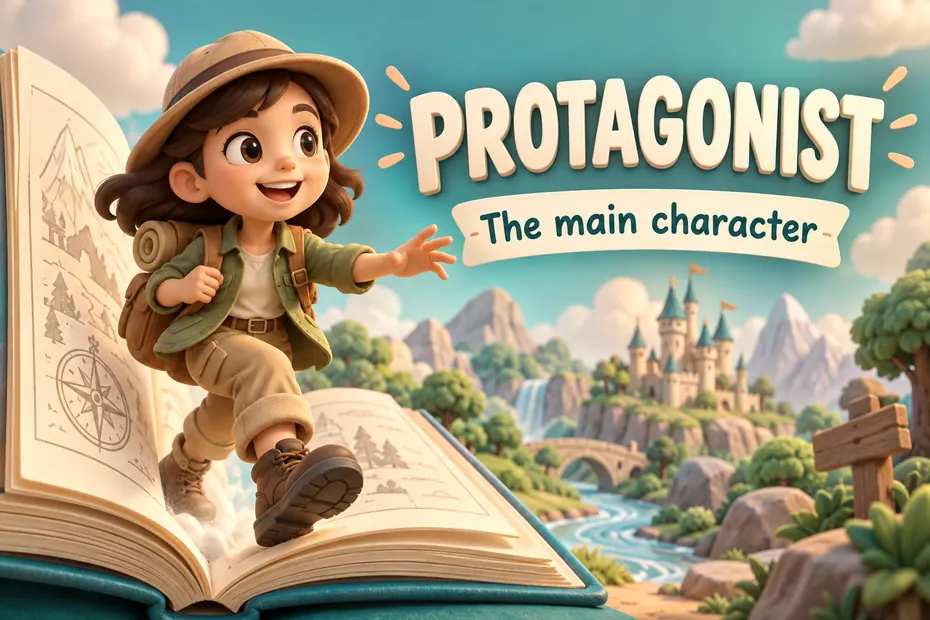
A protagonist is a central character in a story, play, or film: “The protagonist risks her job to uncover the truth.” Use the noun to identify whose story the audience follows. A protagonist need not be admirable, victorious, or the person telling the story.
- Word class: countable noun; one protagonist, two protagonists.
- Common pattern: the protagonist of a novel, film, or play.
- Possessive: the protagonist’s decision; the protagonists’ decisions.
- Useful distinction: protagonist describes a narrative role; hero can describe admirable conduct.
- Wider meaning: dictionaries also record an important participant or supporter of a cause.

Protagonist sentence patterns and examples
Put protagonist where a noun belongs, then add a specific action or relationship. “The protagonist changes” is grammatical but gives little information. “The protagonist abandons his plan after discovering the forged letter” shows both a decision and its cause.
| Pattern | Original example | What it identifies |
|---|---|---|
| The protagonist of + work | The protagonist of the mystery is a retired teacher. | The central character’s identity |
| Protagonist + action | The protagonist refuses to leave her brother behind. | A consequential choice |
| Adjective + protagonist | An unreliable protagonist hides evidence from the reader. | A relevant character trait |
| Protagonist’s + noun | The protagonist’s mistake triggers the final confrontation. | Ownership or connection |
| Plural protagonists | The novel’s two protagonists tell alternating stories. | Shared narrative importance |
The examples above are written for this guide. Their purpose is to demonstrate grammar and meaning, rather than quote published reviews. For an essay, replace generic descriptions with the character’s name and the title of the work so readers can check your interpretation.
Is the protagonist always the hero?
The protagonist is not necessarily a morally good hero. The term identifies narrative importance, whereas calling someone heroic usually praises courage or conduct. A selfish thief can be a story’s protagonist if the plot follows the thief’s decisions and consequences.
For example, “The protagonist cheats his friends, and the ending exposes his dishonesty” is coherent. Do not change protagonist to hero merely because the character appears most often. Dictionary.com’s discussion of hero and protagonist explains the distinction between these overlapping terms.
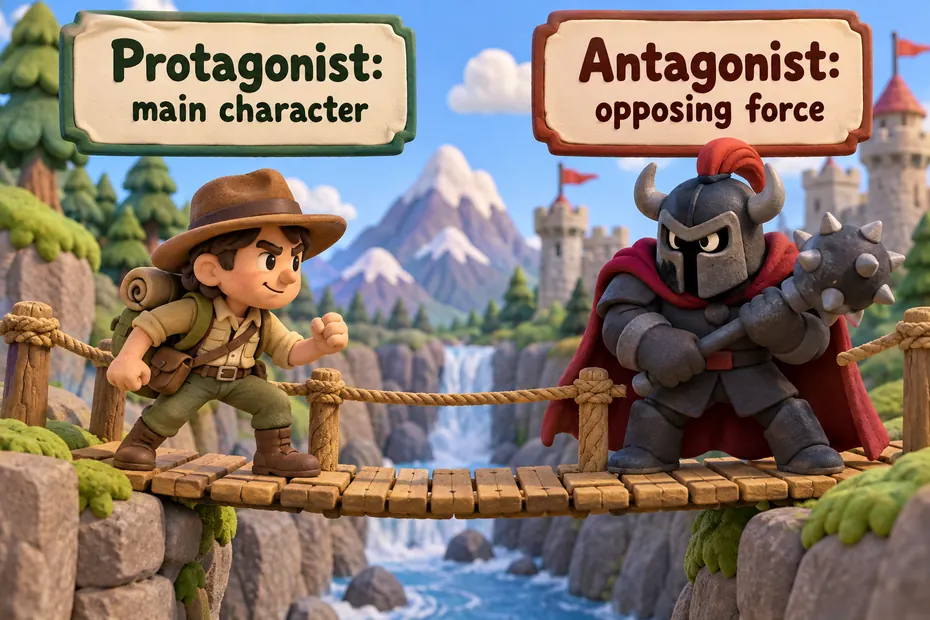
An antagonist opposes the protagonist. A rival character can fill that role, but the conflict may involve another kind of obstacle. When writing a basic school response, identify the actual opposition in the work instead of assuming every story contains a single villain. Also distinguish the narrator, who tells the story, from the protagonist, whose experience is central: those roles can belong to different people.
Which real-world uses sound natural?
Protagonist can describe an important participant or advocate outside fiction, but more direct occupational terms often make everyday sentences clearer. Merriam-Webster records both narrative and wider senses, and Cambridge Dictionary includes a supporter sense. Context must make the intended meaning understandable.
The older examples below sometimes apply the word broadly to ordinary college activities. They remain available, but a literal report benefits from more precise wording. “The protagonist of the experiment” could suggest a narrated account; “the study participant” directly identifies someone who took part in research.
- Research: “A participant completed the memory test.”
- Group work: “The team leader assigned the remaining tasks.”
- Competition: “The finalist defended her argument confidently.”
- Internship: “The intern prepared a report for the supervisor.”
- Narrative account: “The documentary’s protagonist describes her first internship.”
These alternatives do not make every wider use incorrect. They remove ambiguity when the sentence is about a role, rather than a story or a prominent figure in a conflict. In a creative personal essay, “I became the protagonist of my own story” is understandable as a metaphor; in a methods section, concrete research terminology is better.
How can you improve a sentence with protagonist?
Name the work, identify the character, and explain a meaningful action. Begin with “The protagonist of the short story is Mara.” Then develop the observation: “Mara, the protagonist of the short story, returns the stolen money even though she risks arrest.” The second version gives evidence for discussion.
Check that the subject and verb agree: “The protagonist faces a dilemma,” but “The protagonists face a dilemma.” Use a protagonist when introducing one central character and the protagonist when the character is already identifiable. Keep the word lowercase except at the beginning of a sentence or in a title.
Frequently asked questions
Can a story have more than one protagonist?
Yes. A story can give two or more characters substantial central roles. Write “The film has two protagonists” when both characters anchor the narrative. Do not label every named character a protagonist; explain how each central character’s goals or choices shape the story you are discussing.
What is the plural of protagonist?
The plural is protagonists, formed by adding s. For possession, write “the protagonist’s goal” for one character and “the protagonists’ goals” for multiple characters. If each character has a different goal, the plural noun helps communicate that distinction without adding a separate explanation.
Can protagonist refer to a woman or an animal?
Yes. Protagonist identifies a role and does not specify gender or species. A girl, an adult woman, a boy, or a fictional animal can be a protagonist. Choose pronouns appropriate to the character and keep the same narrative test: whose experience and decisions are central?
What is a simple sentence for a beginner?
“The protagonist of the story is a brave child” is a clear beginner sentence. It identifies the character’s role and adds one description. To practice meaning rather than memorizing the definition, add an action: “The protagonist helps a lost traveler find the way home.” Both examples use the noun naturally.
To use protagonist in a sentence clearly, connect the noun to a particular story and a meaningful action. Preserve the distinction between central character, narrator, hero, and participant so the sentence tells readers exactly which role you mean.

Have you ever wondered who the central character in a story is? Look no further than the protagonist. The protagonist is the main character around whom the plot revolves.
This character is usually the hero or heroine of the story, driving the narrative forward with their actions and decisions. In many cases, the protagonist faces challenges and undergoes personal growth throughout the story, making them relatable and engaging for the audience.
7 Examples Of Protagonist Used In a Sentence For Kids
- The protagonist is the main character in a story.
- The protagonist is usually the hero of the story.
- The protagonist is someone we cheer for in a book or movie.
- The protagonist is the one who solves problems in the story.
- The protagonist is often brave and determined.
- The protagonist is someone we look up to in a story.
- The protagonist is important for moving the story forward.
14 Sentences with Protagonist Examples
- The protagonist of this story is a determined college student who overcomes many obstacles to achieve their dream of becoming a successful entrepreneur.
- As the protagonist of their own life, the college student must make difficult decisions about their future career path.
- The protagonist of this film is a college student who discovers a hidden talent for music and decides to pursue it against all odds.
- In the psychology class, the protagonist of the experiment was a college student struggling with anxiety and was able to overcome it through therapy.
- The protagonist of the debate competition was a college student who eloquently defended their arguments with passion and conviction.
- As the protagonist of a group project, the college student must lead their team to successfully complete the assignment on time.
- The protagonist of this research study is a college student investigating the effects of social media on mental health.
- The protagonist of the internship program is a college student gaining valuable work experience in their chosen field.
- The protagonist of the coding competition is a college student who excels in programming and impresses the judges with their skills.
- As the protagonist of the campus play, the college student must memorize lines and rehearse tirelessly to deliver a stellar performance.
- The protagonist of the sports tournament is a college student who demonstrates exceptional teamwork and sportsmanship on and off the field.
- The protagonist of the leadership workshop is a college student who learns valuable skills to inspire and motivate others.
- As the protagonist of the volunteer project, the college student dedicates their time and effort to make a positive impact on the community.
- The protagonist of the scholarship application process is a college student who showcases their academic achievements and extracurricular activities to secure funding for their education.
How To Use Protagonist in Sentences?
To use the word Protagonist in a sentence, first, you need to understand its meaning. A protagonist is the main character or the leading figure in a story, novel, movie, or any other narrative.
Here’s a simple example sentence using protagonist: “Harry Potter is the protagonist in the popular book series written by J.K. Rowling.”
When constructing a sentence with protagonist, remember to place the focus on the central character of the story who is driving the plot forward. You can clearly identify the protagonist by looking for the character who faces challenges, makes decisions, and experiences growth throughout the narrative.
Additionally, it may be helpful to provide context or background information about the protagonist in your sentence to help others understand their significance within the story. For example, you can mention their goals, motivations, or key characteristics that define their role in the plot.
By following these simple guidelines, you can effectively incorporate the word protagonist into your sentences and communicate the central character’s importance in a story to others.
Conclusion
In literature, the protagonist is the central character around whom the story revolves. The protagonist’s thoughts, actions, and beliefs drive the plot forward, making them a crucial element of storytelling. For example, in “To Kill a Mockingbird,” we follow Scout Finch as she learns about justice and morality in a racially divided society. Similarly, in “Harry Potter,” we witness Harry’s journey through the magical world as he confronts evil and discovers his true identity.
Understanding the role of the protagonist allows readers to connect with the story on a deeper level, as they empathize with the character’s struggles and triumphs. By examining the protagonist’s growth, motivations, and conflicts, we gain insights into the human experience and the complexities of life. Ultimately, the protagonist serves as a lens through which we explore themes, relationships, and the different facets of humanity.