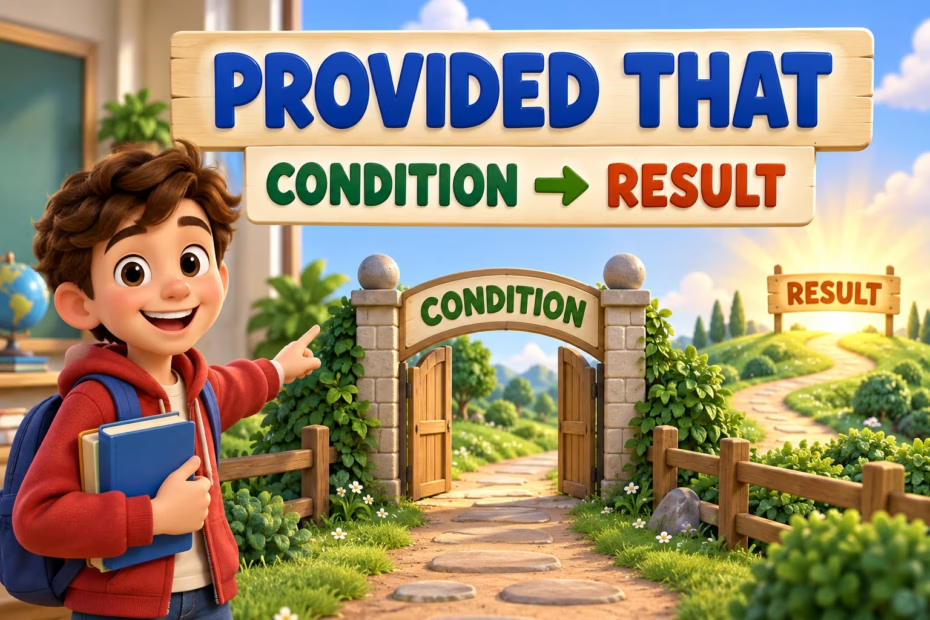
“Provided that” in a sentence introduces a condition: the action or result in the main clause applies if that condition is met. The phrase usually begins a dependent clause containing a subject and verb, and it can appear before or after the main clause.
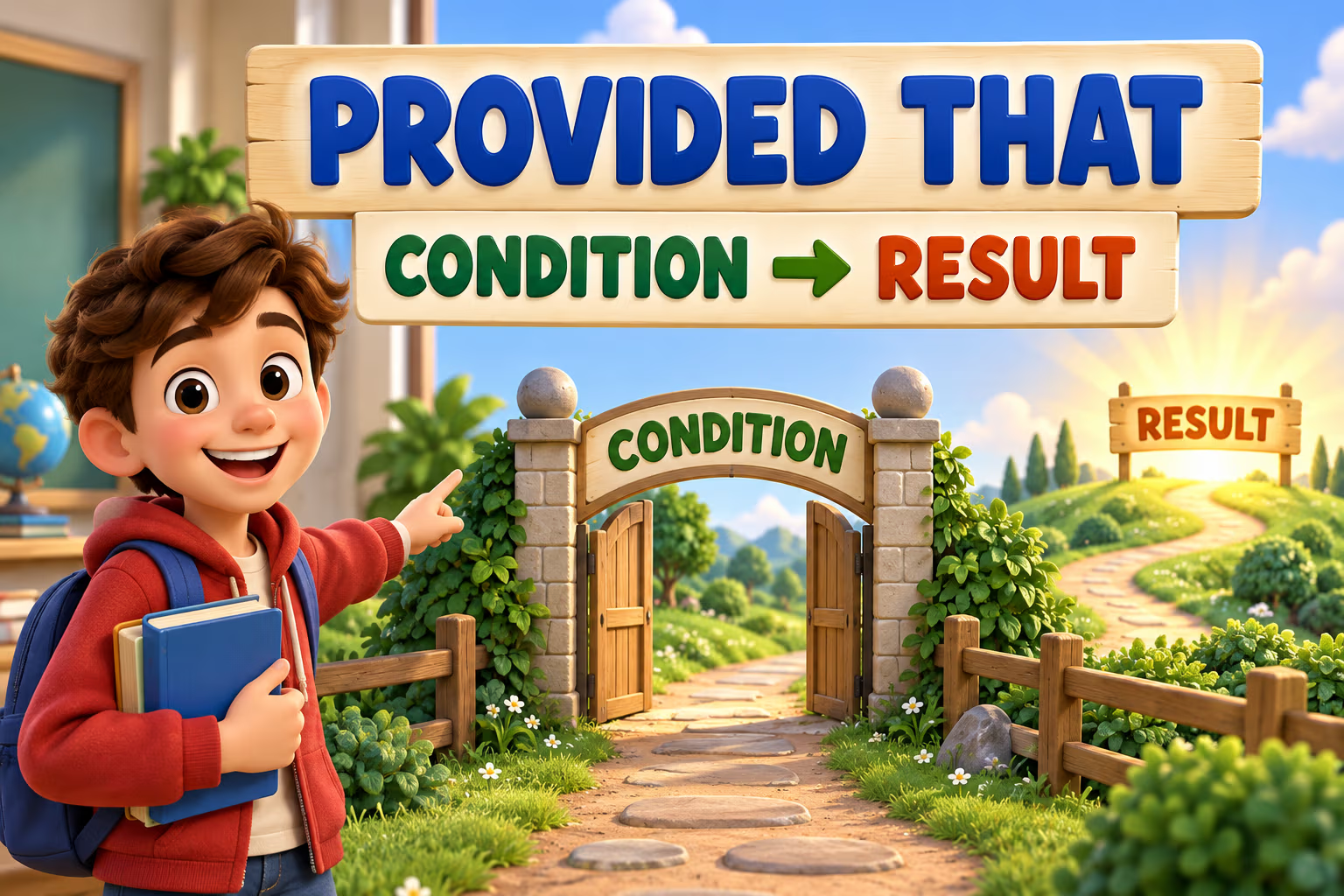

For example, “Provided that the venue is open, we’ll meet there” states that the meeting depends on the venue being open. The phrase can sound more formal or explicit than if, but the exact force depends on the surrounding sentence.
At a glance: how “provided that” works
- Meaning: “provided (that)” introduces a condition, roughly “if” or “on the condition that.”
- Clause pattern: provided (that) + subject + verb forms a dependent condition clause.
- Condition first: a comma normally follows the opening condition clause.
- Condition last: a comma is usually unnecessary before a closely connected final condition clause.
- “That” is optional: both provided and provided that can introduce the condition.
What does “provided that” mean?
“Provided that” means “if” or “on the condition that.” It connects a condition to a result, permission, plan, or statement that applies only when the condition is satisfied. Cambridge Dictionary identifies it as a conjunction with the meaning “if, or only if,” and Cambridge Grammar Today lists it among multiword subordinating conjunctions.
In “We can use the room provided that we leave it clean,” the condition is we leave it clean; the main clause is we can use the room. The sentence does not claim that the room will certainly be used or that the condition is already true. It states the terms under which the permission applies.
Cambridge Dictionary also records provided without that, as in “provided you can produce proof of purchase.” Both forms are standard.
How do you structure the condition clause?
A common pattern is provided (that) + subject + verb, followed or preceded by a main clause. The part after provided that is normally a clause, not just a noun phrase: it has a subject and a verb, such as the bus arrives or you have a ticket.
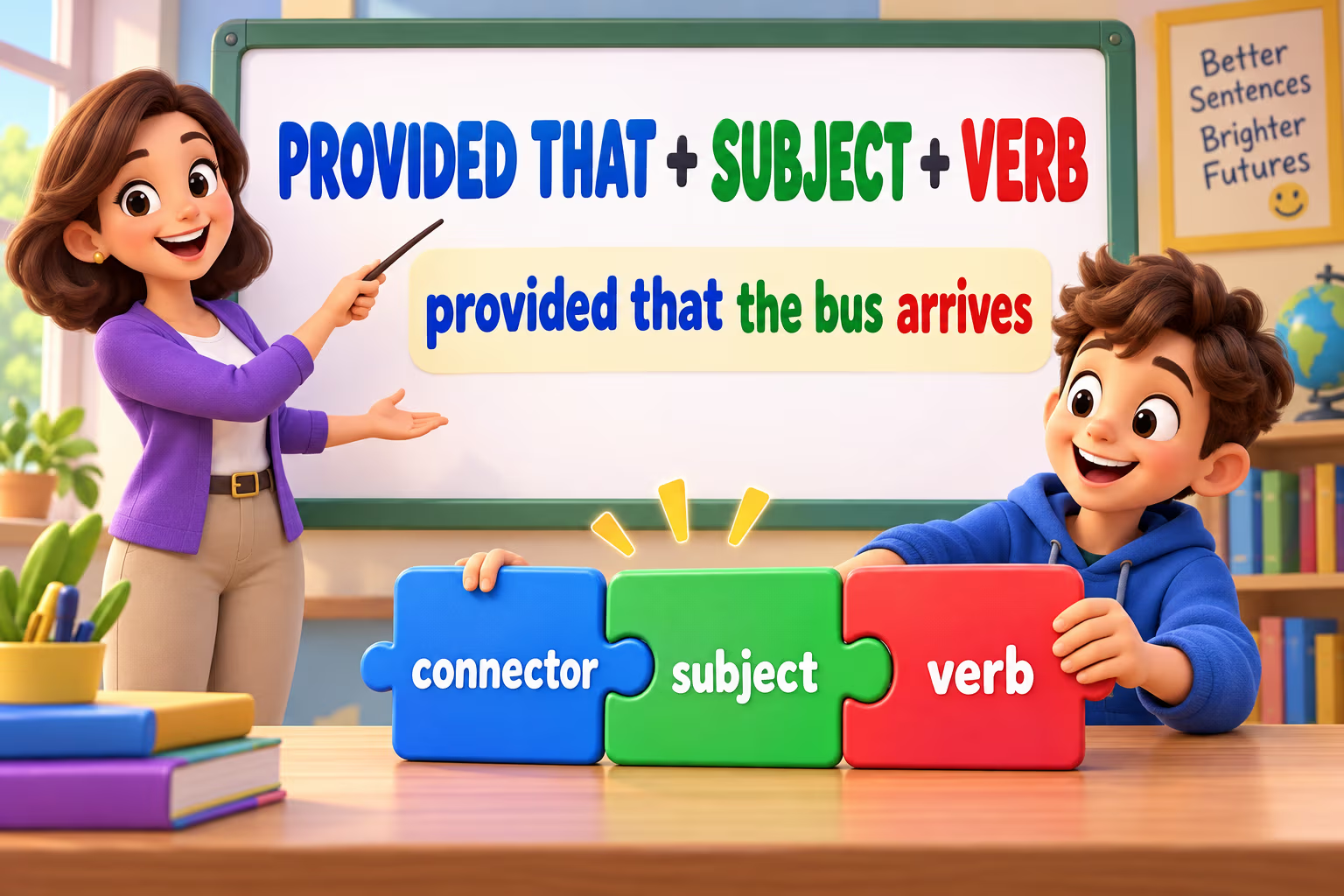
Use the pattern to make the condition and its consequence easy to identify:
- Condition: Provided that the forecast stays clear, we’ll hold the event outdoors.
- Main clause: we’ll hold the event outdoors.
- Condition after the main clause: We’ll hold the event outdoors provided that the forecast stays clear.
Because the condition clause is dependent, it cannot normally stand alone as a complete sentence. “Provided that the forecast stays clear.” leaves the reader waiting for the main point. Join it to a complete clause: “Provided that the forecast stays clear, we’ll hold the event outdoors.”
Where does the comma go?
Place a comma after an opening “provided that” clause; usually omit a comma when that condition clause follows the main clause. This follows the general punctuation convention for introductory dependent clauses described by Cambridge Grammar Today and Purdue OWL.
| Clause order | Example | Typical punctuation |
|---|---|---|
| Condition first | Provided that the trail is open, we’ll hike. | Comma after the condition clause |
| Main clause first | We’ll hike provided that the trail is open. | No comma before the condition clause |
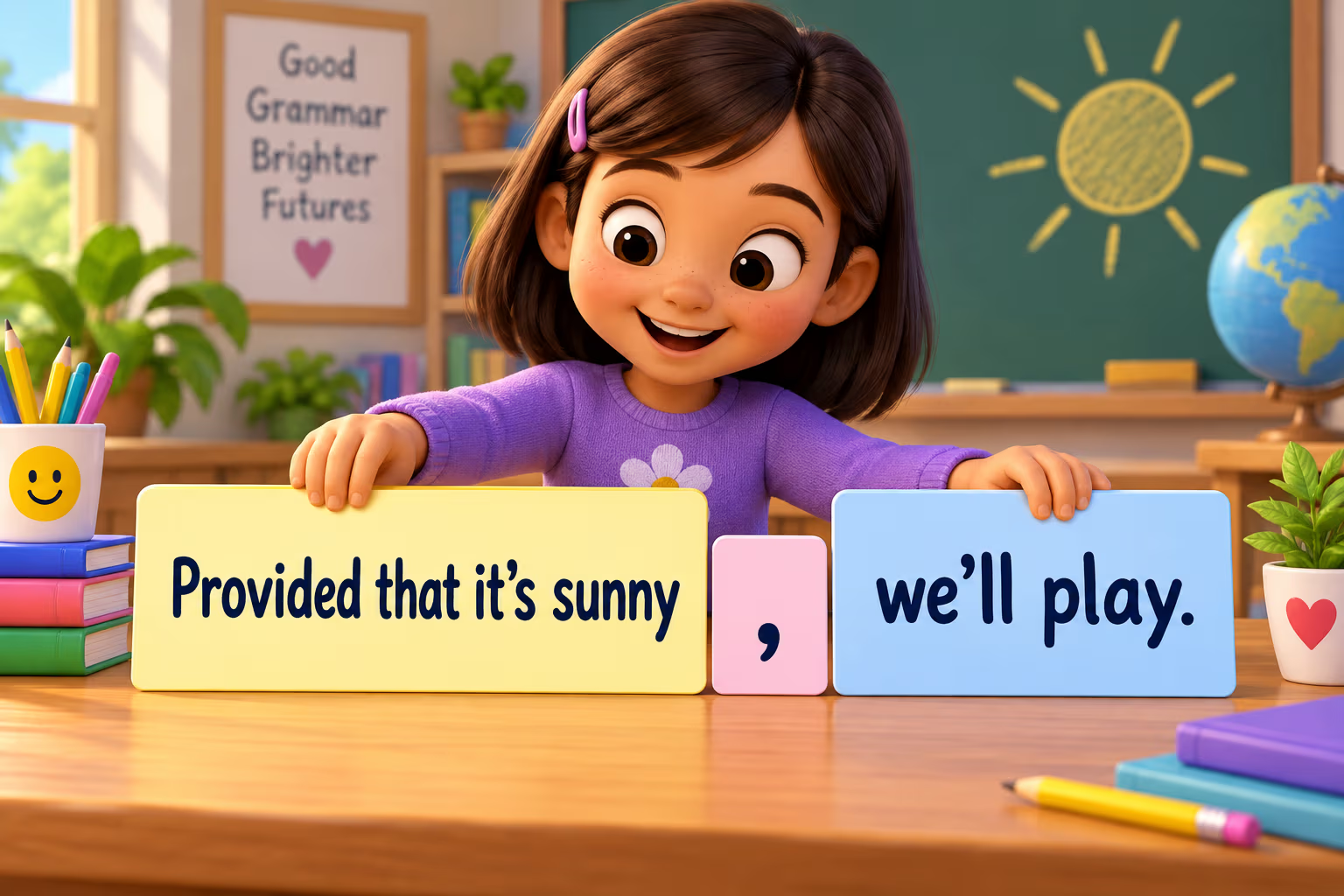
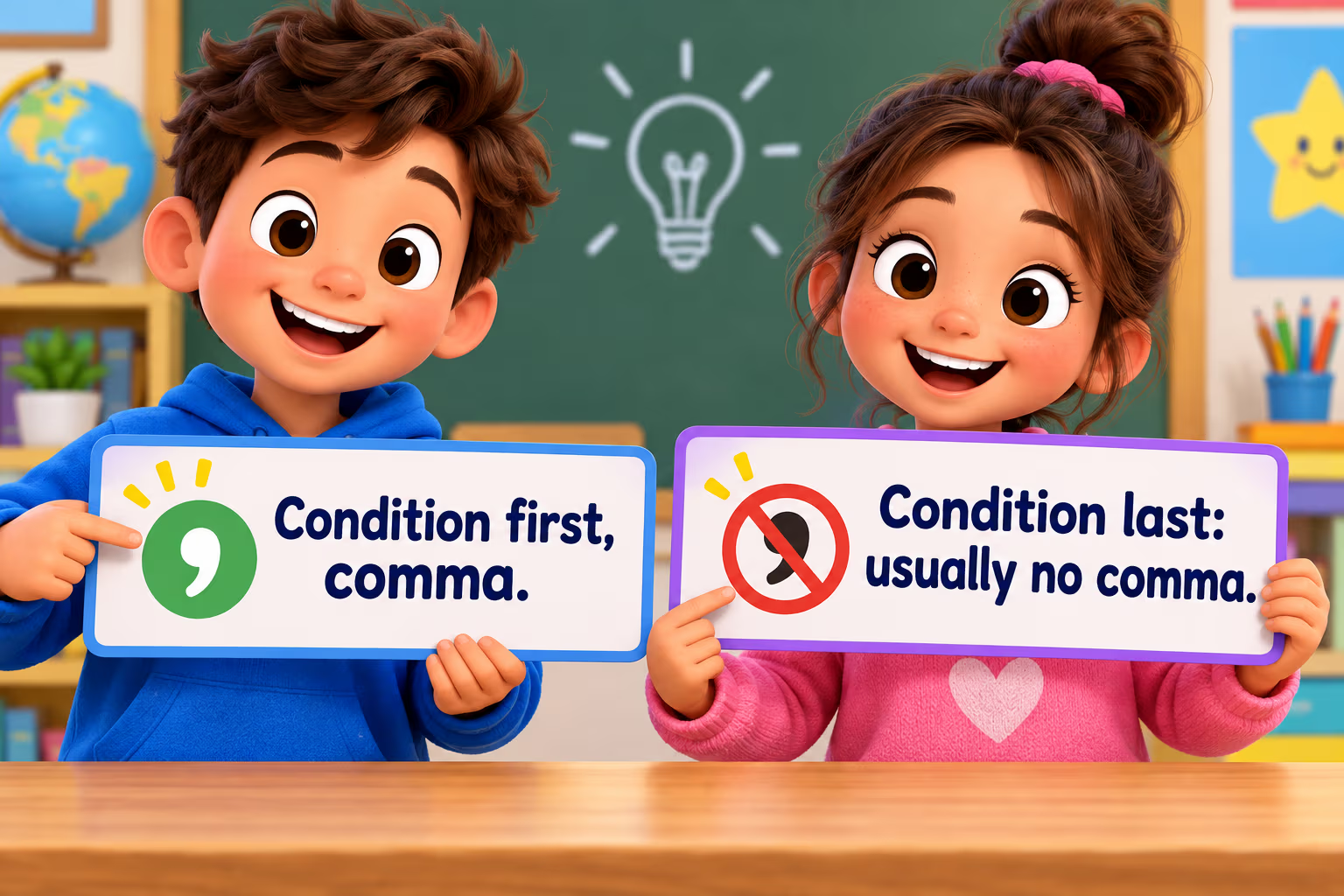
These are default patterns, not a ban on every other comma. A writer may need punctuation for an interruption, a parenthetical aside, or a special contrast. In an ordinary sentence where the final condition is closely connected to the main clause, though, a comma is not needed.
How is it different from “if” or “only if”?
“If” is the broad, neutral choice for a condition; “provided that” often makes the condition sound explicit or stipulated. “Only if” can express a strict necessary condition: if a result occurs, the stated condition must hold. In everyday sentences, dictionaries sometimes define “provided that” with “if” or “only if,” so interpret the relationship from context rather than treating the phrases as identical in every logical use.
| Expression | Typical use | Example |
|---|---|---|
| if | General condition | If the room is free, we can meet there. |
| provided (that) | Condition presented as a term or requirement | We can meet there provided that the room is free. |
| only if | Emphasizes a necessary condition | We can meet there only if the room is free. |
| as long as | Often expresses a condition that must continue or remain true | You may borrow the book as long as you return it Friday. |
These expressions overlap, but they are not always interchangeable. In a contract, policy, or other consequential document, choose the wording that expresses the intended condition and have the full terms reviewed as appropriate; a grammar explanation alone cannot determine legal effect.
Can “provided that” begin a sentence?
Yes. A sentence can begin with the dependent condition clause, followed by a comma and the main clause: “Provided that everyone agrees, we’ll move the meeting to Friday.” The clause order changes emphasis and information flow, not the basic conditional relationship.
Writers also place the phrase within a sentence after the main clause: “We’ll move the meeting to Friday provided that everyone agrees.” Cambridge’s grammar guide gives an example of an initial “provided that” clause and explains the usual comma pattern for initial subordinate clauses.
What common mistakes should you avoid?
- Leaving the condition as a fragment. Pair “provided that the bus arrives” with a main clause: “We’ll leave provided that the bus arrives.”
- Adding a comma automatically before every final condition. In a routine sentence, write “We can start provided that everyone is ready,” without a comma.
- Confusing the conjunction with the verb provide. In “provided that we have time,” the phrase introduces a condition; in “the school provided supplies,” provided is the past-tense verb meaning supplied.
- Assuming a condition is a guarantee. “We’ll proceed provided that the test passes” states the plan’s condition; it does not report that the test passed or that the plan is certain to succeed.
Frequently asked questions
Can you use “provided” without “that”?
Yes. Both “provided the train is on time” and “provided that the train is on time” are grammatical. The shorter form is not an error; include that when it makes the clause easier to read or the sentence more formal in tone.
Is “provided that” formal?
It can sound more formal or contract-like than if, especially when it introduces a requirement, but it is also used in ordinary English. The surrounding wording and situation affect its tone.
Can a sentence end with “provided that”?
The phrase normally introduces a condition clause, so it needs the words that state the condition. A sentence can end with that full clause—“We can use the room provided that we clean up”—but not usually with the connector alone.
Is a comma needed before “provided that”?
Usually not when “provided that” begins a closely connected condition clause after the main clause. If the condition clause comes first, use a comma after it: “Provided that the room is available, we can meet there.”
Source examples and editorial note
The examples and explanations from the earlier version of this article are retained below. One earlier sentence says that “provided that” typically implies a stronger condition than if; that is too broad as a general grammar rule. The phrase explicitly states a condition, but its strength depends on context, and only if can carry a stricter necessary-condition meaning. The earlier wording is kept as source material, not endorsed as a universal distinction. The earlier usage passage also calls “you are over 18” a noun phrase; it is a clause with a subject and verb, which is the usual pattern after “provided that.”
“Provided that” is a connective phrase that introduces a condition or requirement for something else to happen. This phrase indicates that a certain circumstance must be met in order for a particular action or outcome to take place.
In English grammar, “provided that” is commonly used to specify a condition that must be satisfied for a statement or clause to be applicable. It is a useful tool for setting conditions and creating logical relationships between different parts of a sentence.
7 Examples Of Provided That Used In a Sentence For Kids
- Provided that you finish your lunch, you can go play outside.
- We can have a picnic in the park provided that it doesn’t rain.
- You can have a cookie provided that you brush your teeth afterwards.
- Provided that you finish your homework, you can watch your favorite cartoon.
- We can have a movie night provided that you clean up your toys.
- You can play with your toys provided that you share them with your friends.
- You can have some ice cream provided that you eat your vegetables first.
14 Sentences with Provided That Examples
- Provided that you maintain good attendance and submit all assignments on time, you should do well in this course.
- It’s fine to party on weekends provided that you’ve completed all your assignments beforehand.
- Provided that you have a valid student ID, you can access the library resources anytime you want.
- You can borrow books from the library for up to two weeks provided that you return them on time.
- It’s okay to use your phone in class provided that it’s for academic purposes.
- You can skip a lecture provided that you have a legitimate reason and inform your professor in advance.
- You can wear casual attire to college provided that it’s not against the dress code.
- You can join extracurricular activities provided that it doesn’t affect your academic performance.
- You can take a leave of absence from college provided that you have a valid reason and approval from the administration.
- You can volunteer for campus events provided that it doesn’t clash with your study schedule.
- You can negotiate your project deadline with your professor provided that you have a valid excuse.
- You can take a short break during exams provided that it’s within the designated break time.
- You can discuss your grades with your professor provided that it’s done in a respectful and professional manner.
- You can request for extra help from your professor provided that you’ve tried understanding the material on your own first.
How To Use Provided That in Sentences?
To use “Provided That” in a sentence, you need to understand its meaning and how it affects the sentence structure. “Provided That” is a conjunction that introduces a condition that must be fulfilled for something else to happen.
When using “Provided That” in a sentence, you should place it at the beginning of the dependent clause that expresses the condition. For example: “You can go to the party provided that you finish your homework first.” Here, the condition for going to the party is finishing homework first.
It’s important to remember that after “Provided That,” you need to include a clause that gives the condition that must be met. This could be in the form of a verb phrase, such as “you finish your homework,” or a noun phrase, such as “you are over 18.”
Additionally, the main clause of the sentence, which comes after the condition, usually expresses the consequence or action that will follow if the condition is met.
One key point to remember is that “Provided That” is similar to “if” or “only if” but typically implies a stronger condition. It suggests that the condition is essential for the main clause to take place.
In summary, when using “Provided That” in a sentence, make sure to place it at the beginning of the dependent clause that states the condition, and follow it with the main clause that describes the consequence.
Conclusion
In summary, the various examples of sentences with the keyword “provided that” demonstrate its important role in setting conditions or limitations for specific situations. The phrase is used to indicate that certain actions or outcomes are contingent upon certain conditions being met, allowing for clearer communication and ensuring that agreements are understood and followed.
By using “provided that” in sentences, individuals can clearly outline expectations, requirements, or exceptions, helping to prevent misunderstandings and conflicts in various contexts. Whether in contracts, agreements, or everyday conversations, the inclusion of this phrase ensures that all parties involved are aware of the terms and conditions that must be adhered to, promoting clarity and effective communication.


