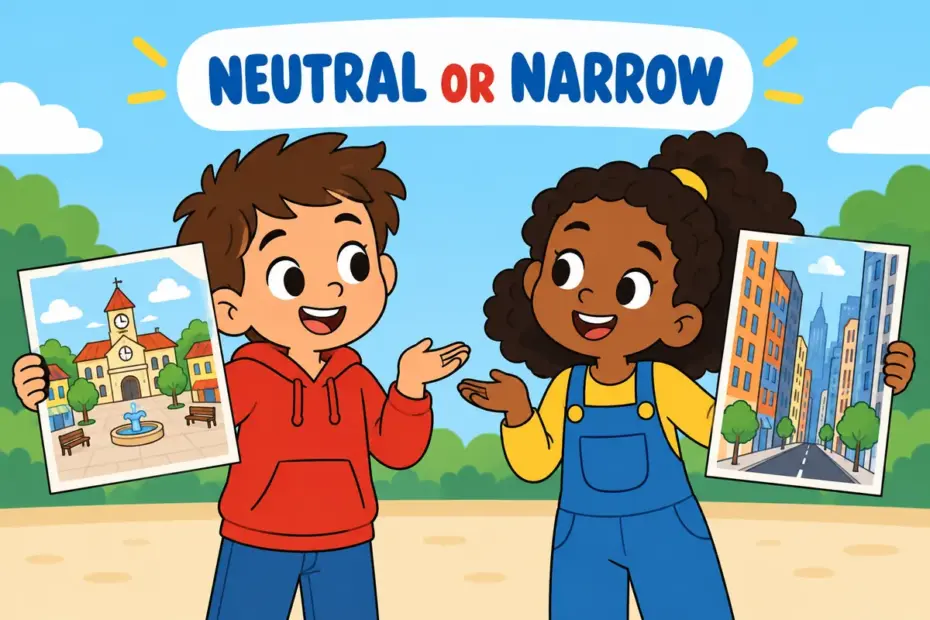
Provincial is an adjective meaning belonging to a province or, more critically, limited in outlook, and a noun for someone from outside the capital. To use provincial in a sentence, decide whether you mean the neutral place or the narrow attitude: a provincial capital is neutral, a provincial mind is not.
Provincial at a glance
- Provincial is an adjective and a noun; the adjective has a neutral geographic sense and a critical sense about narrow outlook.
- In the neutral sense it means belonging to a province or to the regions outside the capital.
- In the critical sense it means limited, unsophisticated or interested only in local matters.
- The noun a provincial names a person from outside the capital, often with a sneer.
- The commonest error is reading the place sense as an insult when the writer means it neutrally.
What does provincial mean?
Provincial is an adjective meaning belonging to a province or the regions outside a capital, and a noun meaning a person who comes from those regions. The Cambridge entry for provincial records both the geographic and the disapproving senses, and the split matters: one tells you where something is, the other tells you what a writer thinks of it. Where an insular outlook is meant, insular is even more pointed about being closed to outside ideas.
| Sense | Plain meaning | Example sentence |
|---|---|---|
| Adjective: geographic | Belonging to a province or region | She won a seat in the provincial assembly. |
| Adjective: critical | Narrow or unsophisticated in outlook | His provincial tastes amused the city critics. |
| Noun | A person from outside the capital | The capital press called them provincials. |
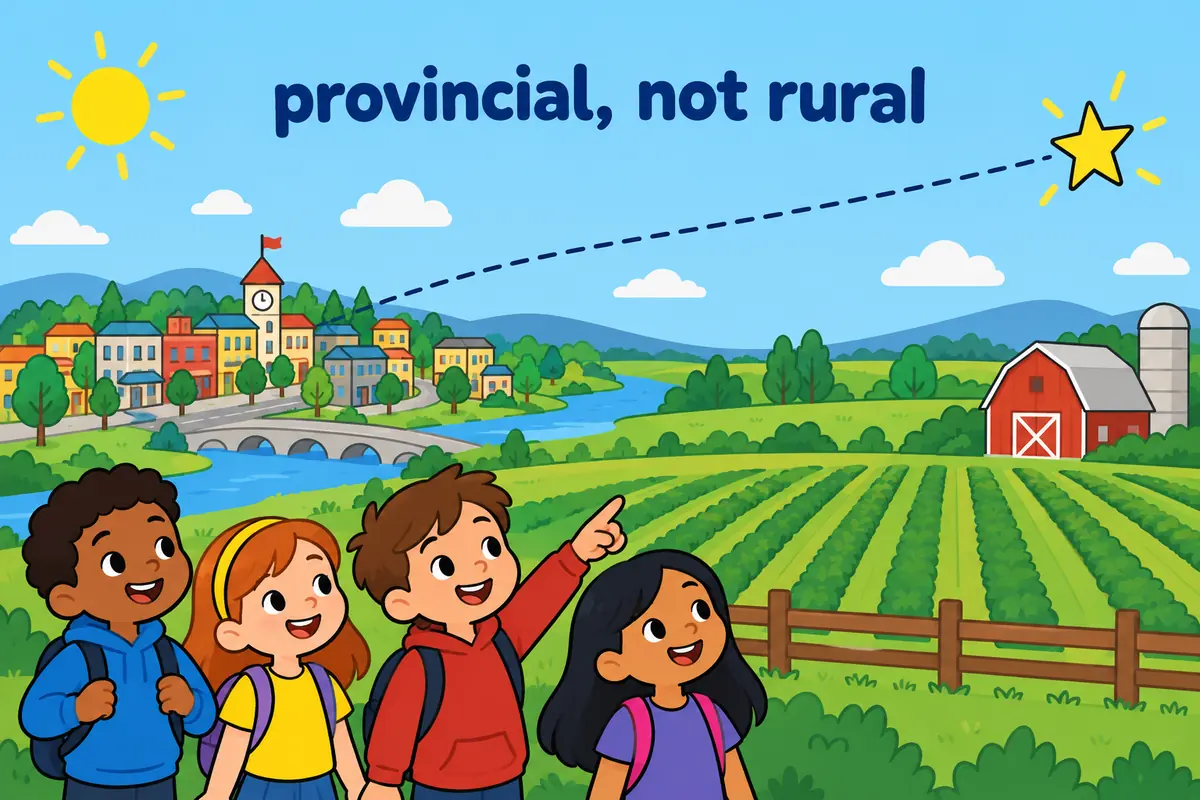
One limitation is worth stating. Provincial can insult, so a neutral writer reaches for regional instead. It is not a synonym for rural, because it measures distance from a centre rather than the presence of fields. And when it criticises a narrow-minded attitude, the sting comes from the writer, not from the word alone.
How do you use provincial in a sentence?
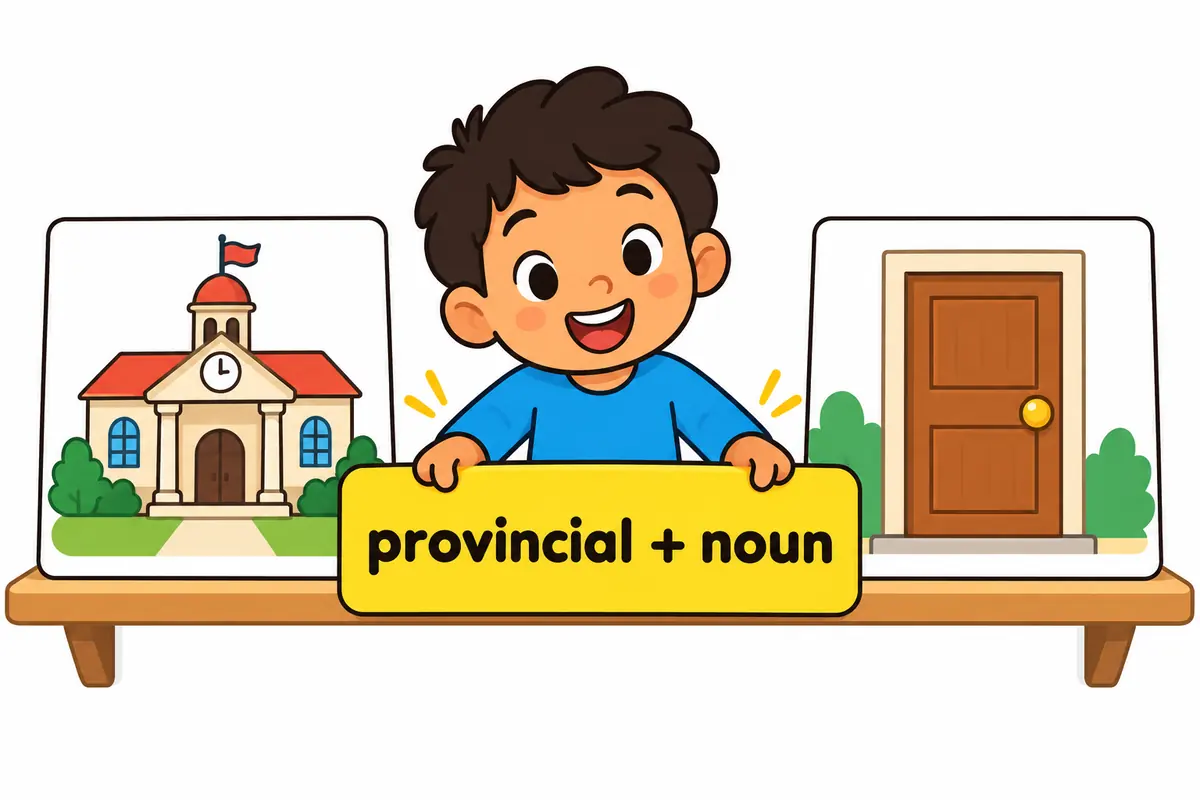
Provincial sits before a noun when it describes belonging to a region, as in a provincial capital or a provincial election, and it stands after linking verbs when it judges an outlook, as in the town felt provincial. The noun that follows is the strongest signal, because institutions and places read as neutral while tastes and attitudes read as criticism.
| Pattern | Example | What it signals |
|---|---|---|
| provincial + noun (place) | The provincial government set the tax. | Neutral; the noun is an institution or area. |
| provincial + noun (attitude) | A provincial outlook limited the plan. | Critical; the noun is an attitude or taste. |
| be/look/sound provincial | The cafe looked provincial but served excellent food. | The outlook sense in the predicate. |
| provincial in + noun | He was provincial in his reading. | Names the area where the outlook shows. |
| the provinces | Reporters rarely leave the provinces. | The plural noun means everywhere outside the capital. |
The plural noun the provinces means everywhere outside the capital, and it usually implies that the speaker is speaking from the centre. That is why a sentence about reporters rarely leaving the provinces quietly reveals where the writer stands.
Provincial in a sentence: examples across contexts
Provincial changes colour without changing shape. The nine sentences below move from a government report to a conversation, and each one shows whether the place sense or the outlook sense is at work. In travel writing, a rustic cafe can give a small town its charm without the least criticism.
| Context | Example sentence | Why this works |
|---|---|---|
| Government | The provincial assembly voted to fund the new bridge. | The neutral place sense in a formal setting. |
| News report | The storm closed provincial roads across the north. | Names a region without any judgement. |
| Travel writing | A rustic cafe gave the provincial town its quiet charm. | The place sense with a warm, descriptive tone. |
| Book review | The novel treats provincial life with affection rather than scorn. | Shows that the word need not sneer. |
| Criticism | The jury showed a provincial taste for loud colour. | The critical sense aimed at narrow style. |
| Conversation | He called my playlist provincial, and he was not wrong. | The word as a friendly jab in speech. |
| Academic prose | Provincial newspapers carried the story a day later. | Names regional papers neutrally. |
| History essay | The capital grew rich while provincial towns declined. | Contrasts the centre with the regions. |
| Diplomacy | Delegates complained that the agenda was too provincial. | Criticises a narrow, local focus in a formal register. |
The place sense dominates formal writing, while the outlook sense dominates reviews and opinion, which is the simplest way to predict how a reader will take the word.
Provincial vs parochial and rural
Provincial is confused with two words that both shrink a person or a place. parochial is the sharper criticism of narrow horizons, while rural simply means of the countryside.
| Attribute | provincial | parochial | rural |
|---|---|---|---|
| Core meaning | Of a province; or narrow in outlook | Narrowly local, often tied to a parish | Of the countryside |
| Main use | Neutral geography or a mild sneer | A sharper sneer about limited horizons | A neutral description of place |
| About place | Yes | Partly | Yes |
| About attitude | Yes, mildly | Yes, strongly | No |
| Register | Neutral to mildly critical | Critical | Neutral |
Verdict: use provincial for the regions seen from a capital, parochial when the narrowness is the point, and rural when the countryside is all you mean.
Word forms and grammar of provincial
Provincial is regular, and it shares its root with two common words. The table keeps the adjective, the adverb and the noun apart, and shows the root province that ties them together.
| Form | Part of speech | Example |
|---|---|---|
| provincial | adjective | The provincial court sat in the north. |
| provincial | noun | A provincial rarely moved to the capital. |
| provincially | adverb | The party was organised provincially. |
| provincialism | noun | Provincialism can mean local speech or narrowness. |
| province | noun, root | The province raised its own taxes. |
Two small points follow. The noun a provincial is countable, so provincials means people from the regions, and the abstract noun provincialism can mean either local loyalty or a narrow outlook.
Common mistakes with provincial
- Incorrect:
He lives in a provincial.Correct: He lives in a province. Rule: As a noun provincial means a person, not the place; use province for the area. - Incorrect:
The provincial of the region is large.Correct: The province of the region is large. Rule: Use the noun province when you mean the territory itself. - Incorrect:
Rural means narrow-minded.Correct: Rural means of the countryside. Rule: Rural is about place, while provincial can be about either place or outlook. - Incorrect:
Her provincially attitude annoyed them.Correct: Her provincial attitude annoyed them. Rule: Use the adjective before a noun; keep the adverb for verbs. - Incorrect:
The capital looked down on the provincial people.Correct: The capital looked down on the provincial towns. Rule: Provincial modifies places and things; for a person use the noun a provincial.
Practice using provincial
Work through the six items, then check the reasoning rather than only the answer.
- Fill the gap: The ______ government announced a new road across the north.
- Choose the better word: For a plain description of fields and farms, use (rural / provincial).
- Correct the error: She grew up in a quiet provincial.
- Build a sentence: use provincial outlook about someone who never reads news from elsewhere.
- Spot the register: which fits a book review — the novel treats provincial life warmly, or the novel is well provincial, innit?
- Rewrite without the sneer: His tastes are provincial. Use regional or a warmer phrase.
Answers
- provincial — the adjective modifies the noun government neutrally.
- rural — the sentence is about countryside, not distance from a capital.
- She grew up in a quiet province — provincial is not used for the place itself.
- Model answer: His provincial outlook meant he rarely trusted ideas from the capital.
- The novel treats provincial life warmly — a review keeps a measured, descriptive tone.
- His tastes are regional and rooted in his home town — a neutral phrase removes the insult.
The bottom line
Use provincial in a sentence to place something in the regions away from a capital, or to criticise a narrow outlook, and let the noun that follows show which you mean. The two facts that decide most sentences are that the place sense is neutral while the outlook sense is not, and that provincial is not a synonym for rural.
Frequently asked questions about provincial
Does provincial mean the same as rural?
No. Rural describes the countryside and its way of life, so a farm is rural. Provincial describes a place or people seen in relation to a capital, so a small regional city is provincial even if it is busy. A provincial town can be urban, and a rural village is not automatically provincial in the critical sense.
Is provincial an insult?
It can be. The geographic sense is neutral, as in a provincial assembly, but the outlook sense criticises someone as narrow and unsophisticated. Tone and the noun that follows decide, so provincial capital stays neutral while provincial tastes usually stings. A careful writer chooses regional when no criticism is meant.
What is the difference between province and provincial?
Province is the noun for the region itself, while provincial is the adjective that describes things belonging to it, and also a noun for a person from outside the capital. You live in a province, work for a provincial government, and are called a provincial by a sneering columnist.
Can provincial describe a person?
Yes, as the noun a provincial, meaning someone from outside the capital, and as the adjective before words like tastes or manners. The noun often carries a sneer, so it belongs in opinion writing rather than neutral reporting. When a person is meant, the adjective provincial needs a following noun such as resident or accent.
Do you struggle with understanding the difference between “provincial” and “local” when describing an area or a concept? In simple terms, a provincial adjective refers to something related to a province, while local usually pertains to a specific area or neighborhood. Let’s explore this distinction further to help clarify any confusion you may have.
When using the term “provincial,” think of a broader geographical context such as a province within a country. On the other hand, “local” tends to focus on a more defined or smaller area like a town, city, or neighborhood. Understanding the nuances between these two terms can enhance your communication skills and ensure you convey your message accurately in various contexts.
7 Examples Of Provincial Used In a Sentence For Kids
- The provincial fair had fun games and delicious food.
- My aunt lives in a small provincial town.
- The provincial flags were displayed proudly during the parade.
- Our school is hosting a provincial art competition next month.
- I saw a beautiful provincial garden with colorful flowers.
- The provincial museum has interesting exhibits about the local history.
- In the provincial market, you can find fresh fruits and vegetables.
14 Sentences with Provincial Examples
- Provincial attitudes often hinder students from experiencing diverse cultures and perspectives.
- Many college students tend to stick to their provincial hometown traditions when they first move to a new city for studies.
- It is important for students to expand their horizons beyond their provincial backgrounds to thrive in a diverse academic environment.
- Some students find it challenging to adapt to a new lifestyle due to their provincial upbringing.
- Embracing new ideas and customs can help students break away from their provincial mindset.
- Exposing oneself to different ideologies can help in broadening a provincial student’s perspective.
- Overcoming provincial beliefs can be a significant step towards personal growth and development.
- Interacting with students from various backgrounds can help in breaking down provincial stereotypes.
- Traveling to different regions of the country can allow students to experience cultures beyond their provincial bubble.
- Engaging in volunteer work can help students empathize with individuals from diverse provincial backgrounds.
- Attending workshops and seminars can offer a platform for students to challenge their provincial viewpoints.
- Engaging in debates and discussions can help students critically analyze their provincial biases.
- Participating in cultural exchange programs can be a transformative experience for provincial students.
- Learning a new language can open doors for provincial students to communicate with individuals from different parts of the world.
How To Use Provincial in Sentences?
To use the word Provincial in a sentence, you can incorporate it to refer to something relating to a province or a local region. For example, “The small town’s charm and simplicity had a provincial feel that was different from the bustling city life.” In this sentence, Provincial is used to describe the quaint and localized atmosphere of the town.
Another way to use Provincial in a sentence is to describe someone or something as having narrow-minded or conservative views due to being from a rural area. For instance, “His provincial upbringing limited his exposure to diverse perspectives.” Here, Provincial is used to suggest that the individual’s upbringing in a small town hindered his ability to engage with different ideas.
You can also use Provincial in a sentence when talking about laws, regulations, or policies that pertain to a specific province within a country. For instance, “The new provincial legislation aims to improve environmental sustainability in the region.” In this context, Provincial is used to indicate that the legislation is applicable only to a particular province within the country.
By including Provincial in your sentences in these various contexts, you can effectively convey different meanings and nuances associated with the word.
Conclusion
In conclusion, sentences with the word “provincial” often refer to ideas, attitudes, or customs that are local, traditional, or narrow in scope. When describing someone or something as provincial, it implies a lack of sophistication, openness, or awareness of the wider world. For example, a sentence like “Her provincial mindset limits her ability to see beyond her small town” highlights a mindset that is insular and unenlightened.
Overall, sentences with “provincial” serve to underscore the idea of being restricted to or characteristic of a particular region or locality, often suggesting a lack of cosmopolitanism or global perspective. By recognizing and understanding the implications of using this term in various contexts, one can better grasp the nuances and connotations associated with provincialism.


