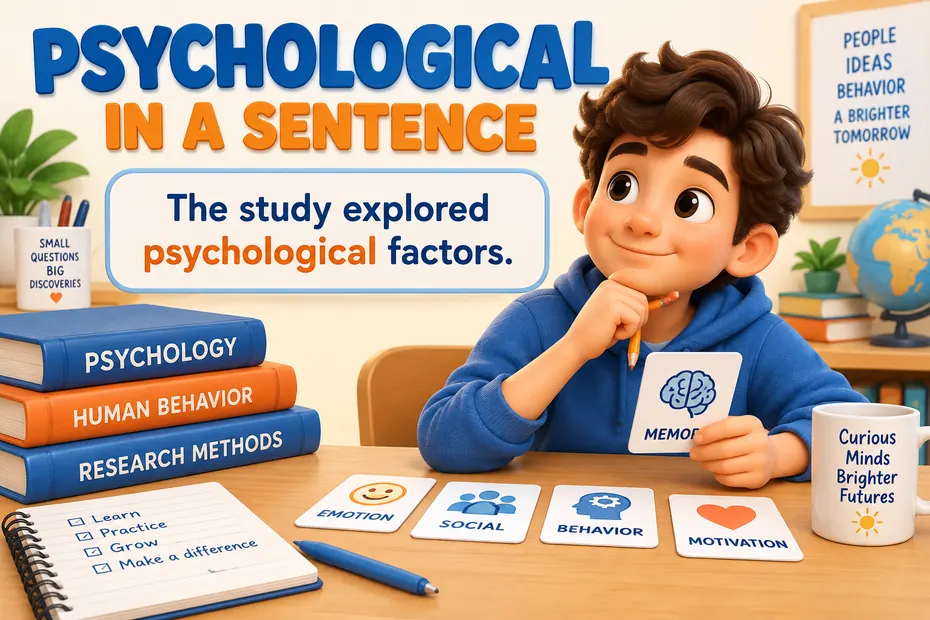
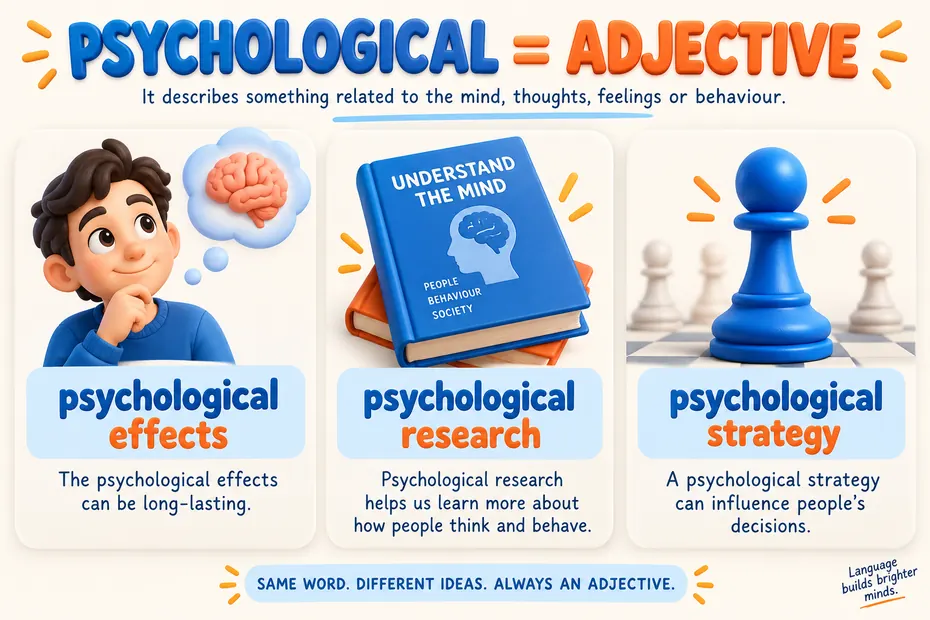
Psychological in a sentence: “The study explored psychological factors that influence memory.” Psychological is an adjective relating to the mind, mental processes, or the study of psychology. Use it to describe a noun, such as effects, research, pressure, or support; use psychologically when an adverb is needed.
- Psychological describes a noun or follows a linking verb.
- Psychologically is the related adverb.
- Psychology names the field; psychologist names a practitioner or researcher.
- The initial p is silent in ordinary English pronunciation.
- The word does not automatically mean illness, imaginary, or unimportant.
How do you use psychological in a sentence?
Place psychological before the noun it describes: “The team studied psychological effects.” You can also put it after a linking verb: “The barrier was psychological.” In the second sentence, the adjective still describes the noun barrier; it does not describe the action of being.
Merriam-Webster’s psychological entry covers meanings connected with psychology, the mind, and attempts to influence motivation or behavior. Choose the meaning from context rather than assuming that every sentence concerns therapy. A psychological thriller, a memory experiment, and psychological pressure all use the same adjective in different settings.
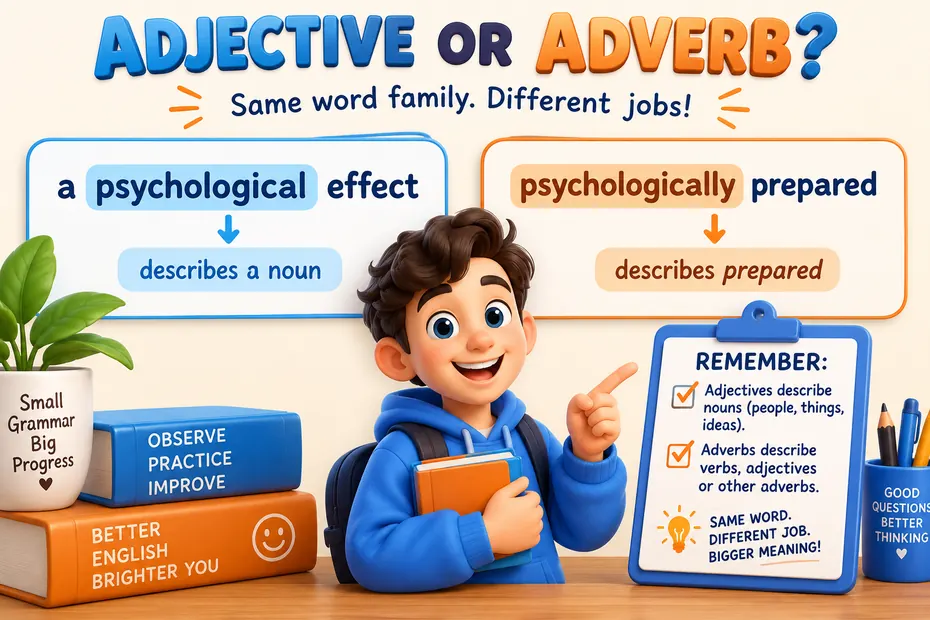
| Form | Job | Original example |
|---|---|---|
| Psychological | Adjective | The novel explores psychological conflict. |
| Psychologically | Adverb | She felt psychologically prepared. |
| Psychology | Noun: field | He studies psychology. |
| Psychologist | Noun: person | The psychologist explained the task. |
Do not write “She felt psychological prepared.” The word prepared needs the adverb psychologically in that construction. Conversely, “a psychologically effect” is incorrect: use the adjective in “a psychological effect.” Checking the word immediately after the target term often reveals which form belongs there.
Psychological sentence examples with clear contexts
These examples show research, everyday communication, fiction, and sport. They are language models, not findings about a particular study or person.
- The class discussed psychological factors in decision-making.
- The experiment examined psychological responses to uncertainty.
- Her essay compared physical and psychological challenges.
- The coach described the psychological pressure of the final match.
- The detective novel focuses on psychological suspense.
- The interviewer asked about the psychological demands of the job.
- The researcher recorded psychological measures alongside reaction times.
- We discussed the character’s psychological conflict after reading the chapter.
- The report distinguished psychological explanations from financial explanations.
- Although the task looked simple, the participants described a psychological barrier.
For younger learners, use a concrete explanation alongside the longer word: “The lesson explored psychological questions, such as how people remember names.” That example introduces the idea without equating psychology solely with feeling happy or calm. A sentence can concern attention, learning, expectations, or choices as well as emotions.
What is the difference from physiological?
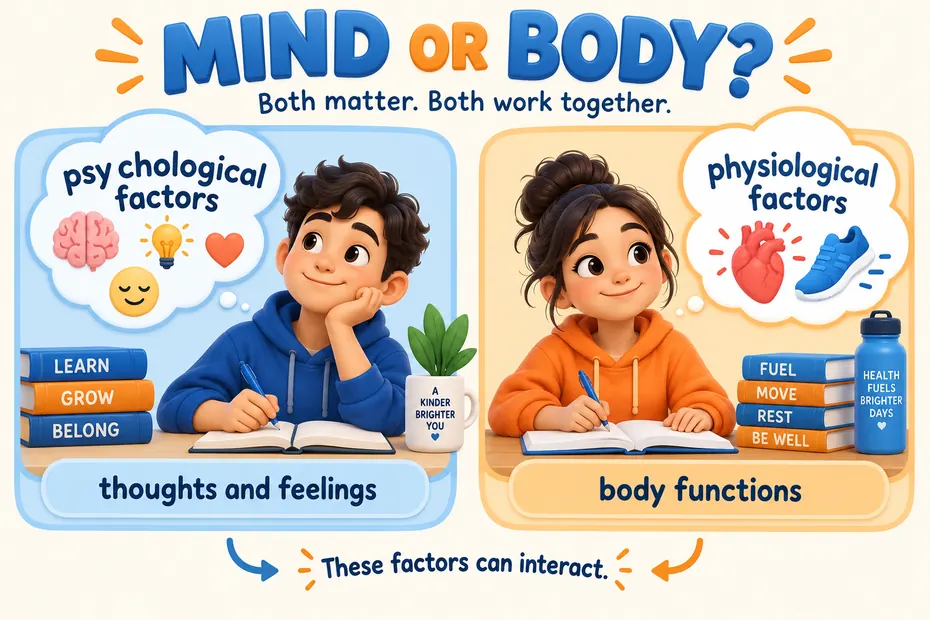
Psychological concerns the mind or psychology; physiological concerns bodily functions. Merriam-Webster’s physiological entry connects that adjective with physiology and the functioning of an organism. The spelling difference is easy to miss, but the meanings are distinct.
Compare “The study recorded physiological changes in heart rate” with “The study examined psychological reactions to the task.” The first sentence names a bodily measure; the second names a mental or behavioral focus. Both kinds of factor can occur in the same situation, so the distinction does not imply that mind and body never interact.
Which vague or misleading uses should you revise?
Some older examples below use broad expressions such as “psychological foundation” or “psychological habits.” Those phrases can be grammatical, but a reader may not know what they mean. Name the relevant idea: “Students practiced a revision routine” is more concrete than “Students developed good psychological habits.”
Avoid using psychological as a label for a person: “She is psychological” does not clearly express an ordinary meaning. Write what you actually intend, such as “She studies psychology” or “She is interested in psychological research.” Do not infer a diagnosis from a vocabulary example or describe someone’s experience as unreal simply because it is psychological.
Claims such as “psychological studies have shown” also need a named study and a precise finding in factual writing. For a grammar exercise, “The class reviewed a psychological study” demonstrates the adjective without inventing evidence. Use the original examples for vocabulary practice, and keep factual claims separate from sample sentences.
Frequently asked questions
Can psychological start a sentence?
Yes. “Psychological research explores how people think and behave” begins with an adjective modifying the noun research. The full noun phrase is the subject. Starting with the adjective does not turn it into a noun; the word it describes still supplies the subject’s central meaning.
Is a psychological or an psychological correct?
Write a psychological before a suitable noun, as in “a psychological explanation.” Although the spelling begins with p, the spoken word begins with an s sound, which is a consonant sound. Write “an unusual psychological explanation” when unusual comes immediately after the article.
Does psychological always mean negative?
No. “Psychological research” is neutral, while “psychological resilience” can describe an ability to cope with difficulty. The surrounding noun determines much of the tone. “Psychological pressure” suggests a challenge, but that does not make the adjective itself an inherently negative word.
How do you spell the adverb?
Write psychologically, retaining the adjective’s base before the ending. In “The players were psychologically ready,” the adverb modifies ready. In “The players faced psychological pressure,” the adjective modifies pressure. Comparing these two complete sentences makes the difference easier to remember.

Have you ever wondered about the impact of psychological factors on our everyday lives? Psychological pertains to the mind and how it influences behavior, emotions, and thoughts. It deals with mental processes such as perception, cognition, and motivation.
Understanding psychological principles can help us comprehend human behavior and relationships better. This field of study dives deep into factors like personality, memory, and learning, shedding light on why we do the things we do.
7 Examples Of Psychological Used In a Sentence For Kids
- Understanding our feelings and thoughts is part of psychological growth.
- Psychological well-being includes being happy and calm.
- Talking to someone can help us with our psychological problems.
- Learning new things can help our psychological development.
- It’s important to take care of our psychological health, just like our physical health.
- Psychological assessments can help us understand our strengths and weaknesses.
- Expressing our feelings is important for our psychological health.
14 Sentences with Psychological Examples
- Psychological well-being should be a priority for college students in India.
- Understanding psychological concepts can help students manage stress effectively.
- College life can have a significant impact on students’ psychological development.
- Building a strong psychological foundation is essential for academic success.
- Seeking psychological support when needed is a sign of strength, not weakness.
- Engaging in psychological self-care activities can improve overall well-being.
- Being aware of the psychological challenges of transitioning to college can help students prepare better.
- It is important for college students to prioritize their psychological health along with their academic goals.
- Developing good psychological habits early on can set students up for success in the long run.
- Understanding psychological principles can enhance interpersonal relationships among college students.
- It’s important for college students to address any psychological issues they may be facing in a timely manner.
- Practicing mindfulness can have a positive impact on students’ psychological well-being.
- Being part of a supportive psychological counseling program can benefit college students greatly.
- Engaging in psychological research projects can help students deepen their understanding of human behavior.
How To Use Psychological in Sentences?
Psychological is an adjective that relates to the mind and mental processes of an individual. When using the word “psychological” in a sentence, it is important to consider its context and meaning in relation to mental health, emotions, and behavior.
Here’s a helpful guide on how to use psychological in a sentence:
-
Psychological assessments are frequently used by therapists to better understand their patients’ mental health.
-
The impact of childhood experiences can have long-lasting psychological effects on an individual’s well-being.
-
Stressful situations can lead to various psychological symptoms such as anxiety and depression.
-
The study of dreams falls within the realm of psychological research and analysis.
-
PTSD is a psychological disorder that can develop after experiencing a traumatic event.
-
Some people find psychological therapy to be beneficial in managing their emotions and improving their mental health.
-
Psychological studies have shown that social support plays a crucial role in mental well-being.
-
The field of psychological research continues to evolve, with new findings shedding light on the complexities of the human mind.
By following these examples, you can effectively incorporate the word psychological in your sentences to accurately convey concepts related to mental processes and behaviors.
Conclusion
In conclusion, the examples of sentences with psychological concepts illustrate the broad range of factors that influence human behavior and mental processes. These sentences touch on emotions, behavior, and cognitive processes, shedding light on how individuals perceive and interact with the world around them through a psychological lens. The varied examples demonstrate the complexity and depth of the field of psychology in understanding human thought and behavior, showcasing its relevance in everyday life and decision-making.
By exploring these sentences with psychological themes, we gain insight into the intricate workings of the mind and the role it plays in shaping our experiences and reactions. From analyzing motivations and emotions to studying memory and learning processes, the field of psychology offers valuable perspectives on human nature that can deepen our understanding of ourselves and others.