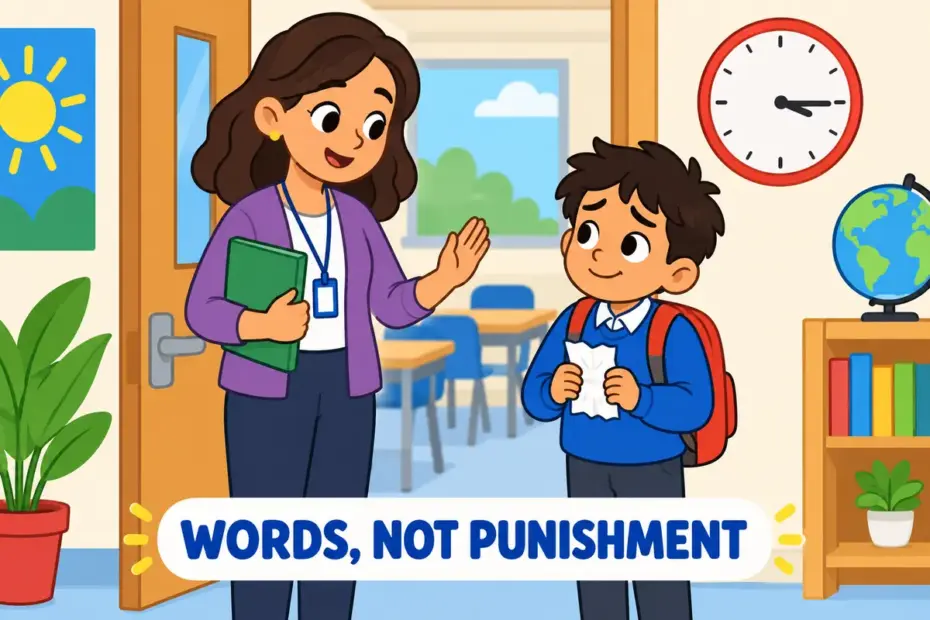
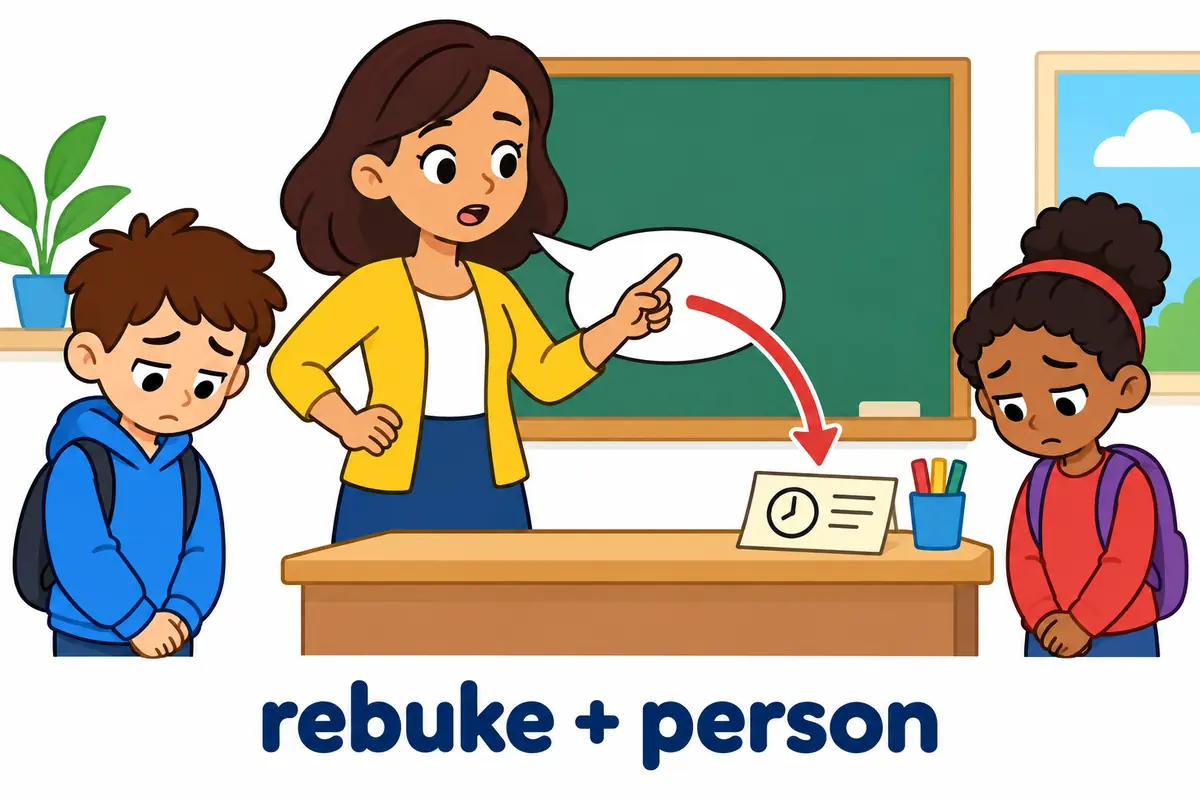
Rebuke means to tell someone sharply that their behaviour is wrong. To use rebuke in a sentence, name the person and the fault: “The coach rebuked the players for arriving late.” The verb takes a person as its object and often adds for before the reason, and the same word also works as a noun.
Rebuke at a glance
- Rebuke is a verb and a noun meaning a sharp expression of disapproval.
- The usual pattern is rebuke + person + for + fault.
- Its tone is formal or literary rather than casual.
- The noun appears in phrases such as a sharp rebuke and a public rebuke.
- The commonest error is confusing rebuke with rebuff, which means a blunt refusal.
What does rebuke mean?
Rebuke is a verb meaning to speak sharply to someone about their behaviour, and it is also a noun for that act. The Cambridge entry for rebuke records both uses. The verb names spoken correction; it does not describe punishment or a private change of mind.
| Sense | Plain meaning | Example sentence |
|---|---|---|
| Verb | Tell someone off sharply | The judge rebuked the lawyer for stalling. |
| Noun | A sharp spoken criticism | His remarks drew a rebuke from the chair. |
| Figurative | A warning aimed at a group or habit | The report is a rebuke to complacency. |
One limitation is worth stating. Rebuke is about words, not penalties, and it usually implies a person with some authority. A manager rebukes a junior; a fine or a suspension is a punishment, not a rebuke.
How do you use rebuke in a sentence?
Put the person straight after the verb and the reason after for. The five patterns below carry the verb and the noun through formal and everyday writing.
| Pattern | Example | What it signals |
|---|---|---|
| rebuke + person + for + noun or gerund | She rebuked him for shouting. | Names both the person and the fault. |
| rebuke + person | The captain rebuked the team. | The fault is left understood. |
| be rebuked by | He was rebuked by the committee. | Passive voice, common in reports. |
| a + adjective + rebuke | The minister faced a sharp rebuke. | Noun use in a formal register. |
| rebuke + somebody’s + noun | The chair rebuked the member’s language. | Criticises the act, not the whole person. |
Where the speaker is gentler, admonish fits a mild warning, and reprimand is the formal word for an official telling-off.
Rebuke in a sentence: examples across contexts
Rebuke shifts register easily, which is why it appears in courts, classrooms and newspapers. The nine sentences below keep the same word while changing the setting.
| Context | Example sentence | Why this works |
|---|---|---|
| Classroom | The teacher rebuked the class for talking during the test. | Names the person and the fault with for. |
| Workplace email | The memo rebukes staff for ignoring the new safety rules. | Uses the present tense for a written warning. |
| News report | The regulator was rebuked for missing the warning signs. | Passive use keeps the focus on the body criticised. |
| Legal writing | The judge rebuked counsel for repeated interruptions. | Formal register suits a courtroom. |
| Sports writing | The captain rebuked his players for a careless start. | Authority and fault are both clear. |
| History essay | The king’s rebuke silenced the court for a season. | Uses the noun in a literary register. |
| Conversation | She rebuked me for being late, and she was right. | The first person is fine in speech. |
| Editorial | The report is a rebuke to years of delay. | Figurative noun aimed at a practice. |
| Academic prose | Reviewers rebuked the authors for overstating the data. | Names the reviewers as the source of criticism. |
Only two sentences use the noun, and both keep a formal subject. The verb dominates ordinary writing because it names exactly who spoke and why.
Rebuke vs rebuff
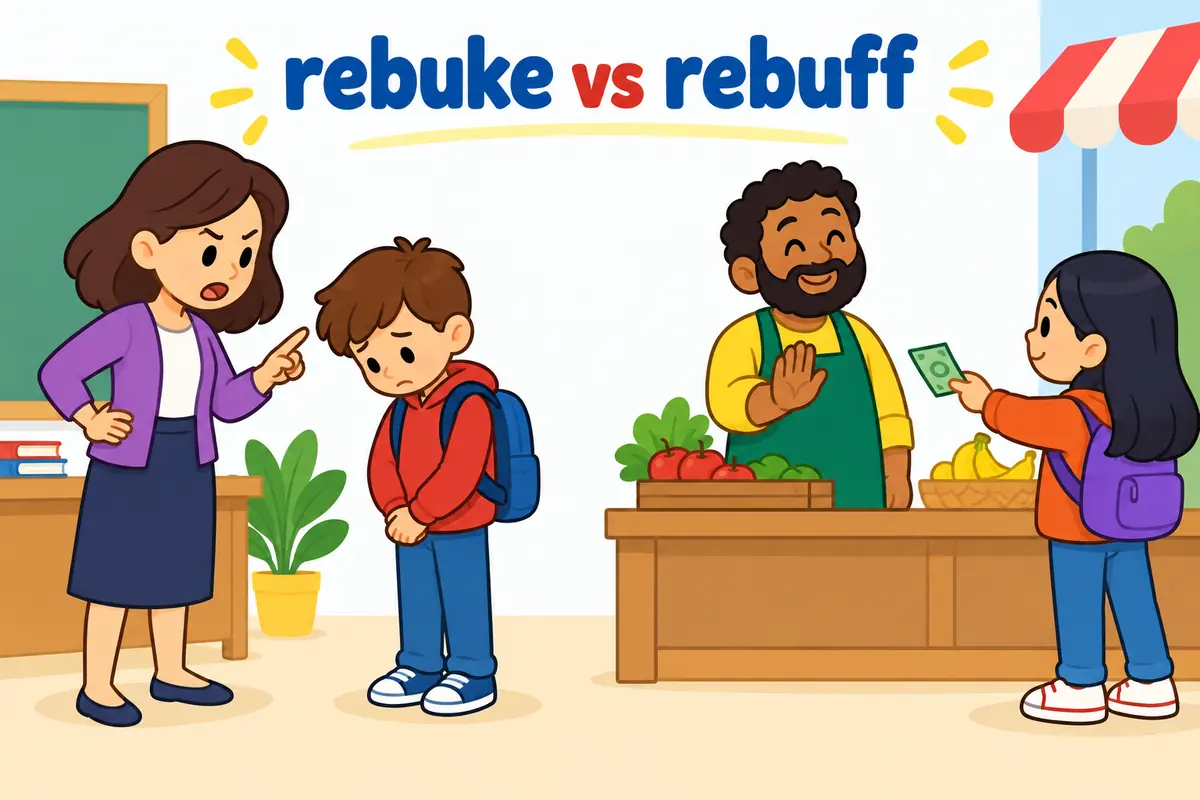
Rebuke and rebuff differ by two letters and by one whole action. Rebuke is spoken correction; rebuff is a blunt refusal of an offer, a request or an approach. A teacher rebukes a late pupil, while a company rebuffs a takeover bid.
| Attribute | rebuke | rebuff |
|---|---|---|
| Core job | Correct behaviour in words | Refuse an offer or advance |
| Typical object | A person or a fault | An offer, a request or a person |
| Register | Formal and literary | Formal and journalistic |
| What follows | Reproach or reprimand | Rejection or silence |
| Example | She rebuked the clerk for rudeness. | She rebuffed the reporter’s question. |
Verdict: choose rebuke when someone is corrected in words, and rebuff when an offer or approach is turned away.
Word forms and grammar of rebuke
Rebuke inflects regularly and, unusually, the same spelling serves as both verb and noun. The table sets out the forms.
| Form | Part of speech | Example |
|---|---|---|
| rebuke | verb, base form | I will rebuke him firmly. |
| rebukes | verb, third person singular | The chair rebukes latecomers. |
| rebuked | verb, past and past participle | The referee was rebuked for the error. |
| rebuking | verb, present participle | She was rebuking the noisy crowd. |
| rebuke | noun | The rebuke was deserved. |
The noun is countable, so it needs an article: a rebuke, the rebuke, or a sharp rebuke. The near-twin rebuff is a separate word with a different meaning. A formal body records its criticism as censure, and everyday speech prefers scold.
Common mistakes with rebuke
- Incorrect:
The manager rebuffed the staff for lateness.Correct: The manager rebuked the staff for lateness. Rule: Rebuff means refuse; rebuke means correct. - Incorrect:
She rebuked at the noise.Correct: She rebuked the noisy students. Rule: Rebuke is transitive and needs a person as its object. - Incorrect:
He rebuked the mistake.Correct: He rebuked the clerk for the mistake. Rule: The object is the person, and for introduces the fault. - Incorrect:
The teacher rebuked him a detention.Correct: The teacher gave him a detention. Rule: A rebuke is a spoken correction, not a penalty such as detention. - Incorrect:
The rebuke was given to the new rule.Correct: The rebuke was given to the new clerk. Rule: A rebuke lands on a person, not on a rule or an object.
Practice using rebuke
Work through the six items, then check the reasoning rather than only the key.
- Fill the gap: The referee ______ the player for diving.
- Choose the better word: The firm (rebuked / rebuffed) the takeover offer.
- Correct the error: The chair rebuked at the late arrivals.
- Build a sentence: use be rebuked by about a careless driver.
- Spot the register: which fits a news report — the minister faced a sharp rebuke, or the minister got told off big time?
- Rewrite with the noun: The judge rebuked the lawyer. Use rebuke as a noun.
Answers
- rebuked — the referee corrects the player, so for introduces the fault.
- rebuffed — the firm refused an offer, which is rebuff.
- The chair rebuked the late arrivals — the verb needs a person as its object.
- Model answer: The driver was rebuked by the instructor for ignoring the signal.
- The minister faced a sharp rebuke — a report keeps the formal noun.
- The judge delivered a sharp rebuke to the lawyer — the noun is countable and takes an article.
The bottom line
Use rebuke in a sentence when someone in authority corrects another person aloud, and put the person after the verb and for before the fault. Two points decide the trickier cases: a rebuke is a matter of words rather than punishment, and the near-twin rebuff means refusal, not correction.
Frequently asked questions about rebuke
Is rebuke a formal word?
Rebuke is formal and literary, at home in news reports, court writing and serious fiction. In everyday speech people usually say tell off or scold, which are plainer and less weighty. A friend telling you off sounds casual, while a committee rebuking an official sounds official.
Can rebuke be a noun?
Yes. Rebuke works as a countable noun, so it takes an article, as in a sharp rebuke or the rebuke was deserved. The verb and the noun share the same spelling, which is why the pattern a rebuke to complacency can name a whole public warning rather than a private telling-off.
What is the difference between rebuke and reprimand?
Both mean to correct someone sharply, but reprimand is the more official term, often used for a formal notice in a workplace or the armed forces. Rebuke is broader and more literary, and it can describe a single sharp remark as well as a formal censure.
Does rebuke mean punish?
No. Rebuke names spoken disapproval, not a penalty. A person can be rebuked and receive no punishment at all, and a punishment such as a fine or detention is not a rebuke. The word centres on the words used to correct someone, not on the consequence.
Have you ever wanted to express disapproval or criticism towards someone or something in a clear and direct manner? This act of rebuking, which involves reprimanding or scolding, can be a powerful tool in asserting boundaries or conveying displeasure.
A rebuke can be delivered in various forms, whether it’s through words, actions, or simply non-verbal expressions. It serves as a way to address wrongdoing, correct behavior, or simply express disappointment.
7 Examples Of Rebuke Used In a Sentence For Kids
- Do not shout in the classroom, the teacher will rebuke you.
- Remember to raise your hand before speaking, or you may receive a rebuke.
- Do not run in the hallway, the teacher will rebuke you for that.
- Always listen to your elders and don’t make them rebuke you.
- Use gentle words when talking to others to avoid a rebuke from the teacher.
- Follow the rules to avoid any rebuke from the teacher.
- Be kind and helpful to your friends, you won’t receive any rebuke that way.
14 Sentences with Rebuke Examples
- Rebuke your friend if they constantly interrupt you during group discussions.
- Don’t be afraid to rebuke a classmate who copies your assignments.
- It is important to rebuke any form of discrimination or prejudice in the classroom.
- If someone is talking loudly on their phone in the library, feel free to rebuke them politely.
- As a group leader, you may need to rebuke members who are not pulling their weight in group projects.
- It is not acceptable to rebuke a professor in front of the whole class.
- When faced with a disrespectful comment, it is appropriate to rebuke it assertively.
- If a roommate is continually breaking house rules, it may be necessary to rebuke them.
- As a college student, it is important to rebuke any form of academic dishonesty.
- In group presentations, it is crucial to rebuke any member who is not contributing equally.
- Remember to rebuke any form of offensive language or behavior in social settings.
- Rebuke those who try to take advantage of your kindness or generosity.
- It is necessary to rebuke any peer pressure that may lead you astray from your goals.
- If a friend is spreading rumors about you, don’t hesitate to rebuke them and set the record straight.
How To Use Rebuke in Sentences?
To use “Rebuke” in a sentence, you can follow these steps:
-
Understand the meaning: Rebuke means to express sharp disapproval or criticism towards someone because of their actions or behavior.
-
Choose the context: Think of a situation where you want to express your disapproval or criticize someone politely yet firmly.
-
Construct the sentence: Start your sentence with the person you are addressing followed by the bolded word Rebuke. For example, “I had to rebuke my coworker for constantly coming in late to work.”
-
Provide reason: To make your sentence more impactful, you can add a brief explanation of why you are rebuking that person. For instance, “The manager had to rebuke the team for not meeting the project deadline.”
-
Practice using it: Try using rebuke in different sentences to get more comfortable with incorporating it in your daily conversations.
-
Be respectful: While rebuking someone, it’s important to maintain a respectful tone and focus on their behavior rather than attacking their character.
Remember, using rebuke in a sentence can help you communicate your disapproval effectively while promoting constructive dialogue.
Conclusion
In conclusion, the use of sentences with “rebuke” demonstrates a strong and direct way to express disapproval or criticism towards someone’s actions or behavior. These sentences often convey a sense of sternness and authority, aiming to admonish or reprimand the individual for their perceived wrongdoings. By employing sentences with “rebuke,” one can assertively communicate their displeasure and set clear boundaries, effectively highlighting the need for correction or change in behavior.
Whether in personal relationships, professional settings, or public discourse, sentences with “rebuke” serve as powerful tools for holding others accountable and emphasizing the importance of ethical conduct. Through clear, assertive language, individuals can effectively address breaches of conduct and uphold standards of morality and respect. Ultimately, sentences with “rebuke” play a crucial role in maintaining accountability and fostering a culture of integrity and accountability in various aspects of life.