Recipient Meaning and a Quick Example
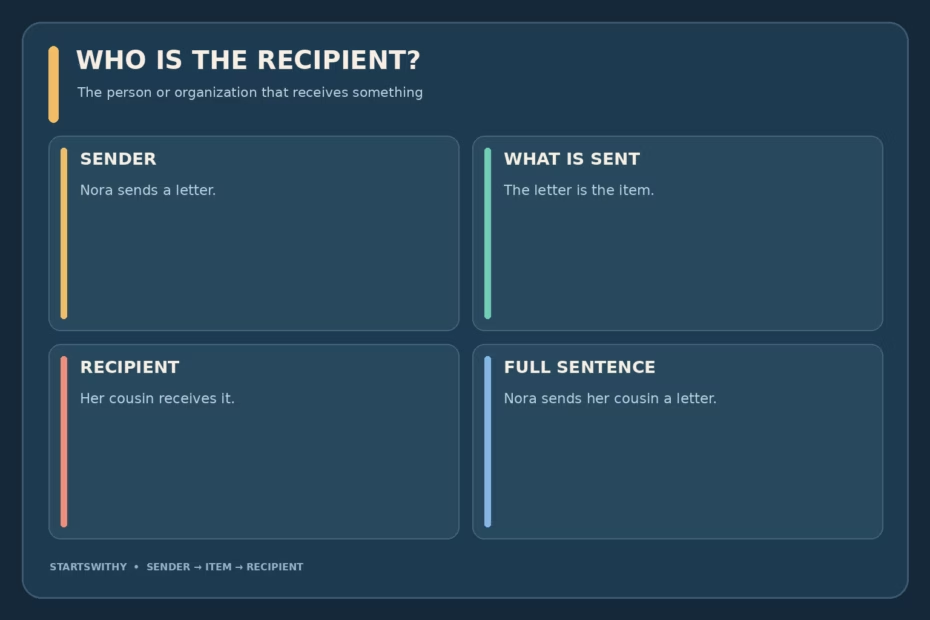
A recipient is a person, group, or organization that receives—or is intended to receive—something. In Rina sent the library a donation, the library is the recipient and the donation is what it receives. A recipient can receive a physical item, money, information, an award, or another transfer. The word is a countable noun: a recipient, the recipient, or several recipients.
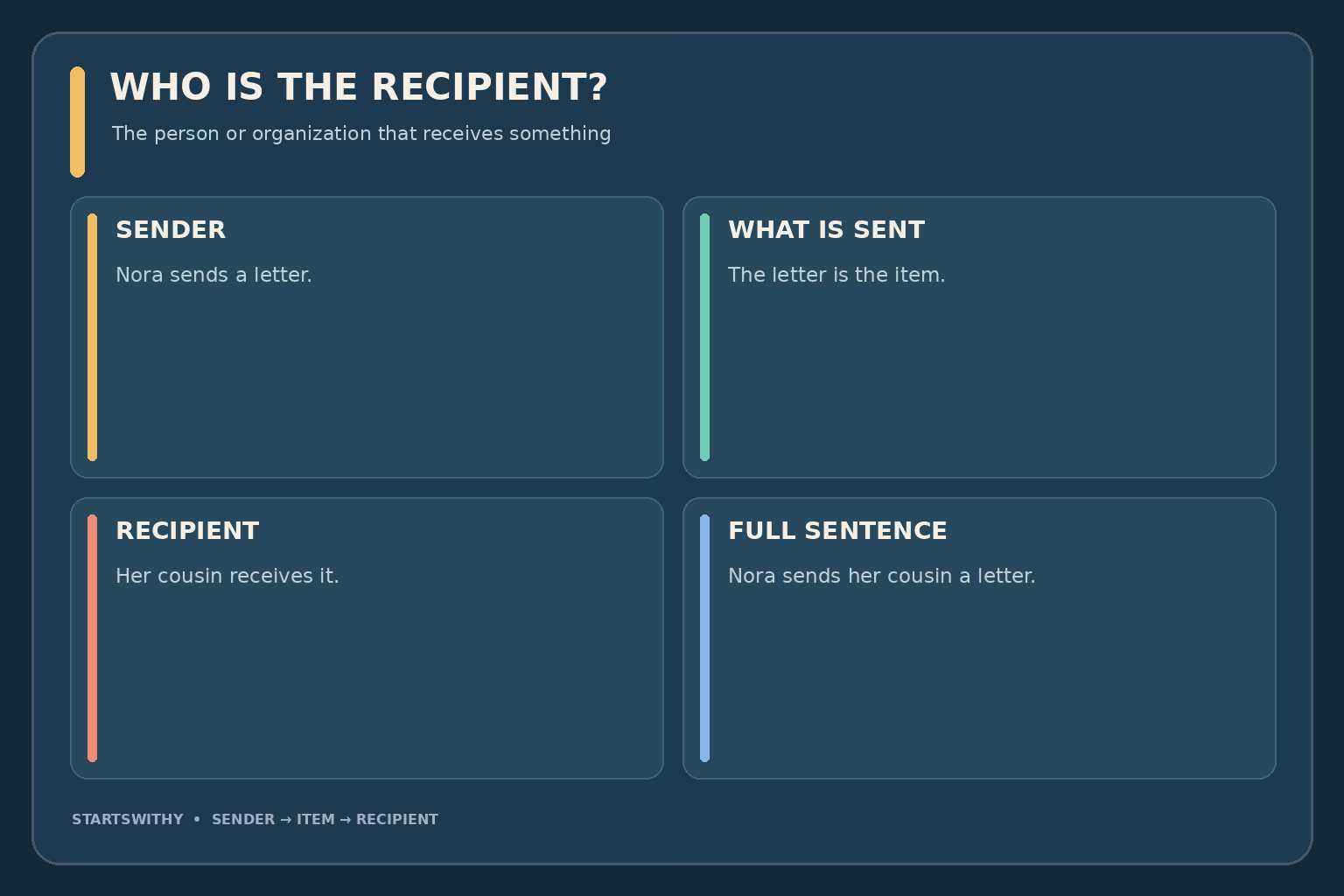
Quick answer: use recipient for the person or organization on the receiving end. For example, “The recipient of the scholarship thanked the committee.” The scholarship is the thing received; the recipient is the person receiving it.
How to Put “Recipient” in a Sentence
The noun often appears in one of two clear patterns: recipient + of + thing, or thing + to + recipient. It can also follow a form of be when you identify who received something. These examples show the role of each phrase.
- Recipient of something: “The recipient of the award gave a short speech.”
- Something to the recipient: “Mina mailed the signed form to the recipient.”
- Recipient as subject: “Each recipient received a confirmation email.”
- Organization as recipient: “The neighborhood clinic was the recipient of a community grant.”
- Intended recipient: “Check the address before sending the parcel to its intended recipient.”
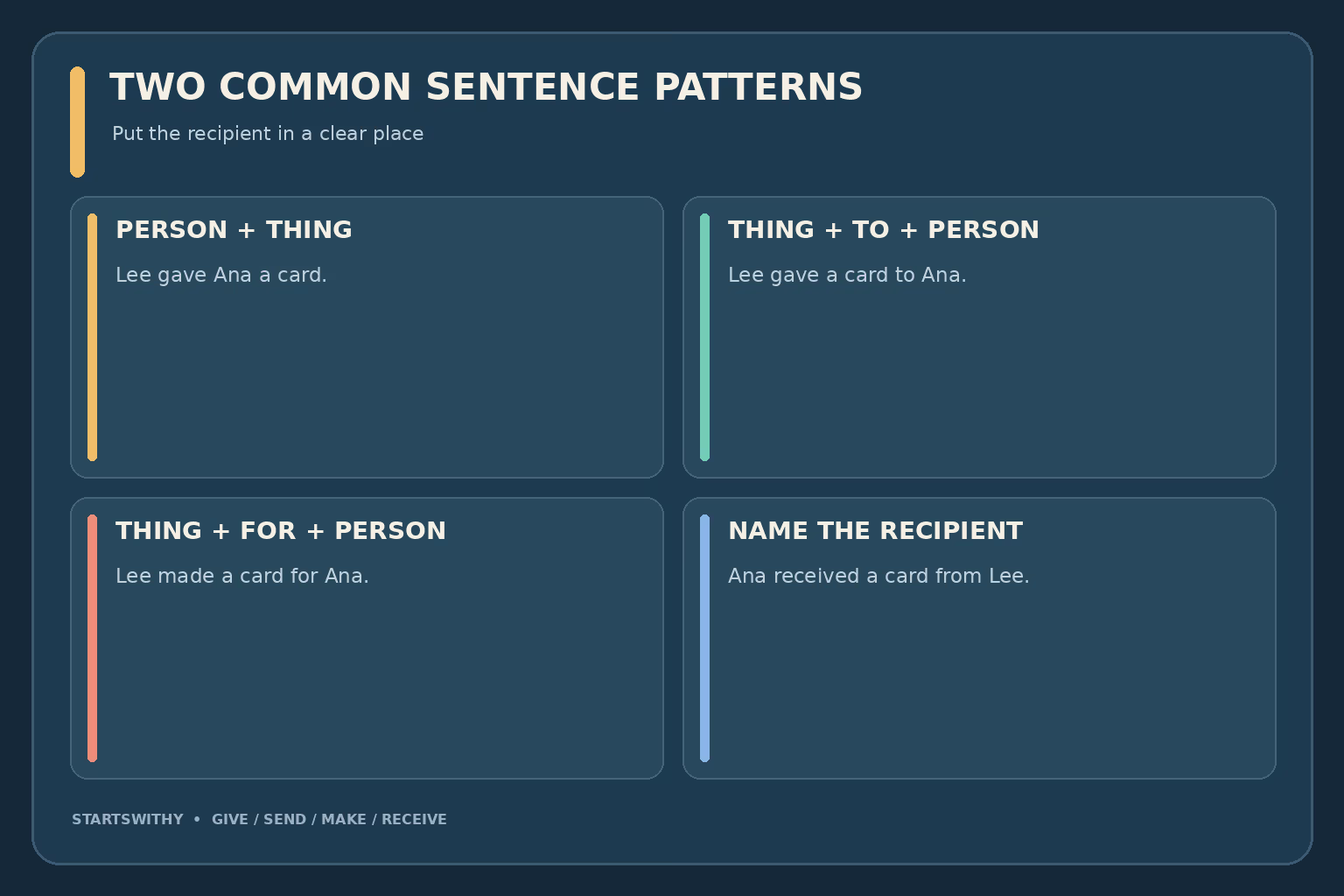
With verbs such as give, send, and show, English often allows both verb + person + thing and verb + thing + to + person: “The coach gave Omar a certificate” and “The coach gave a certificate to Omar.” Both make Omar the recipient. The second pattern is useful when the item comes first or when the recipient needs emphasis. Cambridge’s grammar guide describes this alternation for verbs that take two objects.
“Recipient of” Examples
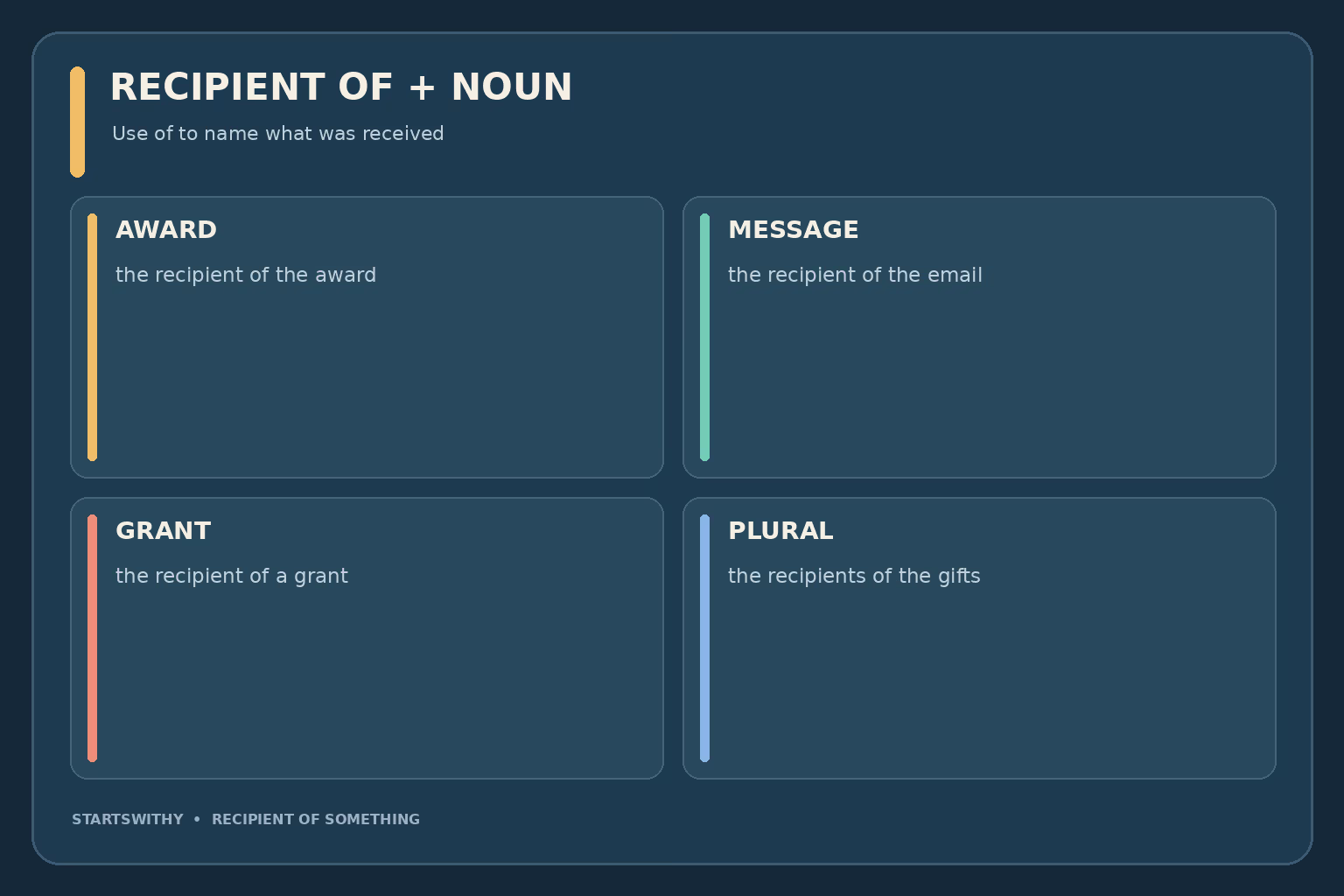
Use of after recipient to name what was received. The noun after of is the item, message, or benefit—not the person receiving it.
- “She was the recipient of a regional science prize.”
- “The recipient of the email replied before noon.”
- “The nonprofit became a recipient of emergency funding.”
- “Every recipient of the invitation must confirm attendance.”
Recipient, Sender, Receiver, and Attendee
Choose the noun that names the role you mean. A sender sends something; a recipient receives it. Receiver can also mean someone or something that receives a signal or transmission, while recipient is especially common for people or organizations in letters, gifts, grants, awards, and official records.
A recipient is not necessarily an attendee. An attendee goes to an event, and an audience watches or listens. So a person who receives an invitation is its recipient; a person who goes to the lecture is an attendee. A beneficiary is someone who benefits from a will, policy, program, or action. One person can hold more than one role, but the words are not interchangeable in every sentence.

For example, “The recipient of the speaker’s invitation joined the audience” clearly separates the roles. If you mean the people who attended the speaker’s visit, say “The audience welcomed the speaker” or “The attendees listened to the speaker.” Reserve recipient for something actually received or intended for someone.
Common Usage Checks
- Make the received item clear. “The recipient opened it” may be unclear if the reader does not know what it means; “The recipient opened the package” is specific.
- Use singular or plural to match the sentence. Write “one recipient was selected” but “the recipients were selected.”
- Separate the recipient from the thing received. In “Ava sent the recipient a postcard,” the recipient is the person; the postcard is the direct object.
- Use “intended recipient” when delivery is not confirmed. A message may be addressed to a person who has not yet received it.
- Use a more precise role when needed. For a person who simply attends an event, choose attendee; for someone who benefits, choose beneficiary.
Frequently Asked Questions
What does recipient mean in a sentence?
It means the person, group, or organization that receives or is meant to receive something. In “The recipient signed for the parcel,” the recipient is the person who got the parcel.
Can a company or organization be a recipient?
Yes. A school, charity, agency, or business can receive a grant, donation, message, or other item, so it can be called a recipient.
What is the difference between a recipient and a beneficiary?
A recipient receives something; a beneficiary gains an advantage or benefit. The same person can be both, but the terms describe different roles.
For a straightforward definition, Oxford Learner’s Dictionaries defines recipient as a noun. For the sentence patterns with two objects, see Cambridge Dictionary’s explanation of objects in English grammar.
Original featured illustration

Original Examples and Explanation
The original 21 examples and usage explanation follow, preserved in full.
Have you ever wondered how to use the word “recipient” in a sentence? Well, look no further! The term “recipient” refers to the individual or entity that receives or is intended to receive something, such as a gift, award, or message.
In a sentence, the word “recipient” is typically used to indicate the person or group benefiting from the action or transfer of something. By understanding how to properly use “recipient” in context, you can effectively convey the message or intention of the sentence to ensure clarity and precision in your communication.
7 Examples Of Recipient Used In a Sentence For Kids
- The recipient of the medal was very happy.
- The teacher gave a book to the recipient.
- My friend is the recipient of the birthday cake.
- The doctor is the recipient of the thank you card.
- The bird brought a worm to the recipient.
- The princess is the recipient of the crown.
- The baby was the recipient of a hug.
14 Sentences with Recipient Examples
- The recipient of the scholarship will be announced next week.
- The recipient of the best project award will receive a cash prize.
- You are the designated recipient of the group presentation materials.
- The recipient of the book donation will be the library.
- The recipient of the intern of the month award has not been revealed yet.
- The recipient of the sports team captain title will need to demonstrate leadership skills.
- The recipient of the research grant will be able to conduct a study on campus.
- The recipient of the guest speaker’s visit will be the Entrepreneurship club.
- Please make sure to inform the correct recipient of the meeting location and time.
- The recipient of the software license key is the computer science department.
- The recipient of the meal delivery service must be home at the specified time.
- The recipient of the career fair information session is the final year students.
- The recipient of the academic achievement award will be announced during the convocation ceremony.
- The recipient of the internship placement opportunity should submit their resume by next Friday.
How To Use Recipient in Sentences?
Recipient refers to the person or entity that receives something. In a sentence, the recipient is typically the one who is on the receiving end of an action or gift. To use recipient in a sentence, start by identifying who is receiving something and then construct the sentence accordingly with the recipient as the focus.
For example, “Sarah was the recipient of the scholarship awarded by the university.” In this sentence, Sarah is the recipient of the scholarship.
Another example could be, “The charity organization selected Tom as the recipient of their donation.” Here, Tom is the recipient of the donation.
When using recipient in a sentence, it is important to make sure that the context is clear so that the reader understands who is receiving something. You can use recipient to describe various situations where someone is getting or being given something, whether it’s a physical object, an award, a message, or any other form of transfer.
By understanding how to use recipient correctly in a sentence, you can effectively convey the idea of someone receiving something in a clear and concise manner.
Conclusion
In conclusion, understanding the importance of crafting clear and coherent sentences with the recipient in mind is crucial for effective communication. Tailoring your message to the audience ensures that it is easily comprehensible and aligns with the recipient’s expectations or needs. By considering the recipient when constructing a sentence, you can enhance clarity, avoid confusion, and convey your message more effectively.
Whether you are writing an email, a report, or a text message, remembering to focus on the recipient can help you communicate your ideas more efficiently. By being mindful of the recipient’s perspective, language proficiency, and background, you can tailor your sentences to suit their needs and achieve better outcomes in your communication efforts.


