
How to use recommendation in a sentence
A recommendation is a suggestion about what to choose or do, or an endorsement of a person or thing. A clear example is: “My recommendation is to read the shorter book first.” Recommendation is a noun; the related verb is recommend, as in “I recommend the shorter book.”
The Merriam-Webster entry for recommendation covers both something recommended and an expression of commendation. These senses explain why the word appears in everyday suggestions, formal reports, and letters supporting someone’s application.
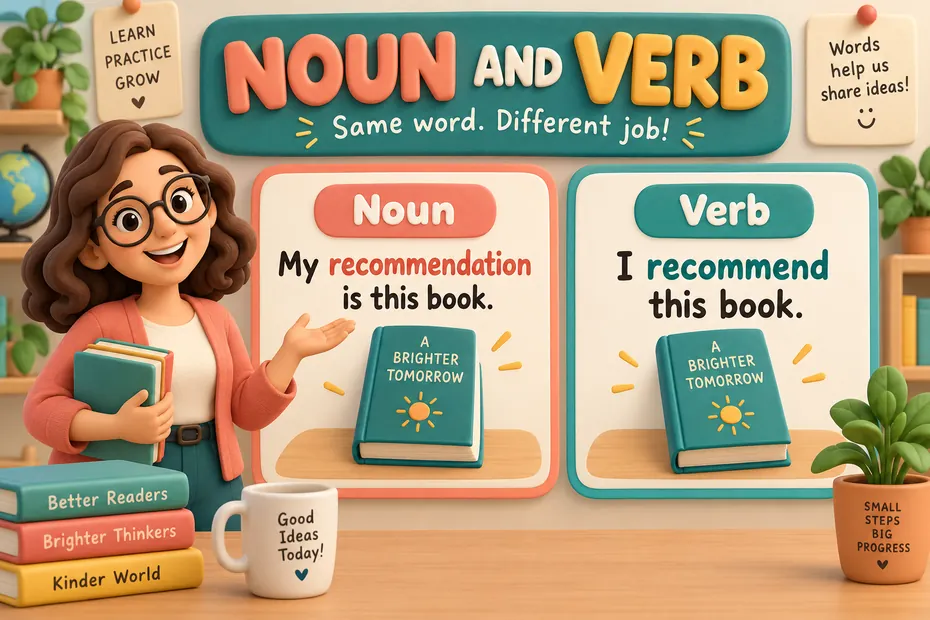
Recommendation versus recommend
| Word | Job | Correct example |
|---|---|---|
| Recommendation | Noun naming the suggestion | Her recommendation was helpful. |
| Recommendations | Plural noun | The report contains three recommendations. |
| Recommend | Verb expressing the action | I recommend this dictionary. |
| Recommended | Past-tense or participle form | The teacher recommended this dictionary. |
| Recommending | Verb form ending in -ing | She is recommending a simpler method. |
The older example “I recommendation eating fruits and vegetables” uses the noun where a verb is needed. For a grammar correction, write “I recommend reading this book” or “My recommendation is to read this book.” The first describes your action; the second names your suggestion. The dictionary entry for recommend identifies it as the verb.
A label such as “Recommendation: read the first chapter” can work in notes or a report. It is a heading followed by advice, rather than a model showing the noun inside a full sentence. When practicing sentence construction, use a subject and verb: “The recommendation was to read the first chapter.”
Common patterns with recommendation
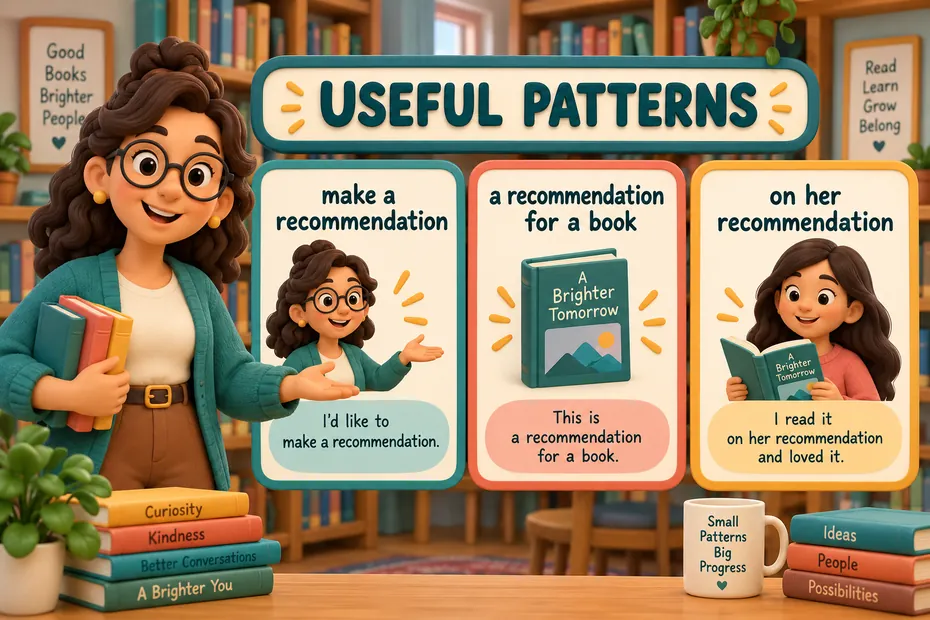
- Make a recommendation: “The librarian made a recommendation after hearing my interests.”
- Give someone a recommendation: “My colleague gave me a recommendation for a beginner’s guide.”
- A recommendation for something: “Do you have a recommendation for a good atlas?”
- A recommendation to do something: “The committee accepted the recommendation to revise the timetable.”
- On someone’s recommendation: “I borrowed the novel on my friend’s recommendation.”
- Follow a recommendation: “We followed the editor’s recommendation and shortened the opening.”
The preposition changes the relationship. A recommendation for a book identifies the kind of item you want. A recommendation to revise the timetable identifies an action. “On her recommendation” tells readers whose suggestion influenced the decision.
Suggestion, recommendation, and requirement
A suggestion offers an idea for consideration. A recommendation often expresses a clearer judgment that one choice is advisable or suitable. The words overlap, so use the surrounding sentence to show how strongly you mean it.
A recommendation does not automatically mean a requirement. “The guide recommends arriving early” advises an action; “The rules require arrival by nine” states a condition. If a report includes both, label them carefully so readers know what they may choose and what they must do.
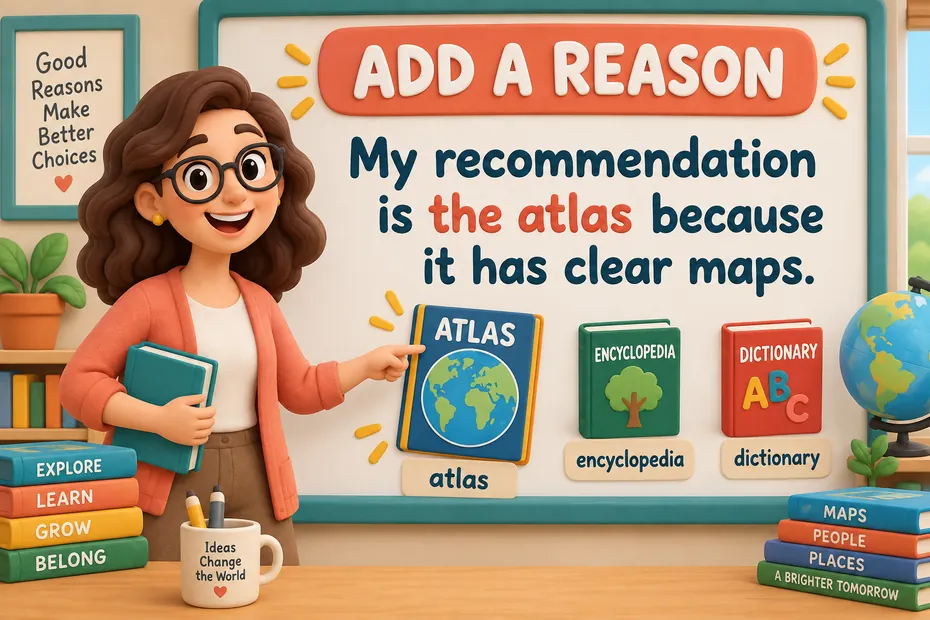
Likewise, a recommendation is not proof that a choice will work for everyone. In an example sentence, naming the reason makes the judgment understandable: “Her recommendation was the atlas because its maps were easier to read.” This explains the basis without claiming the atlas suits every reader.
Add a reason when it helps
A useful recommendation usually tells readers the option and why it fits the situation. Compare “My recommendation is this book” with “My recommendation is this book because its short chapters suit beginners.” The second sentence connects the choice to a reader’s needs.
You can also explain a limitation: “My recommendation is to start with the smaller project, unless your deadline allows a longer trial.” That gives the reader a condition to consider. Keep the recommendation separate from the evidence when a long explanation would make the sentence difficult to follow.
Natural example sentences
- Can you give me a recommendation for a mystery novel?
- Her recommendation helped us choose the right reference book.
- The team made a recommendation to simplify the registration form.
- We changed the wording on the editor’s recommendation.
- The report’s recommendations are listed in the final section.
- My recommendation is to compare the two outlines before choosing.
- The museum visit was a good recommendation for our class project.
- I asked my former supervisor for a letter of recommendation.
- The panel accepted one recommendation and requested more detail on another.
- His recommendation was specific enough for us to act on.
Letters of recommendation
A letter of recommendation supports a person by describing relevant qualities, work, or experience. The phrase names the type of letter: “The application includes a letter of recommendation from her tutor.” It differs from a casual recommendation for a book or a place to visit.
Use the possessive when naming the source: “my tutor’s recommendation” or “the supervisor’s recommendation.” If two supervisors jointly wrote it, “the supervisors’ recommendation” places the apostrophe after the plural S. Clear naming prevents confusion about who offered the endorsement.
Frequently asked questions
Is recommendation a noun or a verb?
It is a noun. Recommend is the verb. Write “I recommend the book” and “My recommendation is the book.”
Can recommendation be plural?
Yes. Use recommendations for several suggestions or endorsements: “The report contains five recommendations.” A single specific suggestion is a recommendation.
What is an easy example for children?
“My recommendation is to read this story.” It places the noun naturally in a complete sentence and keeps the meaning clear.
Does a recommendation have to be followed?
The word itself describes advice or an endorsement. A separate rule or context may affect what someone must do, so avoid treating recommendation and requirement as automatic synonyms.
Do you ever find yourself unsure of what choice to make or where to turn for advice? The word “recommendation” stands as a guiding compass in these moments, offering suggestions or endorsements for a particular course of action.
A recommendation is a formal or informal suggestion provided to assist in decision-making or the selection of a specific option. It serves as a valuable resource in various aspects of life, from choosing a book to read, a restaurant to dine at, or even a career path to pursue.
7 Examples Of Recommendation Used In a Sentence For Kids
- Recommendation: brush your teeth twice a day.
- I recommendation eating fruits and vegetables every day.
- Recommendation: drink lots of water to stay hydrated.
- Recommendation: wash your hands before eating food.
- Recommendation: always wear your helmet when riding a bicycle.
- Recommendation: share your toys with your friends.
- Recommendation: listen to your teachers and parents.
14 Sentences with Recommendation Examples
- Recommendation: Attend career fairs and workshops to enhance your professional network.
- Recommendation: Utilize online resources to learn new skills and stay updated in your field of study.
- Recommendation: Join student organizations and clubs to broaden your experiences and meet like-minded individuals.
- Recommendation: Seek advice from academic advisors to plan your course schedule effectively.
- Recommendation: Take advantage of internship opportunities to gain practical experience in your field.
- Recommendation: Attend seminars and guest lectures to expand your knowledge beyond the classroom.
- Recommendation: Form study groups with classmates to improve your understanding of complex subjects.
- Recommendation: Participate in volunteer activities to develop a well-rounded profile for future job applications.
- Recommendation: Explore different career paths through informational interviews with professionals in various industries.
- Recommendation: Create a personalized study timetable to effectively manage your academic workload.
- Recommendation: Stay organized by using planners or digital tools to track deadlines and assignments.
- Recommendation: Make use of library resources and online databases for research projects and assignments.
- Recommendation: Seek feedback from professors and peers to continuously improve your academic performance.
- Recommendation: Prioritize self-care and mental well-being by engaging in activities like exercise, meditation, or hobbies.
How To Use Recommendation in Sentences?
Recommendation is a suggestion or piece of advice about what should be done in a particular situation. When using Recommendation in a sentence, it’s important to clearly convey your point.
Here are some tips on how to use Recommendation effectively in a sentence:
-
Identify the context: Before using Recommendation, make sure to understand the situation in which you are providing the advice. This will help ensure that your Recommendation is relevant and appropriate.
-
Be specific: When giving a Recommendation, be clear and specific about what you are suggesting. Avoid vague or general statements.
-
Use confident language: When making a Recommendation, use strong and assertive language to convey your message effectively.
-
Provide reasoning: It can be helpful to provide a reason or explanation for your Recommendation. This will help the recipient understand why you are suggesting a particular course of action.
-
Consider the tone: Pay attention to the tone of your Recommendation. Make sure it is appropriate for the situation and the relationship you have with the recipient.
By following these guidelines, you can use Recommendation effectively in a sentence to provide helpful advice and guidance.
Conclusion
In conclusion, incorporating sentences with recommendations into your writing can significantly enhance the clarity and impact of your message. Utilizing such sentences allows you to provide guidance, suggest actions, or propose solutions to your audience in a clear and direct manner. Whether you are giving advice, sharing opinions, or making suggestions, recommendations can effectively steer your readers towards a desired course of action.
By including sentences with recommendations in your communication, you can help your audience make informed decisions, motivate them to take necessary steps, and guide them towards achieving desired outcomes. This simple yet powerful technique can elevate the persuasiveness and effectiveness of your writing, making it easier for your audience to understand and act upon your intended message.



