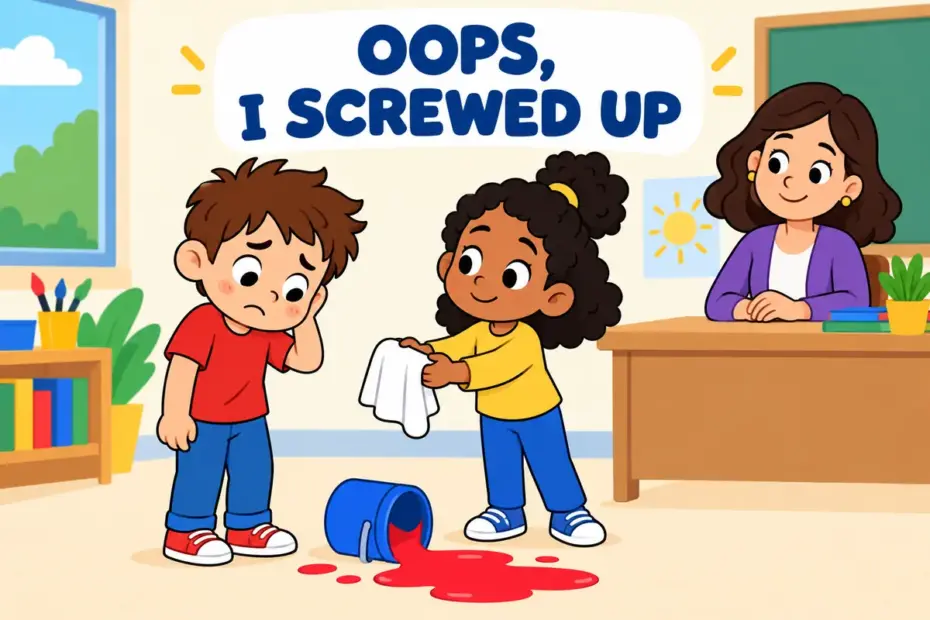
Screw up means to make a mistake or to spoil something you were trying to do. To use screw up in a sentence, name what went wrong or leave the object out: “I screwed up the booking.” The verb is informal and separable, so a pronoun must sit between screw and up, as in screw it up.
Screw up at a glance
- Screw up is an informal separable phrasal verb; its forms are screws up, screwed up and screwing up.
- The object may follow the particle (screw up the order) or sit between the words (screw the order up).
- A pronoun object must sit between them: screw it up, never screw up it.
- Unusually for a phrasal verb, it also works with no object at all: everyone screws up now and then.
- The commonest error is using the hyphenated noun screw-up in place of the verb.
What does screw up mean?
Screw up is an informal separable phrasal verb meaning to make a mistake or to spoil a plan or task. The Cambridge entry for screw up records both the error sense and the spoil sense, and the difference is what the speaker blames: a person screws up, while a person or an event screws up a plan. Three senses cover almost every real sentence.
| Sense | Plain meaning | Example sentence |
|---|---|---|
| Make a mistake | Do something wrongly or badly | She screwed up the order at the till. |
| Ruin or spoil | Damage a plan or a situation | The storm screwed up our whole schedule. |
| Tighten literally | Turn a screw or lid until it grips | Screw the lid up firmly before you shake it. |
One limitation matters here. Screw up is informal, so it looks out of place in a report or a formal letter, where made an error, ruined the schedule or failed to follow the procedure reads better. It is also milder than it sounds: a small mix-up is a screw up, and so is a serious blunder, so the word alone does not tell a reader how bad the damage was. For a single careless act, blunder is the more literary choice, and for the result rather than the error, ruin a plan is stronger.
How do you use screw up in a sentence?
Screw up is separable and can also stand alone. With an object the pronoun must sit between the verb and the particle, so screw it up is correct and screw up it is not. Without an object the phrase simply reports that a mistake happened, which is the pattern that makes it so common in speech.
| Pattern | Example | What it signals |
|---|---|---|
| screw up + object | I screwed up the numbers. | A mistake inside a named task. |
| screw + object + up | I screwed the numbers up. | Same meaning, with a touch more emphasis on the thing. |
| screw + pronoun + up | I screwed it up. | The only place a pronoun may sit. |
| screw up, no object | Everyone screws up now and then. | A mistake with nothing named, commonest in speech. |
| screw up + face or courage | She screwed up her courage and spoke. | Fixed figurative sense of gathering a feeling. |
Its closest twin is mess up a room, which stresses the disorder left behind, while botch a repair describes a job done clumsily from beginning to end.
Screw up in a sentence: examples across contexts
Screw up changes tone more than meaning as it moves between settings. The seven sentences below keep the same verb while shifting from a playground to a laboratory log, which is where the informality starts to strain.
| Context | Example sentence | Why this works |
|---|---|---|
| Classroom | I screwed up the last sum and had to start again. | A small, forgivable error suits the informal verb. |
| Workplace email | We screwed up the delivery date and I am sorry for the confusion. | An apology keeps the admission direct without becoming stiff. |
| News report | The airline screwed up the refunds for hundreds of passengers. | Quoted speech or commentary allows the informal register. |
| Technical writing | The script screwed up the file names, so the build failed. | A casual tone fits a developer log rather than a manual. |
| Conversation | I totally screwed up and forgot her birthday. | The bare no-object pattern is at home here. |
| Customer service | Our system screwed up your booking, and we have fixed it. | Admits fault and immediately names the remedy. |
| Academic prose | Treating screw up as formal style would be a mistake in a thesis. | Names the word as an object of study, not as the writer’s own voice. |
When the sentence needs to stay neutral, fix the mistake describes the repair, and in formal writing err is the flat verb for getting something wrong.
Screw up vs mess up and botch
Screw up, mess up and botch all describe failure, but each blames something different. Screw up points at the error, mess up points at the disorder left behind, and botch points at the clumsy handling of a whole job.
| Attribute | screw up | mess up | botch |
|---|---|---|---|
| Core job | Make a mistake or spoil a task | Make a mess of something | Do a job badly and clumsily |
| Object needed | Optional; can stand alone | Usually a thing or a situation | Almost always a task or an attempt |
| What it emphasises | The error itself | The untidy result | The clumsy method |
| Register | Informal | Informal | Informal but a little more vivid |
| Example | I screwed up the booking. | Do not mess up my desk. | He botched the repair. |
Verdict: choose screw up for a mistake, mess up when the resulting disorder matters, and botch when a whole attempt was handled badly. None of the three belongs in a formal report without quotation.
Word forms and grammar of screw up
Screw up inflects as a regular verb, but its noun and adjective take a hyphen and change the grammar of the sentence. Keeping the three spellings apart is the main skill.
| Form | Part of speech | Example |
|---|---|---|
| screw up | phrasal verb, base | Do not screw up the presentation. |
| screws up | third person singular | He screws up whenever he rushes. |
| screwed up | past and past participle | They screwed up the address. |
| screwing up | present participle | She is screwing up the courage to ask. |
| screw-up | noun, hyphenated | The whole screw-up cost us a day. |
| screwed-up | adjective, hyphenated | A screwed-up booking caused the delay. |
The non-standard form to avoid is the bare two-word noun, as in the screw up cost us a day. Write screw-up with the hyphen whenever the word names the mistake rather than doing the acting.
Common mistakes with screw up
- Incorrect:
The screw up in the report cost the team a day.Correct: The screw-up in the report cost the team a day. Rule: The noun is hyphenated; only the verb is two bare words. - Incorrect:
She was very screwed up after the meeting.Correct: She was very upset after the meeting. Rule: Screwed up as an adjective usually means troubled or confused, so use it only when that is the meaning you want. - Incorrect:
I have screwed up my exam yesterday.Correct: I screwed up my exam yesterday. Rule: A finished past time takes the simple past, not the present perfect. - Incorrect:
Please screw up the forms before you file them.Correct: Please sort out the forms before you file them. Rule: Screw up means ruin or err, so it can never mean organise. - Incorrect:
He screws up always in a hurry.Correct: He always screws up when he is in a hurry. Rule: Adverbs of frequency go before the verb, and a clause replaces the loose phrase.
Practice using screw up
Work through the six items, then read the reasoning rather than only the key.
- Fill the gap: I completely ______ the directions and we drove the wrong way.
- Choose the better word: The caterer (screwed up / botched) the whole wedding menu from start to finish.
- Correct the error: The screw up in the invoice delayed our payment.
- Build a sentence: use screw + pronoun + up about mistyping a password.
- Spot the register: which belongs in a formal report, the schedule was ruined by a data-entry error, or we totally screwed up the schedule?
- Rewrite without the object: I screwed up the application. Keep the informal verb and drop the object.
Answers
- screwed up — the bare no-object pattern reports the mistake without naming a thing.
- botched — a whole job handled badly from beginning to end suits botch better than screw up.
- The screw-up in the invoice delayed our payment — the noun takes a hyphen.
- Model answer: I screwed it up twice before the login worked. The pronoun it sits between screwed and up.
- The schedule was ruined by a data-entry error — a report avoids the informal phrasal verb.
- I screwed up — the verb can stand alone, and the context supplies the missing object.
The bottom line
Use screw up in a sentence when you want an informal, direct word for a mistake, and decide whether the sentence needs an object. Two nuances decide most sentences: the verb can stand alone, so I screwed up is complete, and the noun is the hyphenated screw-up. In formal writing, choose error, ruin or fail instead.
Frequently asked questions about screw up
Is screw up rude or just informal?
Screw up is informal rather than rude, and it is common in speech, messages and casual journalism. It rarely causes offence on its own, but it can sound flippant in a formal apology, where a phrase such as made an error carries the same meaning without the slang. Keep it for relaxed settings.
What does screw up your courage mean?
To screw up your courage means to gather your resolve and prepare to do something difficult, as in she screwed up her courage and knocked. This figurative sense comes from tightening something until it is firm, so the phrase describes steeling yourself rather than making a mistake.
Can you say I screwed up without naming what?
Yes. Screw up works without an object, so I screwed up is a complete sentence meaning I made a mistake. The listener understands from context what went wrong. This no-object pattern is one of the few places where the verb behaves intransitively, which is why it suits spoken English so well.
What is a gentler word for screw up?
For a neutral tone, use made a mistake, slipped up or got it wrong, all of which keep the meaning without the slang. Slip up is the closest informal match, while err is the most formal. Choose the replacement that matches how serious the error actually was.
Ever felt the sting of messing up something important? That, my friend, is what we call a “screw up.” This term refers to making a mistake or error that has negative consequences, often causing frustration or disappointment.
Whether it’s a small blunder like forgetting someone’s name or a major mess-up like missing a deadline at work, screwing up is a part of life that we all experience. It’s important to learn from these slip-ups, grow from them, and strive to do better next time.
7 Examples Of Screw Up Used In a Sentence For Kids
- Be careful with your toys so you don’t screw up them.
- Make sure to follow the recipe, or you might screw up the dish.
- Don’t rush your drawing or you might screw up the picture.
- It’s okay to make mistakes as long as you learn from them and don’t screw up again.
- Remember to double-check your homework so you don’t screw up your answers.
- If you feel lost, don’t be afraid to ask for help so you don’t screw up your work.
- Always think before you act so you don’t screw up your game.
14 Sentences with Screw Up Examples
- Screw up an exam by not studying properly.
- Missing a deadline can really screw up your assignment.
- Accidentally submitting the wrong file can screw up your grade.
- Screw up a presentation by not practicing beforehand.
- Forgetting about a group project meeting can screw up your team’s progress.
- Screw up a relationship by not communicating effectively.
- Oversleeping for an important class can really screw up your attendance record.
- Screw up a job interview by not preparing adequately.
- Losing your study materials can screw up your chances of success.
- Screw up your health by not getting enough sleep or exercise.
- Messing up a lab experiment can screw up your final grade in science.
- Screw up a scholarship opportunity by not meeting the requirements.
- Procrastinating on an assignment can screw up your time management skills.
- Screw up your chances of getting into a good college by not putting effort into your applications.
How To Use Screw Up in Sentences?
To use the phrase “screw up” in a sentence, you can follow these simple steps:
-
Identify the Situation: Think about a scenario where someone has made a mistake or failed to do something correctly.
-
Choose Your Words: In your sentence, decide who made the mistake and what they did wrong.
-
Insert the Phrase: Place the phrase “screw up” in your sentence where it makes sense grammatically.
-
Add Details: Provide additional context to help clarify the situation and emphasize the mistake.
Example: “I screwed up the presentation by forgetting to include the crucial data, and my boss was not pleased.”
In this sentence, “screwed up” is used to express making a significant mistake in the presentation by forgetting important information. The phrase adds emphasis to the seriousness of the error.
Remember, when using “screw up,” it is important to consider the context and tone of your sentence. This phrase is casual and can be considered informal, so be mindful of when and where you use it.
Conclusion
In conclusion, making mistakes is a normal part of life, and everyone occasionally screws up. Whether it’s at work, in relationships, or in daily tasks, we all have moments where things don’t go as planned. It’s important to remember that mistakes provide opportunities for growth and learning, helping us develop resilience and problem-solving skills.
Instead of dwelling on our screw-ups, we should strive to learn from them, make amends when necessary, and move forward with a newfound understanding. By acknowledging our mistakes and taking responsibility for them, we can turn moments of failure into valuable lessons that ultimately contribute to personal development and success.