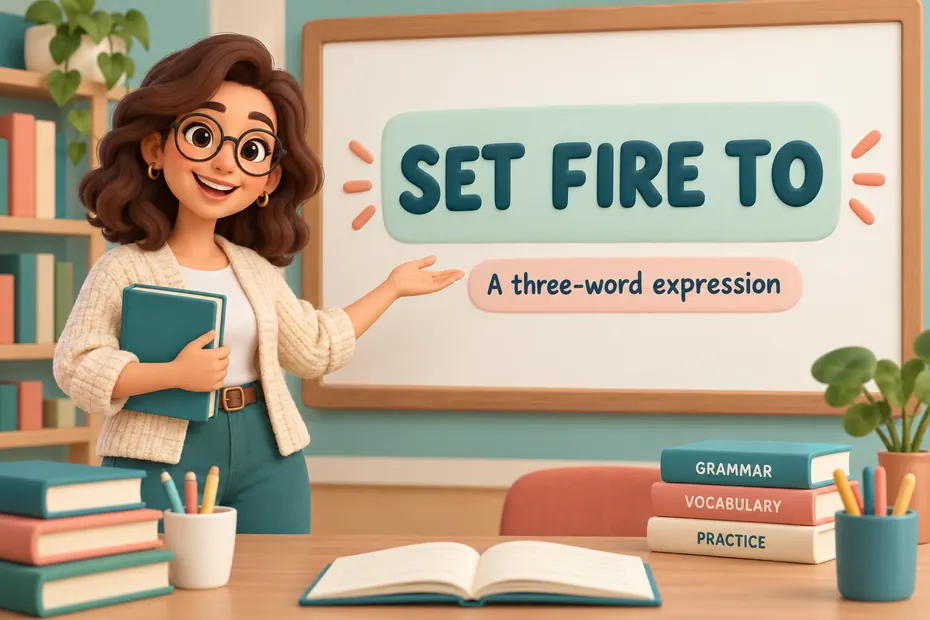
How do you use set fire to in a sentence?
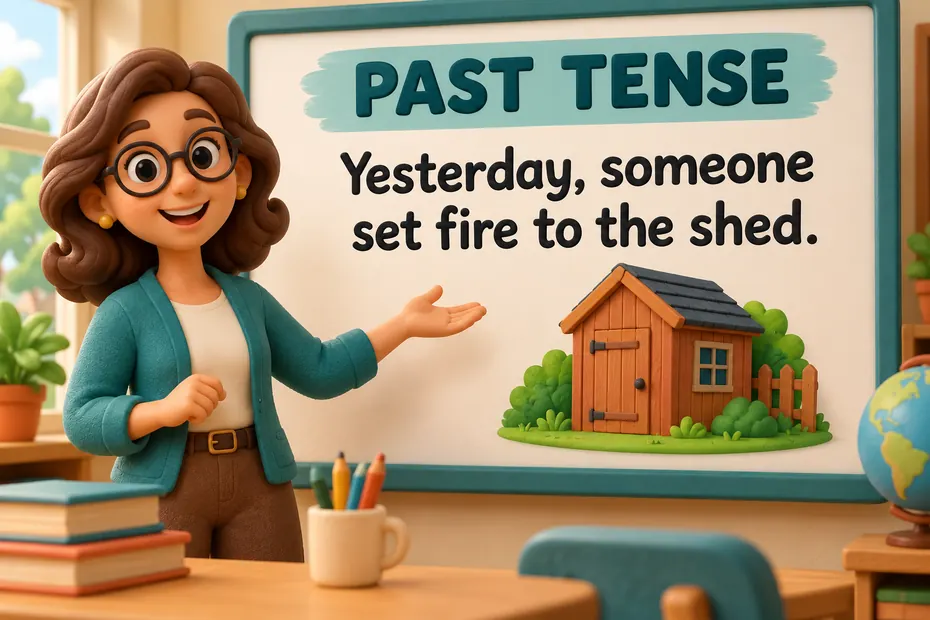
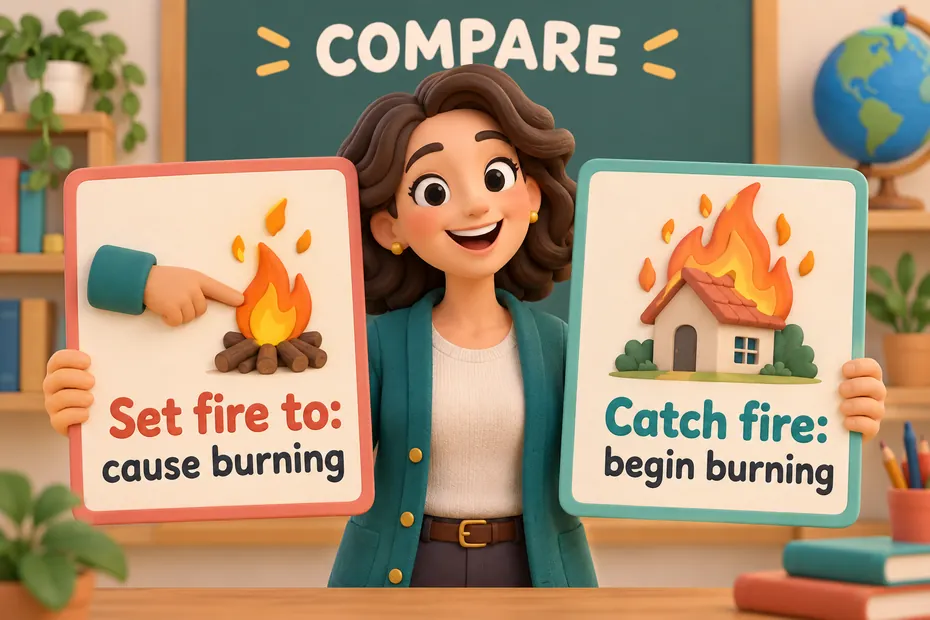
Set fire to means cause something to burn, commonly through deliberate action. Put the thing after to: “In the story, someone set fire to the shed.” The past tense is set, not setted. Compare “The shed caught fire,” which describes the beginning of burning without identifying a person who caused it.
What does the phrase mean?
Merriam-Webster defines the phrase in terms of deliberately causing something to burn. In a sentence, “set fire to” identifies a cause or agent rather than merely reporting that a fire exists. “The character set fire to the shed” assigns the action to the character. “The shed was on fire” describes the condition without specifying how it began.
These are vocabulary examples, not instructions for starting fires. A sentence can discuss a fictional event, a reported incident, or a warning without recommending the act. The earlier article’s claim that the expression should be used only for controlled burning is too narrow: English speakers also use it to describe destructive acts and other reported events.
Word order and original grammar examples
| Pattern | Original example | Teaching point |
|---|---|---|
| Set fire to + noun | In the novel, the villain set fire to the warehouse. | The noun follows to |
| Set fire to + pronoun | The witness said someone had set fire to it. | Keep the phrase together before it |
| Negative past | The character did not set fire to the building. | Did not is followed by base-form set |
| Present continuous | The detective believes someone is setting fire to the empty sheds. | Setting carries the continuous form |
| Present perfect | The report says someone has set fire to the abandoned shed. | The past participle is also set |
| Passive alternative | The warehouse was set on fire in the story. | On fire provides a natural passive construction |
Set, sets, setting: how does the verb change?
The base form, past tense, and past participle are all set. Write “someone set fire to it yesterday,” not “someone setted fire to it.” For a third-person singular subject in the simple present, use sets: “In each chapter, the villain sets fire to another clue.” For continuous forms, use setting.
The expression is not limited to present or future tense, despite the older guide’s simplified advice. It works in a past narrative: “The witness said the suspect set fire to the shed.” It also works with a past perfect: “By the time the detective arrived, someone had set fire to the shed.” Choose the tense that matches the sequence you are describing.
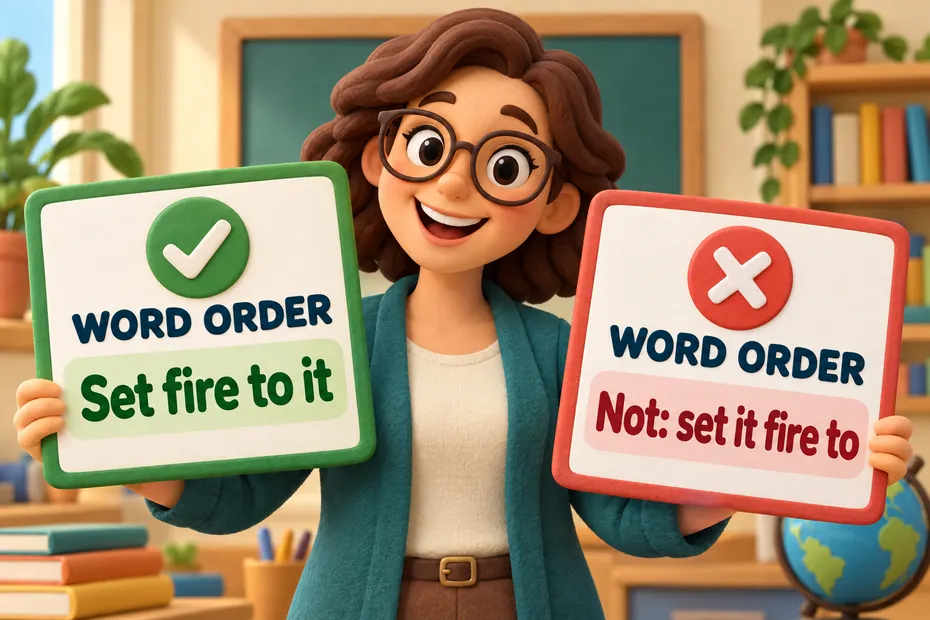
Keep to before the object: “set fire to it,” not “set it fire to.” Another natural construction is “set it on fire.” Those two patterns have different word order, so copying part of one into the other creates an error. With a noun, compare “set fire to the shed” and “set the shed on fire.”
Set fire to, catch fire, or light?
Set fire to foregrounds a cause of burning. Catch fire foregrounds the object beginning to burn. “The curtain caught fire” does not, by itself, say that someone deliberately ignited it. “Someone set fire to the curtain” makes a much more specific claim about an agent’s action. Preserve that difference when summarizing a report.
Light often sounds more natural for an intended candle or campfire: “She lit the candle” and “They lit the campfire” are ordinary constructions. “Set fire to the candle” can suggest burning or damaging the candle as an object rather than simply lighting its wick. The older examples are retained below, but these alternatives provide clearer learner models.
Which figurative examples need correction?
The older student examples repeatedly use “set fire to your skills” or “set fire to your curiosity.” A writer can invent such a metaphor, but these are not dependable everyday idioms meaning improve or encourage. “Develop your communication skills,” “spark your curiosity,” and “fuel your enthusiasm” state those intentions more naturally.
“Set fire to the midnight oil” also mixes expressions. The established phrase is burn the midnight oil, meaning work late into the night. For a student example, write “She burned the midnight oil to finish the assignment.” You do not need to include “set fire to” in a sentence where a different expression conveys the intended meaning.
One children’s example below says “something accidentally set fire to objects.” If describing a recurring possibility, use “something accidentally sets fire to objects.” If describing a completed event, past set is possible, but the surrounding sentence should establish the past time. The same list also opens with a comma splice; “Do not play with matches or lighters; they can cause fires” supplies a complete correction.
Frequently asked questions
What is the past tense of set fire to?
The past tense is set fire to. Set does not take an -ed ending: “The witness reported that someone set fire to the shed.” The past participle is also set.
Is set fire to it correct?
Yes. The pronoun follows to. You can also write “set it on fire,” but “set it fire to” incorrectly mixes the two patterns.
Can I write set fire to a candle?
It is understandable, but “light a candle” is normally clearer when you mean ignite the wick. “Set fire to” often suggests causing the object itself to burn.
Can the phrase be figurative?
Yes, especially in expressive writing, but the metaphor needs clear context. Do not assume “set fire to your skills” is an established equivalent of develop your skills.
Sources and usage notes
The meaning and verb forms were checked against Merriam-Webster: set fire to and Merriam-Webster: set. Added examples are original fictional or reported scenarios. The original text remains below with its grammar and idiom issues clarified above.
Have you ever wondered how to use the phrase “set fire to” correctly in a sentence? This common expression means to ignite something and cause it to burn.
When you “set fire to” something, you are intentionally starting a fire, often for destruction or heat.
7 Examples Of Set Fire To Used In a Sentence For Kids
- Do not play with matches or lighters, it can *set fire to things.*
- Always ask an adult for help if you see something that can *set fire to things.*
- Never touch anything hot or that can *set fire to objects around you.*
- Always be careful around things that can *set fire to items.*
- Remember, only adults should handle things that can *set fire to stuff.*
- If you see smoke or flames, tell an adult because it might *set fire to things.*
- Memorize emergency numbers in case something accidentally *set fire to objects.*
14 Sentences with Set Fire To Examples
- Set fire to the midnight oil and finish up that assignment before the deadline.
- Don’t forget to set fire to your passion for your chosen field of study.
- Set fire to your creativity and come up with a unique project idea.
- Let’s set fire to our imaginations during the brainstorming session.
- Set fire to your determination and ace that exam.
- It’s important to set fire to your curiosity and keep learning new things.
- Set fire to your leadership skills by taking charge of the group project.
- Set fire to your entrepreneurial spirit and start that side hustle you’ve been planning.
- Set fire to your enthusiasm and join a club or organization that interests you.
- Remember to set fire to your communication skills for the upcoming presentation.
- Set fire to your time management skills and create a study schedule that works for you.
- Set fire to your networking abilities by attending career fairs and industry events.
- Set fire to your resilience and bounce back from any setbacks you encounter.
- Don’t be afraid to set fire to your comfort zone and try new things while in college.
How To Use Set Fire To in Sentences?
To use Set Fire To in a sentence, follow these simple steps:
-
Determine the object: Set Fire To is a phrasal verb that means to ignite something and cause it to burn. Identify the object that you want to set fire to.
-
Form the sentence: Suggest the action in a clear and concise manner. For example, “I will set fire to the old newspapers in the backyard.”
-
Check verb agreement: Ensure that the verb “set” agrees with the subject of the sentence. For example, “She will set fire to the candles on the birthday cake.”
-
Use in present or future tense: The phrasal verb can be used in the present or future tense, depending on the context. For example, “They are planning to set fire to the campfire tonight.”
-
Be cautious: Remember that setting fire to things should be done safely and responsibly. Only use Set Fire To when referring to controlled burning in appropriate settings.
By following these steps, you can effectively use Set Fire To in a sentence. Practice using the phrasal verb in various contexts to improve your fluency and understanding of its usage.
Conclusion
In conclusion, the phrase “set fire to” commonly refers to the act of igniting something with the intention of causing it to burn. This action can have destructive consequences, as seen in examples such as “The criminal set fire to the abandoned building” or “The protestors set fire to several cars.” It is a serious offense and can result in harm to property, people, and the environment.
While the phrase is often used metaphorically to describe intense emotions or conflicts, it is crucial to remember the real-world implications of setting fire to objects. Whether literal or figurative, the act of setting fire to something should not be taken lightly, as it can have far-reaching consequences and should be approached with caution and responsibility.



