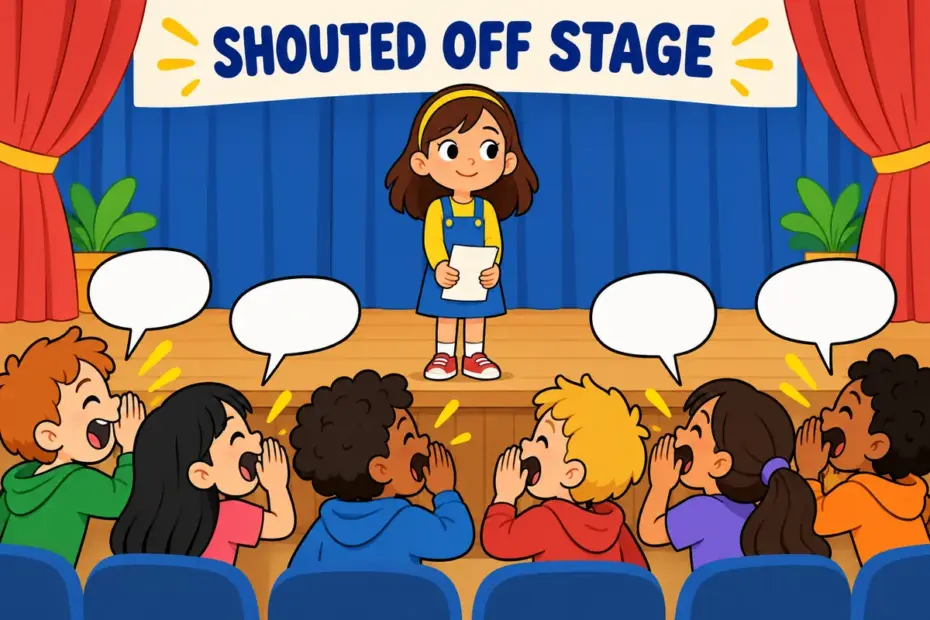
Shout down means to stop a speaker from being heard by shouting louder than they can. To use shout down in a sentence, name who is silenced and what they were saying: ‘The crowd shouted down the referee.’ The phrasal verb is transitive and separable, so a pronoun goes in the middle, as in shout her down.
Shout down at a glance
- Shout down is a transitive phrasal verb meaning to silence a speaker with louder shouting.
- Its forms are shout down, shouts down, shouted down and shouting down.
- It is separable: shout down the heckler and shout the heckler down are both correct.
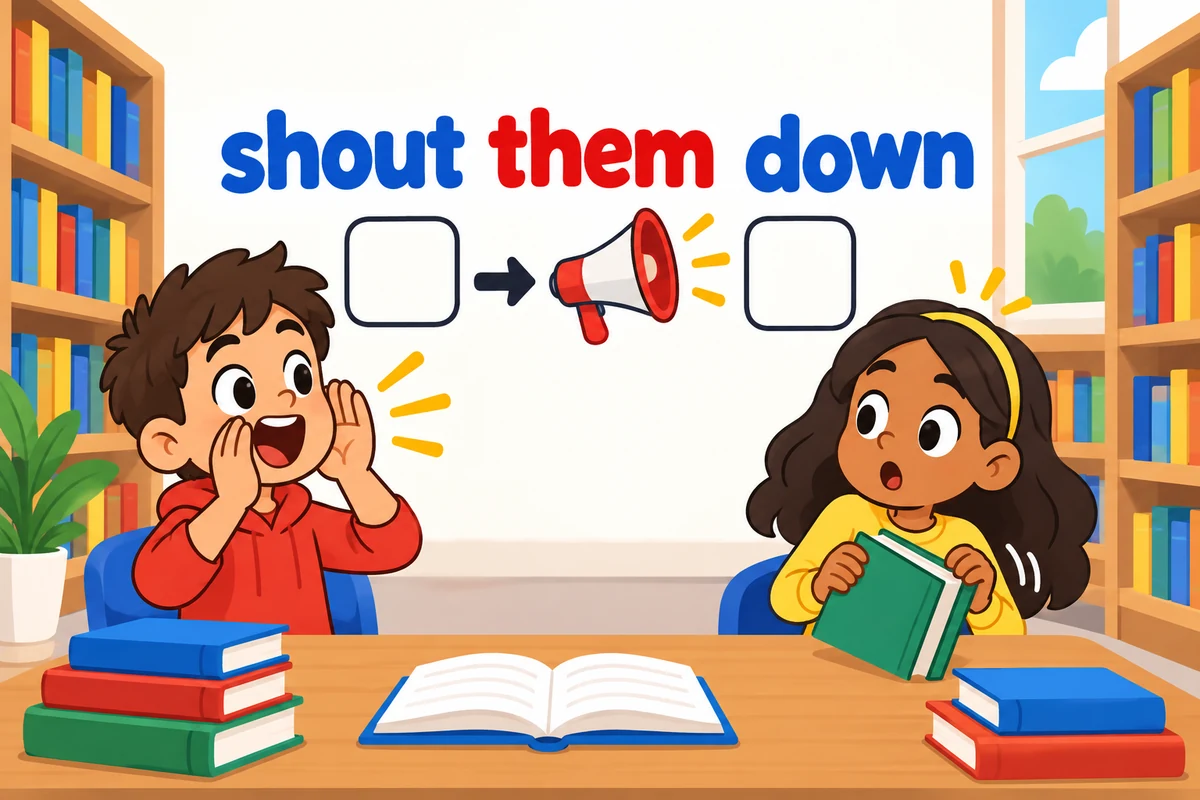
- A pronoun object must sit between the verb and the particle, so shout them down, never shout down them.
- The commonest error is confusing shout down with shout out, which means to praise someone publicly.
What does shout down mean?
Shout down is a transitive phrasal verb meaning to drown out a speaker with loud shouting until they stop. The Cambridge entry for shout down records this single sense, and the shouting is aimed at a person, not at an idea. An audience that jeers a guest until she leaves has shouted her down, and a meeting where one group talks over another does the same. Where the aim is to interrupt with a pointed remark, heckle a speaker is not the same act, because heckling needles a speaker while shouting down ends the speech.
One limitation matters. Shout down describes the effect on the speaker, so it never reports what was argued. A vote can reject a motion, but only noise can shout it down, and that difference is worth keeping.
How do you use shout down in a sentence?
Choose the order first, because shout down is separable and the position of the object changes with it. Five patterns cover almost every real sentence.
| Pattern | Example | What it signals |
|---|---|---|
| shout down + object | The crowd shouted down the speaker. | Standard order, with the object after the particle. |
| shout + object + down | The crowd shouted the speaker down. | Separated order, with the object between verb and particle. |
| shout + pronoun + down | They shouted her down. | With a pronoun, the middle position is the only correct one. |
| be shouted down | The proposal was shouted down. | Passive voice, common in reports of meetings. |
| shout down + idea | Delegates shouted down the motion. | The object can be a proposal, not only a person. |
Writers who want the effect rather than the act can silence a room, but that verb drops the noise entirely. The practitioner rule is simple: if the sentence needs the word them, it goes before down.
Shout down in a sentence: examples across contexts
Shout down keeps one meaning while its setting shifts. The eight sentences below move from a classroom to a parliament, and each names who was silenced.
| Context | Example sentence | Why this works |
|---|---|---|
| Classroom | The class shouted down the boy who kept changing the rules. | Names the group and the person they silenced. |
| Workplace meeting | Two managers shouted the new recruit down before she finished. | Uses the separated order, which suits a past narrative. |
| News report | Protesters shouted down the mayor at the public hearing. | Names both sides and the formal setting. |
| Parliament | The motion was shouted down before a vote could be taken. | Passive voice keeps attention on the proposal. |
| Sports | Fans shouted down the captain as he tried to explain. | Shows the act interrupting an explanation. |
| Online meeting | He was shouted down the moment he mentioned the budget. | Ties the silencing to a single trigger. |
| Academic seminar | Nobody shouted the visiting scholar down, though many disagreed. | The negative form stresses that debate stayed open. |
| Conversation | They tried to shout me down, but I kept talking. | Uses the pronoun in the middle, the natural spoken shape. |
Only the last row uses a pronoun, and that is the shape speakers reach for. In reported writing, the separated order with a full noun is just as common. Where the speaker is interrupted but not silenced, interrupt a speaker is the more accurate phrase.
Shout down vs drown out
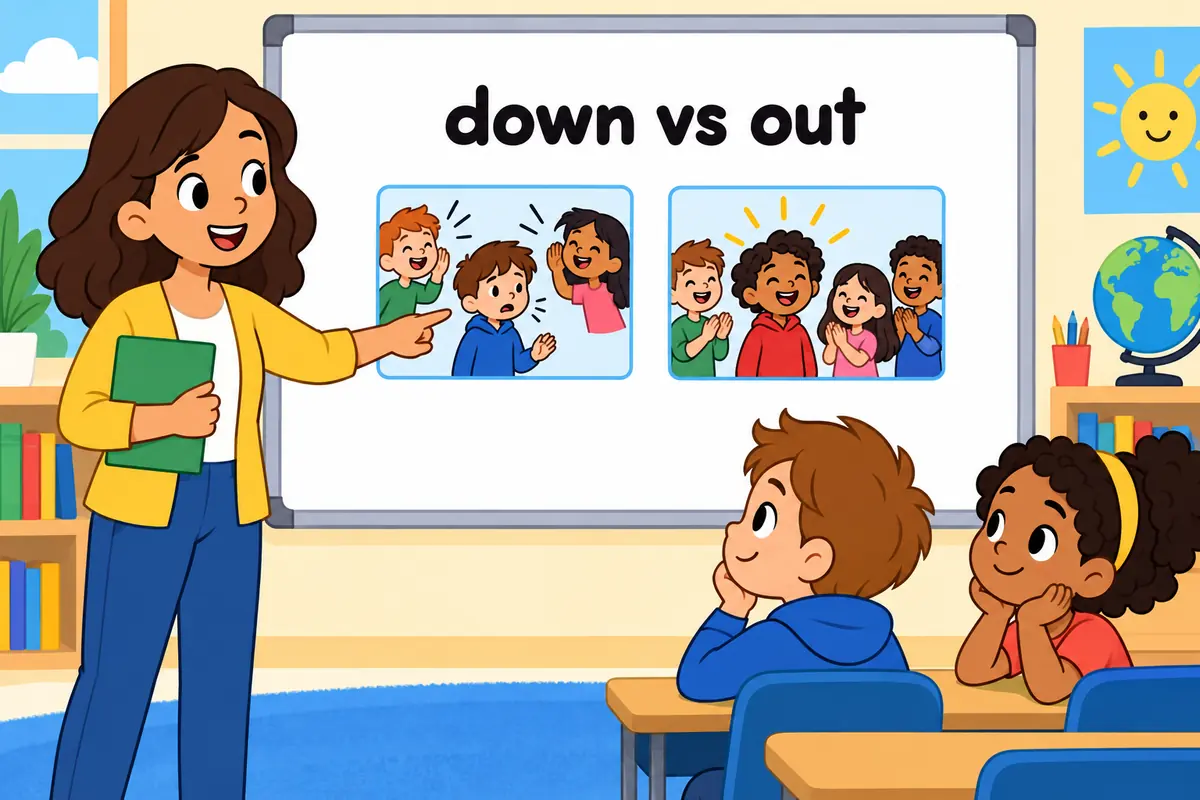
Shout down and drown out the noise both make a voice inaudible, and the difference is intent. Shout down is deliberate and aimed at a person; drown out is about volume and can happen by accident.
| Attribute | shout down | drown out |
|---|---|---|
| Core meaning | Silence a speaker by shouting | Make a sound inaudible with louder sound |
| Intent | Deliberate, often hostile | Neutral; may be accidental |
| Typical subject | A crowd, an audience, a faction | Traffic, music, engines, other noise |
| Typical object | A person, a proposal, a motion | Speech, an alarm, a broadcast |
| Register | Journalistic and political | Everyday and technical |
Verdict: choose shout down only when people shout a person or proposal into silence, and choose drown out whenever something is merely made hard to hear.
Word forms and grammar of shout down
Shout down inflects on the verb, so only shout changes. The table also lists the near neighbour that learners mix up with it.
| Form | Part of speech | Example |
|---|---|---|
| shout down | phrasal verb, base form | Do not shout down the witness. |
| shouts down | phrasal verb, third person singular | The chair shouts down any heckler. |
| shouted down | phrasal verb, past and past participle | The speaker was shouted down twice. |
| shouting down | phrasal verb, present participle | They kept shouting down every question. |
| shout-down | noun, attributive, rare | Incorrect in most writing: a shout-down of the plan. Prefer the verb. |
| shout out | phrasal verb, different meaning | Fans will shout out their favourite player. |
Keep shout out separate in meaning: it praises somebody in public, which is nearly the opposite of silencing them.
Common mistakes with shout down
- Incorrect:
They shouted down them.Correct: They shouted them down. Rule: A pronoun object sits between the verb and the particle, never after it. - Incorrect:
The audience shouted down at the speaker.Correct: The audience shouted down the speaker. Rule: Shout down is transitive and takes a direct object, so no preposition follows it. - Incorrect:
He shout down the objection.Correct: He shouted down the objection. Rule: The tense is marked on shout, which keeps its normal past form shouted. - Incorrect:
The crowd shouted her out.Correct: The crowd shouted her down. Rule: Shout out means praise; the particle down is what carries the silencing. - Incorrect:
She gave the protester a shout down.Correct: She shouted the protester down. Rule: Use the verb; the attributive noun shout-down is rare and sounds forced. The same particle appears in other verbs, but back down means to yield rather than to silence.
Practice using shout down
Work through the six items, then read the reason with each answer.
- Fill the gap: A fair chair never ______ a nervous speaker.
- Choose the better word: The audience (shouted down / shouted out) the young debater.
- Correct the error: The fans shouted down them from the stand.
- Build a sentence: use shout + object + down about a committee that silences a proposal instead of voting on it.
- Spot the register: which belongs in a news report, they shouted her down, or they totally shouted her down?
- Rewrite in the passive: The crowd shouted the singer down. Use be shouted down.
Answers
- shouts down — a singular subject takes the third person singular form.
- shouted down — the debater was silenced; shouted out would mean she was praised.
- The fans shouted them down — the pronoun belongs between shout and down.
- Model answer: The committee shouted the proposal down without a vote.
- They shouted her down — a report avoids totally and keeps the plain verb.
- The singer was shouted down — the passive keeps attention on the act.
The bottom line
Use shout down in a sentence when a person or proposal is silenced by louder shouting, and remember that it is separable. The two details that decide most sentences are these: a pronoun object must sit between shout and down, and the verb needs a real object, so nobody is shouted down in general. For plain noise rather than intent, use drown out.
Frequently asked questions about shout down
Is shout down one word or two?
The phrasal verb is two words, shout down, and so is the separated form shout the heckler down. A hyphen appears only in the rare attributive noun, as in a shout-down culture. In ordinary writing, keep the verb open and let the object decide the order.
Can you shout down an idea instead of a person?
Yes. Shout down commonly takes a proposal, motion or objection as its object. Delegates shouted down the motion means the plan was silenced by noise. The act still describes how people were prevented from speaking, so the underlying target is always someone trying to be heard.
What is the difference between shout down and shout out?
The particle reverses the meaning. Shout down silences a speaker by shouting louder, while shout out praises somebody in public, as when fans shout out a favourite player. Both are separable and transitive, so the only reliable clue is the particle that follows the verb.
Does shout down need a direct object?
Yes. Shout down is transitive, so a person, proposal or objection must follow it, either before or after the particle. A sentence such as the audience shouted down is incomplete unless the object is clear from context, and a pronoun must sit between the verb and down.
Have you ever been in a situation where your voice was drowned out by louder and more forceful opinions? This is what is commonly referred to as “shouting down” – a practice where one person or group overwhelms the conversation by speaking louder or more aggressively than others, effectively silencing opposing viewpoints.
Shouting down can occur in various settings, from public debates and discussions to everyday conversations. It can hinder the exchange of ideas and prevent meaningful dialogue from taking place. Understanding the dynamics of shouting down and learning how to address it respectfully can help ensure that all voices are heard and valued in any interaction.
7 Examples Of Shout Down Used In a Sentence For Kids
- Shout down when you want someone to be quiet.
- Shout down if you cannot hear the teacher.
- Do not shout down during class.
- It is not nice to shout down at your friends.
- When someone is speaking, do not shout down.
- Remember to raise your hand instead of shouting down.
- Let’s use our inside voices and not shout down.
14 Sentences with Shout Down Examples
- During a heated debate in class, one student tried to shout down another to prove their point.
- The professor had to shout down the noisy students in the back of the classroom so the lecture could continue.
- It’s important to engage in respectful discussions and not resort to shouting down someone just because you disagree with them.
- The student union president had to shout down the unruly crowd during the meeting to maintain order.
- Sometimes in group projects, certain members may try to shout down others to push their ideas through.
- During a cultural event on campus, a guest speaker was disrupted by attendees attempting to shout down their talk.
- In a panel discussion, it’s crucial to listen to different perspectives and not just shout down those who have opposing views.
- The student government meeting became chaotic when members started to shout down each other during a debate.
- It’s important for college students to learn how to respectfully disagree without resorting to trying to shout down others.
- A productive classroom environment can be disrupted when students constantly try to shout down each other instead of having a civil discussion.
- The class representative had to step in and shout down disruptive students who were preventing others from asking questions during a guest lecture.
- It’s not respectful to constantly try to shout down classmates in a discussion just to make your voice heard.
- During a political debate on campus, tensions ran high as supporters of different parties tried to shout down each other.
- In a team meeting for a group project, it’s important to listen to everyone’s ideas and not just shout down those you disagree with.
How To Use Shout Down in Sentences?
To use Shout Down in a sentence, start by identifying a situation where you need to assert yourself with a forceful communication style. For example, “She tried to shout down the speaker in the meeting to make her own point.” In this case, the phrase “shout down” indicates the act of interrupting or attempting to silence someone through loud or aggressive speech.
When using Shout Down, pay attention to the tone and volume of your voice to convey authority without coming off as disrespectful. For instance, “He decided to shout down his critics during the debate by confidently presenting his arguments.”
Remember that Shout Down is not always the most effective or respectful way to communicate, so use it judiciously and consider the context of the situation. It is more suitable for asserting oneself in a heated discussion or debate rather than in a casual conversation.
In summary, Shout Down is a powerful communication tool that can be used to assert oneself forcefully in a discussion or debate. Whether you are trying to make a point or silence opposition, understanding when and how to use Shout Down effectively can help you navigate various social situations with confidence.
Conclusion
In conclusion, the concept of “shut down” can be understood as the act of closing or stopping something, such as a machine, operation, or discussion. In a figurative sense, it can also refer to forcefully ending an argument or conversation by speaking loudly or aggressively, as in “When she couldn’t handle the criticism anymore, she shouted down her opponents.”
Understanding the different contexts in which “shut down” is used can help navigate various situations, whether it involves technical issues like shutting down a system or interpersonal conflicts where individuals may resort to shouting down others to assert dominance. Being conscious of the impact and implications of shutting down can contribute to more effective communication and problem-solving.