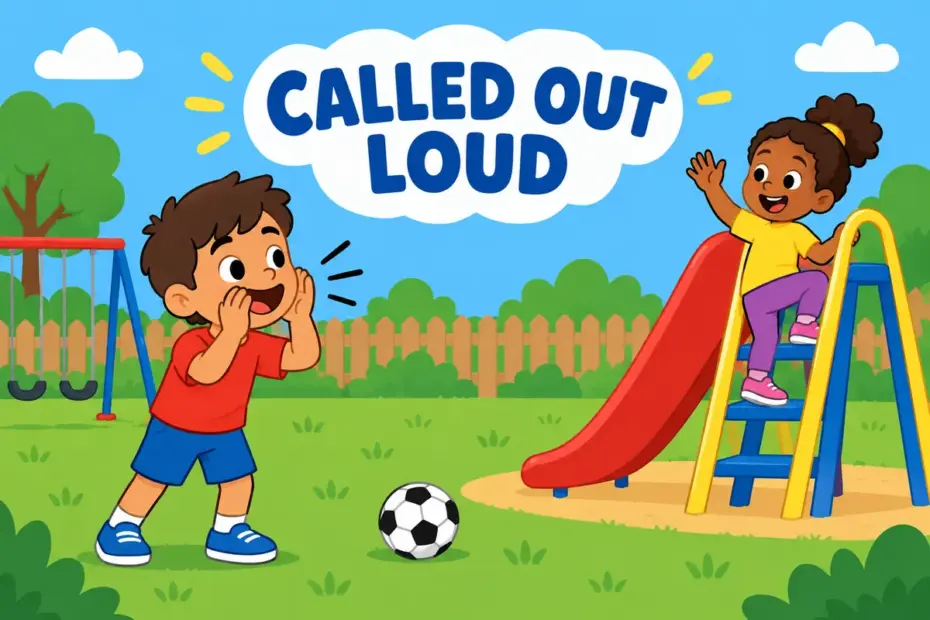
Shout out means to call something in a loud voice, or to praise someone publicly, as in give a shout-out. To use shout out in a sentence, decide which sense you need: “He shouted out the answer” reports a voice, while “She gave her coach a shout-out” reports public thanks.
Shout Out at a glance
- Shout out is a phrasal verb; its forms are shouts out, shouted out and shouting out.
- The verb is separable, so shout the name out and shout out the name are both correct.
- The noun is written shout-out, plural shout-outs, and most often follows give.
- One sense is literal volume; the other is public praise, common on radio and social media.
- The commonest error is writing the noun without its hyphen or mixing the two senses.
What does shout out mean?
Shout out is a phrasal verb with two clearly separate meanings. The Cambridge entry for shout out records the literal sense of calling loudly and the newer sense of praise a helper in public, which behaves almost like a noun.
| Sense | Plain meaning | Example sentence |
|---|---|---|
| Call loudly | Raise the voice so something is heard | He shouted out the window for help. |
| Announce by calling | Say a name or answer aloud | The teacher shouted out the winners. |
| Praise publicly | Thank or name someone in front of others | She shouted out her whole team. |
One limitation matters here. The praise sense is informal, and a formal speech would use single out or acknowledge instead. Shout out also never means to argue with or scold someone; that is shout at, or shout down when a crowd drowns a speaker out.
How do you use shout out in a sentence?
Shout out is separable and transitive in both senses: the object can follow the whole verb or sit between the two parts. The one fixed form is the noun, where the hyphen cannot move.
| Pattern | Example | What it signals |
|---|---|---|
| shout + object + out | The captain shouted the names out. | Separable verb with the object in the middle. |
| shout out + object | The captain shouted out the names. | The same meaning with the object after the particle. |
| shout out, no object | He shouted out in the dark. | Intransitive use, pure volume. |
| give + a shout-out | Give a shout-out to the volunteers. | The noun, which needs an article. |
| shout out to + person | Shout out to my sister for the lift. | An informal praise opener, common online. |
When the object is a pronoun it must go in the middle: shout it out, never shout out it. That single rule catches most learner errors, and the same out particle gives ask someone out, where the word order rules are identical.
Shout Out in a sentence: examples across contexts
Shout out moves easily from a literal call to a public thank-you. The eight sentences below keep the same words and show how the setting decides the sense.
| Context | Example sentence | Why this works |
|---|---|---|
| Classroom | The teacher asked the class to shout out the answer together. | The literal sense in an orderly setting. |
| Radio show | The host gave a shout-out to the night-shift nurses. | The noun form in its natural broadcast home. |
| Workplace email | I want to shout out the support team for the weekend work. | Informal praise in an internal note. |
| Sports report | The crowd shouted out the striker’s name after the goal. | Literal voice plus a celebratory context. |
| Social media | Shout out to everyone who finished the reading challenge. | The fixed opener of a public thank-you. |
| Conversation | Give me a shout-out when the food arrives. | Everyday request for a call. |
| News report | A witness shouted out a warning before the wall fell. | Reports a spoken warning as an event. |
| Music writing | A plain holler across the yard lacks the warmth of the public shout-out. | Contrasts a neutral call with the praise sense. |
Shout out vs shout down
Shout out and shout down a speaker share a verb and point in opposite directions. One lifts a person up in public; the other buries a speaker under noise.
| Attribute | shout out | shout down |
|---|---|---|
| Meaning | Praise or call loudly | Drown out with shouting |
| Effect on the person | Named and thanked | Silenced |
| Typical object | A name, a team, a helper | A speaker, a heckler, an opponent |
| Separability | Separable | Separable |
| Register | Informal, broadcast and online | Neutral, often public or political |
| Feeling it creates | Warmth | Conflict |
Verdict: use shout out to support someone and shout down to silence them, and never swap one for the other in a report.
Word forms and grammar of shout out
The verb stays two words, while the noun takes a hyphen. That punctuation difference is the whole grammar of the pair.
| Form | Part of speech | Example |
|---|---|---|
| shout out | phrasal verb, base | Please shout out the answer. |
| shouts out | phrasal verb, third person singular | She shouts out every winner. |
| shouted out | phrasal verb, past | The crowd shouted out his name. |
| shouting out | phrasal verb, present participle | He is shouting out the scores. |
| shout-out | noun | Give the cooks a shout-out. |
| shout-outs | noun, plural | The host read three shout-outs. |
The noun takes a hyphen and then a space, never the other way round: a shout-out, not a shout out, when it is the thing you give. The verb keeps the words separate and may split around a pronoun.
Common mistakes with shout out
- Incorrect:
Shout out it to the crowd.Correct: Shout it out to the crowd. Rule: Pronouns go between the verb and the particle. - Incorrect:
She gave a shout out to her mentor.Correct: She gave a shout-out to her mentor. Rule: The noun is hyphenated. - Incorrect:
The manager shouted out him for being late.Correct: The manager shouted at him for being late. Rule: Shouting at someone is an angry act; shout out is praise or volume. - Incorrect:
He shouted out the answer out.Correct: He shouted out the answer. Rule: The particle out appears once. - Incorrect:
The speaker was shouted out by the crowd.Correct: The speaker was shouted down by the crowd. Rule: A silenced speaker is shouted down, not shouted out.
Practice using shout out
Work through the six items, then read the answers for the reasoning, not only the key.
- Fill the gap: The coach shouted the winner’s name ______ across the field.
- Choose the better word: The host gave a (shout out / shout-out) to the volunteers.
- Correct the error: Please shout out it so everyone hears.
- Build a sentence: use give a shout-out about a classmate who helped tidy up.
- Spot the register: which belongs on a radio show — a shout-out to the nurses, or an acknowledgement of the nurses?
- Rewrite with a pronoun: Shout out the answer. Use it in place of the answer.
Answers
- out — the name sits between shout and out, the separable position.
- shout-out — the noun is hyphenated after give.
- Please shout it out so everyone hears — a pronoun object must sit between the verb and the particle.
- Model answer: We gave a shout-out to Sam for staying behind to tidy up.
- A shout-out to the nurses — radio keeps the warm informal noun and avoids the stiff acknowledgement.
- Shout it out — the pronoun replaces the noun phrase in the middle slot.
The bottom line
Use shout out in a sentence either for calling something loudly or for praising someone in public, and let the word order carry the difference. Keep a pronoun inside the verb, shout it out, and give the noun its hyphen when you write a shout-out. For a formal setting, to acknowledge the team or single out does the work without the radio tone.
Frequently asked questions about shout out
Is shout out one word or two?
As a verb it is two words, shout out, and it may be split by its object, as in shout the names out. As a noun it is one hyphenated word, shout-out, with the plural shout-outs. The hyphen is what tells a reader you mean the noun.
Is shout out formal or informal?
The literal sense, calling loudly, is neutral. The praise sense is informal and belongs to radio, sport and social media rather than to a formal report. In an official speech, acknowledge or single out carries the same meaning without the relaxed tone.
What is the difference between shout out and shout at?
Shout out means to call something aloud or to praise someone publicly. Shout at means to speak angrily to a person, and it always carries the conflict. The two are never interchangeable: you shout out a name, but you shout at a person who has annoyed you.
Can shout out be a noun?
Yes, in the hyphenated form shout-out. It follows the verb give most often, as in give the volunteers a shout-out, and it takes an article or a possessive. The plural is shout-outs, and no apostrophe is needed because the noun is not possessive.
Have you ever heard someone giving a shout out to a friend or a colleague? In essence, a shout out is a public acknowledgment or greeting given to someone to show appreciation or recognition. It is a simple way of giving credit or showing support for an individual or group in a public forum.
Typically, shout outs are common in social media, podcasts, events, or any platform where one can address a wider audience. They can be used to express gratitude, promote someone’s work, or simply make a connection with others. Overall, shout outs serve as a positive and uplifting way to spotlight someone deserving of praise or attention.
7 Examples Of Shout Out Used In a Sentence For Kids
- Let’s give a shout out to our teacher for helping us learn new things!
- I want to give a shout out to my friends for playing with me at recess.
- We should all give a shout out to our parents for taking care of us.
- Let’s give a shout out to the rain for making the flowers grow.
- Who wants to give a shout out to our school for being so fun?
- Let’s give a shout out to the sun for shining brightly in the sky.
- Everyone should give a shout out to themselves for working hard every day.
14 Sentences with Shout Out Examples
- Shout out to all the college students who are balancing academics and part-time jobs simultaneously.
- Are you looking for affordable textbooks? Shout out to online resources for saving money!
- Shout out to all the student clubs and organizations that make college life more exciting.
- Feeling stressed about exams? Take a break and give yourself a shout out for all your hard work.
- Need some motivation to finish that assignment? Here’s a shout out to your future successful self.
- Shout out to all the late-night study sessions that have helped us ace our exams.
- Want to make new friends? Join a sports team and give a shout out to teamwork.
- Shout out to all the professors who go the extra mile to support their students.
- Feeling overwhelmed with deadlines? It’s okay to ask for help! Shout out to your support system.
- Shout out to all the college students who are juggling internships and classes to build a promising career.
- Stay hydrated and get enough sleep during exam week! Shout out to self-care.
- Shout out to all the students who are pursuing their passion and working towards their goals.
- Need a break from studying? Take a walk outside and give yourself a shout out for making progress.
- Shout out to all the college students who are adapting to virtual learning and embracing new challenges.
How To Use Shout Out in Sentences?
To use Shout Out effectively in a sentence, follow these simple steps:
-
Identify the person or group you want to give recognition to. For example, “I want to shout out to my parents for always supporting me.”
-
Use the phrase “shout out” before mentioning the person or group. For instance, “I would like to shout out to my best friend for being there for me.”
-
You can also use shout out as a way to acknowledge someone’s achievements or contributions. For example, “Let’s shout out to the volunteers who worked hard to make this event a success.”
-
Remember to use “shout out” in an informal context, such as social media, casual conversations, or informal writing. For instance, “I want to give a quick shout out to everyone who helped make this project possible.”
-
Consider using shout out as a way to express gratitude or appreciation publicly. For example, “I just want to shout out my team for their hard work and dedication.”
By following these steps, you can effectively incorporate Shout Out into your sentences to show appreciation, acknowledge someone’s efforts, or simply give credit where it’s due.
Conclusion
In summary, a shout out is a public acknowledgment or mention, often to show appreciation or give recognition to someone or something. It is a way to highlight and commend individuals, businesses, or organizations for their contributions or achievements. Shout outs can be seen across social media, in speeches, or during events, serving as a way to express gratitude and support.
Whether it’s a shout out to a friend for their birthday, a shout out to a local business for their exceptional service, or a shout out to a non-profit organization for their impactful work, these expressions of recognition help build connections and foster positivity within communities. Ultimately, shout outs play a significant role in showcasing and celebrating the efforts and successes of individuals and entities deserving of recognition.


