
Show off is a phrasal verb meaning to display something so that others admire it, or to behave in a way that invites attention. To use show off in a sentence, keep the object between the verb and the particle: she showed her new bike off. The same phrase also stands alone, as in he is always showing off.
Show off at a glance
- Show off is a phrasal verb; its forms are shows off, showed off and showing off.
- It is separable, so the object may sit between show and off or follow the particle.
- With a pronoun object it must separate, giving show it off rather than show off it.
- It works both transitively, showing off a skill, and intransitively, simply showing off.
- The commonest error is treating the whole phrase as a noun in formal writing.
What does show off mean?
Show off is a phrasal verb meaning to display something proudly, or to behave boastfully in order to win admiration. The Cambridge entry for show off records both the transitive display sense and the intransitive boastful one, and the noun show-off, written with a hyphen, names the person who does it.
| Sense | Plain meaning | Example sentence |
|---|---|---|
| Display something | Show an object or skill proudly | He showed off his new watch at lunch. |
| Behave boastfully | Invite admiration with no object | Stop showing off and finish your work. |
| Noun: show-off | A person who seeks attention | The little show-off sang the loudest. |
One limitation is worth stating plainly. Show off is almost always negative, so it rarely makes a compliment. To praise someone’s skill without the sneer, use display or demonstrate, both of which describe the act without judging the motive.
How do you use show off in a sentence?
Show off is separable, and that is the fact that governs most sentences. The object may follow the verb and before the particle, or come after the whole phrase, and both orders are standard.
| Pattern | Example | What it signals |
|---|---|---|
| show + object + off | She showed her medal off to the class. | The split order, required whenever the object is a pronoun. |
| show off + object | She showed off her medal to the class. | The joined order, natural with a longer noun phrase. |
| show off (no object) | He shows off whenever guests arrive. | Intransitive, describing boastful behaviour in general. |
| show off + to + person | They showed off to the visitors. | Names the audience the display is aimed at. |
Two more grammatical facts matter. The particle may strand at the end of a clause, so the medal she showed off is correct, and the phrase is transitive only when an object is present. A pronoun object cannot follow off: write show it off, never show off it.
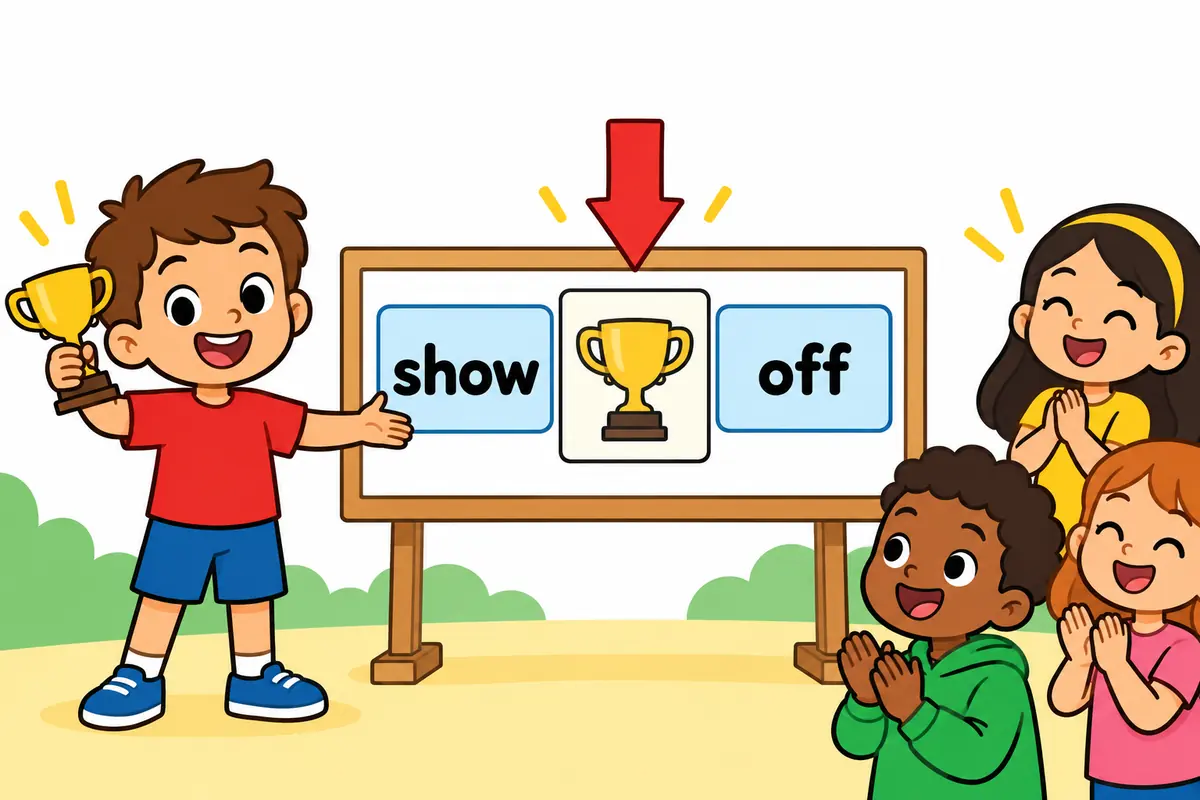
Show off in a sentence: examples across contexts
Show off shifts register more than it shifts meaning. The nine sentences below move from a playground to a product review, and each keeps the phrase in a natural order.
| Context | Example sentence | Why this works |
|---|---|---|
| Playground | Mia showed off her skipping tricks to the whole line. | A concrete skill and an audience make the display vivid. |
| Workplace email | The sales team showed off the new dashboard at the review. | Transitive display sense, useful and neutral in tone. |
| News report | The champion showed off her serve before the final. | Names a public figure performing for a crowd. |
| Product review | The phone shows off its camera in low light. | The machine as subject suits technical praise. |
| Classroom | Stop showing off and let someone else answer. | Intransitive use, the common gentle rebuke. |
| Sports writing | The winger showed off his footwork near the corner flag. | Skill on display in a competitive setting. |
| Conversation | He always shows off when his cousins visit. | Present tense marks a habit rather than one event. |
| Travel writing | The harbour shows off its fishing boats at dusk. | A personified place, a common figurative extension. |
| Academic prose | The study showed off a method that few labs could copy. | Formal context, same transitive pattern. |
Show off vs boast
Show off and boast both describe seeking admiration, but they describe different actions. Show off is about doing something visible, while boast is about saying something, and a sentence usually needs only one of them.
| Attribute | show off | boast |
|---|---|---|
| Core action | Display an object or skill | Talk about your own success |
| Needs an object | Optional, can stand alone | Never, the speaker is the subject |
| Typical subject | A person or even a thing | A person only |
| Register | Informal to neutral | Neutral to formal |
| Implies a display | Always, something is seen | No, the claim may be pure talk |
Verdict: choose show off when something is seen, and boast when something is said. A quiet champion can boast without an audience, but showing off needs somebody to watch.
Word forms and grammar of show off
The phrase keeps its two parts through every tense, and the hyphens change when it becomes a noun or adjective. The table lists the forms writers need most.
| Form | Part of speech | Example |
|---|---|---|
| show off | phrasal verb, base form | They love to show off on stage. |
| shows off | verb, third person singular | She shows off her drawings every week. |
| showed off | verb, past tense | The team showed off the trophy yesterday. |
| showing off | verb, present participle | He is showing off again. |
| show-off | noun or adjective | A show-off answer rarely wins friends. |
| show off it | non-standard order | Do not write it; the pronoun forces show it off. |
The hyphen is the useful signal: a show-off is a person or a description, while show off with a space is the action. Its neighbour show up shares the verb but means to arrive, so the particle carries the entire difference.
Common mistakes with show off
- Incorrect:
The children showed off it to the teacher.Correct: The children showed it off to the teacher. Rule: A pronoun object must sit between the verb and the particle. - Incorrect:
He is a big show off.Correct: He is a big show-off. Rule: The noun takes a hyphen, showing that it is one unit. - Incorrect:
Please show off me your project.Correct: Please show me your project. Rule: That sentence needs the plain verb show, not the boastful phrase. - Incorrect:
She showed off in front of nobody.Correct: She showed off to the visitors. Rule: Showing off implies an audience, so name the person or group who watches.
Practice using show off
Work through the six items, then read the reason with each answer.
- Fill the gap: At the fair, the twins ______ their juggling to the crowd.
- Choose the better word: The captain (showed off / boasted) that she had scored twice, though nobody saw it.
- Correct the error: He showed off it at every meeting.
- Build a sentence: use show + object + off about a new pair of running shoes.
- Spot the register: which belongs in a formal report — the device demonstrates its speed under load, or the device shows off big time?
- Rewrite with the noun: He is always showing off. Use show-off instead.
Answers
- showed off — the object is a long noun phrase, so the joined order reads naturally.
- boasted — nobody saw the claim, so the talking verb fits and showing off does not.
- He showed it off at every meeting — the pronoun must go before off.
- Model answer: Sam showed his new running shoes off to the whole team.
- The device demonstrates its speed under load — a report avoids the slang big time and the boastful phrase.
- He is a real show-off — the hyphens mark the noun that names the person.
The bottom line
Use show off in a sentence when something is displayed for admiration, and remember that the phrase is separable, so the object can sit between the verb and the particle. Two nuances decide most sentences: a pronoun object forces the split order, as in show it off, and the phrase carries disapproval, so a neutral report may prefer exhibit or demonstrate. Keep the hyphen only for the noun.
Frequently asked questions about show off
Is show off one word or two?
As a verb it is two words, show off, as in she showed off her medal. As a noun or an adjective it takes a hyphen, show-off, as in he is a show-off. The spelling change signals the job the phrase is doing, so the hyphen never appears in the verb itself.
Can you say show off it?
No. When the object is a pronoun, it must sit between the verb and the particle, so the correct form is show it off. The joined order show off it is not used by native speakers. Longer noun phrases may take either order, which gives more freedom.
Is show off rude?
Show off usually carries mild disapproval, because it suggests someone is seeking attention rather than simply doing well. Saying a classmate shows off can sound critical. For neutral praise, use demonstrate, display or exhibit, all of which describe the act without judging the person’s motive.
What is a show-off?
A show-off is a noun for a person who constantly seeks admiration, as in the little show-off sang the loudest. It is written with a hyphen and takes articles like any noun. The word is informal and slightly teasing, so it suits a playground more than a formal report.
Have you ever wanted to impress someone by flaunting your abilities or possessions? That act of displaying or demonstrating something proudly to attract attention is what we commonly refer to as “showing off.”
Whether it’s showcasing your talents, achievements, or material possessions, showing off is often used to gain admiration or validation from others. While it can be perceived as arrogant or boastful, there are times when a little bit of showing off can be harmless fun or a way to boost one’s confidence.
7 Examples Of Show Off Used In a Sentence For Kids
- Show off your colorful drawing to your friends.
- Let’s show off our dance moves at the school assembly.
- Show off your favorite toy during playtime.
- We can show off our beautiful costumes at the school play.
- Show off your new book to the class.
- It’s fun to show off your fancy lunch box.
- Show off your best handwriting to the teacher.
14 Sentences with Show Off Examples
- Show off your knowledge in the subject by actively participating in class discussions.
- Make sure to show off your unique talents during talent shows and college events.
- It’s important to show off your creativity through your projects and assignments.
- Don’t be afraid to show off your dance moves at cultural events and parties.
- Show off your leadership skills by taking on roles in student organizations and clubs.
- Use social media platforms to show off your achievements and experiences to your peers.
- Attend networking events to show off your communication skills and make new connections.
- Take part in sports activities to show off your physical prowess and team spirit.
- Show off your fashion sense by dressing stylishly on campus.
- Use your public speaking skills to show off your confidence during presentations.
- Attend workshops and seminars to show off your commitment to learning and self-improvement.
- Show off your time management skills by balancing academics and extracurricular activities effectively.
- Showcase your musical talents and skills by showing off during college music festivals.
- Display your academic achievements proudly to show off your dedication to your studies.
How To Use Show Off in Sentences?
To Show Off in a sentence, you can highlight something you are proud of or want others to notice.
Here are some examples to help you understand how to use Show Off effectively in sentences:
- “She loves to show off her new dance moves at every party.”
- “He couldn’t resist showing off his impressive collection of vintage cars.”
- “It’s okay to show off your talents and skills during the interview.”
- “Don’t show off too much during the presentation; it can be distracting.”
- “The artist decided to show off her latest masterpiece at the gallery opening.”
Remember, using Show Off in a sentence is a great way to express pride or confidence in yourself or something you’ve accomplished. Just be mindful not to come across as boastful or arrogant. Instead, use Show Off to share your achievements or abilities in a positive and engaging way. Practice using it in different contexts to become more comfortable incorporating it into your everyday language.
Conclusion
In everyday situations, people often tend to showcase their possessions or abilities through ‘show off’ behaviors. Some may flaunt their expensive belongings, while others may boast about their achievements to receive admiration or validation from others. However, excessive ‘showing off’ can sometimes come across as arrogant or unnecessary, potentially leading to negative perceptions or reactions from those around.
It is important to strike a balance between sharing accomplishments or possessions in a humble manner and being mindful of how such displays may be perceived by others. Ultimately, genuine confidence and self-assuredness shine through without the need to constantly ‘show off’ to prove one’s worth.


