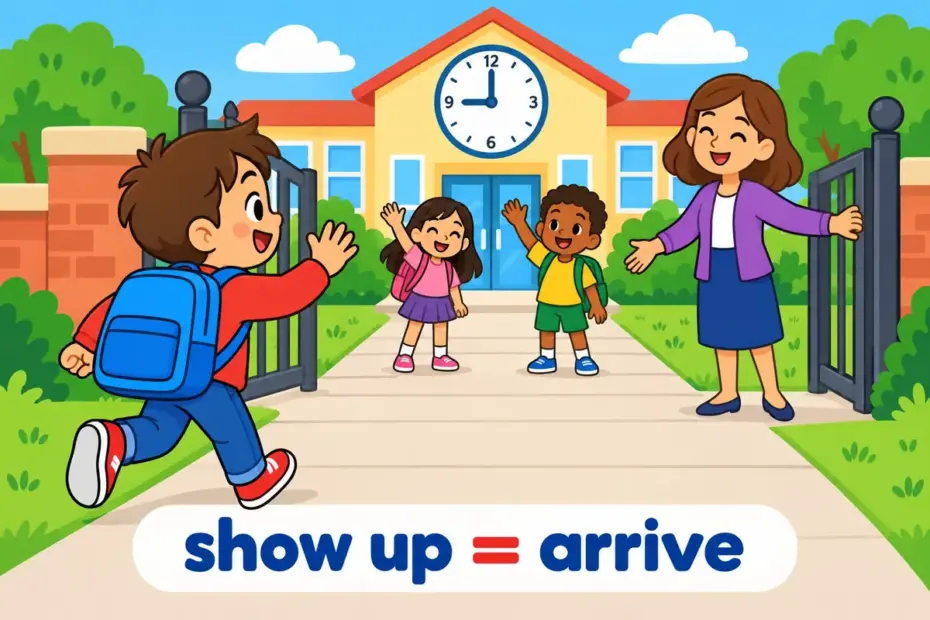
Show up is a phrasal verb meaning to arrive or appear, often when expected. To use show up in a sentence, put the person or thing before it and leave the object out: “She showed up at nine.” The verb is intransitive, so it rarely takes an object, and it can mean arriving in person or simply becoming visible.
Show up at a glance
- Show up is an intransitive phrasal verb; its forms are shows up, showed up, shown up and showing up.
- The particle up stays next to the verb when the meaning is arrive.
- The main senses are reaching a place and becoming visible.
- It belongs to informal and neutral speech, common in conversation and email.
- The commonest error is giving the arrival sense a direct object.
What does show up mean?
Show up is a phrasal verb meaning to arrive or to become visible. The Cambridge entry for show up records both senses. The arriving sense is intransitive, so it takes no object and the particle stays fixed, as in the guests showed up at noon. The visible sense describes something that becomes noticeable, as in a dent showed up on the door. For a formal register, appear is the safer verb.
| Sense | Plain meaning | Example sentence |
|---|---|---|
| Arrive | Reach a place, often expected or late | The band showed up an hour late. |
| Become visible | Become noticeable or apparent | A crack showed up in the ceiling. |
| Expose (show someone up) | Make someone look foolish by comparison | He showed his brother up at dinner. |
Show up is too casual for a formal report, where arrive or attend reads better. It also never means to bring a person somewhere, so do not write show up a friend at the party.
How do you use show up in a sentence?
Show up keeps its particle in place when it means arrive, so the verb is intransitive and inseparable in that sense. The separate idiom show someone up is the exception: there the object may sit between the verb and the particle.
| Pattern | Example | What it signals |
|---|---|---|
| subject + show up + time | She showed up at nine. | Plain arrival, no object. |
| show up + for + event | Half the team showed up for training. | Attendance at a named event. |
| show up + in/on + noun | A stain showed up on the wall. | Something becomes visible. |
| show someone up | He showed his rival up at the debate. | Embarrassing another by comparison. |
| be shown up | The mistake was shown up by the audit. | A fault is exposed, in the passive. |
The arrival sense cannot be split: say she showed up, never she showed up it. Turn up follows the same inseparable pattern. For something that becomes visible, surface is a close synonym.
Show up in a sentence: examples across contexts
Show up changes little in meaning but moves easily between casual and neutral writing. The nine sentences below place it in a classroom, a news report and a conversation, and each one names who or what appeared.
| Context | Example sentence | Why this works |
|---|---|---|
| Classroom | Only six students showed up for the early revision class. | Everyday school attendance in plain language. |
| Workplace email | The client showed up without an appointment, so we rescheduled. | Neutral office use with a clear subject. |
| News report | Hundreds showed up for the vigil despite the rain. | Reporting prefers a countable crowd as the subject. |
| Science writing | Traces of the chemical showed up in every sample. | The visible sense fits technical measurement. |
| Customer service | The error showed up again after the update. | A fault becoming apparent, not a person arriving. |
| Sports commentary | The substitute showed up in the second half. | Informal arrival of a player. |
| Literary prose | A shadow showed up on the far wall. | The visible sense carries a quiet, atmospheric tone. |
| Conversation | He showed up late and left early. | Short, casual, verb and particle together. |
| History essay | New records showed up a decade later. | Documents becoming known over time. |
For a scheduled, formal event, attend is the verb a report would choose; show up keeps the informal flavour of people drifting in. With a different particle the verb changes meaning entirely, as in show off.
Show up vs turn up
Show up and turn up both mean arrive, and in many sentences either will do. The difference lies in surprise and in regional habit, with turn up suggesting that the arrival was not planned.
| Attribute | show up | turn up |
|---|---|---|
| Core meaning | Arrive, often expected | Arrive, often by chance |
| Surprise | Low; the person was due | Higher; unannounced |
| Transitivity | Intransitive | Intransitive |
| Typical partner | show up for class | turn up at the door |
| Extra sense | expose (show someone up) | increase volume or heat |
| Regional feel | Common in American English | Common in British English |
Choose show up for an expected arrival and turn up when the arrival is a surprise, especially if you are writing for a British reader.
Word forms and grammar of show up
The verb is regular apart from the participle, and the particle never changes. Learners often mix showed and shown, or try to separate the parts when the meaning is arrive.
| Form | Part of speech | Example |
|---|---|---|
| show up | base form | They show up on time. |
| shows up | third person singular | She shows up early. |
| showed up | past tense | He showed up at dawn. |
| shown up | past participle | They had shown up before us. |
| showing up | present participle | Showing up late looks careless. |
| shown-up | not standard as a compound | Use who showed up instead. |
Keep materialize as the formal synonym when a report needs a less casual verb than show up.
Common mistakes with show up
- Incorrect:
She showed up the meeting.Correct: She showed up for the meeting. Rule: the arrival sense is intransitive, so it takes a preposition, not a direct object. - Incorrect:
He showed up it late.Correct: He showed up late. Rule: the particle cannot be separated in the arrival sense. - Incorrect:
They shown up early.Correct: They showed up early. Rule: the simple past is showed; shown is the participle. - Incorrect:
Please show up your ticket at the door.Correct: Please show your ticket at the door. Rule: the arrival phrasal verb cannot take an object; show alone means display. - Incorrect:
I will show up to the class tomorrow.Correct: I will show up for the class tomorrow. Rule: show up for is the fixed collocation for events.
Practice using show up
Work through the six items, then check the reason with each answer.
- Fill the gap: Forty guests ______ at the hall before the music began.
- Choose the better word: After the storm, a leak (showed up / turned up) in the ceiling.
- Correct the error: The band shown up two hours late.
- Build a sentence: use show up for about a friend arriving at a football match.
- Spot the register: which belongs in a news report — hundreds showed up for the vigil, or we all showed up, obviously?
- Rewrite without the phrasal verb: The manager showed up at the meeting. Use attend.
Answers
- showed — the simple past of show is showed, and the guests are the subject with no object.
- showed up — a leak becomes visible, which is the visible sense; turned up would suggest someone arrived.
- The band showed up two hours late — the past tense is showed, not shown.
- Model answer: Sam showed up for the match with the tickets already in his pocket.
- Hundreds showed up for the vigil — a report avoids obviously and the first person.
- The manager attended the meeting — attend is the formal verb for a scheduled event.
The bottom line
Use show up in a sentence when someone arrives or something becomes visible, and remember that the arrival sense takes no object. The two nuances that decide most sentences are that the particle cannot be split, and that the separate idiom show someone up means to embarrass rather than to arrive.

Frequently asked questions about show up
Is show up one word or two?
It is always two words. Show up is a phrasal verb made of the base verb show and the particle up, and the two parts stay separate. The noun for the act of arriving, show-up, is rare and hyphenated, so in normal writing you should keep show and up apart.
What is the difference between show up and show off?
Show up means to arrive or become visible, and it takes no object. Show off means to display something in order to impress people, and it can take an object, as in he showed off his new bike. The particle changes the meaning completely, so they are never interchangeable.
Can you say show up something?
Not in the arrival sense. When show up means to arrive, it is intransitive, so you cannot show up a party; you show up for a party. The only object-taking use is the idiom show someone up, which means to embarrass someone by comparison, and there the object sits between the two parts.
Is show up formal or informal?
It is informal to neutral. Friends, emails and news reports use it freely, as in half the class showed up. A formal report would prefer arrive or attend, because show up sounds conversational. The visible sense is a little more neutral, as in a fault showed up in testing.
Have you ever wondered how to properly use the phrase “show up” in a sentence? Essentially, “show up” means to arrive or make an appearance at a specified place or time. It can also indicate appearing or becoming visible.
The phrase “show up” is commonly used in various contexts, from social gatherings to work commitments. Understanding its correct usage can enhance your communication skills and convey your message effectively. Let’s explore how this versatile phrase can be incorporated into different types of sentences for improved clarity and impact.
7 Examples Of Show Up Used In a Sentence For Kids
- Show up on time for school every day.
- Show up for the morning assembly.
- Let’s all show up at the playground for playtime.
- Please show up with your homework completed.
- A magician will show up at our school to perform tricks.
- Make sure to show up in your school uniform.
- Don’t forget to show up for the school play rehearsal.
14 Sentences with Show Up Examples
- Show up for the first day of college with all your required documents.
- Make sure you show up to class on time to avoid missing important information.
- It’s important to show up for group study sessions to contribute and learn from your peers.
- Don’t forget to show up for your exams well-prepared and confident.
- Make sure you show up for club meetings to stay involved in campus activities.
- Show up for networking events to make valuable connections for your future career.
- Plan to show up for career fairs to explore job opportunities and internships.
- Don’t procrastinate; show up for your assignments and submit them on time.
- Make it a habit to show up for extracurricular activities to develop new skills and interests.
- It’s essential to show up for your counseling sessions to take care of your mental health.
- Show up for seminars and workshops to expand your knowledge beyond the classroom.
- Set reminders so you don’t forget to show up for guest lectures by industry experts.
- Make an effort to show up for sports events to support your college team.
- Don’t hesitate to show up for volunteer opportunities to give back to the community.
How To Use Show Up in Sentences?
Show Up
When using the phrase Show Up in a sentence, you are referring to the act of being present at a specific location or event. Here are some tips on how to use it effectively:
-
Verb form: The main word in the phrase is Show Up, which is a verb that means to arrive or appear in a particular place. For example, “I will show up at the meeting on time.”
-
Use in a sentence: When incorporating Show Up in a sentence, remember to place it before the location or event you are attending. For instance, “She decided to show up at the party despite feeling tired.”
-
Tense: Ensure to conjugate the verb correctly based on the subject and the tense of the sentence. For instance, “They always show up at work early each day.”
-
Informal use: The phrase Show Up can be used in a more casual context when talking about attendance. For example, “I hope you can show up to my birthday party this weekend.”
-
Synonyms: If you want to vary your vocabulary, consider using synonyms such as “attend,” “appear,” or “present” in place of Show Up in your sentences to convey a similar meaning.
By following these guidelines, you can effectively incorporate Show Up into your sentences with confidence and clarity.
Conclusion
In conclusion, the sentences created using the keyword “show up” illustrate the concept of appearances, visibility, and arrival. These examples showcase how the phrase can be used to describe physical presence, attendance, and manifestation in various contexts. Whether it’s about showing up for a meeting, event, or duty, the keyword effectively conveys the idea of being present and actively taking part in something.
Overall, the diversity of sentences using “show up” highlights the importance of showing up in different facets of life – from personal relationships to professional commitments. By making a conscious effort to show up, individuals can demonstrate reliability, dedication, and engagement, ultimately contributing positively to their own growth and the success of the endeavors they are involved in.