
Significance in a Sentence: Meaning and Examples
Significance is the importance or special meaning of something in a particular context. In a sentence, the surrounding details should show what matters, to whom, or what an object or event means; the noun often appears in patterns such as the significance of, significance to, and attach significance to.
- Meaning: importance, or a special meaning.
- Grammar: significance is usually an uncountable noun in everyday use.
- Common patterns: the significance of, of great significance to, and attach significance to.
- Writing tip: explain the reason something matters instead of relying on “very significant.”
- Technical caution: statistical significance alone does not show that a result is large or practically important.


What does significance mean in a sentence?
Significance can name either how much something matters or the meaning it carries. Cambridge Dictionary separates these as “importance” and “special meaning”; context tells readers which sense a sentence uses.
| Sense | Sentence pattern | Example |
|---|---|---|
| Importance or consequence | the significance of / significance to | The report explains the significance of clean drinking water to public health. |
| Special or implied meaning | the significance of a sign, remark, or gesture | She wondered whether the old photograph had any significance for her family. |
| Statistical use | statistical significance | The study reported statistical significance, then described the estimated effect separately. |
Note about the preserved examples: The source material below is kept verbatim. Some list items are phrases or sentence fragments rather than complete sentences; use the new usage guidance and examples after the preserved material when you need a complete model sentence.
Discovering the significance of a word in a sentence is like uncovering its hidden power. In linguistics, the significance of a word refers to its importance, impact, or meaning within a specific context.
Understanding the significance of a word can greatly enhance our comprehension of a sentence’s message and intent. By recognizing the weight that a word carries in a sentence, we can decipher nuances, implications, and underlying messages that may not be immediately apparent.
7 Examples Of Significance Used In a Sentence For Kids
- Significance means something is very important.
- Understanding the significance of family is essential.
- We must respect the significance of our national flag.
- Knowing the significance of honesty is crucial.
- Learning about nature’s significance is fascinating.
- Exploring the significance of colors can be fun.
- Celebrating festivals helps us understand their significance.
14 Sentences with Significance Examples
- Significance of attending college fests goes beyond fun; it helps in developing organizational skills.
- College canteens hold great significance as they serve as social hubs for students to meet and relax.
- Joining a club or extracurricular activity in college has immense significance for personal growth and skill development.
- The significance of internships in college cannot be emphasized enough for gaining practical experience.
- Significance of networking with alumni lies in the potential opportunities and mentorship they can provide.
- Research projects showcase the significance of critical thinking and problem-solving skills in a college curriculum.
- The significance of attending lectures regularly cannot be understated for academic success.
- Developing a strong professional network during college holds immense significance for future career opportunities.
- The significance of time management skills in college is crucial for balancing academics and extracurricular activities.
- Participating in college sports holds significance for maintaining physical health and fostering teamwork skills.
- The significance of mental health awareness and seeking support services in college cannot be ignored.
- The significance of peer-to-peer learning and study groups in college aids in better understanding complex subjects.
- Regularly visiting the college library holds significance for accessing academic resources and improving study habits.
- The significance of career guidance and counseling in college helps students make informed decisions about their future.
How To Use Significance in Sentences?
Significance is a word that is used to describe the importance or meaning of something in a sentence. To use Significance correctly, first, identify the key idea or event that you want to highlight. Next, think about how this idea or event impacts the overall meaning or purpose of your sentence.
Here are some examples of how to use Significance in a sentence:
- “The discovery of a cure for a rare disease is of great significance to the medical community.”
- “The significance of the painting lies in its unique portrayal of human emotion.”
- “The significance of the historical event cannot be overstated in shaping our understanding of the past.”
- “The significance of winning the championship was evident in the celebratory parade that followed.”
When using Significance in a sentence, remember to provide context so that the reader understands why the idea or event is important. You can also use words like “importance,” “meaning,” or “impact” to convey a similar meaning if Significance feels too formal.
By following these simple guidelines and practicing using Significance in your sentences, you will be able to effectively communicate the importance of various ideas and events in your writing.
Conclusion
In conclusion, sentences with significance play a crucial role in conveying important ideas, emotions, and information. They are carefully crafted to make a profound impact on the reader or listener, eliciting thought, reflection, or action. These sentences are often memorable and go beyond mere words to leave a lasting impression on individuals.
Whether found in literature, speeches, or everyday conversations, sentences with significance have the power to inspire, educate, and connect people from different backgrounds. They are the building blocks of effective communication and are key in expressing complex concepts in a clear and impactful manner. Thus, the ability to craft sentences with significance is a valuable skill that can enhance one’s writing, speaking, and overall ability to communicate effectively.
How do you use significance naturally?
Use significance when you can identify the connection between an event, object, result, or idea and what it means or affects. A useful sentence names the subject, the relevant context, and the reason for its importance.
- Name the event or object: “The bridge’s opening…”
- State the relevant context: “…for the island’s residents…”
- Explain the importance or meaning: “…was significant because it shortened the only year-round road journey to the clinic.”
- Use the noun form if it reads smoothly: “The significance of the bridge’s opening was its year-round connection to the clinic.”

That detail is more informative than “The bridge was very significant.” The adjective significant states that something matters; a reason or consequence shows readers how it matters in this case.
Which phrases commonly go with significance?
The preposition and surrounding verb clarify the relationship that significance expresses. Oxford Learner’s Dictionaries includes the pattern attach significance to; these examples show other common constructions.
| Pattern | Use | Example |
|---|---|---|
| the significance of X | Identifies the subject whose meaning or importance is being discussed. | The guide explains the significance of the symbols on the map. |
| significance to X | Names the person, group, field, or outcome for which something matters. | The change has practical significance to small libraries. |
| significance for X | Connects a fact or event to its effects or relevance for a person or purpose. | The result has significance for future planning. |
| attach significance to X | Describes assigning importance or meaning to something. | Readers may attach different significance to the same ending. |
| of little / great significance | Evaluates relative importance; the context should support the evaluation. | The correction was of little significance to the final result. |
In ordinary sentences, significance is generally treated as uncountable: “The discovery has significance.” The plural significances occurs when writers mean several distinct meanings or interpretations, but it is less common and often sounds more natural as “different meanings” or “different kinds of significance.”
How is significance different from meaning, importance, and impact?
These related words overlap, but they direct attention to different parts of an explanation. Choose the one that names the point you want readers to understand.
| Word | What it emphasizes | Example |
|---|---|---|
| meaning | What a word, sign, action, or event communicates or represents. | The meaning of the blue symbol is explained in the map key. |
| importance | How much something matters or deserves attention. | The importance of a clear map is obvious during an evacuation. |
| impact | An effect or change caused by something. | The new route reduced travel time for clinic visitors. |
| significance | The importance or meaning of something in a particular context. | The route’s significance is its reliable access to the clinic during winter. |

What does statistical significance mean?
In statistics, statistical significance describes a result evaluated under a statistical model and a chosen threshold; it does not by itself measure the size or real-world importance of an effect. The American Statistical Association cautions that statistical significance is not equivalent to scientific, human, or economic significance.
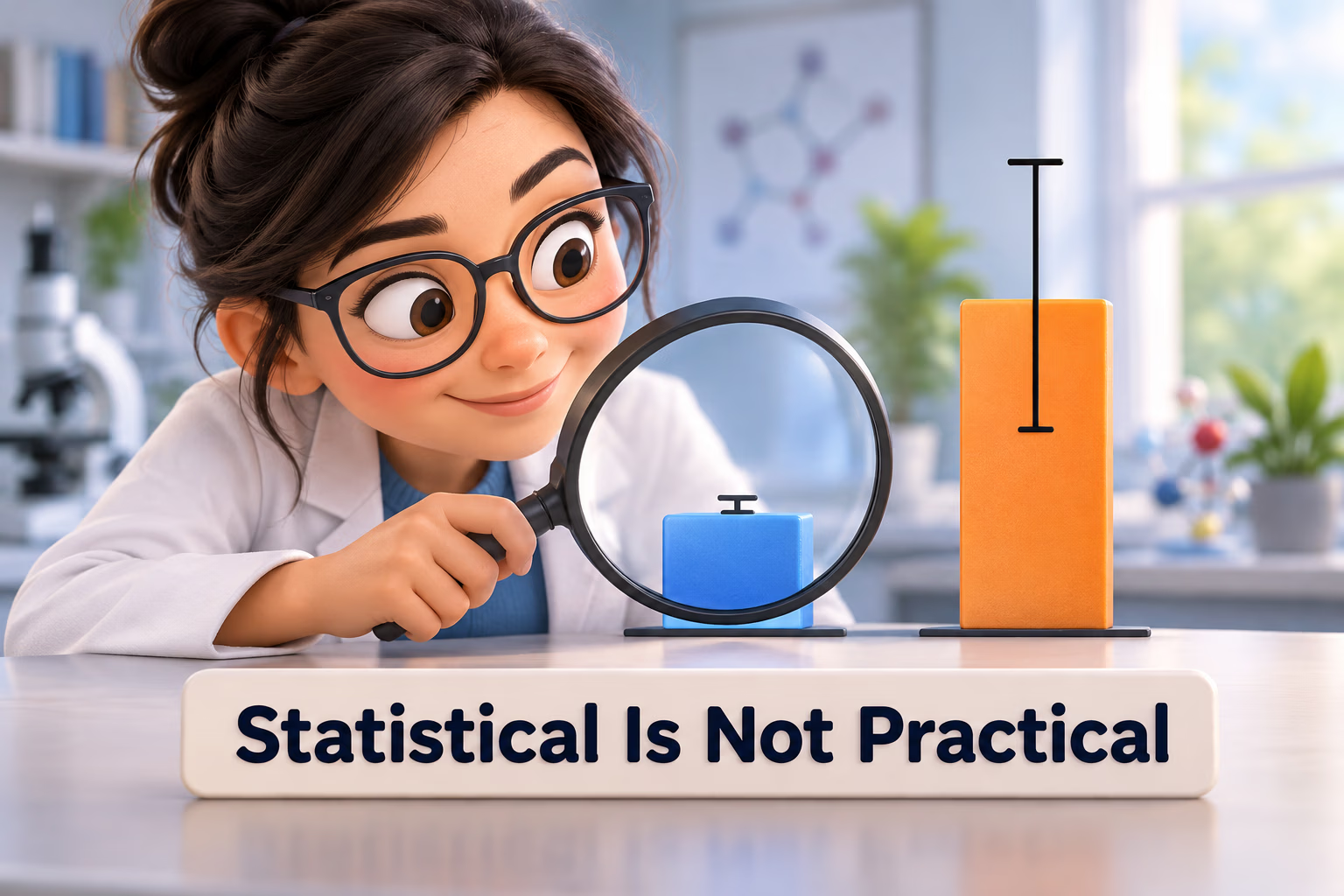
For example, a very small difference can meet a statistical threshold in a large, precise study, while a potentially meaningful difference can remain uncertain in a small study. When writing about research, report the effect estimate and its uncertainty alongside any significance label; do not translate “statistically significant” into “large,” “important,” or “proved.”
What mistakes should writers avoid?
- Leaving the context unstated: explain who or what the issue matters to.
- Using the noun where an adjective is needed: write “a significant change” or “the significance of the change,” depending on the sentence.
- Calling every result important: distinguish a result’s measured evidence from its practical consequences.
- Overstating a personal interpretation: phrases such as “the symbol’s significance” should be supported by the relevant story, culture, or speaker rather than assumed to be universal.
- Using “significance” as decoration: when no special importance or meaning is intended, a simpler word may be clearer.
Frequently asked questions about significance in a sentence
Is significance a noun?
Yes. Significance is a noun, usually uncountable in common use. It names the importance or special meaning of something: “The discovery has scientific significance.” Use the adjective significant before a noun (“a significant discovery”) or after a linking verb (“the discovery is significant”).
What is a simple sentence with significance?
“The old letter had special significance to Maya.” Here, significance means personal meaning, and to Maya identifies the person for whom the letter matters. A sentence about importance could be: “The survey has significance for local planners.”
Can significance mean importance and meaning?
Yes. Cambridge Dictionary records both importance and special meaning. “The significance of the bridge” may refer to its practical importance, while “the significance of the gesture” may refer to what the gesture implies. A nearby explanation can remove ambiguity.
Does statistical significance mean a result is important?
No. Statistical significance alone does not measure an effect’s size or practical importance. Describe the effect estimate, its uncertainty, the study context, and the decision that depends on it before deciding whether the result matters in practice.
Sources
For definitions and usage patterns, see Cambridge Dictionary: significance and Oxford Learner’s Dictionaries: significance. For the technical distinction, see the American Statistical Association’s statement on p-values.
Conclusion: A clear sentence with significance states whether something matters or carries a special meaning and supplies the context that explains why. In statistical writing, use the phrase precisely and keep evidence, effect size, and practical importance distinct.


