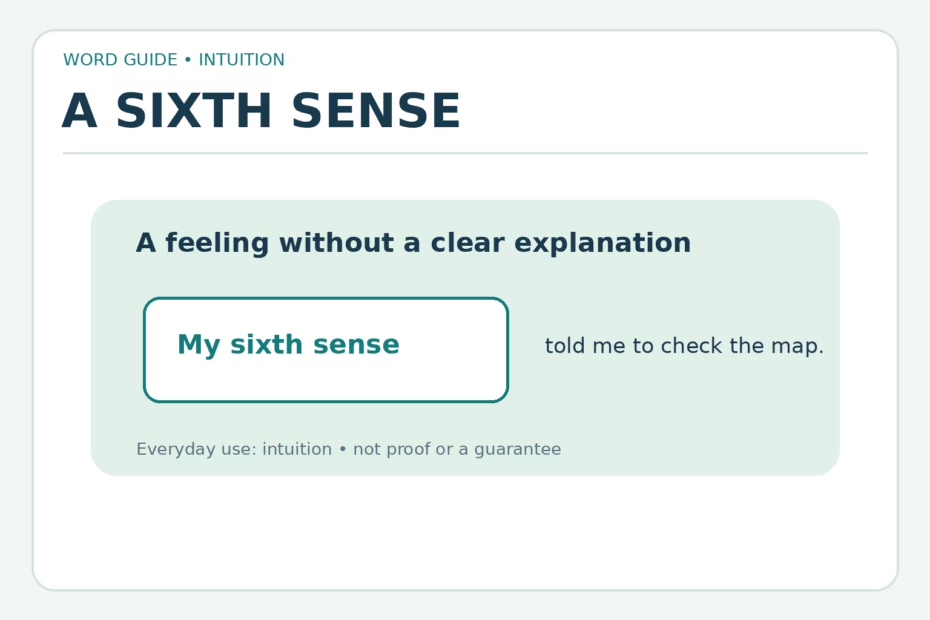
A sixth sense is an intuitive feeling that seems to tell someone something without an obvious explanation. In ordinary conversation, it usually means a hunch or strong intuition, not a literal extra physical sense. For example: My sixth sense told me that I had left my keys at the café. Cambridge Dictionary also describes the phrase as an ability some people believe gives information beyond the five familiar senses. The wording can refer to paranormal beliefs, but everyday speakers often use it figuratively.
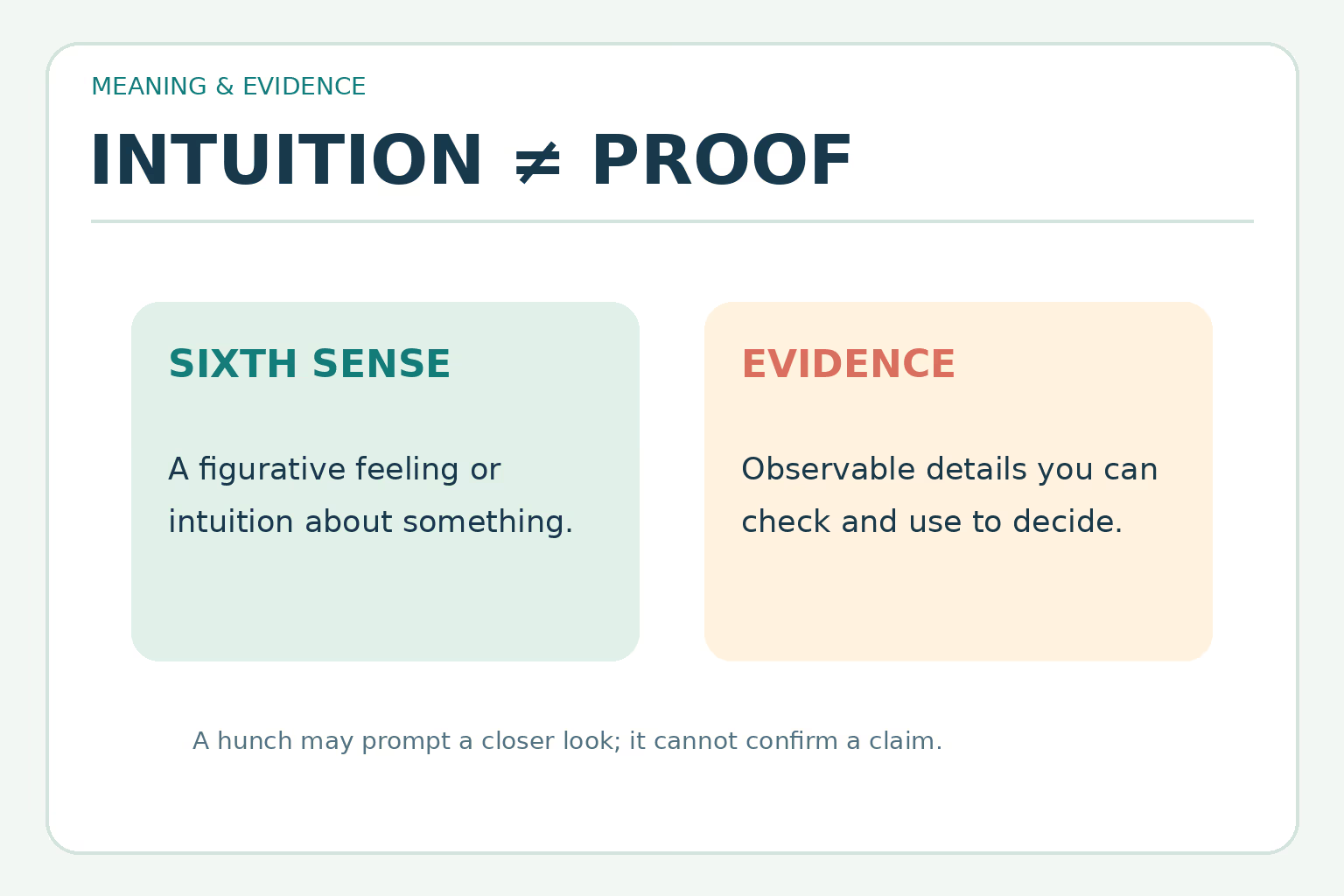
Use sixth sense to describe a feeling, suspicion, or instinct. It can make a sentence vivid, but it does not mean that the feeling is always correct. A hunch may come from small details a person has noticed without consciously reasoning through them; the phrase itself does not prove that someone has special knowledge.
How to use “sixth sense” in a sentence
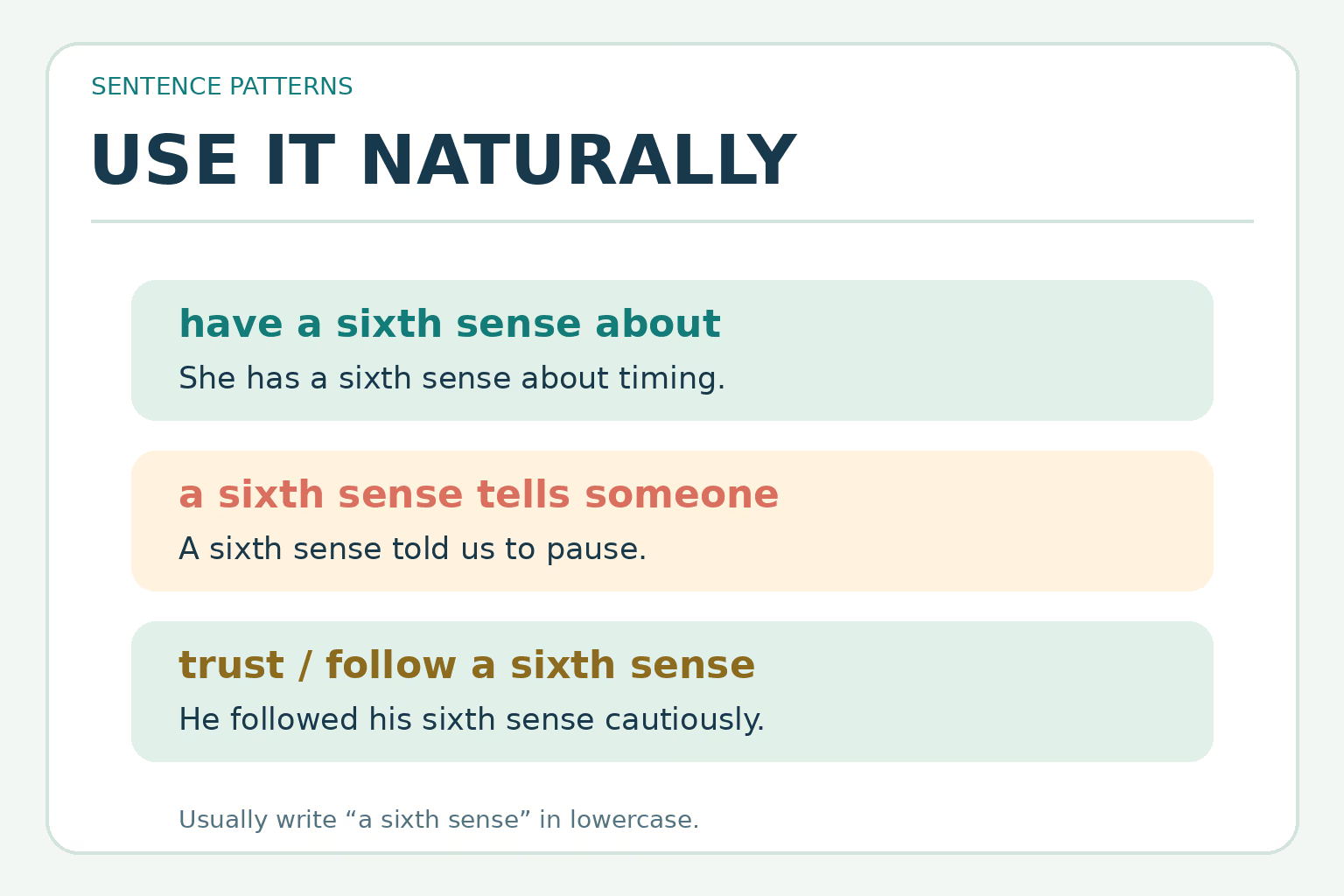
The phrase is a singular count noun, so it commonly follows a or a possessive word: a sixth sense, my sixth sense, her sixth sense. It often appears with these patterns:
- have a sixth sense about something: “Nina has a sixth sense about when a meeting is running too long.”
- a sixth sense tells someone (that) …: “A sixth sense told Omar that he had taken the wrong bus.”
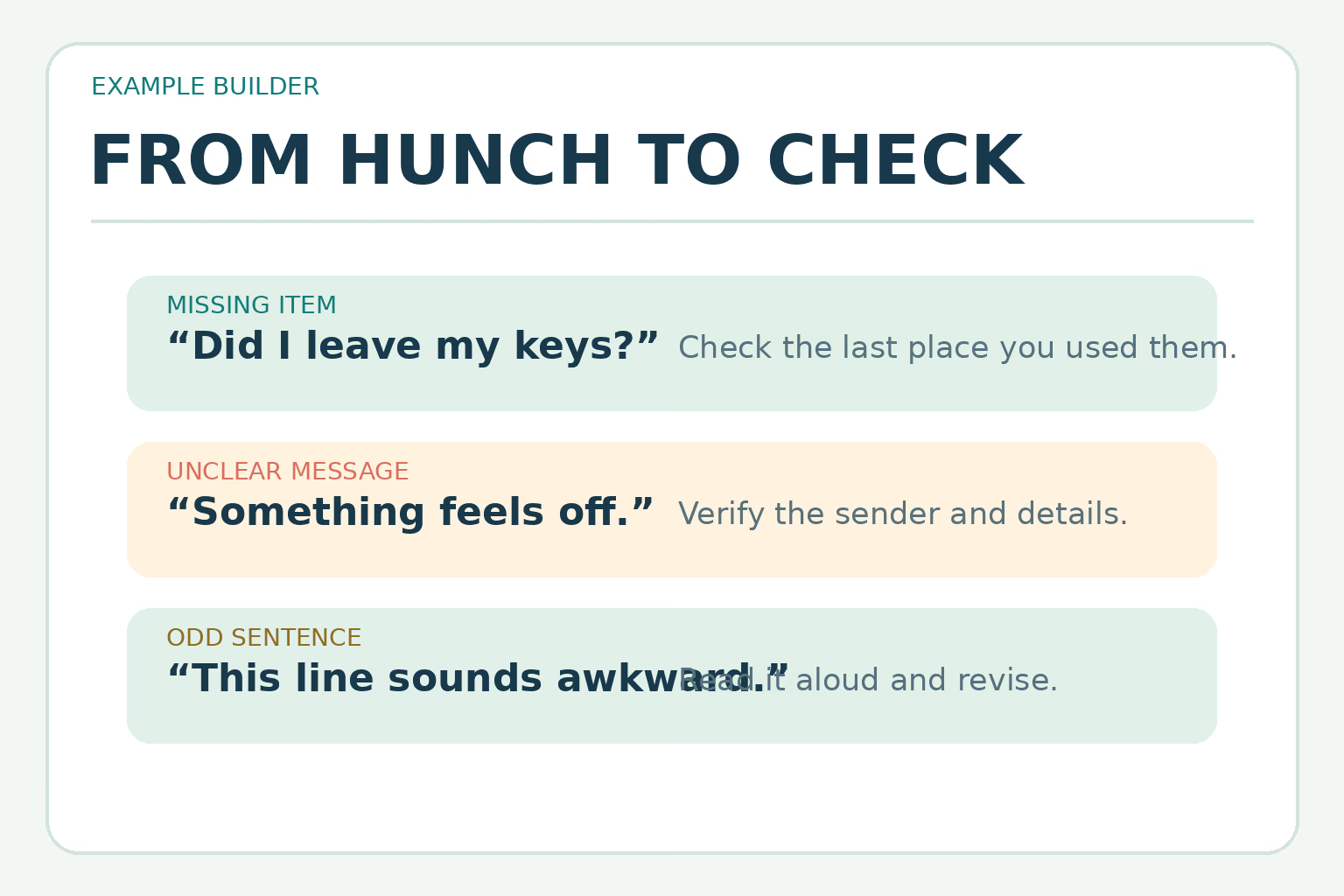
- trust, follow, or ignore a sixth sense: “I had a sixth sense that the email needed another check, so I read it again.”
- a sixth sense for something: “The editor has a sixth sense for a confusing sentence.”
Use the simple present for a general ability (She has a sixth sense for patterns), the past tense for one earlier feeling (I had a sixth sense that the room was familiar), and will or might when describing a feeling about what could happen (He might have a sixth sense about the result). After tells me, a that-clause is optional: My sixth sense tells me (that) we should check the address.
“Sixth sense” sentence examples
- My sixth sense told me I had left my notebook on the train.
- She has a sixth sense about when a customer needs a little more time.
- A sixth sense warned Leo that he had misread the appointment date.
- The gardener seems to have a sixth sense for knowing when the soil is too dry.
- I had a sixth sense that the familiar street was not the route we usually took.
- Her sixth sense for dialogue helps her notice when a line sounds unnatural.
- He followed his sixth sense and checked the meeting link before sending it.
- The coach has a sixth sense for spotting a player who needs encouragement.
- Our cat seemed to have a sixth sense about which box contained a toy.
- Do you ever get a sixth sense that you have forgotten something important?
- My first impression was only a sixth sense, so I asked a question before deciding.
- The detective’s sixth sense made her look twice at the inconsistent timestamp.
These examples use the expression to describe an impression or instinct. In real decisions, someone can explain the clues behind the feeling or check the relevant facts rather than treating intuition as a guarantee.
“Sixth sense,” “intuition,” and “instinct”
Intuition is the broader, more neutral word for understanding or judging something immediately, without consciously working through the facts. A sixth sense is a more colorful expression for that kind of feeling and can carry a mysterious or paranormal tone. Instinct often suggests a natural, immediate response or tendency. The words overlap, so the best choice depends on the tone: My intuition was that the instructions were incomplete sounds neutral; my sixth sense warned me sounds more dramatic; my instinct was to step back emphasizes an immediate reaction. Cambridge’s definition of intuition focuses on knowing or understanding based on feelings rather than facts.
Second sight is another expression for a supposed ability to know things beyond ordinary perception, often with a stronger supernatural implication. In casual conversation, people sometimes use it loosely as a synonym for sixth sense. If you simply mean a practical impression, intuition or hunch may be clearer.
Is “sixth sense” literal or figurative?
In most everyday sentences, sixth sense is figurative: it names a strong feeling or intuitive impression. Some speakers use the phrase to discuss extrasensory perception or paranormal ideas, but that is a claim or belief, not something the expression establishes. For a neutral account, describe the observable cue: instead of saying My sixth sense proved the offer was a scam, write The sender’s unfamiliar address and request for a password made me cautious, so I verified the message independently.
That distinction matters in advice about personal safety, health, money, or other consequential choices. A feeling can be a reason to pause and gather information; it should not replace practical checks or qualified help. In a fictional story, by contrast, a character’s sixth sense can be presented as a real supernatural power within that imagined world.
Common usage questions
Do you say “a sixth sense” or “the sixth sense”?
Use a sixth sense when describing someone’s intuitive ability or one particular hunch: She has a sixth sense about timing. Use the sixth sense when referring to the idea or concept as a whole: The story explores the idea of the sixth sense.
Should “sixth sense” be capitalized?
Usually no. Write sixth sense in lowercase in the middle of a sentence. Capitalize it at the start of a sentence or when it is part of a proper title.
What does “a sixth sense about someone” mean?
It means having an intuitive impression about that person. For example, Rae has a sixth sense about when her friend needs to talk describes a feeling, not proof of what the friend is thinking.
Is “sixth sense” the same as “gut feeling”?
They are close in everyday use. Gut feeling is an informal phrase for a strong impression; sixth sense can sound more dramatic or mysterious.
Can I write “my sixth sense tells me that …”?
Yes. The pattern is grammatical, and that can be left out: My sixth sense tells me (that) the train is delayed. The sentence reports a feeling, not a confirmed fact.
Sources and usage note
Definitions and usage distinctions were checked against Cambridge Dictionary’s entry for “sixth sense” and its entry for “intuition.” All example sentences in this guide are original.

Have you ever experienced a sudden intuition or gut feeling that seemed to come out of nowhere? This mysterious instinct that goes beyond our traditional five senses is what we commonly refer to as the “sixth sense.”
The sixth sense can be described as an innate ability to perceive or understand things without the use of the known physical senses. It’s often associated with a heightened awareness or a deep sense of intuition that guides us in ways we can’t always explain.
7 Examples Of Sixth Sense Used In a Sentence For Kids
- Sixth sense helps us feel things that we can’t see.
- Sometimes our sixth sense tells us when something is not right.
- We can trust our sixth sense to keep us safe.
- Our sixth sense can help us make good decisions.
- Animals also have a sixth sense to protect themselves.
- It’s important to listen to our sixth sense and trust our feelings.
- Our sixth sense is like a secret superpower that helps us understand things better.
14 Sentences with Sixth Sense Examples
- Sixth sense can help you anticipate difficult questions before exams and prepare better.
- Developing your sixth sense for time management can make juggling academics and extracurricular activities easier.
- College students often rely on their sixth sense to choose the right book in a crowded library.
- Trusting your sixth sense can lead you to join clubs and societies that align with your interests.
- Utilizing your sixth sense in group projects can help you sense conflicts before they arise.
- Your sixth sense may guide you to the best study spots on campus for maximum productivity.
- Listening to your sixth sense during interviews can help you gauge whether a job opportunity is right for you.
- College students often experience a heightened sixth sense during campus events and competitions.
- When exploring new academic pursuits, your sixth sense can help you choose the right courses.
- Pay attention to your sixth sense when selecting roommates to ensure a harmonious living arrangement.
- Your sixth sense can alert you to potential scams or fake job offers targeting college students.
- Attending seminars and workshops can help you fine-tune your sixth sense for career opportunities.
- Engaging in mindfulness practices can enhance your sixth sense and intuition.
- Developing your sixth sense for networking can open up new doors for internships and job placements.
How To Use Sixth Sense in Sentences?
Sixth Sense is a term used to describe the ability to perceive things beyond the five physical senses. When Sixth Sense is mentioned in a sentence, it usually refers to a gut feeling or intuition about something that cannot be explained logically.
To use Sixth Sense in a sentence effectively, consider the following tips:
1. Identify the Situation: Think about a situation where you or someone else had a feeling that turned out to be true, even though there was no apparent reason for it.
2. Intuition: Use the term Sixth Sense when referring to that intuitive feeling. For example, “She had a strong Sixth Sense that something was about to go wrong.”
3. Trust Your Instincts: Emphasize the importance of trusting your instincts and paying attention to your Sixth Sense in the sentence. For instance, “He always listens to his Sixth Sense when making important decisions.”
4. Uncertain Situations: Mention Sixth Sense in situations where there is uncertainty or a need for intuition. For example, “In moments of doubt, her Sixth Sense guides her to the right choice.”
Overall, using Sixth Sense in a sentence adds depth and insight to discussions about gut feelings and intuition. It helps convey the idea that there is more to understanding the world than just relying on the five traditional senses.
Conclusion
In conclusion, the concept of the sixth sense refers to an intuitive ability or instinct that allows individuals to perceive information beyond the five traditional senses. This innate intuition is often described as a gut feeling or hunch that guides decision-making and helps individuals navigate uncertain situations. Despite lacking scientific evidence, many people believe in the existence of a sixth sense based on personal experiences or anecdotal stories.
Whether it manifests as a feeling of impending danger, a sudden insight, or unexplained knowledge, the sixth sense remains a mysterious and intriguing aspect of human perception. While it may not be fully understood or easily explained, trusting and honing this intuitive faculty can lead to better decision-making and a deeper connection to the world around us.


