
What “So Far” Means
So far means “up to now,” “until this point,” or “up to a particular place or stage.” It looks back across a stretch of time or progress and marks the point reached. Cambridge Dictionary gives examples such as a number of people registering “so far” and a new appliance that works well “so far.” The expression is written as two open words in its ordinary adverbial use.
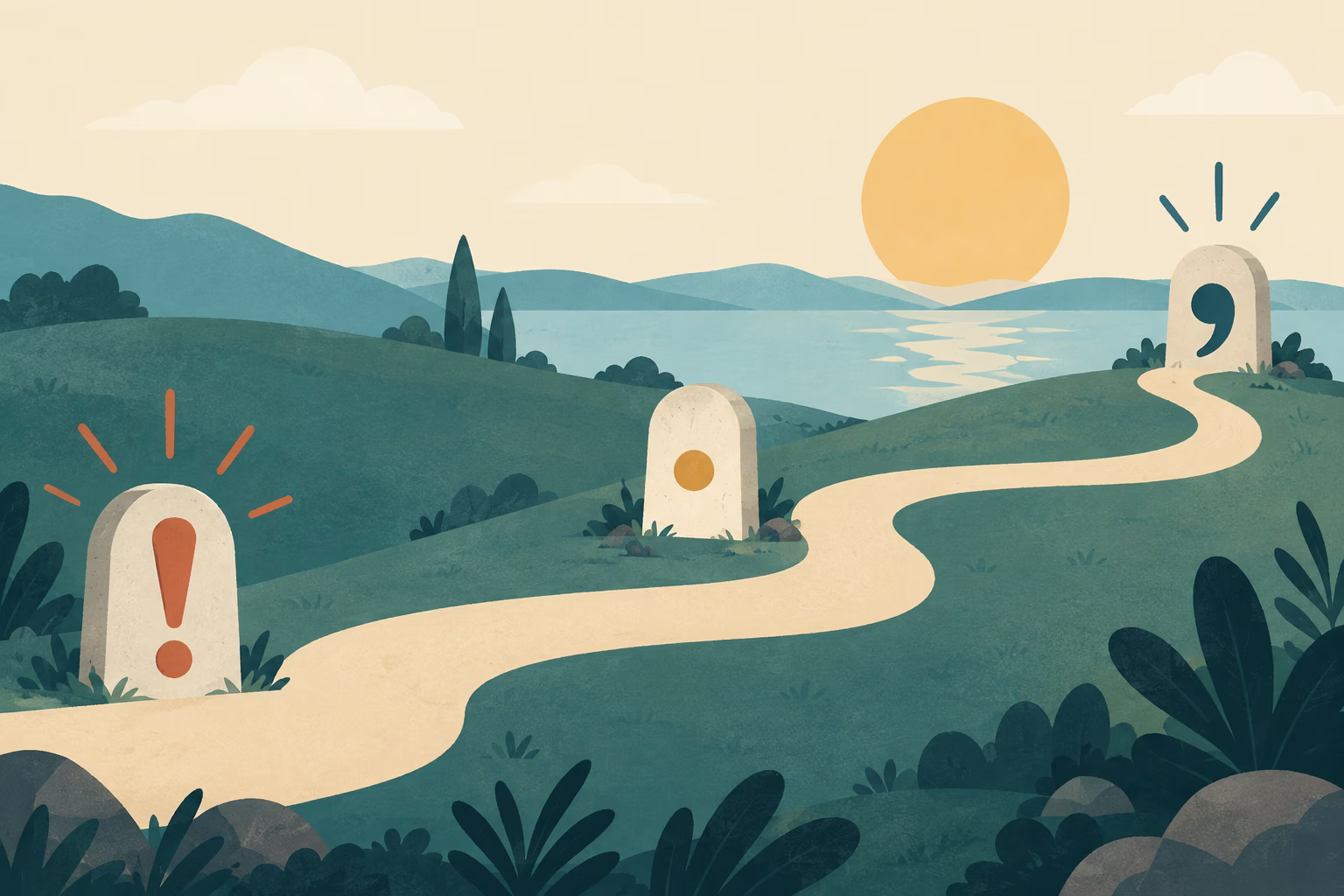
For example, We have received twelve applications so far means twelve have arrived by now, while more may still come. The phrase does not by itself tell us whether the process is finished. Context supplies that information: So far, the road is clear reports the situation at this point, not necessarily what will happen later.
Where to Put “So Far” in a Sentence
Two natural positions are at the beginning or end of a clause. At the beginning, it frames the whole update: So far, the team has answered every question. At the end, it often sounds like a brief time limit or status note: The team has answered every question so far. A comma commonly follows an introductory so far when it sets off the opening phrase.
It can also appear in the middle of a clause, especially after an auxiliary verb: We have so far found two reliable sources. These positions are not a rigid formula. Choose the one that makes the scope easiest to follow, and avoid placing the phrase where readers might mistake what it limits. Compare So far, Maya has read three chapters (a broad update) with Maya has read three chapters so far (the same basic information, with the time span at the end).

Verb Tenses That Commonly Go with “So Far”
The present perfect is common when an event or activity began earlier and the time period continues to the present: I have written four pages so far today. The total is measured from the start of today through now. The same pattern works with unfinished periods such as this week, this year, or the current project: So far this month, sales have increased.
The simple present is natural for a current state or general observation: So far, the plan works. The simple past can also appear when the speaker is reporting a completed, bounded stage or telling a story: So far in the first half, the visitors scored twice. Tense depends on the time frame and meaning; so far does not require one particular tense in every sentence.
When the phrase describes distance rather than elapsed time, it can refer to a physical point on a route: We have walked so far that we need a rest. In the common phrase so far, so good, it means that things have gone well up to this point, while leaving the future open.
Using “So Far” for Questions, Negatives, and Limits
In a question, so far can ask for an update: How many chapters have you read so far? or Has the repair helped so far? In a negative statement, it can say that something has not happened by the time of speaking: We have not heard back so far. Depending on context, yet may sound more idiomatic in a short negative—We have not heard back yet—but both forms can be grammatical.
The phrase can also mark a limit: I can follow the instructions so far, but the last step is unclear. Here it means “up to this point.” In That is as far as we have gotten so far, the idea of a stopping point is especially clear. Do not use it to mean “very much” or “very distant” without additional words; those meanings belong to other uses of far.

“So Far” Versus “So Far As”
So far on its own usually marks progress or time up to the present. The longer expressions so far as I know and so far as I can tell mean “to the extent that I know” or “based on what I can tell.” For example, So far as I know, the office is open limits the claim to the speaker’s knowledge. In everyday writing, as far as I know is also common. These expressions are related in wording but perform a different job from a simple progress update.
Does “So Far” Need a Hyphen?
In ordinary sentences, keep so far open: The project is going well so far. Do not write so-far simply because the two words appear together. A hyphen may be used in some compound modifiers before a noun, but exact choices depend on the phrase and the publication’s style. General style guidance treats hyphens as a way to clarify multiword modifiers and often leaves a modifier open after the noun. Because constructions such as so-far results can look awkward, the clearest choice is usually to rewrite: say results so far or results to date.
Chicago’s hyphenation guidance, for example, says a compound modifier following its noun can usually be left open, with some exceptions. Microsoft’s style guide recommends hyphenating certain multiword modifiers before a noun when the hyphen prevents confusion. Neither rule means that the ordinary adverbial expression should be joined with a hyphen. When in doubt, put so far after the noun or clause it limits.
More “So Far” Sentence Examples
- So far, the garden has produced six tomatoes.
- We have tested three versions of the design so far.
- How much rain has fallen so far this spring?
- The new schedule seems practical so far.
- So far, no one has reported a problem.
- I have saved enough for the first part of the trip so far.
- As far as the records show, the package has not left the depot.
- The conversation has been helpful so far, and we can continue tomorrow.
Quick Editing Check
When editing a sentence with so far, ask what period or route it measures, whether that period is still open, and which part of the sentence the phrase limits. Put it near that idea, keep it as two words in the normal adverbial use, and add a comma when an opening phrase needs a pause. If a hyphenated modifier feels clumsy, a short rewrite will usually make the sentence clearer.
Sources and further reading: Cambridge Dictionary, “so far”; The Chicago Manual of Style, hyphenation guidance; Microsoft Writing Style Guide, “Hyphens”.
Have you ever wondered how to effectively use the phrase “so far” in a sentence to indicate the extent of something? “So far” is a versatile English expression that signifies the distance or progress achieved up to a certain point in time or space.
Typically used in casual conversations, writing, or presentations, “so far” adds clarity and context to convey how much has been accomplished or experienced in a given situation. It’s a useful tool to provide an update on the current status or to discuss the limits of what has been achieved up to the present moment.
7 Examples Of So Far Used In a Sentence For Kids
- We have learned about colors so far.
- We have sung two songs so far.
- We have counted up to ten so far.
- We have read a story so far.
- We have played a game so far.
- We have drawn pictures so far.
- We have clapped our hands so far.
14 Sentences with So Far Examples
- So far, I have attended all my classes this semester.
- I have completed three out of five assignments so far.
- So far, no one has figured out the answer to that tricky math problem.
- So far, I have managed to stay awake during all my early morning lectures.
- I have only missed one deadline so far this semester.
- So far, I have not received any feedback on my latest project.
- So far, I have been able to balance my studies and social life effectively.
- So far, all my presentations have gone smoothly without any technical glitches.
- I have been able to maintain a good attendance record so far.
- So far, I have not encountered any major obstacles in my research project.
- So far, my professors have been very understanding about my academic difficulties.
- So far, I have not had to pull an all-nighter to complete any assignments.
- I have been able to keep up with my reading schedule so far this semester.
- So far, I have managed to avoid any conflicts with my classmates.
How To Use So Far in Sentences?
When So Far is used in a sentence, it indicates the distance or progress already achieved. Here is a guide on how to use it effectively:
Example 1: “I have so far completed half of my assignment.” – In this sentence, So Far is used to show the progress made on the assignment.
Example 2: “The project has so far been successful.” – Here, So Far emphasizes the success achieved up to this point.
Example 3: “We have walked so far, but the destination seems far away.” – In this case, So Far highlights the distance that has been covered in the journey.
Remember to always place So Far after the verb or phrase it is modifying in the sentence. It is commonly used to refer to distance or progress. It can also be used to express surprise, doubt, or uncertainty about the amount completed or traveled.
Overall, using So Far adds context and clarity to your statement by specifying the extent or progress achieved. Practice using it in different sentences to become more comfortable with its usage.
Conclusion
In conclusion, the sentences provided so far have showcased the versatility and usage of the keyword in various contexts. Whether used to indicate progress, limitation, or anticipation, the phrase “so far” has proven to be a useful addition in conveying information effectively. From discussing achievements to acknowledging current circumstances, the examples have demonstrated how this phrase adds depth and clarity to written communication.
By analyzing the diverse sentence structures and meanings associated with “so far,” it becomes evident that this simple phrase holds significant value in enhancing the coherence and coherence of writing. Overall, the examples presented highlight the importance of choosing words thoughtfully to ensure clear and impactful communication.


