
Sparse means thinly scattered or thinly distributed rather than merely small in number. To use sparse in a sentence, name what is spread out and where it sits: “Sparse grass covered the dunes.” The adjective points at the gaps between things, so the noun after it is usually a population, a crowd, vegetation, hair or data.
Sparse at a glance
- Sparse is an adjective meaning thinly scattered; its forms are sparser, sparsest, sparsely and sparseness.
- The dominant pattern is sparse + plural or mass noun, as in sparse vegetation, sparse attendance and sparse data.
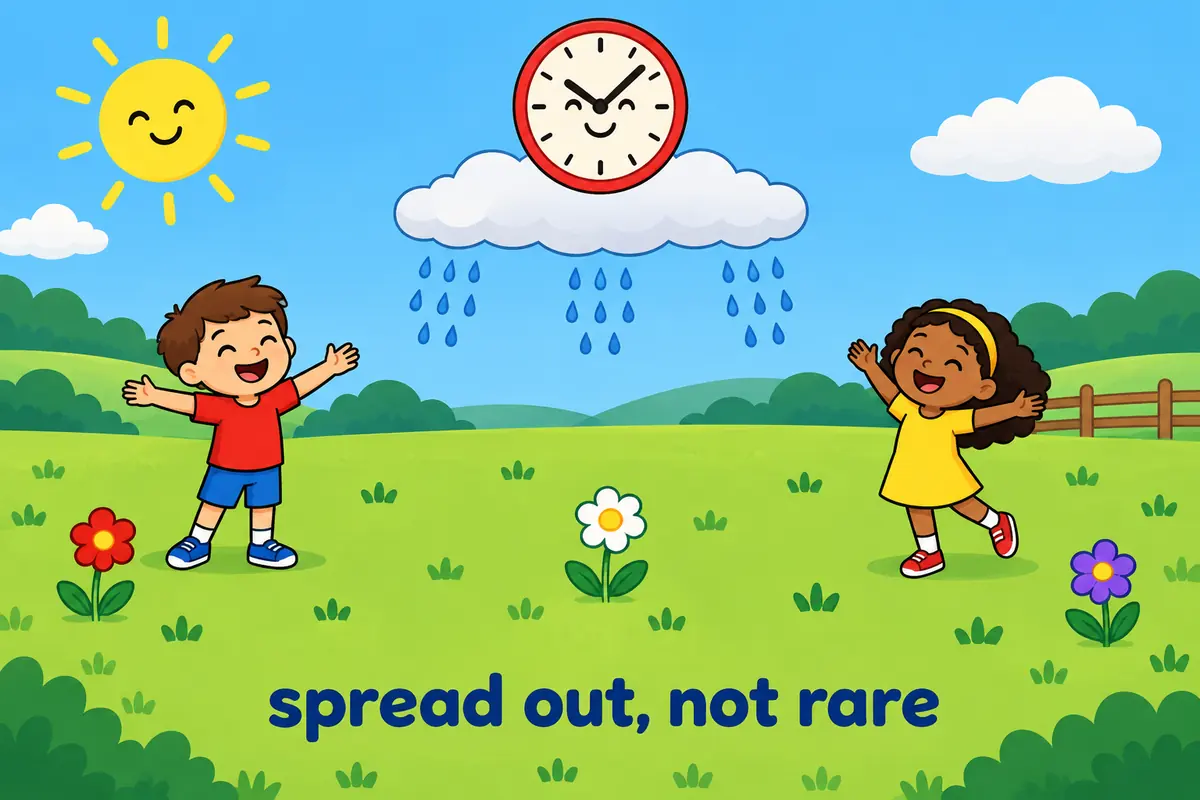
- Sparse describes how things are distributed across a space or period, not how many exist in total.
- It sits in neutral to formal writing; weather reports, science and news use it more than casual conversation.
- The commonest learner error is using sparse for a small quantity that is not spread out, where few or scant fits better.
What does sparse mean?
Sparse is an adjective meaning thinly scattered or thinly distributed across an area, a period or a set. The Cambridge entry for sparse records the central sense of something occurring at wide intervals, and the three uses below follow from it: physical distribution, thin supply and thin attendance.
| Use | Plain meaning | Example sentence |
|---|---|---|
| Physical distribution | Few things spread over a wide area | Sparse pines cover the ridge above the bay. |
| Thin supply | A small amount provided at wide intervals | The report rests on sparse evidence. |
| Thin attendance | Few people present across a space | The final lecture drew sparse attendance. |
One limitation is worth stating plainly. Sparse never describes a single item, and it is not a synonym for few. A shelf holding three well-spaced books is sparse; a shelf holding three books pressed together is merely short of books. Where the complaint is quantity rather than spacing, scant supplies or meager returns are the more precise choices.
How do you use sparse in a sentence?
Put the sparse thing after the adjective and let the sentence say where it is spread. Five patterns cover almost every real use, and the first is by far the most common.
| Pattern | Example | What it signals |
|---|---|---|
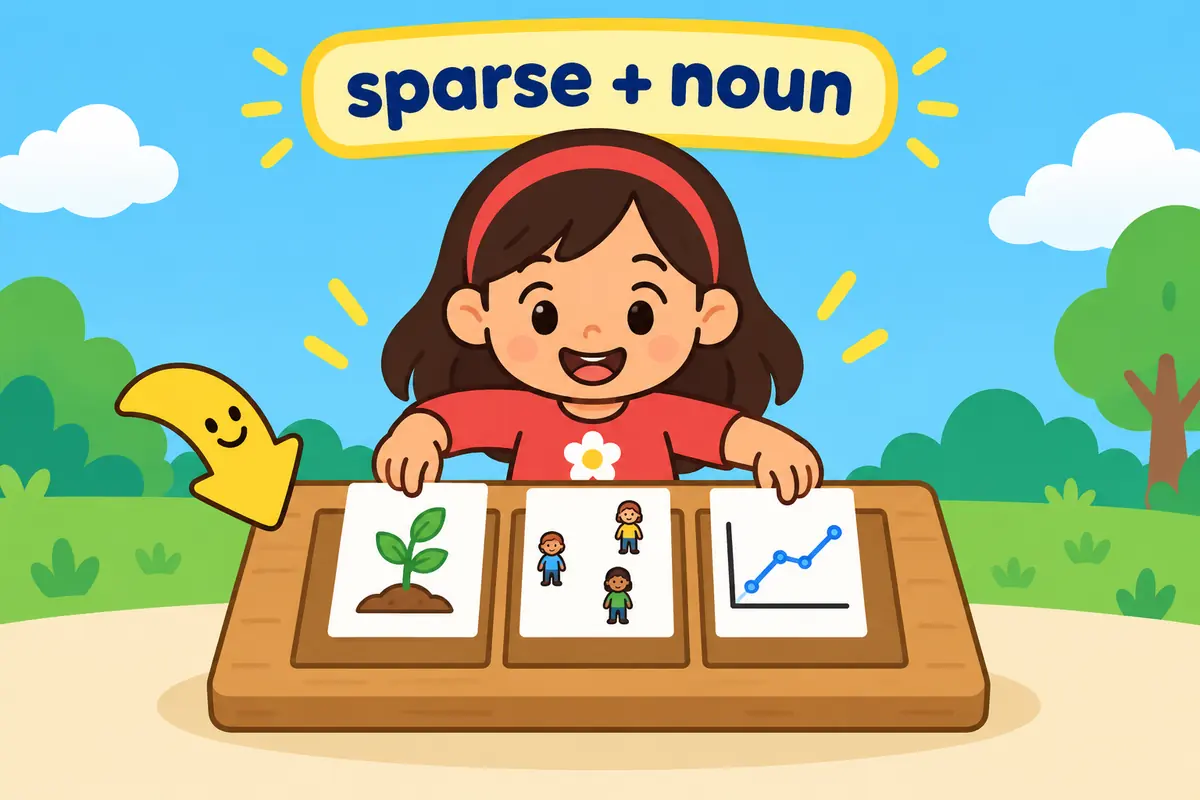
| sparse + noun | The village stands in a sparse landscape of rock and gorse. | Few items distributed over a wide area. |
| sparse + mass noun | Rainfall is sparse between May and September. | A thin supply rather than a long drought. |
| be sparse | Attendance at the evening class was sparse. | Predicate use, common in reports. |
| sparsely + participle | The valley is sparsely planted with pine. | The adverb qualifies how the planting was carried out. |
| sparser / sparsest | Traffic grows sparser after midnight. | Comparison of degree across time or places. |
Sparse in a sentence: examples across contexts
The nine sentences below move from a classroom to a weather desk, and each names what is scattered across a space rather than how much of it exists.
| Context | Example sentence | Why this works |
|---|---|---|
| Classroom | The teacher frowned at the sparse notes beside each diagram. | Names a thin distribution a reader can picture. |
| Weather report | Rain will be sparse and light across the eastern valleys. | Pairs the adjective with a measured forecast, its natural register. |
| Ecology | Deer graze where oak saplings are sparse. | Ties the adjective to a habitat condition. |
| News report | Sparse turnout greeted the second day of the inquiry. | The subject is a crowd and the tone stays neutral. |
| Business email | Sparse orders forced the workshop to cut a shift. | Uses thin supply as the cause of a decision. |
| Conversation | My notes for that lecture are pretty sparse. | Keeps the distribution sense in an informal setting. |
| History essay | Written records for the period are sparse and uneven. | Describes a thin source base without claiming few events happened. |
| Science writing | The signal was strong but the readings were sparse. | Separates a strong measurement from its low frequency. |
| Sports commentary | The crowd was sparse until the second half. | Shows a changing distribution within one event. |
Sparse vs sporadic
Both words describe something that is not continuous, so learners reach for them interchangeably. They are not the same. Sparse measures distribution across space; sporadic measures occurrence across time, and an event can be either without being the other.
| Attribute | sparse | sporadic |
|---|---|---|
| What it measures | Density across an area or set | Frequency across time |
| Typical subject | Vegetation, population, hair, data | Outbreaks, showers, absences, gunfire |
| Question it answers | How spread out? | How often? |
| Implication | Wide gaps between things present | Irregular stops and starts |
| Register | Neutral to formal | Neutral to formal, often medical or news |
Verdict: choose sparse for a thin spread across a place and infrequent or sporadic for an irregular pattern in time.
Word forms and grammar of sparse
Sparse changes form in the ordinary ways an adjective does, and one section of the table catches a form that learners build by mistake.
| Form | Part of speech | Example |
|---|---|---|
| sparse | adjective | The dunes hold sparse grass. |
| sparser | comparative adjective | The crowd grew sparser after dusk. |
| sparsest | superlative adjective | It was the sparsest audience of the season. |
| sparsely | adverb | The valley is sparsely populated. |
| sparseness | noun | The sparseness of the data limits any conclusion. |
| sparsity | noun, technical | The sparsity of the matrix speeds the calculation. |
| sparsed | verb — non-standard | Non-standard: The gardener sparsed the shrubs. |
The adverb sparsely is the form that most often saves a sentence, because it slots in before a past participle such as populated or attended.
Common mistakes with sparse
- Incorrect:
The library had sparse books.Correct: The library had few books. Rule: Sparse needs distribution across an area, not a bare count. - Incorrect:
A sparse tree stood alone.Correct: A single tree stood on the sparse hillside. Rule: Sparse describes a group spread out, never one object on its own. - Incorrect:
The area is sparse populated.Correct: The area is sparsely populated. Rule: Use the adverb sparsely before a participle. - Incorrect:
He visits his aunt sparse.Correct: His visits to his aunt are sparse. Rule: The adjective attaches to a noun; frequency needs a noun such as visits. - Incorrect:
We keep sparse batteries in the drawer.Correct: We keep spare batteries in the drawer. Rule: Spare means extra; sparse means thinly spread.
Practice using sparse
Work through the six items, then read the reasoning rather than only the key.
- Fill the gap: The audience was ______, so the speaker invited everyone to the front row.
- Choose the better word: Rain was (sparse / spare) across the whole region.
- Correct the error: A sparse lighthouse stood alone on the point.
- Build a sentence: use sparsely populated about a remote island.
- Spot the register: which belongs in a weather bulletin — rain will be sparse, or there is hardly any rain about?
- Change to the noun: The data is sparse. Use sparsity instead.
Answers
- sparse — the adjective describes a thin spread of people across a hall.
- sparse — it describes the thin distribution of rain, while spare means extra.
- A lone lighthouse stood alone on the point — sparse needs a group, not one building.
- Model answer: Only a few families remain on the sparsely populated island.
- Rain will be sparse — a bulletin prefers the formal adjective to a casual aside.
- The sparsity of the data limits what can be claimed — the noun names the thin supply itself.
The bottom line
Use sparse in a sentence when you are describing something thinly spread across a place, a period or a set, and let the noun name what is spread out. The two points that settle most sentences are these: sparse measures spacing rather than quantity, and the adverb sparsely is the form that goes before a participle such as populated. Where the problem is simply too little of something in one place, bare shelves and few describe it better.
Frequently asked questions about sparse
Is sparse the same as few?
No. Sparse describes how things are spread out across a space or period, while few counts a small number gathered together. A sparse crowd is thinly spread across a hall, whereas a few people may stand shoulder to shoulder in one corner. Choose sparse when the gaps matter and few when the total is the point.
What is the opposite of sparse?
The opposite is dense, meaning thickly packed or closely clustered. Sparse woodland has trees far apart, while dense woodland has them close together. Other antonyms fit particular contexts: abundant for a rich supply, crowded for people, and thick for hair, each reversing the idea of wide gaps.
Can sparse describe time as well as space?
Sparse usually measures distribution across space, as in sparse vegetation or a sparse crowd. It can extend to a thin supply over time, as in sparse rainfall, but that timing sense is weaker than the spacing sense. For strictly irregular timing, sporadic is the sharper word.
How do you pronounce sparse?
Sparse has one syllable and rhymes with parse and farce, with a long vowel in the middle. The comparative sparser and the superlative sparsest keep that same vowel, and the adverb sparsely adds a clear -lee ending. Keep it to a single beat rather than splitting the word in two.
Do you struggle with writing sentences that are brief and to the point? Crafting sparse sentences can make your writing more impactful and easier to understand. In writing, the term “sparse” refers to sentences that are concise and devoid of unnecessary words or details.
When writing sparse sentences, each word carries significant weight, making the message clear and direct. By trimming down unnecessary elements, you can create sentences that are powerful and easy for the reader to grasp.
7 Examples Of Sparse Used In a Sentence For Kids
- There were sparse leaves on the tree.
- The desert had sparse plants.
- The field had sparse flowers.
- The shelves were sparse of toys.
- The fridge was sparse of food.
- The sky was sparse of clouds.
- The forest had sparse trees.
14 Sentences with Sparse Examples
- Sparse attendance in lectures is a common problem among college students.
- The library had a sparse collection of books on the topic I needed to research.
- Due to the sparse public transport options, it’s difficult for students to commute to campus.
- Some students struggle with maintaining a sparse budget throughout the month.
- The cafeteria usually has sparse seating during peak hours.
- Finding a sparse study space during exam week can be a challenge.
- The professor’s office hours are sparse, making it difficult to get extra help.
- Many college apartments have sparse furnishings due to financial constraints.
- The campus gym sees a sparse crowd during the early morning hours.
- Group projects can be tough when there’s a sparse amount of communication between team members.
- The campus bookstore had a sparse selection of textbooks for that particular course.
- It’s common for college students to experience sparse sleep schedules during exam season.
- The Wi-Fi connection in the dorms can be sparse at times, causing frustration for students trying to complete assignments.
- With only a sparse number of extracurricular clubs available, some students struggle to find activities they are interested in.
How To Use Sparse in Sentences?
To use the word Sparse in a sentence, follow these simple steps. Begin by understanding that the word Sparse is an adjective that means thinly dispersed or scattered. When using Sparse, think of situations where there is a small amount or quantity of something spread out over a large area.
For example, you can say, “The desert landscape was sparse with only a few cacti dotting the sand.” Here, Sparse describes how the cacti are scattered across the desert, emphasizing that there are not many of them.
Alternatively, consider this sentence: “The classroom was sparse with only a couple of students present.” In this case, Sparse communicates that there are very few students in the classroom, highlighting the emptiness or lack of people.
When including Sparse in your writing, keep in mind that it conveys a sense of scarcity, emptiness, or infrequency. Using it in contexts where you want to paint a picture of sparseness or scarcity will help you effectively communicate your message.
Now that you have a better understanding of how to use Sparse, try incorporating it into your writing to add depth and clarity to your descriptions.
Conclusion
In writing, sentences with sparse details can lack the necessary depth and clarity needed to fully convey the intended message. These sentences may leave readers confused or struggling to comprehend the main idea. It is important to ensure that sentences are sufficiently detailed and informative to effectively communicate the writer’s thoughts and ideas.
By incorporating more descriptive language and specifics into sentences, writers can avoid creating sparse sentences. Adding sufficient details can help to engage readers and provide them with a clearer understanding of the message being conveyed. So, it is essential for writers to carefully craft sentences that are not sparse in order to effectively communicate their intended meaning.


