
Spew out means to force something out quickly and in large amounts, often messily. To use spew out in a sentence, put the source first: a machine, a vent or a person spews out smoke, data or words. “The old printer spewed out twenty pages at once.” The phrasal verb is transitive, so it names what comes out.
Spew out at a glance
- Spew out is a separable phrasal verb; its forms are spew out, spews out, spewed out and spewing out.
- It means to force something out quickly and in large amounts, or to pour out words in a rush.
- The usual pattern is a source plus spew out plus what leaves it: a printer spews out pages.
- The verb belongs to vivid description in news and fiction rather than polite formal prose.
- The commonest error is leaving out the object, since spew out almost always names what is produced.
What does spew out mean?
Spew out is a phrasal verb meaning to force something out quickly and in quantity. The Cambridge entry for spew out gives this sense of a fast, full release, and the source is usually a machine, a vent, a crowd or a person under pressure. A device that does this can also emit a signal steadily, but emit carries none of the mess or rush that spew out keeps.
| Sense | Plain meaning | Example sentence |
|---|---|---|
| Force out in bulk | A machine or container releases something fast and in quantity | The old printer spewed out twenty pages at once. |
| Eject violently | A vent, pipe or volcano throws out material | Ash spewed out of the chimney for an hour. |
| Pour out words | A person says a great deal very quickly | He spewed out a list of complaints before the bell. |
One limitation is worth stating plainly. Spew out is vivid, not neutral. A factory that discharge waste into a river would use the legal verb in a permit, and a slow accident is a spill, not a spew. Choose spew out when speed and volume are part of the meaning.
How do you use spew out in a sentence?
The verb is separable, so the object can follow the particle or sit between the two parts. Five patterns cover almost every real sentence, and the pronoun rule is the one learners miss.
| Pattern | Example | What it signals |
|---|---|---|
| source + spew out + thing | The tap spewed out brown water. | The object follows the particle, the most common order. |
| source + spew + thing + out | The tap spewed brown water out. | The object sits between verb and particle, still correct. |
| spew + it + out | The tank cracked and spewed it out. | A pronoun must go between the verb and the particle. |
| spew out + from / out of + source | Steam spewed out from a crack in the pipe. | Names where the material comes from. |
| spew out + words or data | The app spews out updates faster than anyone can read. | The figurative sense applied to information. |

Spew out in a sentence: examples across contexts
The verb keeps its force but changes company depending on the text. The nine sentences below move from a news report to a classroom story, and each one shows which words a writer reaches for alongside it.
| Context | Example sentence | Why this works |
|---|---|---|
| News report | The ruptured main spewed out water across the road. | A concrete subject and a visible result keep a report clear. |
| Science writing | The vent spews out mineral-rich water at great speed. | Names what is released, since the quantity is the point. |
| Classroom story | The volcano model spewed out foam all over the desk. | Picks a harmless subject so the word stays playful. |
| Workplace email | The server spewed out error messages all morning. | The figurative sense suits a technical complaint. |
| Fiction | He spewed out the whole story before anyone could stop him. | Transfers the physical image onto speech. |
| Sports writing | The striker spewed out a stream of protests at the referee. | Shows a rush of words rather than a calm statement. |
| Travel writing | The cliff spring spews out a fine mist over the bay. | Uses the verb for a scenic, continuous flow. |
| Consumer review | This printer spews out pages, but the ink runs dry fast. | Balances praise for speed with a practical warning. |
| Weather report | The storm drain spewed out debris into the street. | Keeps the subject mechanical and the effect measurable. |
Notice how the physical examples keep a machine or a vent as the subject, while the figurative examples let a person or an app do the spewing. That transfer from material to words or data is the clearest sign of the figurative sense.
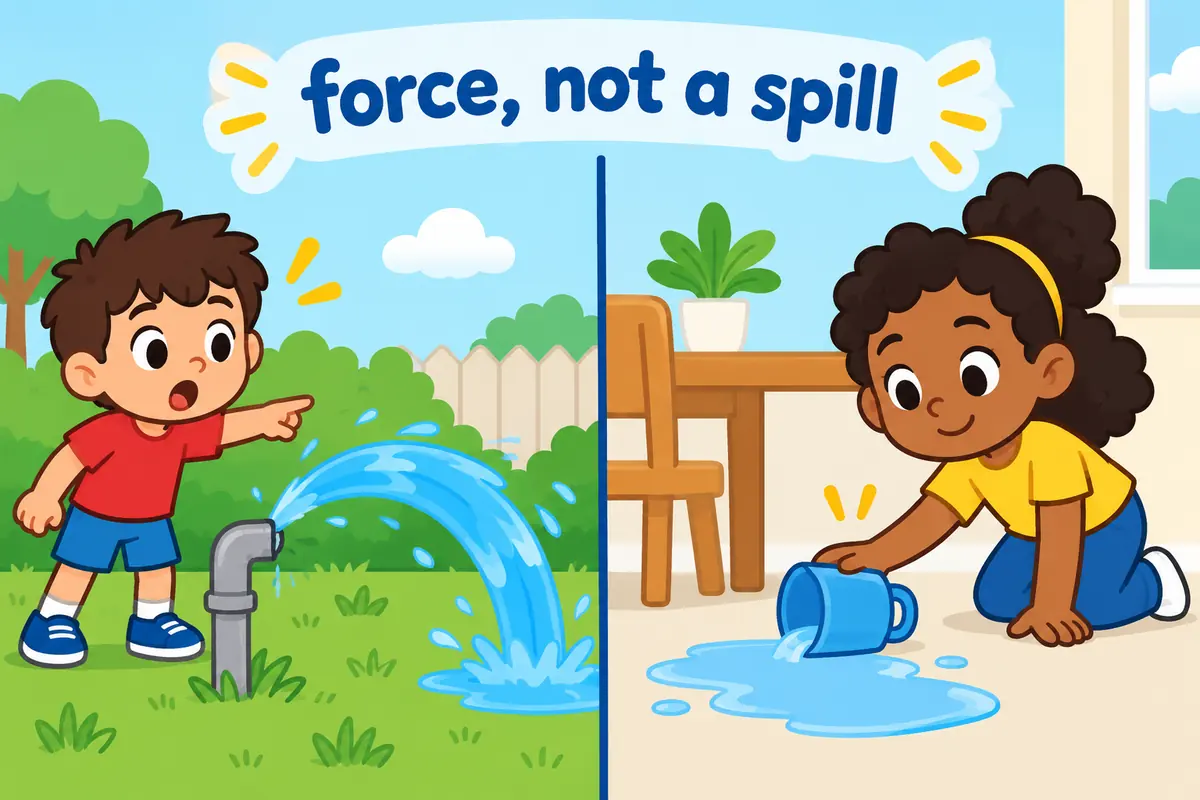
Spew out vs spill
Spew out and spill a drink both describe something leaving a container, but they disagree about speed and force. The table sets out the contrast.
| Attribute | spew out | spill |
|---|---|---|
| Core meaning | Force out fast and in quantity | Let liquid or contents fall by accident |
| Direction | Usually outward and under pressure | Downward and by mishap |
| Typical subject | A machine, vent or crowd of words | A hand, cup or container |
| Register | Vivid, informal to journalistic | Neutral and everyday |
| What it implies | Speed, volume, little control | Loss and mess |
| Grammar | Separable with a following object | Transitive or intransitive, not typically separated |
When the flow is steady rather than sudden, a pipe may gush from a pipe or pour out a stream, and a volcano may erupt suddenly. Each of those keeps one part of the meaning while dropping the note of messy force.
Verdict: choose spew out for a fast, forceful release in quantity, and spill for a slow accident where speed and volume are not part of the meaning.
Word forms and grammar of spew out
Spew out inflects like any phrasal verb, and it also has a base form that works without the particle. The table lists the forms and marks the order that is not standard.
| Form | Part of speech | Example |
|---|---|---|
| spew out | phrasal verb, base form | The machine will spew out a receipt. |
| spews out | phrasal verb, third person singular | The vent spews out hot air. |
| spewed out | phrasal verb, past and past participle | The pipe spewed out grit last night. |
| spewing out | phrasal verb, present participle | The fountain is spewing out foam. |
| spew | base verb, used without out | The dog spewed on the rug. |
| spew out it | non-standard | Avoid this order; write spew it out. |
The base verb spew can stand alone when the focus is on the act of being sick, but the particle out is what adds the idea of a full, fast release. Keeping that difference in mind prevents the most common error, which is letting a pronoun sit after the particle.
Common mistakes with spew out
- Incorrect:
The printer spewed out.Correct: The printer spewed out four pages. Rule: Spew out normally names what is produced, so the object cannot be dropped. - Incorrect:
The tank cracked and spewed out it.Correct: The tank cracked and spewed it out. Rule: A pronoun goes between the verb and the particle, never after it. - Incorrect:
The dish spewed out the sauce on the table.Correct: The dish spilled the sauce on the table. Rule: A slow accidental spill is spilled, not spewed; spew out needs speed and force. - Incorrect:
She spewed out that the rules were unfair.Correct: She spewed out a list of complaints about the rules. Rule: The verb takes a noun phrase, not a that-clause. - Incorrect:
Please spew out the meeting notes politely.Correct: Please send the meeting notes politely. Rule: Spew out implies force and volume, so it clashes with a calm, courteous request.
Practice using spew out
Work through the six items, then check the reasoning rather than only the answer.
- Fill the gap: The cracked pipe ______ a jet of water across the yard.
- Choose the better word: She knocked the cup and the milk (spilled / spewed out) across the cloth.
- Correct the error: The machine spewed out it in a long strip.
- Build a sentence: use spew out about a bus engine releasing smoke.
- Spot the register: which belongs in a news report — the main spewed out water, or the main went spewy?
- Rewrite with the pronoun: The machine spewed out the tickets. Use them.
Answers
- spewed out — the pipe forces the water out under pressure, which is the sense the verb carries.
- spilled — an accident with a cup is a slow spill, while spew out would exaggerate the speed.
- The machine spewed it out in a long strip — the pronoun belongs between verb and particle.
- Model answer: The old bus engine spewed out a cloud of grey smoke at the traffic lights.
- The main spewed out water — a report stays plain, and went spewy is not English.
- The machine spewed them out — the pronoun moves between the verb and the particle.
The bottom line
Use spew out in a sentence when something is forced out fast and in quantity, and name the thing produced so the picture is complete. The two nuances that decide most sentences are these: the verb is separable, so a pronoun goes between verb and particle, and it carries force and volume, which makes spill the better choice for a slow accident.
Frequently asked questions about spew out
Is spew out one word or two?
Spew out is a phrasal verb written as two words. The base verb spew can stand alone, as in the dog spewed on the rug, but adding out adds the idea of a fast, forceful release in quantity. Do not write it as one word or hyphenate it.
Can spew out be separated?
Yes. You can write the printer spewed out pages or the printer spewed pages out, and both are correct. A pronoun must sit between the two parts, so it is spew it out, never spew out it. That placement rule is what marks a separable phrasal verb.
What is the difference between spew out and spill?
Spew out means to force something out quickly and in large amounts, usually under pressure. Spill means to let liquid or contents fall by accident, slowly and without force. A burst pipe spews out water; a hand that knocks a cup spills the tea on the table.
Does spew out always mean something physical?
No. The verb extends naturally to words and data, as in the writer spewed out a dozen reasons or the app spews out updates. In those sentences the speed and volume are borrowed from the physical image, which is why the verb sounds lively rather than neutral.
Has your writing ever felt lackluster or stale? Are you looking to add a dynamic element to your sentences? Enter the phrase “spew out,” a vivid and expressive term that can inject energy and impact into your writing.
When you use “spew out” in a sentence, you conjure up images of forceful and unrestrained expression. This phrase carries a sense of urgency and intensity, making it a powerful tool for conveying emotions or ideas with dramatic flair.
7 Examples Of Spew Out Used In a Sentence For Kids
- The volcano spew out hot lava.
- The baby dragon spew out a puff of smoke.
- The tea kettle spew out steam when it’s hot.
- The fountain spew out water in the park.
- The sprinkler spew out water on the grass.
- The fire hydrant spew out water during an emergency.
- The whale spew out water from its blowhole.
14 Sentences with Spew Out Examples
- The professor’s long lecture caused some students to spew out information during the exam.
- After a night of heavy drinking, some students may spew out their regrets in the morning.
- It’s important to practice before a presentation, so you don’t spew out random facts nervously.
- When asked a tough question, students may spew out whatever comes to mind first in a panic.
- During group discussions, some students tend to spew out their ideas without considering others.
- The pressure of exams can make students spew out memorized information without fully understanding it.
- Spewing out answers without checking sources can lead to plagiarism accusations.
- Students who procrastinate often have to spew out last-minute assignments.
- Caffeine-fueled late-night study sessions may cause students to spew out answers incoherently.
- In a debate, it’s important not to spew out arguments without backing them up with evidence.
- The stress of deadlines can make students spew out rushed and poorly written essays.
- During a heated argument, students may spew out hurtful words they later regret.
- Group projects require coordination, not just spewing out ideas without a plan.
- It’s better to take a moment to think before spewing out a response in a classroom discussion.
How To Use Spew Out in Sentences?
When using Spew Out in a sentence, it is important to remember that it is a phrasal verb that means to eject or discharge something in large quantities. To use it correctly, follow these simple steps:
-
Identify the subject performing the action. This is the entity causing the ejection or discharge of a large quantity of something. For example, “The volcano” or “The machine.”
-
Insert Spew Out after the subject in the sentence. For example, “The volcano spewed out molten lava” or “The machine spewed out smoke.”
-
Add the object that is being ejected or discharged after Spew Out. This tells the reader what is being emitted in large quantities. For example, “The volcano spewed out molten lava” or “The machine spewed out smoke.”
-
Make sure the sentence makes sense and is clear to the reader. Ensure that Spew Out is used in the correct context and that the meaning is conveyed effectively.
By following these steps, you can effectively use Spew Out in a sentence to describe the action of ejecting or discharging something in large quantities. Remember to practice incorporating this phrasal verb into your writing to become more comfortable with its usage.
Conclusion
In conclusion, when sentences spew out information, they flow rapidly and without restraint, often overwhelming the reader or listener with a barrage of words. This style of writing or speaking can be beneficial for conveying a large amount of information quickly, but it can also be difficult to follow and may lack depth or coherence.
To improve the clarity and impact of sentences that spew out information, it is important to carefully organize and structure the content, using clear transitions and focusing on key points. By balancing speed with clarity, writers and speakers can effectively convey their message without overwhelming their audience.


