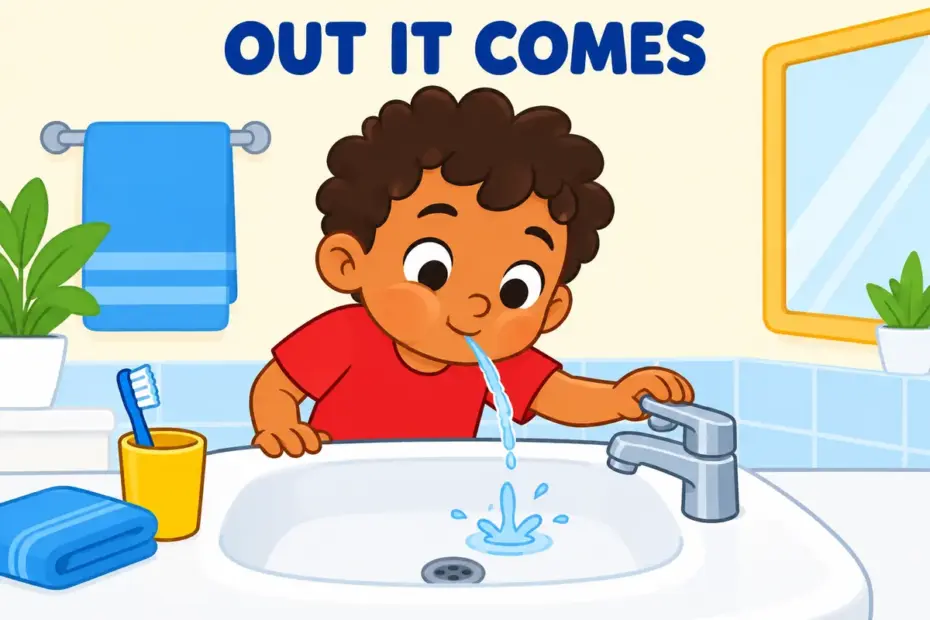
Spit out is a separable phrasal verb meaning to eject something from the mouth, to say words abruptly, or, of a machine, to produce something fast. The object can sit between the two words, and the spoken command spit it out shows how important that word order is.
Spit out at a glance
- Spit out is a phrasal verb; its forms are spits out, spat out and spitting out.
- The verb is separable, so a pronoun must sit inside: spit it out, never spit out it.
- The main senses are physical ejection, abrupt speech and a machine producing items.
- The past tense is spat in British English and usually spit in American English.
- The commonest error is confusing spit out with spit up and spit on.
What does spit out mean?
Spit out is a phrasal verb meaning to force something out of the mouth, to utter words quickly and often angrily, or to describe a machine that produces something in a fast stream. The Cambridge entry for spit out records the physical and the speech senses, and the machine use extends the same image of something being ejected. The verb is transitive, so it always needs an object, whether that object is medicine, a name or a page.
| Sense | Plain meaning | Example sentence |
|---|---|---|
| Eject from the mouth | Force food or liquid out of the mouth | The baby spat out the bitter medicine. |
| Say something abruptly | Utter words quickly, often with anger | He spat out the answer and walked off. |
| Produce rapidly | Emit items fast, as a machine does | The printer spat out forty pages. |
One limitation is worth stating. Spit out is vivid but informal, and its speech sense suggests reluctance or anger, so it is the wrong verb for a neutral report of what somebody said. The phrase also carries a slight disgust that written or formal prose often avoids by choosing say, utter or reply. It never means to swallow or to keep something in.
How do you use spit out in a sentence?
The verb is transitive and separable, which means the object may follow out or sit inside the phrase. Five patterns cover most sentences, and the pronoun rule is the one that learners must memorise.
| Pattern | Example | What it signals |
|---|---|---|
| spit out + object | She spat out the coin into her hand. | Literal ejection, with the object after out. |
| spit + object + out | Spit it out before the bell rings. | Separable form, which is compulsory when the object is a pronoun. |
| spit out + words | He spat out an apology. | Abrupt, unwilling speech rather than calm saying. |
| be spat out | The tickets were spat out by the machine. | Passive voice, natural for machines and systems. |
| spit up | The baby spat up after the feed. | A different phrase for bringing milk back up. |
The practitioner rule is simple: if you can replace the phrase with forced it out of the mouth or said it fast, spit out fits, and if the object is a pronoun, it must stand between the verb and out.
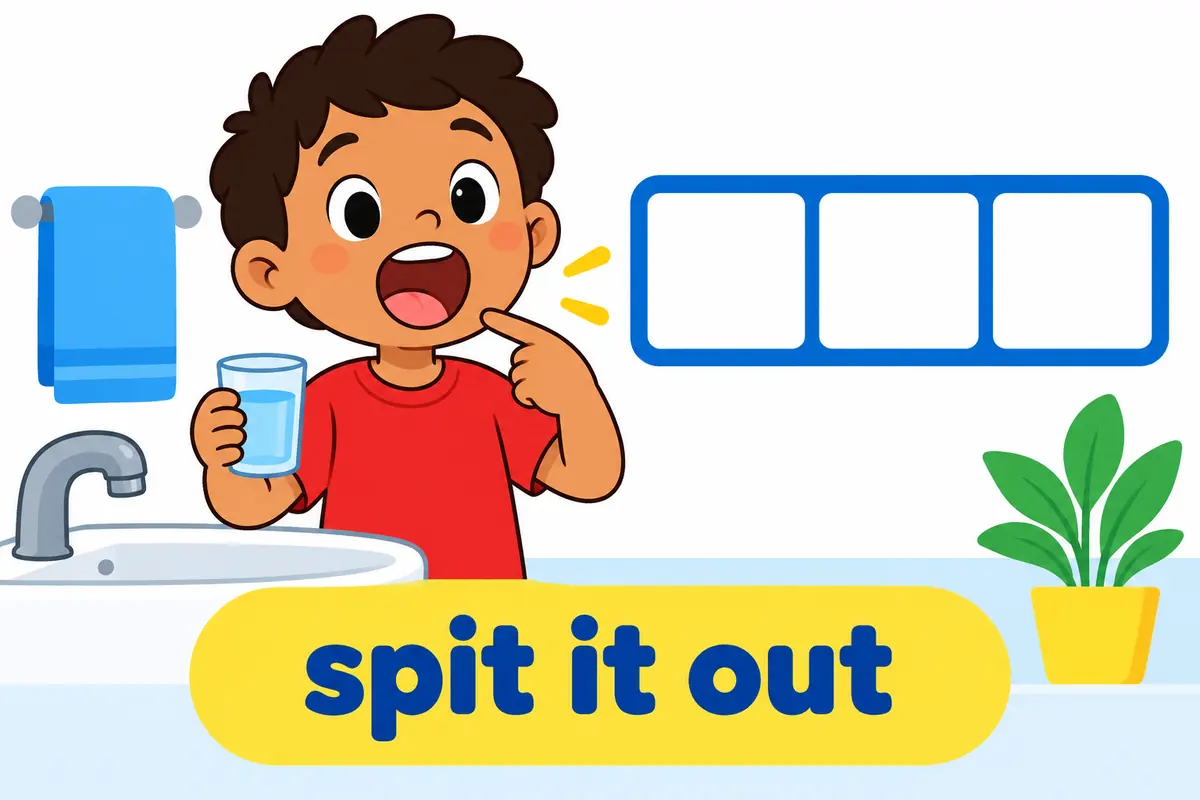
Spit out in a sentence: examples across contexts
The same verb moves from the mouth to the printing press. The eight sentences below keep the image of ejection while the object changes from medicine to words to paper.
| Context | Example sentence | Why this works |
|---|---|---|
| Home | The toddler spat out the olive and reached for water. | A concrete object makes the physical sense obvious. |
| Healthcare | The patient spat out the tablet because it tasted bitter. | A clinical setting, kept simple and non-graphic. |
| Classroom | Spit out the answer, we have only a minute left. | The spoken command sense, common in games and quizzes. |
| News report | The witness spat out the name as if it hurt. | The speech sense with an emotional charge. |
| Office | The printer spat out the whole report in seconds. | A machine as the subject, which is the extended sense. |
| Banking | The cash machine spat out two notes and a receipt. | Machines ejecting money and paper is the set image. |
| Sports report | The captain spat out instructions that nobody heard. | Abrupt speech under pressure, suited to commentary. |
| Science writing | The geyser spits out steam and hot water every hour. | Nature ejecting material extends the same pattern. |
Notice that every sentence names what came out. Because spit out is transitive, a sentence that omits the object feels unfinished, which is the surest sign the verb is being used correctly.
Spit out vs spew out and blurt out
The verb overlaps with two others that also describe forcing something out. Spew means to pour out in large quantity, while blurt is about speech alone, and usually about a slip.
| Attribute | spit out | spew out | blurt out |
|---|---|---|---|
| Core job | Eject one thing or force words out | Pour out in a large quantity | Say something without thinking |
| Quantity | A single object or a short burst | Mass and volume | A single remark |
| Physical sense | Yes, real or metaphorical | Yes, strongly | No, speech only |
| Feeling | Reluctance or disgust | Disgust or chaos | Panic or honesty |
| Register | Informal but common in print | Informal, often critical | Neutral to informal |
Verdict: choose spit out for one thing forced out, whether medicine, a word or a page, spew when the point is sheer volume, and blurt out when a remark escapes before the speaker can stop it. To name the opposite action, swallow is the plain word.
Word forms and grammar of spit out
Spit out follows the irregular verb spit, which keeps the same form in parts of American English. The table also lists the idioms built on the same verb, since they change the meaning.
| Form | Part of speech | Example |
|---|---|---|
| spit out | base phrasal verb | Do not spit out the seeds. |
| spits out | third person singular | The machine spits out a ticket. |
| spat out | past tense, British | She spat out the pip. |
| spit out | past tense, American | She spit out the pip. |
| spitting out | present participle | It is spitting out pages again. |
| spit it out | fixed idiom | Spit it out and tell me the truth. |
The related verbs eject and emit are the formal choices when spit out sounds too physical, and expel suits a report about a body or a system forcing something out.
Common mistakes with spit out
- Incorrect:
Tell me at once, spit out it.Correct: Tell me at once, spit it out. Rule: A pronoun object must sit between the verb and the particle. - Incorrect:
He spat out the pavement in disgust.Correct: He spat on the pavement in disgust. Rule: Spit on means direct it at a surface; spit out means eject it from the mouth. - Incorrect:
The baby spat out her milk straight after the feed.Correct: The baby spat up her milk straight after the feed. Rule: Bringing milk back up from the stomach is spit up, not spit out. - Incorrect:
He spewed out the one word that mattered.Correct: He spat out the one word that mattered. Rule: Spew needs bulk; a single word or item suits spit out.
Practice using spit out
Work through the six items, then read the reasons, because word order decides more than half of them.
- Fill the gap: The photo booth ______ four identical pictures in a minute.
- Choose the better word: The child was too polite to (spit out / spit on) the gristle, so she left it on the plate.
- Correct the error: Come on, spit out it before the teacher sees.
- Build a sentence: use spit out about a cash machine giving out a receipt.
- Spot the register: which belongs in a science report, The vent ejects hot gas all day, or The vent spits out hot gas all day?
- Rewrite with the pronoun inside: The machine spat out the ticket.
Answers
- spat out – the machine is the subject, and the past tense marks a finished burst of pictures.
- spit out – the child is forcing food from her mouth, which is the ejection sense.
- Come on, spit it out before the teacher sees – the pronoun must sit between spit and out.
- Model answer: The cash machine spat out the receipt and then went quiet.
- The vent ejects hot gas all day – a science report prefers the neutral single verb.
- The machine spat it out – the pronoun moves inside the separable phrase.
The bottom line
Use spit out in a sentence for forcing something from the mouth, for words said quickly and unwillingly, or for a machine that produces a fast stream of items. The two details that decide most sentences are that the verb is transitive, so an object is required, and that a pronoun must sit inside the phrase as in spit it out. In formal writing, choose say, eject or emit instead.
Frequently asked questions about spit out
What does spit out mean?
Spit out means to force something out of the mouth, to say words quickly and often angrily, or to describe a machine that produces something in a fast stream. It always needs an object, so a sentence names what came out, whether that is medicine, a word or a printed page.
Is spit out separable?
Yes. The object may follow the particle, as in spit out the seeds, or sit between the two words, as in spit the seeds out. When the object is a pronoun the split is compulsory, so English says spit it out and never spit out it. The idiom belongs to the same pattern.
What is the past tense of spit out?
British English uses spat out, as in the printer spat out the report. American English often keeps spit for the past, giving the printer spit out the report. Both are accepted, and the past participle follows the same choice, so the pages have been spat out or have been spit out.
What is the difference between spit out and spit up?
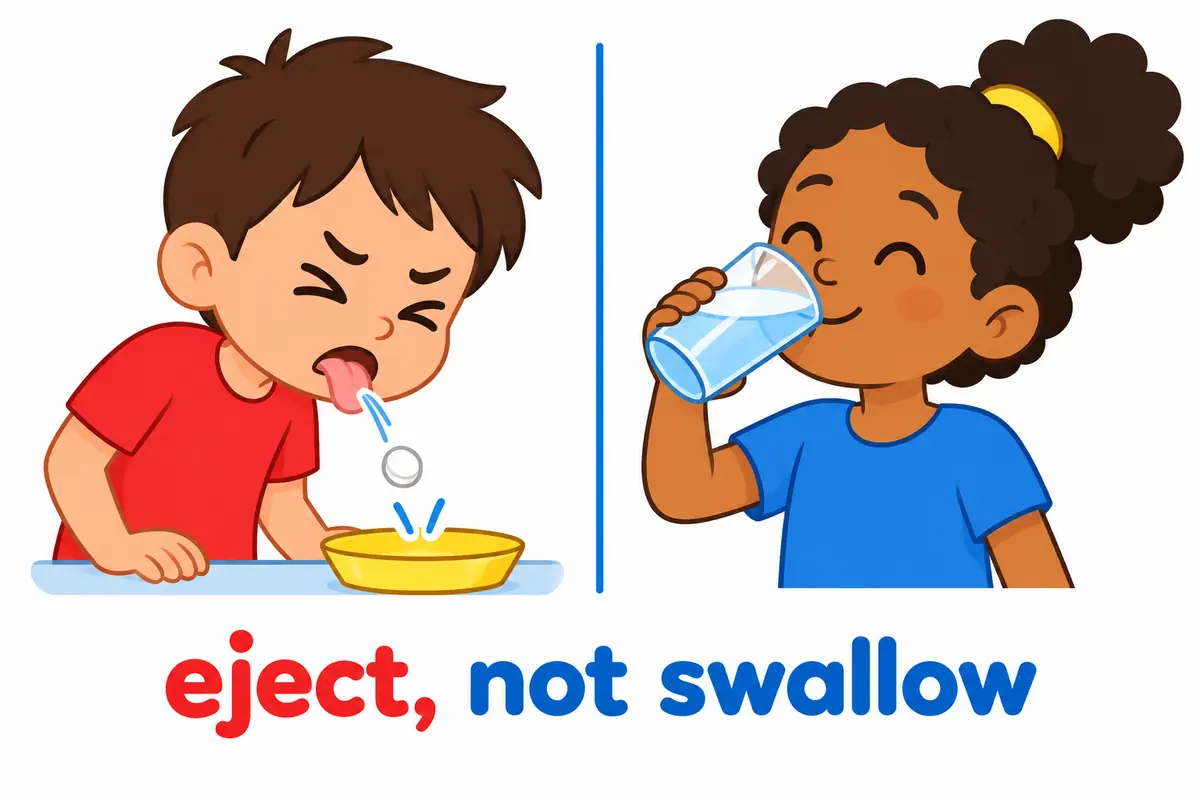
Spit out means to eject something deliberately from the mouth. Spit up means to bring milk or food back up from the stomach, usually without control, and it is the phrase used about babies after a feed. The two look similar but describe very different actions and effects.
Have you ever tasted something so repulsive that you immediately had to remove it from your mouth? This action of forcefully expelling something from your mouth is known as “spitting out.”
When you “spit out” something, you eject it from your mouth due to its unpleasant taste, texture, or any other undesirable quality. This reflexive response is often a natural reaction to items that are deemed inedible, harmful, or simply unappetizing.
7 Examples Of Spit Out Used In a Sentence For Kids
- Spit out the seed after eating the mango.
- Do not spit out chewing gum on the floor.
- Spit out the watermelon seeds into a bowl.
- Remember to spit out toothpaste after brushing your teeth.
- It’s important to spit out the bone while eating fish.
- Spit out the sour candy if you don’t like it.
- Please spit out the food if it’s too hot.
14 Sentences with Spit Out Examples
- Spit out the gum before entering the exam hall.
- Make sure to spit out the food properly before using the library computers.
- It’s offensive to spit out water on the ground during sports practice.
- Spit out any seeds or peels before eating the fruit.
- Remember to spit out the toothpaste after brushing your teeth.
- Be respectful and spit out the paan in a designated spittoon.
- Spit out any unfinished food instead of wasting it by throwing it away.
- It’s important to spit out the mouthwash after rinsing your mouth for the recommended time.
- Don’t forget to spit out the medicine after holding it in your mouth for a few seconds.
- It’s not hygienic to spit out food particles while talking to someone.
- Spit out the tea leaves from your mouth after finishing your chai.
- Ensure to spit out the tobacco before entering any classroom or lecture hall.
- Do not spit out your chewing tobacco on the ground; use a spittoon.
- Before using the shared water dispenser, always spit out any residual water in your mouth.
How To Use Spit Out in Sentences?
Spit Out is a phrasal verb that means to forcefully eject something, usually from your mouth.
To use Spit Out in a sentence, follow these steps:
-
Identify the object you want to eject or get rid of.
- Example: “I spit out the food that tasted bad.”
-
Place the object after Spit Out in the sentence.
- Example: “She spit out the gum into a tissue.”
-
Make sure to use the correct tense of the verb Spit Out based on the subject and time of the action.
- Example: “The baby spit out the pacifier during his tantrum.”
-
It is important to note that Spit Out is usually used in the past tense. The past tense of Spit Out is spat.
- Example: “He spat out the drink after realizing it was spoiled.”
Remember to use Spit Out when describing the act of forcefully expelling something from your mouth. Following these steps will help you correctly use Spit Out in a sentence.
Conclusion
In conclusion, the act of spitting out can symbolize rejection, disgust, or defiance. Whether someone spits out food they find distasteful, words that they disagree with, or substances that can harm them, this action conveys a strong message of resistance or disapproval. Spitting out can serve as a physical manifestation of choosing not to accept something, whether it be a literal or figurative representation.
Overall, when individuals spit out something, they are asserting their boundaries, asserting their autonomy, or expressing their displeasure. It is a visible and unmistakable action that conveys a clear rejection of what is being presented. Next time you witness someone spitting something out, consider the deeper meaning behind this seemingly simple act of defiance.


