How to Use Splash in a Sentence
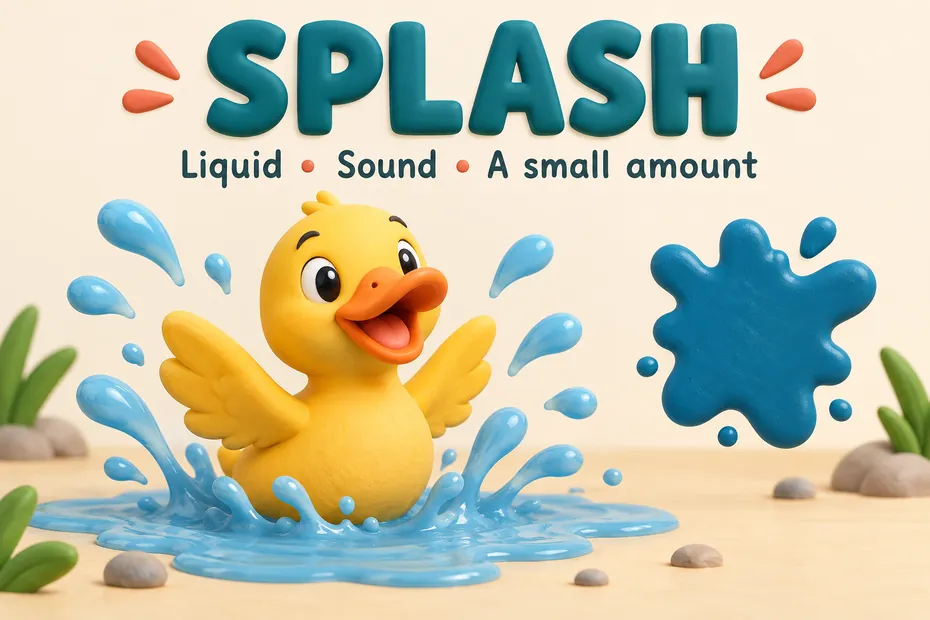
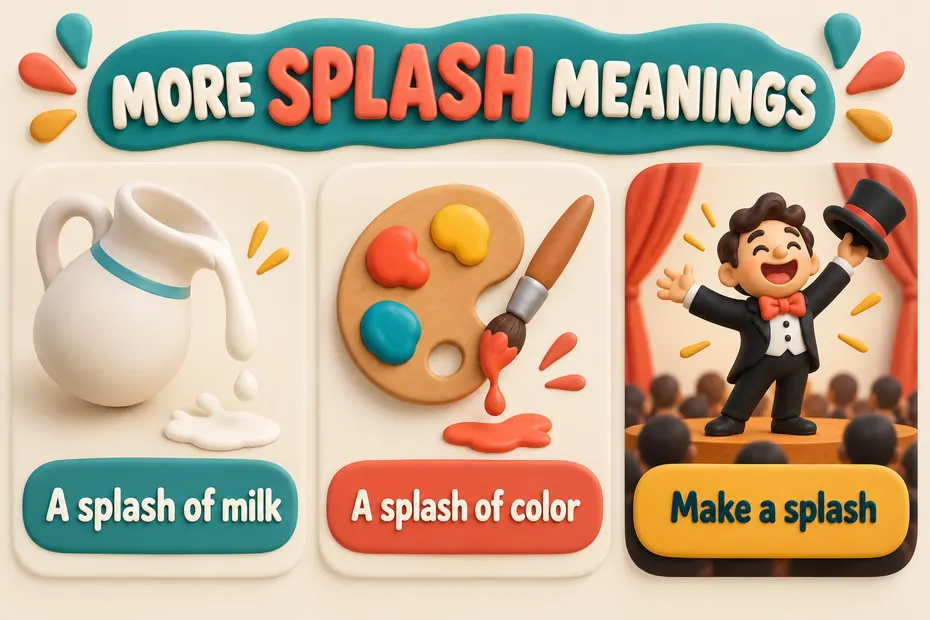
Splash can be a verb for scattering liquid or a noun for the liquid, movement, or sound. For example, “The duck splashed in the puddle,” and “We heard a splash.” It also appears in phrases such as a splash of milk, a splash of color, and make a splash.
Splash Is a Vocabulary Word, Not a Writing Method
Clarification for the introduction below: “To splash a sentence” is not the ordinary dictionary definition of splash or an established name for a writing technique. A writer may invent that metaphor to suggest lively prose, but learners should first understand the word’s usual noun, verb, and idiomatic meanings.
For a sentence example, describe something that scatters liquid, the resulting sound, a small amount, or a figurative burst of attention. “The puddle splashed my shoes” concerns liquid. “The announcement made a splash” concerns attention. These uses give the word a recognizable meaning without relying on the invented idea of “splashing sentences.”
Noun and Verb Examples Side by Side
| Use | Original example | What splash does |
|---|---|---|
| Verb without a direct object | The ducks splash in the shallow water. | Names an action. |
| Verb with a direct object | The wheel splashed muddy water onto the path. | Names what the action scatters. |
| Noun for a sound or movement | A sudden splash startled the fisherman. | Names the event or sound. |
| Noun for a small amount | Add a splash of milk to the tea. | Names an unspecified small quantity. |
| Noun for color | The red cushion adds a splash of color. | Names a noticeable patch or accent. |
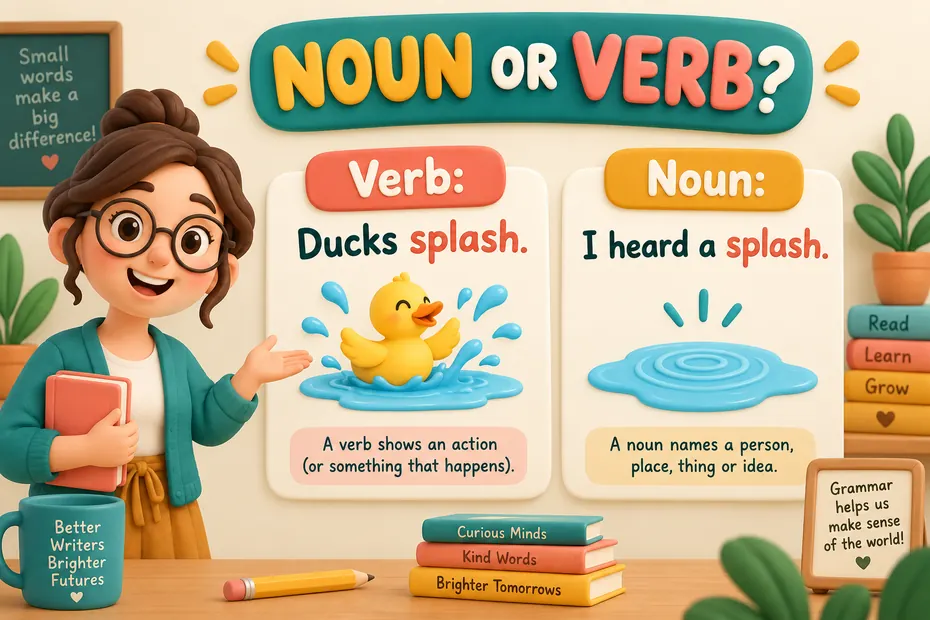
A quick grammar check is to ask whether splash names an action or a thing. In “The ducks splash,” it tells what the ducks do. In “I heard a splash,” it names what was heard. The article a helps identify the noun use. Context supplies the specific meaning, so the same word does not always describe water.
Common Patterns with Splash
- Splash in: “The ducks splashed in the pond.” This pattern locates the action.
- Splash through: “The dog splashed through a shallow puddle.” This pattern describes movement through liquid.
- Splash onto: “Water splashed onto the tiles.” This identifies a destination.
- Splash with: “The passing cart splashed the wall with mud.” This identifies the material.
- A splash of: “The painting needed a splash of yellow.” This introduces an amount or accent.
Compare “Water splashed onto my sleeve” with “The dog splashed my sleeve with water.” The first makes the liquid the subject; the second names the cause and then the affected object. Both are natural. Choose the arrangement that gives the reader the information you want to emphasize.
Make a Splash: The Figurative Meaning
Make a splash is an informal expression for attracting attention in an exciting way. “The student band made a splash at the festival” does not mean the musicians scattered water. It means their appearance drew notice. Merriam-Webster records the expression separately as a phrase.
The idiom fits reviews and conversational writing, but it can be vague. If the effect matters, explain it: “The band made a splash at the festival, drawing a large crowd to its first performance.” Do not use the idiom as evidence that something was successful in every respect. It reports a noticeable impression, not a complete evaluation.
A Splash of Milk Is Not an Exact Measurement
A splash of liquid means a small amount, but it does not specify an exact volume. “A splash of milk” may be enough for a casual preference, while a precise recipe should give a measurable quantity. The sentence teaches the vocabulary meaning; it should not invent a universal conversion for splash.
The same structure works figuratively: “A splash of color brightened the plain room.” Here the phrase names a small but noticeable visual addition. Avoid reading every splash of phrase literally. The following noun tells you whether the writer means liquid, color, or another figurative accent.
Verb Forms and Short Practice Examples
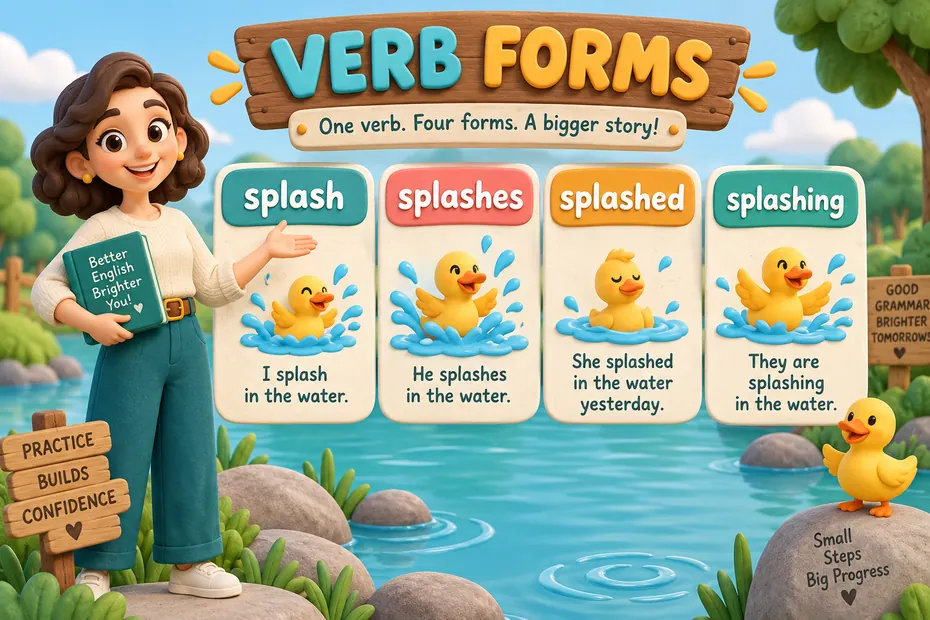
The forms are splash, splashes, splashed, and splashing. Write “The duck splashes” with a singular present-tense subject and “The ducks splash” with a plural one. In the past, write “The duck splashed.” For an ongoing action, use “The duck is splashing.” The spelling does not require doubling the final consonant.
For practice, change one example through time: “Rain splashes against the window,” “Rain splashed against the window,” and “Rain is splashing against the window.” Then turn the action into a noun phrase: “I heard the splash of rain against the window.” This exercise shows how grammar changes while the scene remains similar.
Frequently Asked Questions
What is a simple sentence with splash?
“The duck made a splash” is a simple noun example. “The ducks splash in the pond” uses the word as a verb. The noun names an event, while the verb tells what the ducks do. Add a setting or cause if the reader needs a clearer picture.
Is splash a noun or a verb?
It can be either. In “Water splashes onto the floor,” splashes is a verb. In “I heard a splash,” splash is a noun. The surrounding words reveal its job. A splash of milk or color also uses the noun, even though the phrase describes an amount or accent.
What does make a splash mean?
The informal phrase means attract attention in an exciting way. “The new mural made a splash” describes the mural’s impact on an audience, not water movement. If you need a precise account, explain what drew attention and how people responded instead of leaving the result entirely inside the idiom.
What is the past tense of splash?
The past tense is splashed: “The dog splashed water onto the path.” The ing form is splashing, and the singular present form is splashes. Do not write “splashhed.” The final sh stays together when the normal ed or ing ending is added.
Dictionary Sources
- Merriam-Webster: splash — noun and verb meanings and forms.
- Merriam-Webster: make a splash — the informal phrase.
Have you ever wanted to add a vibrant pop of action to your writing? To “splash” a sentence means to infuse it with liveliness, making it more engaging and memorable for the reader.
By incorporating vivid imagery, strong verbs, and descriptive adjectives, you can create sentences that truly splash off the page. In this guide, we will explore various techniques and strategies to help you master the art of splashing sentences effectively in your writing.
7 Examples Of Splash Used In a Sentence For Kids
- The splash of water made me happy.
- I like to play in the splash pool.
- The dolphin made a big splash in the water.
- I heard the splash of the rain outside.
- Let’s make a big splash in the bathtub!
- The frog made a big splash jumping into the pond.
- The children enjoyed the splash party at school.
14 Sentences with Splash Examples
- Splash! The rain caught us off guard on our way to class.
- Don’t forget to bring an umbrella, the monsoon season is all about unexpected splash.
- The swimming pool party ended with a big splash as everyone jumped in.
- After a long day of lectures, a relaxing splash in the shower feels amazing.
- The cafeteria served a delicious splash of flavors in their new dish.
- During the Holi festival, colorful splash filled the air as students celebrated.
- A splash of cold water in the face is the perfect way to wake up for an early morning exam.
- The sports festival kicked off with a big splash as students competed in various events.
- A sudden splash of color caught everyone’s eye at the art exhibition on campus.
- The water balloon fight ended with a joyful splash as students cooled off in the summer heat.
- After a long week of studying, a weekend getaway to the beach was just the refreshing splash we needed.
- The chemistry lab experiment took an unexpected turn with a loud splash.
- An impromptu dance party in the dorm room started with a splash of music and laughter.
- The college canteen introduced a new drink that became an instant hit for its refreshing splash of citrus.
How To Use Splash in Sentences?
Splash is a valuable tool that enables you to efficiently render dynamic web pages, particularly those with heavy client-side rendering or JavaScript components. To use Splash in a sentence, simply follow these steps:
- First, identify the website or webpage you want to render using Splash.
- Install and set up Splash on your system by following the official installation instructions.
- Once Splash is running, you can make requests to the Splash service using HTTP requests or by utilizing Splash SDKs or APIs.
- Submit the URL of the webpage you want to render to the Splash service, along with any additional parameters or settings you want to apply.
- Review the rendered output provided by Splash to ensure that the page has been fully loaded and all dynamic content has been processed.
- Analyze the rendered page or take any necessary actions based on the Splash output.
By following these steps, you can effectively incorporate Splash into your web scraping, automation, testing, or data analysis workflows. Remember to consult the official Splash documentation for more advanced features and customization options. With Splash, you can efficiently tackle complex web pages and extract the data you need with ease.
Conclusion
In conclusion, sentences with the keyword “splash” can describe a variety of actions and scenes where liquid is dispersed or thrown forcefully. They often evoke images of water splashing, colors splashing against a canvas, or even emotions splashing through the air.
These sentences with “splash” vividly illustrate movement and intensity, bringing a sense of dynamism and energy to the descriptions. Whether it’s a carefree splash in a puddle or a dramatic splash of paint on a canvas, the word “splash” adds a splash of liveliness and vibrancy to the written word.



