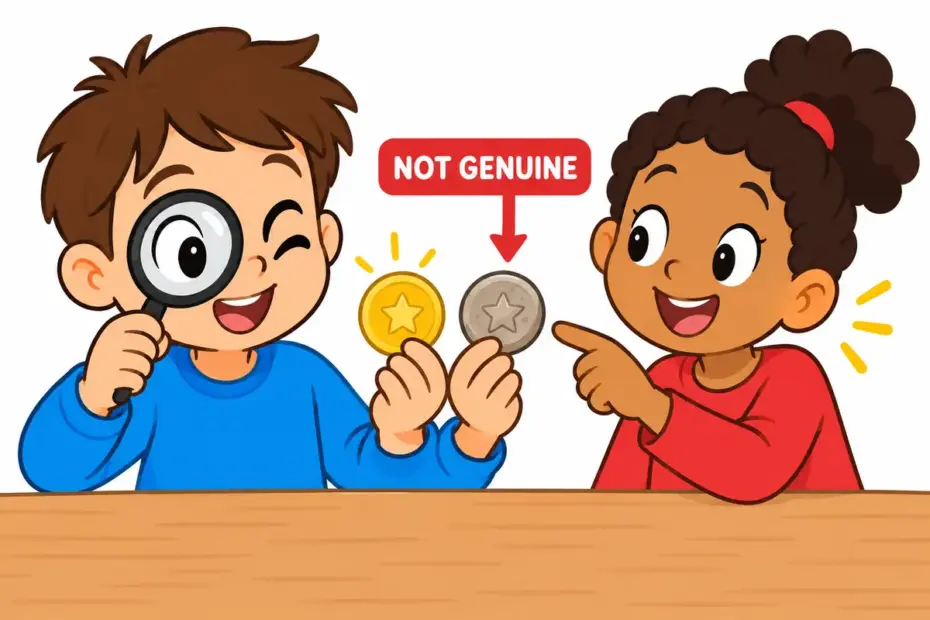
Spurious describes something that is not genuine, valid or based on truth — a spurious claim, a spurious correlation, a spurious coin. To use spurious in a sentence, place it before the noun it judges: “The study rested on a spurious correlation.” The word is an adjective, so it describes a thing, never a feeling.
Spurious at a glance
- Spurious is an adjective; its forms are spuriously and the rare noun spuriousness.
- The senses are not genuine, not valid, and not authentic in origin.
- It usually sits before the noun, as in a spurious claim or a spurious signature.
- The word is formal and forensic, common in reports, law and statistics.
- The commonest error is confusing spurious with furious or with suspicious.
What does spurious mean?
Spurious is an adjective meaning false, not genuine or not based on sound reasoning. The Cambridge entry for spurious records both the not-genuine and the not-valid senses, which is why the word fits a fake coin and a faulty argument alike. Where a thing is simply fake in a blunt, everyday way, bogus claim is plainer, and where it is fake in order to deceive, fraudulent invoice is more specific.
| Sense | Plain meaning | Example sentence |
|---|---|---|
| Not genuine | Fake, not what it claims to be | Spurious banknotes filled the drawer. |
| Not valid | Based on faulty reasoning, not sound | The link was a spurious correlation. |
| Not authentic in origin | Wrongly attributed or not from the stated source | A spurious quotation spread online. |
Spurious is a strong judgement: it says a thing is false, not merely unproven. A claim you doubt is questionable or unsubstantiated; calling it spurious asserts that it is wrong. Use the stronger word only when you can show the fault.
How do you use spurious in a sentence?
Spurious never takes a preposition of its own: it attaches straight to a noun or follows a linking verb. Four patterns cover nearly every real sentence.
| Pattern | Example | What it signals |
|---|---|---|
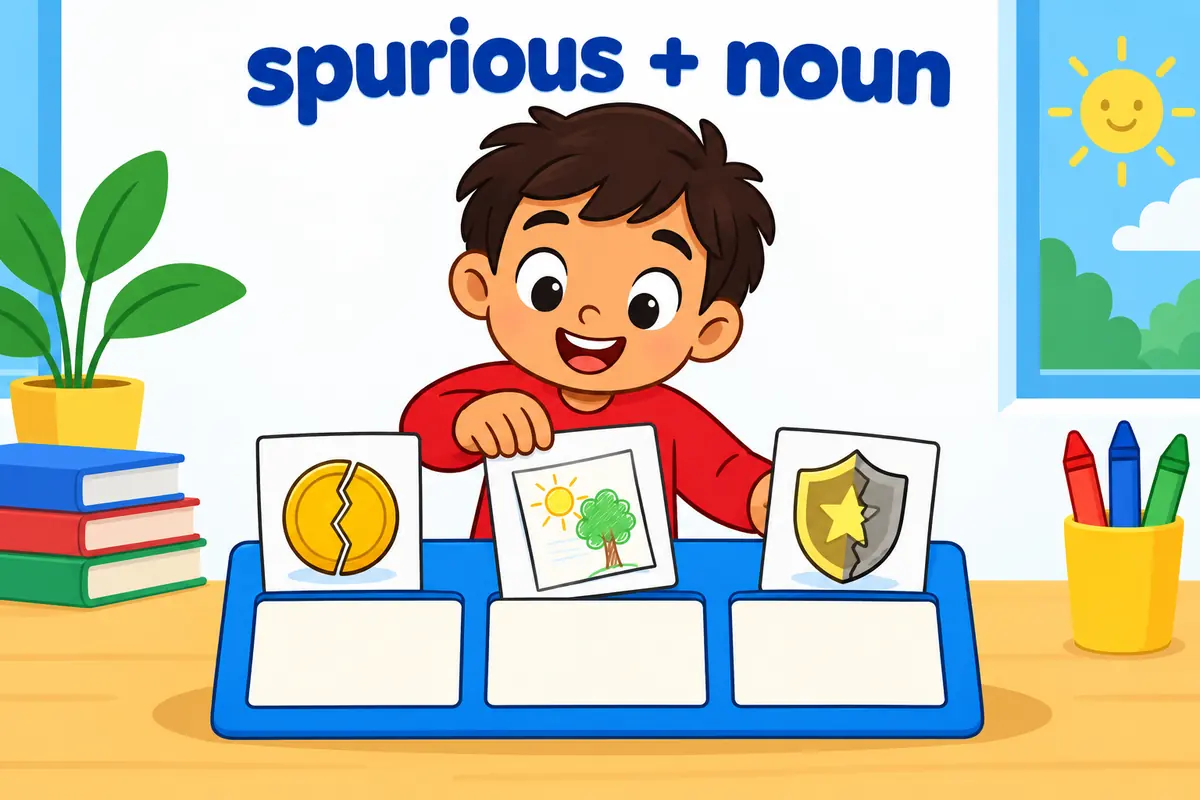
| spurious + noun | The report dismissed a spurious argument. | The adjective sits before the noun it judges. |
| be + spurious | The signature on the deed was spurious. | Predicative use, common in reporting. |
| spurious + correlation, claim or argument | A spurious correlation misleads the reader. | Fixed collocations that signal the false-reasoning sense. |
| look or sound + spurious | The figures looked spurious to the auditor. | Links the adjective to an impression, not a proof. |
A learner who writes spurious about the data has borrowed the frame of suspicious, which is a different word with a different job.
Spurious in a sentence: examples across contexts
Spurious does precise work in formal registers and almost none in speech. The nine sentences below keep the same judgement of falseness while the subject changes.
| Context | Example sentence | Why this works |
|---|---|---|
| Classroom | A spurious footnote sent the whole essay back for revision. | A small fake detail with a large consequence. |
| Workplace email | The invoice looked spurious, so accounts held the payment. | Predicative use in a cautious, professional tone. |
| News report | Investigators called the claims spurious and unsupported. | Pairs the judgement with the reason. |
| Legal writing | The court found the will spurious and set it aside. | The not-genuine sense in a formal setting. |
| Science writing | The team warned that the pattern was a spurious correlation. | Names the classic false-link error. |
| Statistics | Two rising trends produced a spurious relationship between them. | The technical sense, common in data reporting. |
| Conversation | That excuse sounds spurious to me. | The one register where the word survives in speech. |
| History essay | A spurious letter was once accepted as proof of the treaty. | The false-attribution sense. |
| Product review | Shoppers warned that the discount codes were spurious. | Everyday fake-goods sense, still formal in tone. |
Only one line here belongs to speech, and it still carries a note of judgement. In the other registers spurious does precise work: counterfeit notes may be physically fake, and fabricated evidence may be deliberately invented, but spurious can describe either and adds the idea that the thing fails to stand as real.
Spurious vs specious
Specious and spurious both criticise something as bad, but they blame different faults. Specious reasoning is plausible on the surface yet wrong underneath; spurious means not genuine or not valid at all, so it makes a blunter charge.
| Attribute | spurious | specious |
|---|---|---|
| Core charge | Not genuine or not valid | Plausible but actually wrong |
| What it judges | Objects, claims, signatures, correlations | Arguments, reasoning, excuses |
| Surface appeal | Not implied; the thing may look bad at once | Central; it looks convincing at first |
| Typical partner noun | Claim, correlation, coin, quotation | Argument, reasoning, excuse |
| Register | Formal and forensic | Formal and evaluative |
Verdict: choose specious when the fault is a convincing surface hiding a weak argument, and spurious when the thing is simply not what it claims to be.
Word forms and grammar of spurious
Spurious has an adverb and a rare noun but no verb, so a writer who needs an action must reach for another word. The table lists the forms.
| Form | Part of speech | Example |
|---|---|---|
| spurious | adjective | A spurious claim collapsed in court. |
| spuriously | adverb | The two trends were spuriously linked. |
| spuriousness | noun, rare | The auditor noted the spuriousness of the figures. |
| falsify | verb, the needed action | Someone had falsified the record. |
Because there is no verb to spure, a writer who needs an action says falsify, forge or fabricate. The rare noun spuriousness is usually rewritten as the fact that something is spurious.
Common mistakes with spurious
- Incorrect:
The spurious man shouted at the referee.Correct: The furious man shouted at the referee. Rule: Spurious means false; furious means very angry, and the two differ by only two letters. - Incorrect:
I feel spurious about the offer.Correct: I am suspicious about the offer. Rule: Spurious describes a thing, not a feeling; suspicious is the word for doubt. - Incorrect:
This is a spurious information.Correct: This is spurious information. Rule: Information is uncountable, so no article, and the adjective attaches straight to the noun. - Incorrect:
The evidence was spurious, so it proved her case.Correct: The evidence was spurious, so it proved nothing. Rule: A spurious thing is false, so it cannot support a conclusion. - Incorrect:
He spurioused the document.Correct: He falsified the document. Rule: Spurious is an adjective with no verb form.
Practice using spurious
Six items follow; the answer key gives the reason for each so the pattern sticks.
- Fill the gap: The auditor rejected the invoice as ______.
- Choose the better word: His argument sounded convincing but was (specious / spurious) once you checked the sources.
- Correct the error: She felt spurious about the sudden discount.
- Build a sentence: use spurious plus correlation about two graphs that rise together by chance.
- Spot the register: which belongs in a research paper — the link is probably spurious, or the link is obviously fake?
- Replace the word: The quotation was spurious. Make the sentence state the fault plainly.
Answers
- spurious — the adjective describes the invoice as not genuine.
- specious — it looked convincing but failed on inspection, which is the specious fault.
- She felt suspicious about the sudden discount — spurious does not describe feelings.
- Model answer: The two rising graphs created a spurious correlation.
- The link is probably spurious — a paper keeps the formal adjective and avoids obviously fake.
- The quotation was wrongly attributed — this names the specific fault instead of the blunt judgement.
The bottom line
Use spurious in a sentence to call something false, not genuine or not soundly reasoned, and place it before the noun or after a linking verb. The two details that settle most sentences are that the word makes a strong charge of falseness, and that it never describes a feeling. Where an argument merely looks convincing and then fails, specious is the more exact word.
Frequently asked questions about spurious
Is spurious a formal word?
Spurious belongs to formal, written English, where it appears most often in reports, law and statistics. In ordinary conversation most people say fake or phoney instead. A phrase such as a spurious correlation reads naturally in a journal article but sounds bookish at the dinner table.
What is the difference between spurious and furious?
Spurious means false or not genuine, and furious means very angry. The two adjectives differ by two letters and describe completely different things. A spurious accusation is a false one; a furious parent is an angry one. They are never interchangeable, so check the first letters before you write.
What does spurious correlation mean?
A spurious correlation is a statistical link between two things that have no real causal connection, appearing only by chance or because a third factor drives both. Ice cream sales and drowning figures rise together in summer, which is a classic spurious relationship. The pattern looks real in the data but explains nothing.
Is spurious the opposite of genuine?
Not exactly. Genuine has the direct opposite counterfeit or fake, which apply to objects. Spurious is wider: it means not genuine, not valid or not correctly attributed, so it can judge an argument, a correlation or a signature as well as an object. The fault is falseness in a broad sense, not only counterfeiting.
Have you ever come across a statement or argument that seemed plausible at first glance but upon closer inspection turned out to be misleading or false? This kind of misleading representation is what we refer to as “spurious.”
The term “spurious” describes something that is not genuine or authentic, often used to describe information, claims, or arguments that are deceptive or misleading. It is important to be able to identify spurious content in order to make well-informed decisions and avoid being misled by inaccurate information.
7 Examples Of Spurious Used In a Sentence For Kids
- Spurious means not real or genuine.
- Be careful with spurious claims or stories.
- Don’t trust anything that seems spurious.
- It’s important to check if something is spurious before believing it.
- We should always be honest and avoid spurious behavior.
- If something seems too good to be true, it might be spurious.
- Let’s always choose truth over anything spurious.
14 Sentences with Spurious Examples
- Students should always be cautious of spurious job offers promising high salaries with minimal work.
- It is important to research thoroughly before buying textbooks online to avoid purchasing spurious copies.
- College students must be vigilant about avoiding spurious information on social media and only trust reliable sources.
- Plagiarism can have serious consequences, including being accused of using spurious work in academic assignments.
- Some online platforms may sell spurious software claiming to be authentic, so it is essential to purchase from authorized sources.
- It is crucial for college students to be aware of spurious emails asking for personal information to avoid falling victim to phishing scams.
- Be cautious of spurious promises of guaranteed high grades by paying for illegal services like exam paper leaks.
- To protect their health, students should avoid consuming spurious supplements claiming to work miracles without any scientific backing.
- College students should be wary of purchasing spurious electronics from unauthorized dealers to prevent future technical issues.
- Some individuals may try to sell spurious event tickets at a lower price, so always verify the authenticity before making a purchase.
- It is essential for students to verify the credibility of online courses to avoid enrolling in spurious programs.
- College students should avoid sharing spurious academic notes that could mislead their peers during exam preparation.
- When conducting research, it is crucial to reference reputable sources and avoid using spurious information.
- Avoid purchasing spurious study materials that promise guaranteed success in exams without proper validation of their effectiveness.
How To Use Spurious in Sentences?
Spurious is used to describe something that is fake or not genuine. It can be used to refer to information, claims, or objects that are deceptive or misleading.
Here is a simple guide on how to use spurious in a sentence:
-
Identify: Look for situations where there is doubt about the authenticity or validity of something. This could include rumors, stories, or products that seem suspicious.
-
Understand: Once you have identified something that seems questionable, consider if it is a good fit for the word spurious. Is the information or item truly fake or misleading?
-
Construct: When constructing a sentence using spurious, make sure to place it where it accurately describes the deceptive nature of the subject. For example, “The website provided spurious information about the product’s benefits.”
-
Context: Ensure that the word spurious fits naturally within the sentence and conveys the intended meaning. It should be clear to the reader that you are describing something as false or deceitful.
-
Practice: To become more comfortable using spurious, try incorporating it into your writing or conversations. The more you practice, the more confident you will become in using it correctly.
By following these steps, you can effectively incorporate spurious into your vocabulary and communicate more precisely about things that are fake or misleading.
Conclusion
In conclusion, spurious sentences are those that are false, misleading, or not based on truth or solid evidence. They may appear convincing at first glance, but upon closer examination, they lack credibility and validity. By being aware of spurious sentences and practicing critical thinking skills, individuals can better discern between accurate information and deceptive claims.
It is important to be cautious of spurious sentences, especially in a world inundated with misinformation and fake news. Verifying sources, fact-checking information, and seeking out reliable sources can help individuals avoid falling prey to spurious statements. By promoting a culture of skepticism and accuracy, we can work towards creating a more informed and truth-seeking society.


