
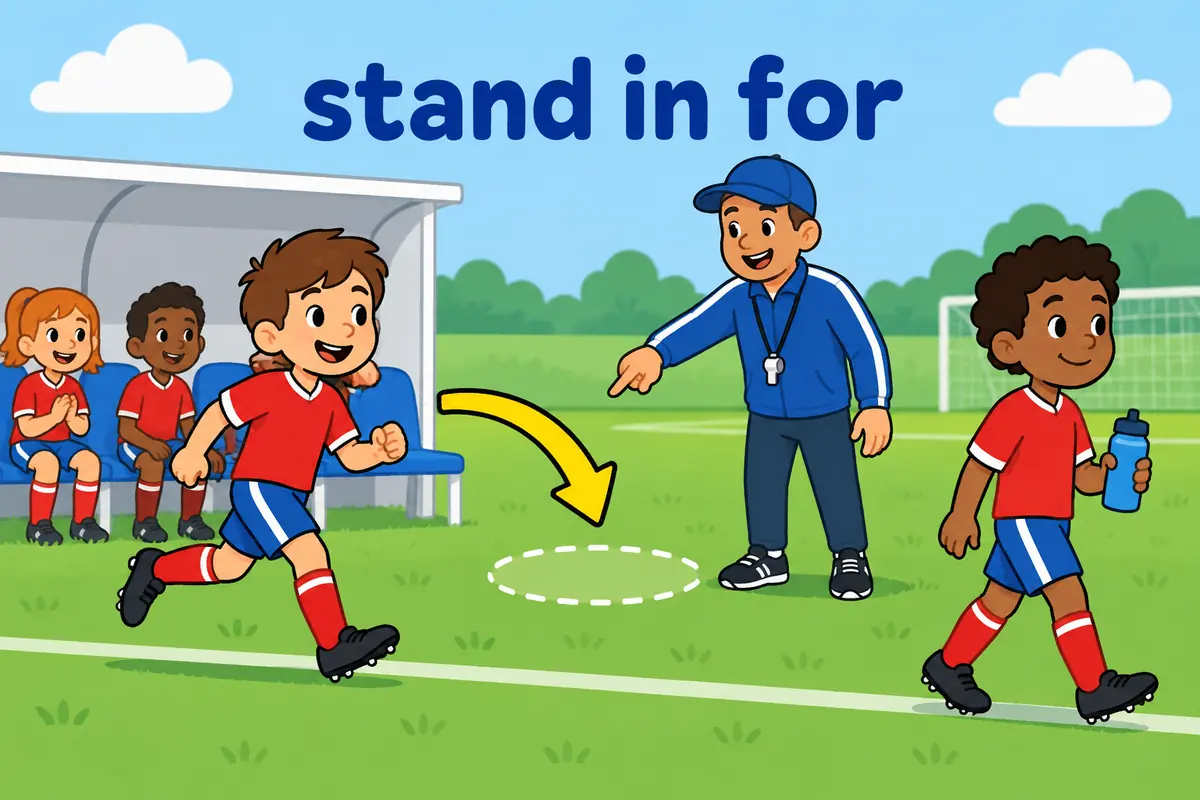
Stand in means to take the place of another person for a time, doing their job or filling their role. To use stand in in a sentence, add for before the person you replace: “Maya stood in for the captain.” The phrase is not separable, so stand and in always stay together.
Stand in at a glance
- Stand in is an intransitive phrasal verb, so it does not take a direct object on its own.
- It almost always appears with for before the person or role being replaced.
- It is not separable: you cannot push the object between stand and in.
- The hyphenated noun stand-in names the substitute person, as in a stand-in for the lead.
- The usual setting is work, sport or theatre, where cover is needed at short notice.
What does stand in mean?
Stand in is a phrasal verb meaning to take the place of somebody for a limited time. The Cambridge entry for stand in records both the verb and the noun stand-in, and the verb is nearly always followed by for. The word stresses the temporary swap, not the reason for it, so it suits a teacher covering a lesson or an actor replacing a colleague at short notice.
| Sense | Plain meaning | Example sentence |
|---|---|---|
| Take a person’s place | Do somebody’s job while they are away | Priya stood in for the coach on Friday. |
| Act in a role | Play a part in place of a performer | The understudy stood in for the lead. |
| Fill a gap on a team | Play a position for somebody else | Ben stood in at goalkeeper for the second half. |
One limitation is worth stating plainly. Stand in does not mean replace permanently. A stand-in hands the role back, while a replacement keeps it. Where the change is lasting, the plain verb replace is the accurate choice, and stand in would overstate how temporary the swap really is.
How do you use stand in in a sentence?
The grammar is simple once you see that stand in is intransitive: the person you help comes after for, not after the verb. The two words never split, so the object cannot sit between them, and the noun form takes a hyphen.
| Pattern | Example | What it signals |
|---|---|---|
| stand in for + person | I stood in for the manager. | The standard pattern; for introduces the person replaced. |
| stand in + role phrase | She stood in as chair for one meeting. | As names the role rather than the person. |
| stand in + at + place or position | He stood in at left back. | Common in sport, where the position is the gap. |
| the stand-in | The stand-in arrived at dawn. | The hyphenated noun names the substitute person. |
| a stand-in for + thing | The clip is a stand-in for the real scene. | Here the noun names a temporary substitute. |
Stand in in a sentence: examples across contexts
Stand in keeps its meaning while the setting changes. The ten sentences below move from a classroom to a broadcast studio, and each one names who was replaced.
| Context | Example sentence | Why this works |
|---|---|---|
| Classroom | A student teacher stood in for our usual music teacher. | For introduces the person being covered. |
| Workplace email | Could you stand in for me at the ten o’clock meeting? | A polite request that names the meeting and the person. |
| News report | The deputy stood in for the minister at the summit. | A formal setting where the role matters more than the person. |
| Sport | The reserve goalkeeper stood in after the injury. | The gap is a position, so the context supplies the object. |
| Theatre | The understudy stood in for the lead on opening night. | Names the stand-in’s own title and the person replaced. |
| Office cover | Colleagues often cover for each other rather than call in a stand-in. | Shows the everyday verb that competes with the formal phrase. |
| Clinical rota | One consultant stood in for another during the holiday. | A rota context where for names the absent colleague. |
| Broadcast | A colleague stood in as presenter for the evening bulletin. | The as-phrase names the role rather than the person. |
| Legal writing | A act for a client is more formal than to stand in. | Shows the register-lifting alternative in professional prose. |
| Conversation | Can you stand in for me while I take this call? | The fixed for-phrase in a quick spoken request. |
Stand in vs step in
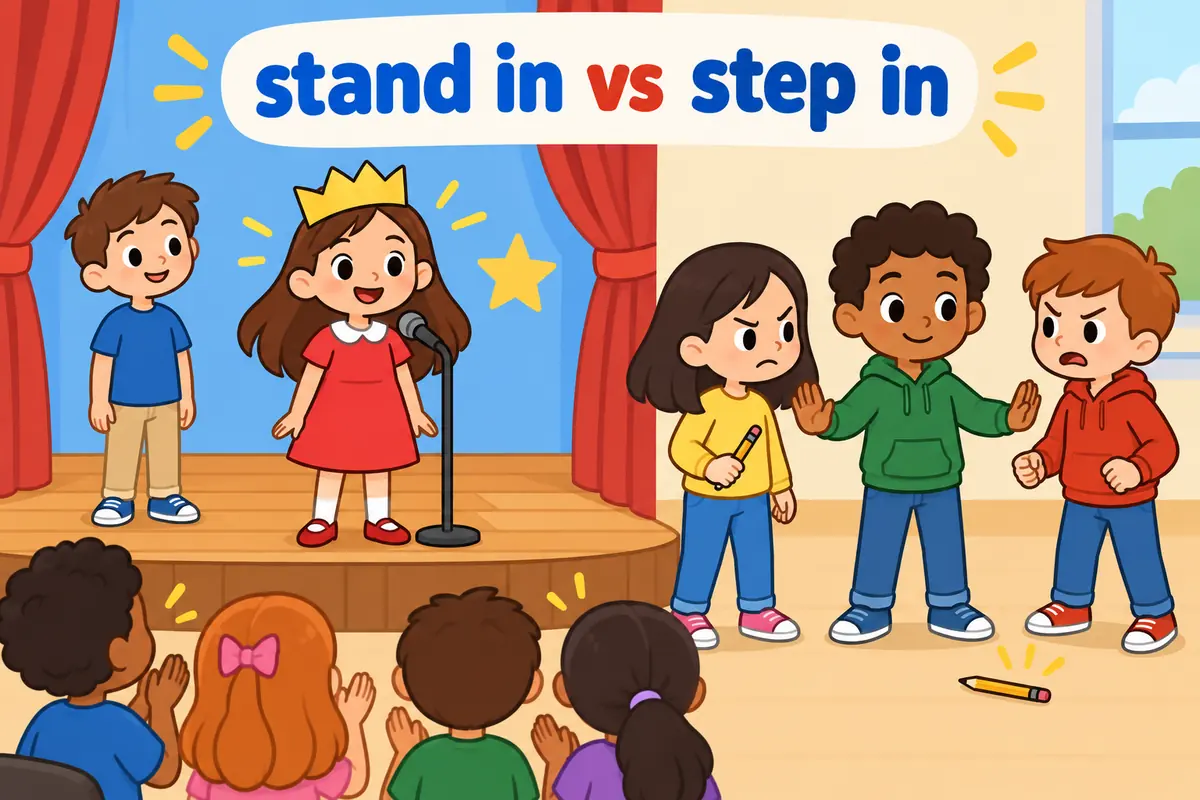
Stand in and step in both describe entering a situation, and the difference is what fills the gap. Stand in means to take over somebody’s role; step in means to become involved in order to help, often when nobody asked. A stand-in is a substitute for a person, while a person who steps in is usually solving a problem.
| Attribute | stand in | step in |
|---|---|---|
| Core job | Take over a person’s role temporarily | Get involved to help or intervene |
| What fills the gap | A named person or role | A problem or a sudden need |
| Usual frame | stand in for somebody | step in to do something |
| Typical setting | Work, sport, theatre | Any situation that needs help |
| What it implies | A planned or agreed swap | A quick, often unplanned action |
Verdict: choose stand in when somebody takes another person’s place, and step in when somebody enters a situation to help.
Word forms and grammar of stand in
Stand in keeps the irregular inflections of stand, and the noun adds a hyphen. The table also shows the near-synonym substitute, which is more formal and can be separated from its preposition.
| Form | Part of speech | Example |
|---|---|---|
| stand in | phrasal verb, base form | I can stand in for you tomorrow. |
| stands in | phrasal verb, third person singular | She stands in whenever the chef is away. |
| stood in | phrasal verb, past and past participle | He stood in for the head last week. |
| standing in | phrasal verb, present participle | The aide is standing in for the director. |
| stand-in | noun, hyphenated | The stand-in was word-perfect. |
| stand-in | adjective use | A stand-in teacher took the class. |
Two spelling points matter. The verb is two words, stand in, while the noun is hyphenated, stand-in. Writing stand in as a noun, or stand-in as a verb, is the slip readers spot first.
Common mistakes with stand in
- Incorrect:
She stood in the manager.Correct: She stood in for the manager. Rule: The verb is intransitive and needs for before the person replaced. - Incorrect:
He stood the lead in.Correct: He stood in for the lead. Rule: Stand in is not separable, so the object cannot go between the two words. - Incorrect:
The actor’s stand in arrived late.Correct: The actor’s stand-in arrived late. Rule: The noun carries a hyphen between stand and in. - Incorrect:
I will stand in to teach the lesson.Correct: I will stand in for the teacher. Rule: Use the for-phrase unless as plus a role follows. - Incorrect:
The deputy stood in the minister at the summit.Correct: The deputy stood in for the minister at the summit. Rule: As and for introduce the person or role; the bare object is impossible.
Practice using stand in
Work through the six items, then read the reasons rather than only the answers.
- Fill the gap: Can you stand in ______ me at the parents’ evening?
- Choose the better word: The technician (stood in / replaced) the manager permanently last year.
- Correct the error: She stood in the captain on Saturday.
- Build a sentence: use stand in as about covering a role at school.
- Spot the register: which belongs in a work email — could you stand in for me, or fancy covering my shift?
- Rewrite with the noun: A colleague acted in place of the chair. Use stand-in.
Answers
- for — the intransitive verb needs for before the person replaced.
- replaced — the change is permanent, so stand in would be wrong.
- She stood in for the captain on Saturday — the phrase is not separable and needs for.
- Model answer: Mr Lee stood in as referee for the final match.
- Could you stand in for me — a work email keeps the formal phrase and the for-phrase.
- A stand-in took the chair — the hyphenated noun names the substitute person.
The bottom line
Use stand in in a sentence when somebody takes another person’s place for a while, and always add for before the person or role. The two details that decide most sentences are these: the phrase is intransitive and inseparable, so the object follows for, and it describes a temporary swap rather than a permanent change. Where help arrives without a named person to replace, call in or step in fits better.
Frequently asked questions about stand in
Is stand in one word or two?
As a verb it is two words, as in she stood in for the coach. As a noun it takes a hyphen, stand-in, as in the stand-in knew every line. Keeping the parts separate is the simplest rule: a verb does the action, and a hyphenated noun names the person.
Do you say stand in or stand in for?
The for-phrase is the standard pattern because the verb is intransitive. Stand in for the manager names the person replaced. You can drop for only when as introduces a role, as in stand in as chair. Without for or as, the sentence is incomplete and sounds unfinished.
Is stand in separable?
No. Unlike many phrasal verbs, stand in does not allow the object between the two words. You cannot say stood the lead in. The person always follows for, giving stood in for the lead. This is why the phrase behaves differently from separable verbs such as phase out.
What is a stand-in in film?
In film, a stand-in is a person who replaces an actor for technical work such as lighting and camera checks, so the star is not needed on set. The stand-in is usually chosen for a similar height and build. The actor returns for the actual performance, which keeps the substitution temporary.
“Have you ever found yourself substituting for someone or holding their place in a situation? If so, you’ve unknowingly taken a ‘stand in’ role. This term refers to stepping into someone else’s place temporarily, often to fulfill a duty or responsibility on their behalf.”
“Whether it’s standing in for a colleague at work, representing someone in their absence, or simply acting as a replacement, being a ‘stand in’ can be a common occurrence in various scenarios. Let’s explore this concept further and see how ‘stand in’ plays a role in different contexts.”
7 Examples Of Stand In Used In a Sentence For Kids
- Stand in a line when waiting for your turn.
- Let’s stand in a circle and hold hands.
- We can stand in a group for the photo.
- Everyone, please stand in a row.
- Can you stand in the middle of the room?
- Stand in a corner if you need help.
- Let’s stand in front of the board and sing a song.
14 Sentences with Stand In Examples
- Stand in line at the library to borrow a book.
- Stand in for your friend as a team leader in a group project.
- Don’t forget to stand in for your friend at the lecture if they miss it.
- You can stand in as a volunteer for sports events on campus.
- Stand in for your roommate at the club meeting if they can’t make it.
- If your classmate is absent, make sure to stand in for them during presentations.
- It’s important to stand in for your professor if they ask for student volunteers.
- Don’t hesitate to stand in for a class representative when needed.
- As a responsible student, be prepared to stand in for any last-minute student council roles.
- You may need to stand in for a teammate during a debate competition.
- In case of emergencies, be ready to stand in for a friend at an extracurricular event.
- Make sure to stand in for a peer during a college committee meeting if they are unavailable.
- You might have to stand in at various student organization events on campus.
- If needed, be willing to stand in for a class presentation on short notice.
How To Use Stand In in Sentences?
Stand In can be used in a sentence when you want to convey the idea of someone serving as a substitute or replacement. Here’s a simple guide on how to use Stand In effectively in a sentence:
-
Identify the need for a substitute: Before using the term Stand In, determine if there is a situation where someone is substituting for another person or taking their place temporarily.
-
Choose the appropriate context: Ensure that the sentence you construct accurately reflects the role of the substitute or replacement. For example, “She will stand in for the lead actress during her absence.”
-
Place the term correctly: Stand In is usually followed by the preposition “for” to indicate who or what is being substituted. For instance, “John will stand in for the manager at the meeting.”
-
Maintain clarity: Make sure that the sentence is clear and easy to understand. Avoid using Stand In in a way that could be interpreted as ambiguous or confusing.
By following these guidelines, you can effectively incorporate Stand In in your sentences to express the concept of substitution or replacement. Practice using this term in various contexts to become more comfortable with its usage.
Conclusion
In conclusion, sentences with “stand in” typically refer to someone or something acting as a substitute or replacement for another person or thing in a particular situation. This could involve temporarily taking someone’s place, filling in for them, or representing them in their absence. These sentences often highlight the concept of standing in as a proxy or stand-in when the original person or thing is unavailable or unable to fulfill a role or function. By using “stand in,” speakers emphasize the idea of substitution and the ability of someone or something to effectively serve as a replacement in various contexts.
Overall, sentences incorporating “stand in” convey the notion of providing support or covering for someone or something when needed, showcasing flexibility and adaptability in different scenarios. Whether it’s in the realm of staffing, representation, or performance, the phrase “stand in” underscores the idea of stepping in when necessary to ensure continuity and seamlessly fulfill a specific role or duty.


