What does stanza mean in poetry?
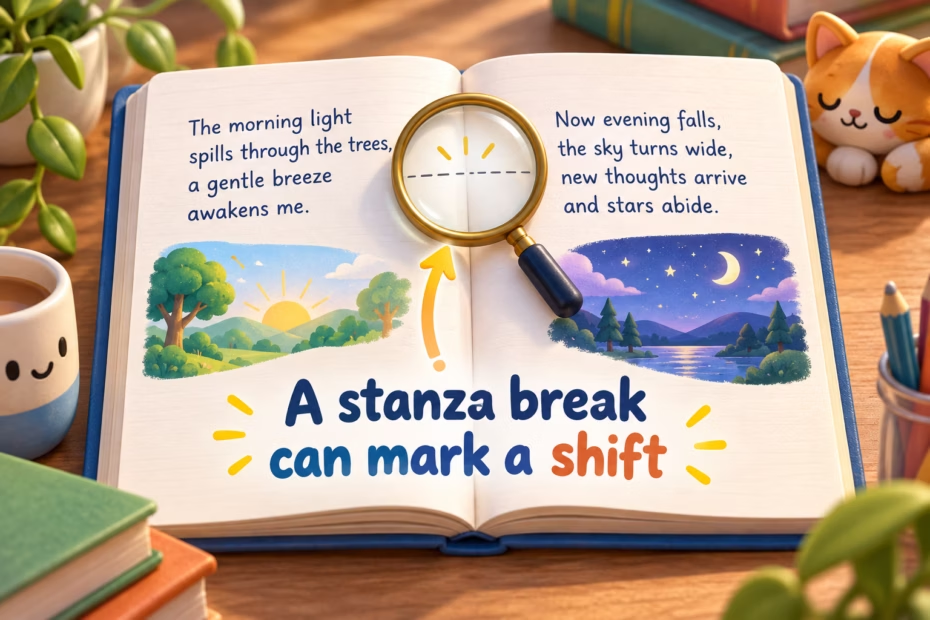
A stanza is a group of poetic lines arranged as a unit within a poem, often separated from other groups by a blank line or indentation. It works somewhat like a paragraph: the poet may use a stanza break to organize an idea, change the scene or speaker, shift time, or create a pause. A stanza does not have to rhyme, and it does not have to contain four lines.
Use stanza as a countable noun: “one stanza,” “the second stanza,” or “three stanzas.” The word can name a group of lines whether the poem uses a fixed form or free verse. A stanza break can shape how a poem reads, but the blank space alone does not tell you what the poem means; look at the words before and after it.

Stanza at a glance
- A stanza groups lines in a poem; a line is one row or unit of verse.
- Stanzas may be separated visually by a blank line or indentation.
- Line count and rhyme are different features: a four-line stanza is a quatrain, but it need not use one fixed rhyme pattern.
- Poets can use stanzas to organize thought, sound, pacing, or a change in focus.
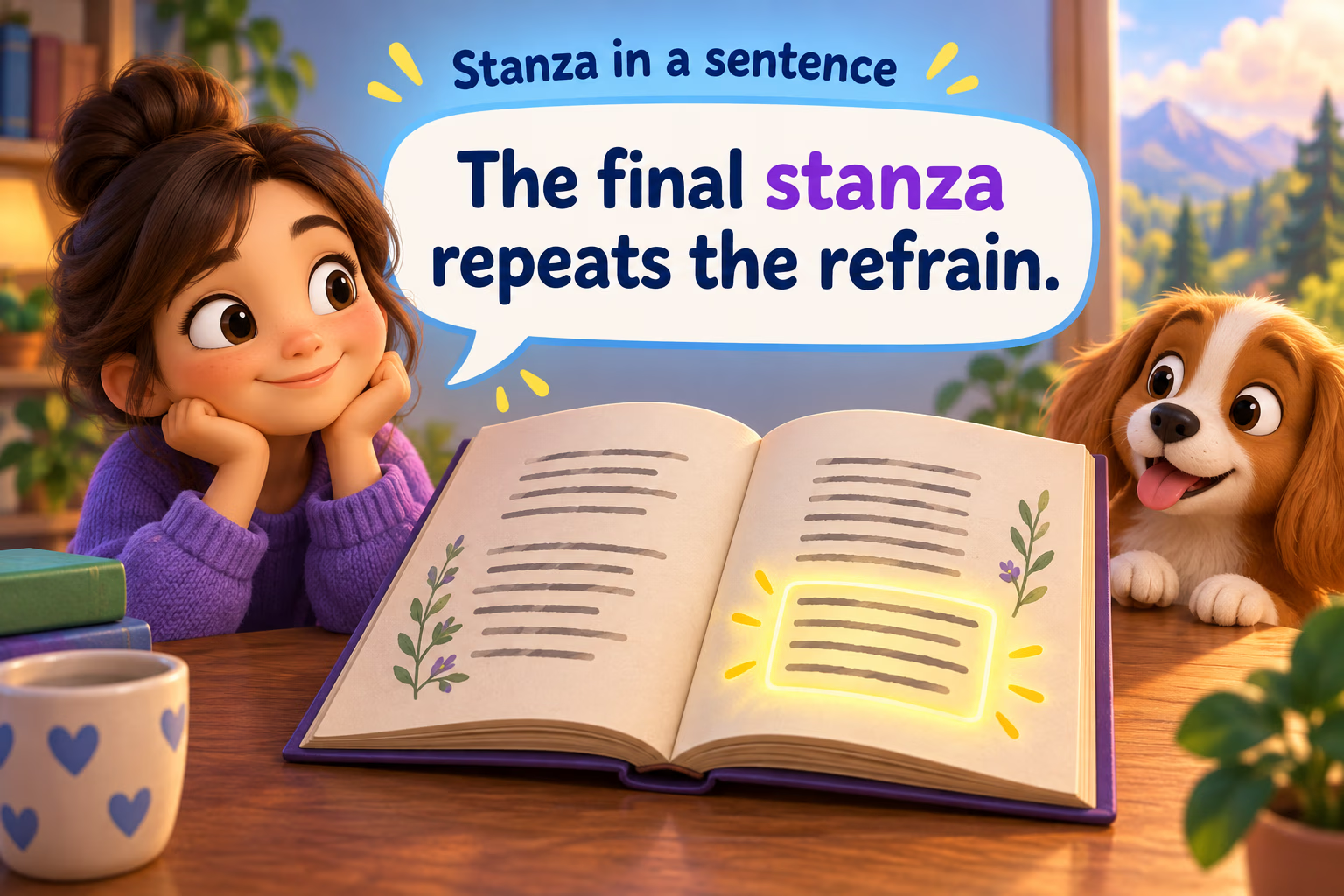
- Sentence pattern: The [ordinal] stanza [verb] [detail] — “The final stanza repeats the refrain.”
How many lines are in a stanza?
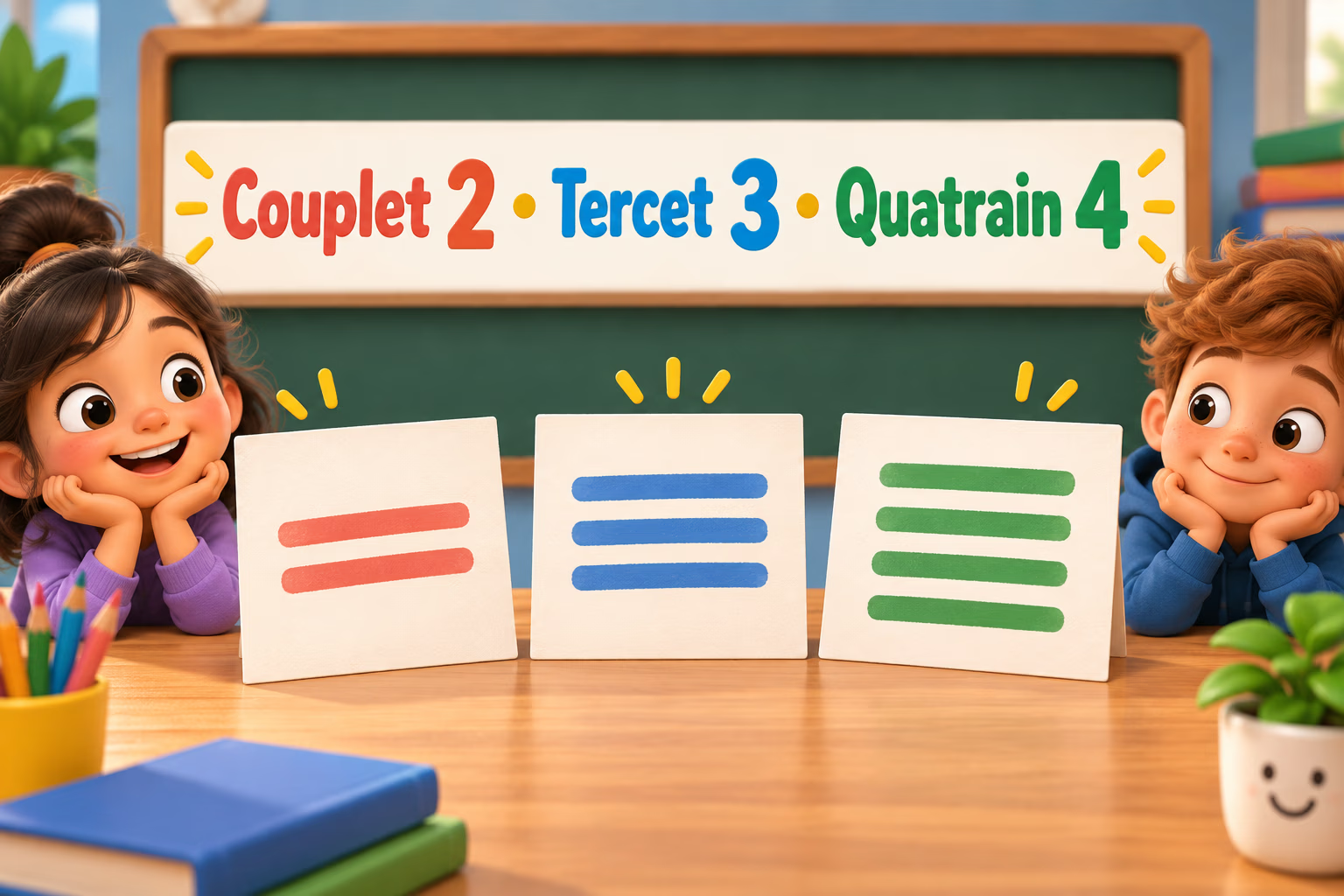
A stanza can have any number of lines; its name often reflects line count when a familiar form applies. These labels describe size, not a required rhyme scheme:
| Term | Lines | Example usage |
|---|---|---|
| Couplet | 2 | “The opening couplet introduces the speaker.” |
| Tercet | 3 | “Each tercet adds a new image.” |
| Quatrain | 4 | “The second quatrain develops the comparison.” |
| Quintain | 5 | “The poem closes with a five-line quintain.” |
| Sestet | 6 | “The sestet answers the question raised earlier.” |
| Octave | 8 | “The octave establishes the poem’s problem.” |
These are common names for groupings, not a rule that every stanza must fit a traditional form. The Poetry Foundation defines a quatrain as a four-line stanza and a couplet as a two-line unit; the Academy of American Poets lists terms from couplet through octave. Some forms organize larger poems from these units: an English sonnet commonly has three quatrains and a concluding couplet, while a Petrarchan sonnet typically has an octave and a sestet. Not every sonnet uses the same arrangement.
Examples of stanza used in a sentence
In everyday writing about poetry, stanza often appears with an ordinal, a number, or a description of what the lines do. These examples use the word in the poetic sense:
- “The final stanza repeats the refrain.”
- “I read the first stanza aloud to hear its rhythm.”
- “The poem has four stanzas, each focused on a different season.”
- “A blank line separates the second stanza from the third.”
- “The last stanza changes the speaker’s hopeful tone.”
- “Her free-verse poem uses a short stanza to slow the pace.”
To build a sentence, first decide whether you mean one group or more than one: use a stanza for a single group and stanzas for the plural. Then add a precise detail: identify its position (“the third stanza”), line count (“a four-line stanza”), or effect (“the stanza creates a pause”). Avoid saying a stanza “has a rhyme scheme” as if rhyme were compulsory; many stanzas are unrhymed.
Stanza, line, and verse: what is the difference?
A line is one unit of verse; a stanza is a group of lines; and verse can refer to poetry more broadly or, in some contexts, a line or stanza. The exact use of verse depends on context, especially in songs, hymns, and traditions that use “verse” for a repeated section. Naming the line count or quoting the heading can remove ambiguity.
A stanza break is a visible boundary, not necessarily a full stop. Enjambment carries a phrase or sentence across a line break, and it can also continue across a stanza break. Read through the punctuation and syntax before treating the whitespace as the end of an idea.
How to use stanza correctly
- Use the plural accurately: “The poem’s three stanzas each contain four lines.”
- Separate structure from interpretation: “The stanza break comes before the speaker describes the storm” reports placement; “the break signals fear” interprets its effect and should be supported by the poem.
- Name the relevant unit: “The last line of the second stanza” is clearer than “the end of the verse” when discussing a specific poem.
Quick check: if the group contains four poetic lines, it may be called a quatrain; if a visual gap separates one group from another, that gap marks a stanza break. Neither observation by itself establishes the poem’s rhyme scheme or meaning.
A note about the separate Stanza software
Stanza is also the name of a natural-language-processing software package, a different subject from the poetry noun. The older Python tutorial preserved later on this page describes that Stanford NLP package, not how to put the poetry word stanza into an English sentence. Its code examples (such as import stanza) use the software name as a proper noun; the poetry examples above use the common noun.
Sources and further reading
The definition and stanza-break guidance follow the Poetry Foundation glossary entry for stanza. Line-group names are cross-checked with the couplet, tercet, and quatrain entries and the Academy of American Poets glossary. The software sense is documented by Stanford’s Stanza NLP package documentation.
Editorial clarification of the preserved original
The source article below is retained in full, including its 21 examples, code, and original conclusion. Two statements in that legacy text need context: poetic stanzas do not each require a rhyme scheme, and sonnets do not all use the same stanza division. The description of Stanza as a Python text-analysis library is about Stanford’s NLP package and answers a separate query; it is not a poetry example. Use the sourced guidance above for the poetry meaning.
Have you ever wondered what a stanza is? In poetry, a stanza is a group of lines that form a unit within a poem. Each stanza usually has a specific rhyme scheme, pattern, or structure that sets it apart from the rest of the poem.
Stanzas are like building blocks in a poem, helping to organize the thoughts and emotions of the poet. By dividing a poem into stanzas, poets create a sense of rhythm and flow that enhances the overall impact of the work.
7 Examples Of Stanza Used In a Sentence For Kids
- Stanza is a group of lines in a poem.
- A stanza can have four lines or even more.
- Each stanza can share a different idea or thought.
- When we read a poem, we look at each stanza.
- Let’s count the number of stanzas in this poem.
- A stanza helps organize a poem neatly.
- I like to draw a picture for each stanza in a poem.
14 Sentences with Stanza Examples
- Stanza analysis is an essential part of studying poetry in Literature class.
- Make sure to organize your essay into clear stanzas to improve readability.
- The professor asked us to identify the main theme of each stanza in the poem.
- Our assignment is to memorize a stanza from a famous Indian poet’s work.
- When writing poetry, pay attention to the structure of each stanza.
- The stanza break-up in the sonnet emphasizes different aspects of the poet’s thoughts.
- We have to submit a detailed analysis of the third stanza by tomorrow.
- The stanza used in the song conveys a sense of longing and nostalgia.
- It’s important to understand the significance of each stanza to grasp the poem’s meaning.
- The stanza about nature in the poem captures the beauty of the Indian landscape.
- Revising your essay by focusing on the stanza structure can enhance its coherence.
- The stanza arrangement in this poetry anthology showcases a variety of styles.
- When reciting a poem, pay attention to the tone shift between each stanza.
- The use of repetition in the final stanza reinforces the poem’s central message.
How To Use Stanza in Sentences?
Stanza is a powerful natural language processing library that can be used to perform various text analysis tasks. To use Stanza effectively in a sentence, follow these steps:
-
Import the Stanza library in your Python script by using the following command:
python

import stanza
-
Download the language model you want to use with Stanza. For example, to download the English model, use the command:
python

stanza.download('en')
-
Create a Stanza pipeline by specifying the language of the text you want to analyze:
python

nlp = stanza.Pipeline('en')
-
Process your text by passing it through the pipeline created in the previous step:
python

doc = nlp("Your input text goes here.")
-
Access the analyzed results. For example, print out the lemmatized form of each word in the text:
python

for sentence in doc.sentences:

    for word in sentence.words:

        print(word.text, word.lemma)
-
Explore the various attributes and methods available in Stanza for performing tasks like tokenization, part-of-speech tagging, named entity recognition, and more.
By following these steps, you can effectively use Stanza to analyze text data and extract valuable insights for your projects.
Conclusion
In poetry, a stanza is a grouping of lines separate from one another by a space. Stanzas help in organizing thoughts and ideas, providing structure and rhythm to a poem. For example, in a sonnet, the fourteen lines are divided into three quatrains and a final couplet, creating a specific structure and form. Each stanza can convey a different idea, emotion, or image, contributing to the overall meaning of the poem.
By breaking up a poem into stanzas, poets can control the pacing, create emphasis, and guide the reader through the text. Different types of stanzas, like tercets or quatrains, offer poets flexibility in expressing their creativity while maintaining a cohesive structure. Overall, stanzas play a crucial role in shaping the flow and impact of a poem, allowing poets to craft their message effectively.


