
Stave off means to keep something bad away for a time, usually by acting before it arrives, so it delays rather than removes a threat. To use stave off in a sentence, put the trouble after the phrase: a late goal staved off defeat. The verb is transitive, and a pronoun object splits it.
Stave off at a glance
- Stave off is a transitive phrasal verb; its forms are staves off, staved off and staving off.
- It means to avert or postpone something unwelcome, such as hunger, defeat or bankruptcy.
- Its object normally follows off, as in stave off a crisis.
- A pronoun object sits between the parts, as in stave it off.
- The commonest error is dropping off, as in stave a cold, which changes the meaning.
What does stave off mean?
Stave off is a phrasal verb meaning to prevent or delay something unpleasant from happening, especially for a limited period. The Cambridge entry for stave off pairs it with hunger and defeat, and the note of delay is what separates it from prevent a problem, which can mean stopping something for good.
| Usual object | What it means | Example sentence |
|---|---|---|
| Hunger or thirst | Keep a basic need at bay for now | A warm bowl of soup staved off the cold. |
| Defeat or relegation | Postpone a loss in sport or politics | The equaliser staved off defeat. |
| Bankruptcy or closure | Delay a financial collapse | A single order staved off closure for a month. |
One limitation matters. Stave off never promises a permanent cure: it buys time. When the danger is gone entirely, remove or eliminate is the honest verb, and when a threat is driven away by force, avert a disaster and repel fit better.
How do you use stave off in a sentence?
Place the threat after off, because the verb is mostly inseparable in that order. The particle may still move behind a short object, and a pronoun must always split the pair.
| Pattern | Example | What it signals |
|---|---|---|
| stave off + noun | The keeper made three saves to stave off defeat. | The threat follows off, the usual order. |
| stave + noun + off | Early rain helped stave the fire off. | A short object may sit before the particle. |
| stave it off | The team needed one goal to stave it off. | A pronoun always sits between the parts. |
| be staved off | A default was staved off by a late payment. | The threat becomes the subject of a passive. |
| stave off + gerund | We are staving off running out of funds. | An ing-form names the outcome being delayed. |
Long objects stay after off, so a phrase such as stave off the collapse of the whole scheme reads better unbroken, while the pronoun in stave it off can do nothing else.
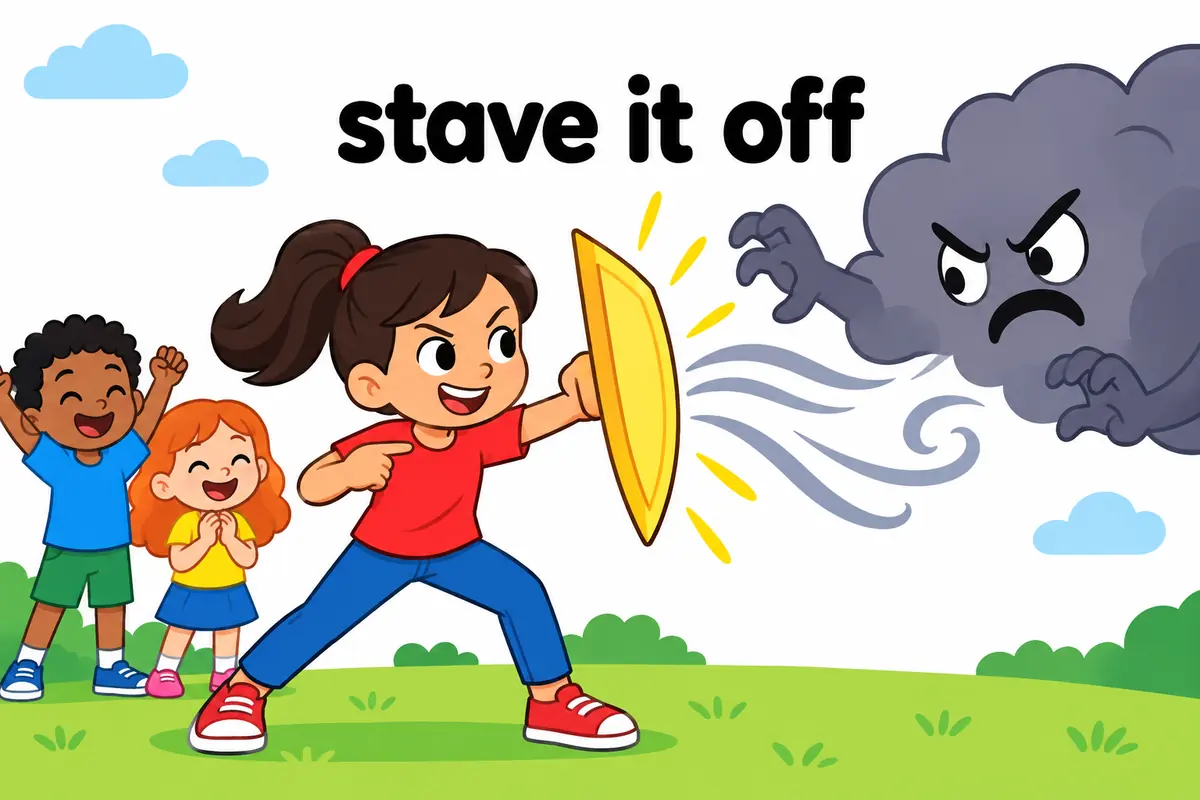
Stave off in a sentence: examples across contexts
Stave off suits any setting where effort buys time. The nine sentences below move from a hospital ward to a football ground, and each one names the trouble being held back.
| Context | Example sentence | Why this works |
|---|---|---|
| Classroom | A short break staved off tiredness during the long test. | A small, familiar action delays a familiar problem. |
| Workplace email | Extra staff helped stave off missed deadlines this quarter. | The subject is the remedy, not the threat. |
| News report | The clinic bought supplies to stave off a shortage. | A public threat is reported plainly. |
| Medical writing | Fluids and rest can stave off dehydration in hot weather. | Advice pairs a cause with its prevention. |
| Business writing | The bridge loan staved off insolvency for two months. | A precise duration shows the delay. |
| Sports commentary | A late penalty staved off relegation on the final day. | The stakes are high and the timing is exact. |
| Environmental writing | Sea walls stave off flooding at high tide. | A barrier is the means of delaying harm. |
| History essay | A single alliance staved off war for a decade. | A long but finite span fits the delay sense. |
| Conversation | We grabbed a snack to stave off hunger until dinner. | The everyday use names the hours saved. |
Only the conversation sentence belongs in speech without strain. The rest keep the phrase in writing that reports effort against a deadline.
Stave off vs ward off
Stave off and ward off both keep trouble away, but they part on method and duration. Stave off buys time by holding a threat back; ward off drives a threat away through a defensive move. A goal fend off pressure in football delays a loss, while a charm is said to ward off bad luck.
| Attribute | stave off | ward off |
|---|---|---|
| Core idea | Postpone trouble for a time | Turn a threat aside |
| Typical objects | Hunger, defeat, bankruptcy | Colds, blows, evil, danger |
| Method | Effort that buys time | A guard or defence |
| Duration | Usually temporary | Often immediate |
| Register | Neutral to formal | Neutral, slightly literary |
| Separability | Pronoun must split it | Pronoun must split it |
Verdict: choose stave off when a fix just holds trouble back for now, and ward off when a defence turns the threat away, with forestall a crisis close to stave off whenever the action comes first.
Word forms and grammar of stave off
The verb inflects regularly and keeps off attached in every tense. The Merriam-Webster entry for stave off lists no surprise forms, though a shorter verb, break off talks, shares the particle but means to stop suddenly rather than to delay.
| Form | Part of speech | Example |
|---|---|---|
| stave off | verb, base form | We must stave off a second delay. |
| staves off | verb, third person singular | A hot drink staves off the chill. |
| staved off | verb, past and past participle | The loan staved off closure. |
| staving off | verb, present participle | They are staving off defeat. |
| stave | noun, separate meaning | A loose stave rattled in the barrel. |
The noun stave, meaning a curved wooden slat, is a different word, so the phrase carries its meaning only when off is present.
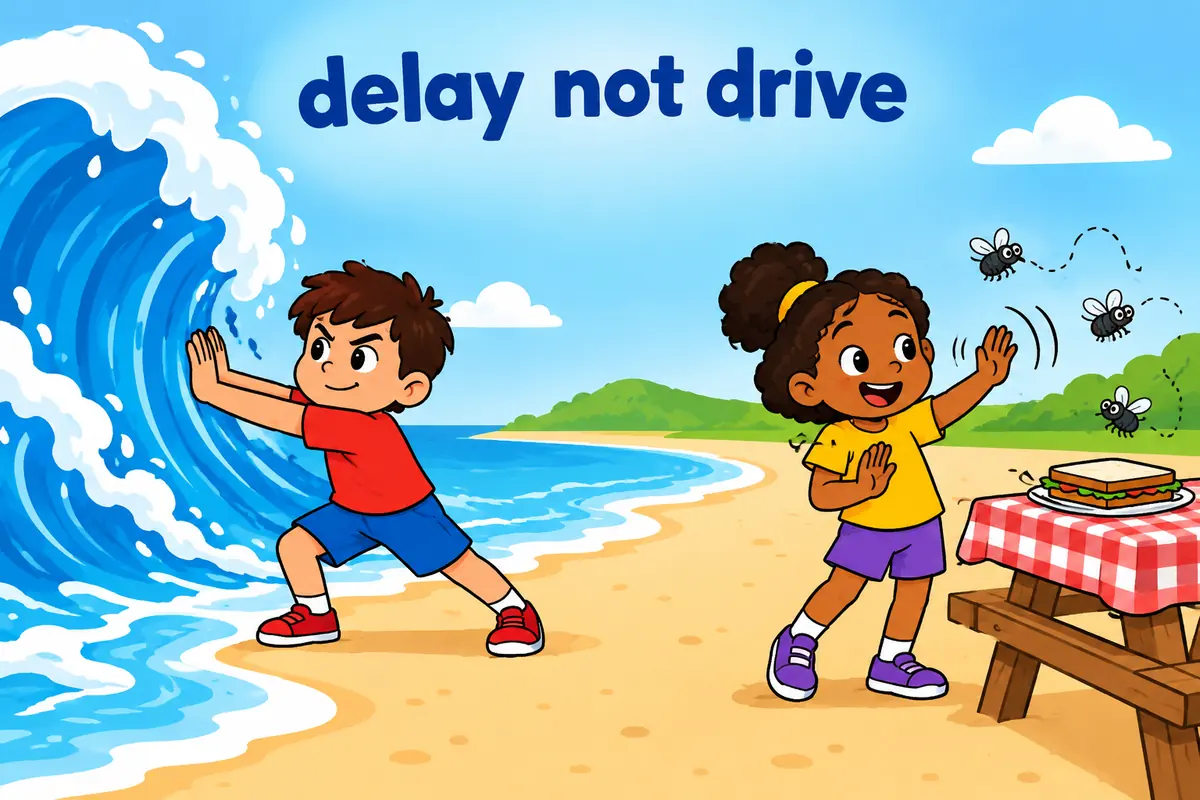
Common mistakes with stave off
- Incorrect:
The medicine staved a cold.Correct: The medicine staved off a cold. Rule: Off is part of the verb, so the phrase needs both words to keep its meaning. - Incorrect:
They staved off from bankruptcy.Correct: They staved off bankruptcy. Rule: The verb is transitive and takes a direct object, never from. - Incorrect:
The deal stove off collapse.Correct: The deal staved off collapse. Rule: The past tense is staved, formed regularly with ed. - Incorrect:
A save staved off it.Correct: A save staved it off. Rule: A pronoun object must sit between the verb and the particle. - Incorrect:
The wall staves off the river last year.Correct: The wall staved off the river last year. Rule: Match the tense to the time marker, so stave becomes staved.
Practice using stave off
Work through the six items, then check the reasoning rather than only the answer.
- Fill the gap: A single goal was enough to ______ relegation for another week.
- Choose the better word: The fence is meant to (stave off / ward off) stray dogs by blocking the gap.
- Correct the error: A snack helped stave hunger.
- Build a sentence: use stave it off about a class play that might be cancelled.
- Spot the register: which belongs in a business report – The loan staved off insolvency, or We totally staved off going bust?
- Rewrite as a passive: One late order staved off closure. Begin with Closure.
Answers
- stave off – the goal delays relegation, and off stays with the verb.
- stave off – the fence holds the dogs back for now rather than driving them away at once.
- A snack helped stave off hunger – dropping off removes the meaning.
- Model answer: We sold extra tickets to stave it off and keep the play on.
- The loan staved off insolvency – a report avoids slang and filler adverbs.
- Closure was staved off by one late order – the threat becomes the subject of the passive.
The bottom line
Use stave off in a sentence when effort keeps trouble away for a limited time, and place the threat after off. The verb is transitive, so a pronoun must split the phrase, as in stave it off, and the underlying note of delay is why stave off differs from a permanent fix. Where the action comes well before the danger, delay the outcome is the plainer cousin.
Frequently asked questions about stave off
Can you separate stave off?
Yes, but only with a short object, and always with a pronoun. You may write stave the fire off, yet the usual order keeps off after the noun. A pronoun such as it cannot follow off, so stave it off is the only grammatical version.
Does stave off mean the same as prevent?
Not quite. Prevent can mean stopping something completely, while stave off means holding it back for a time. A cure prevents an illness; a warm coat staves off a chill until you reach shelter. The difference is whether the danger returns.
Is stave off used in sports writing?
Yes, and sport is where readers meet the phrase most often. Reporters write that a late goal staved off defeat or that a win staved off relegation, because the result only postpones the danger rather than ending the whole season.
What is the past tense of stave off?
The past tense is staved off, formed by adding ed to stave and keeping off in place. So the correct form is the loan staved off closure. The irregular-looking stove belongs to a different sense of stave and never replaces staved in this phrase.
Do you know how to “stave off” potential problems and maintain stability in various situations? To “stave off” means to prevent or delay something unwanted or harmful from happening. This versatile phrase can be applied in a wide range of contexts, from health and wellness to financial planning and beyond.
7 Examples Of Stave Off Used In a Sentence For Kids
- Stave off the cold by wearing a warm sweater.
- Drink water to help stave off dehydration.
- Eating fruits and vegetables can help stave off illness.
- Washing your hands regularly can help stave off germs.
- Getting enough sleep can help stave off feeling tired.
- Exercise can help stave off feeling lazy.
- Remember to brush your teeth to stave off cavities.
14 Sentences with Stave Off Examples
- Stave off procrastination by setting small goals and deadlines for your assignments.
- Make sure to prioritize your tasks to stave off feeling overwhelmed during exam season.
- Stave off distractions by finding a quiet study space or using noise-canceling headphones.
- It’s important to get enough sleep to stave off exhaustion and maintain focus in class.
- Regular exercise and a balanced diet can help stave off illnesses during flu season.
- Building a strong support system of friends and mentors can help stave off feelings of isolation.
- It’s essential to manage your finances wisely to stave off unnecessary stress about money.
- Stave off negative thoughts by practicing mindfulness and self-care techniques.
- Developing good time management skills can help stave off last-minute cramming for exams.
- Taking regular breaks while studying can help stave off burnout and improve productivity.
- Stave off peer pressure by staying true to your values and principles.
- Setting boundaries with your social life can help stave off distractions from your academic responsibilities.
- Seek help from counselors or mental health professionals if you’re struggling to stave off feelings of anxiety or depression.
- Utilize resources like libraries, online databases, and academic support centers to stave off academic challenges.
How To Use Stave Off in Sentences?
To Stave Off means to prevent or avoid something unpleasant. For example, when you Stave Off a cold, you are trying to keep it from getting worse or happening altogether.
Here’s an example sentence using Stave Off:
– “She drank plenty of water and rested to Stave Off the flu.”
When using Stave Off in a sentence, it is important to place the phrase before the action you are trying to prevent. For instance, you could say, “To Stave Off exhaustion, he took short breaks throughout the workday.”
Remember that Stave Off can be used in various situations, such as preventing illnesses, avoiding problems, or delaying negative outcomes. It is a versatile phrase that can help convey the idea of taking action to keep something undesirable at bay.
Another example using Stave Off:
– “The team worked extra hours to Stave Off the impending deadline.”
In summary, when you want to describe the act of preventing or avoiding something unwelcome, you can use the phrase Stave Off in your sentence. Just remember to place it before the undesirable outcome you are trying to avoid.
Conclusion
In conclusion, incorporating preventive measures such as healthy eating, regular exercise, and sufficient rest can help stave off illness and maintain overall well-being. Consistent handwashing, getting vaccinated, and staying hydrated are also effective ways to ward off infections and diseases. By following these simple steps, individuals can strengthen their immune system and reduce the risk of falling ill.
Remember, prevention is key in protecting yourself from illnesses and maintaining good health. By adopting a proactive approach and implementing these habits into your daily routine, you can significantly stave off potential threats to your well-being and enjoy a healthier, more resilient body.


