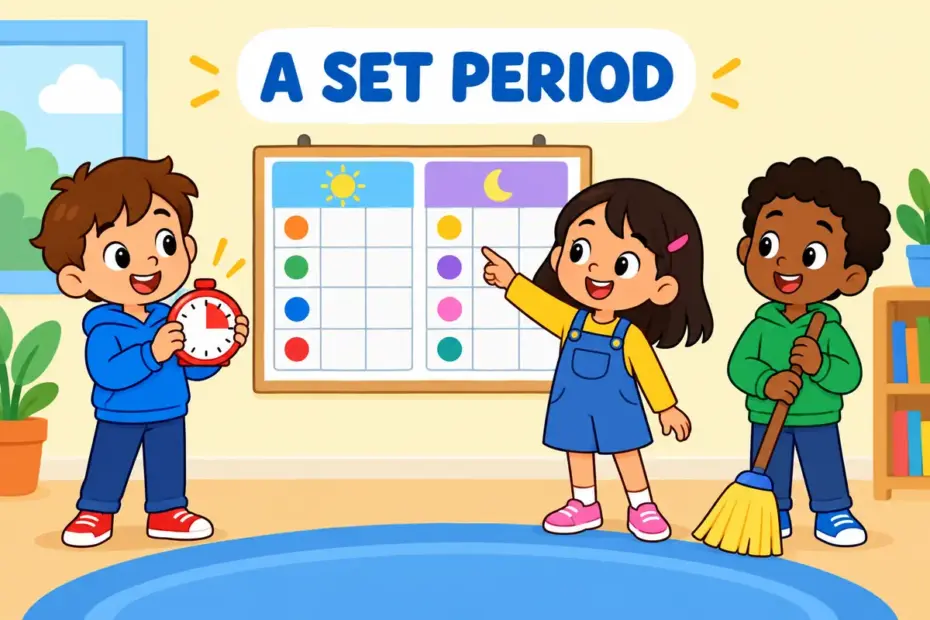
Stint means a fixed period spent doing a particular job or activity. To use stint in a sentence, name the role and how long it lasted: “She completed a two-year stint as editor.” The noun is countable, and the separate verb stint, meaning to give too little, is much rarer.
Stint at a glance
- Stint is usually a countable noun meaning a period of work or duty.
- Its commonest pattern is a stint as a role or a stint at a place.
- It usually comes after a time phrase, as in a two-year stint.
- A separate, rarer verb stint means to be sparing or to give too little.
- The commonest error is using stint for an ongoing role with no end in view.
What does stint mean?
Stint is most often a countable noun meaning a fixed period spent in a job, a place or an activity. The Cambridge entry for stint records the period sense and the separate verb meaning to be sparing. The noun almost always carries a length or a role, as in a brief stint in sales. It implies a beginning and an end, which is why an open-ended post is not a stint.
| Sense | Plain meaning | Example sentence |
|---|---|---|
| A period of work | A bounded time in a job | He had a short stint as coach. |
| A turn of duty | A fixed share of work | Each nurse took a four-hour stint. |
| The verb | To give too little | Do not stint on the repairs. |
Stint is not a synonym for career. It marks a limited stretch with a clear end, so a lifelong role is never a stint. The verb is also narrower than save: to stint is to withhold or limit, usually with on, as in the workers stinted on training.
How do you use stint in a sentence?
Stint follows a small set of patterns, and a length usually comes first. Where the period is vague rather than dated, spell is the commoner noun, as in a spell in hospital.
| Pattern | Example | What it signals |
|---|---|---|
| time + stint + as + role | She had a two-year stint as chair. | Names the length and the role. |
| time + stint + at or in + place | A brief stint at the branch changed his mind. | Names the length and the setting. |
| a stint of + time | After a stint of six months, he left. | Puts the length inside a phrase. |
| stint + in + field | A stint in publishing taught her the trade. | Names the industry. |
| do or serve a stint | He served a stint on the night shift. | The idiomatic verb pairing. |
The verbs do and serve pair with stint far more often than have, which marks a sentence as native rather than translated.
Stint in a sentence: examples across contexts
The noun stays the same across registers; only the preposition and the length phrase move. The nine sentences below run from a sports desk to a conversation.
| Context | Example sentence | Why this works |
|---|---|---|
| Sports | The coach had a brief stint in charge of the youth side. | The standard sports-report pattern. |
| Diplomacy | A three-year stint as ambassador reshaped her career. | Pairs a length with a formal role. |
| Medicine | Junior doctors work a long stint on nights. | Uses the turn-of-duty sense. |
| Business | His stint at the firm ended after the merger. | Names the setting rather than the role. |
| Politics | A short stint in cabinet taught him the limits of power. | Fits the news register. |
| Academia | She did a two-year stint as a visiting lecturer. | A common academic phrase. |
| Military | He served a stint overseas before returning. | Uses the idiomatic verb serve. |
| Any job | A stint on the help desk is good training. | Shows the period sense plainly. |
| Conversation | I did a stint in retail one summer. | The casual form of the same noun. |
A tour of duty and a night shift describe the same kind of bounded work from different angles.
Stint vs spell
Stint and spell both name a bounded stretch of time, but only stint implies work or duty. Spell usually covers illness, weather or rest.
| Attribute | stint | spell |
|---|---|---|
| Core sense | A fixed period of work or duty | A period of time, often of rest or illness |
| Typical use | Jobs, roles, shifts, tours | Weather, illness, rest |
| Tone | Neutral, slightly journalistic | Neutral, slightly British |
| Length | Usually stated or implied | Often vague |
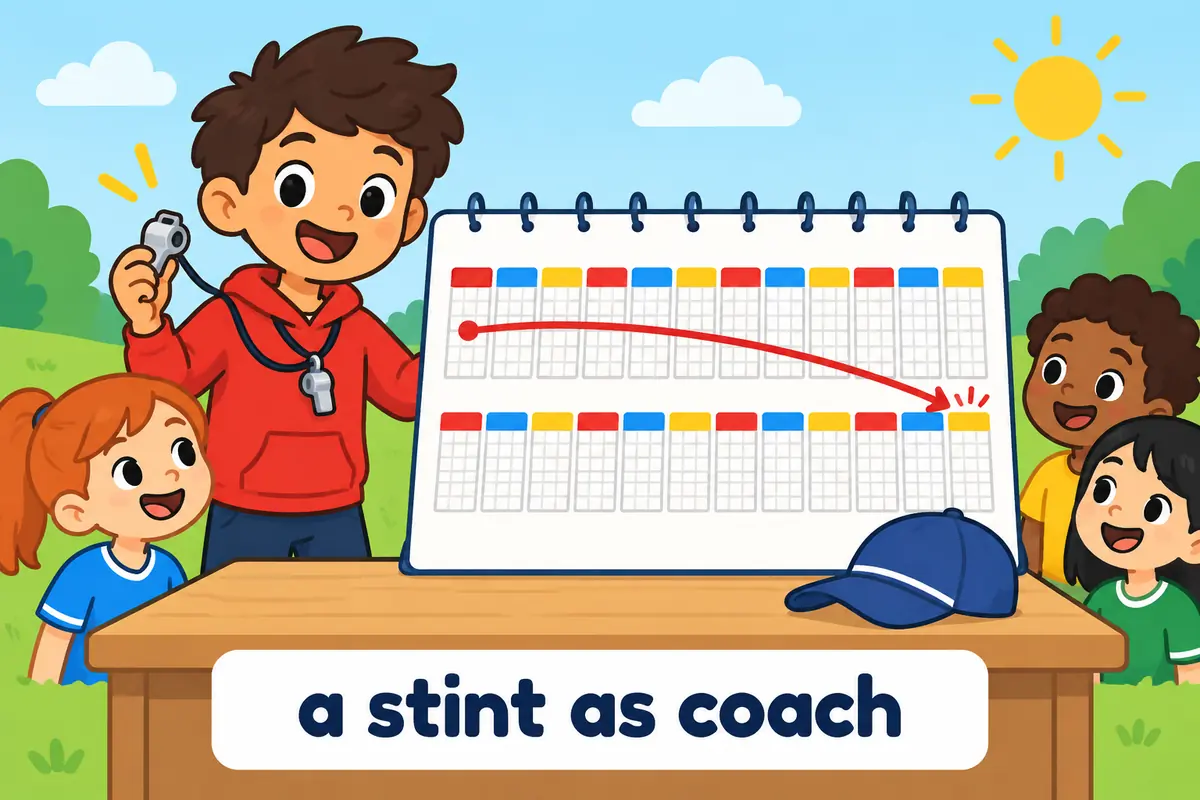
| Common phrase | a stint as coach | a spell in hospital |
Verdict: choose stint when the period is work or duty, and spell when it is time of another kind; for a long professional period, tenure is more precise, and any working stretch can be measured in terms of a stint.
Word forms and grammar of stint
Stint is one of the few nouns here that is also a verb, though the verb is much rarer and always negative in tone. A fixed term of office is the closest formal phrase to the noun sense.
| Form | Part of speech | Example |
|---|---|---|
| stint | noun, singular | Her stint ends in June. |
| stints | noun, plural | He had several short stints abroad. |
| stint | verb, base form | Do not stint on materials. |
| stinted | verb, past | The kitchen stinted on portions. |
| stinting | verb, present participle | They were stinting on safety. |
| stint + on | verb pattern | She never stinted on praise. |
Common mistakes with stint
- Incorrect:
He spent his whole stint of forty years there.Correct: He spent his whole career of forty years there. Rule: A stint is bounded; a lifelong role is a career. - Incorrect:
She stinted at the bank for a decade.Correct: She had a stint at the bank for a decade. Rule: The period sense is a noun, not the verb. - Incorrect:
The company stinted the budget.Correct: The company stinted on the budget. Rule: The verb stint takes on before what is withheld. - Incorrect:
A two-years stint as manager.Correct: A two-year stint as manager. Rule: A compound length before a noun stays singular.
Practice using stint
Work through the six items, then read the reasoning rather than only the key.
- Fill the gap: He did a six-month ______ as a trainee in the lab.
- Choose the better word: After the operation she had a quiet (stint / spell) at home.
- Correct the error: She stinted at the hospital for two years.
- Build a sentence: use a stint as about a temporary role.
- Spot the register: which belongs in a news report — a three-year stint as mayor, or my little go as mayor?
- Rewrite with the verb: They gave too little to the repairs. Use stint with on.
Answers
- stint — the bounded period of work fits the noun.
- spell — time at home after illness is a spell, not a stint of work.
- She had a stint at the hospital for two years — the period sense is a noun.
- Model answer: He took a one-year stint as acting manager.
- A three-year stint as mayor — a news report keeps the neutral formal noun.
- They stinted on the repairs — the verb takes on before what is withheld.
The bottom line
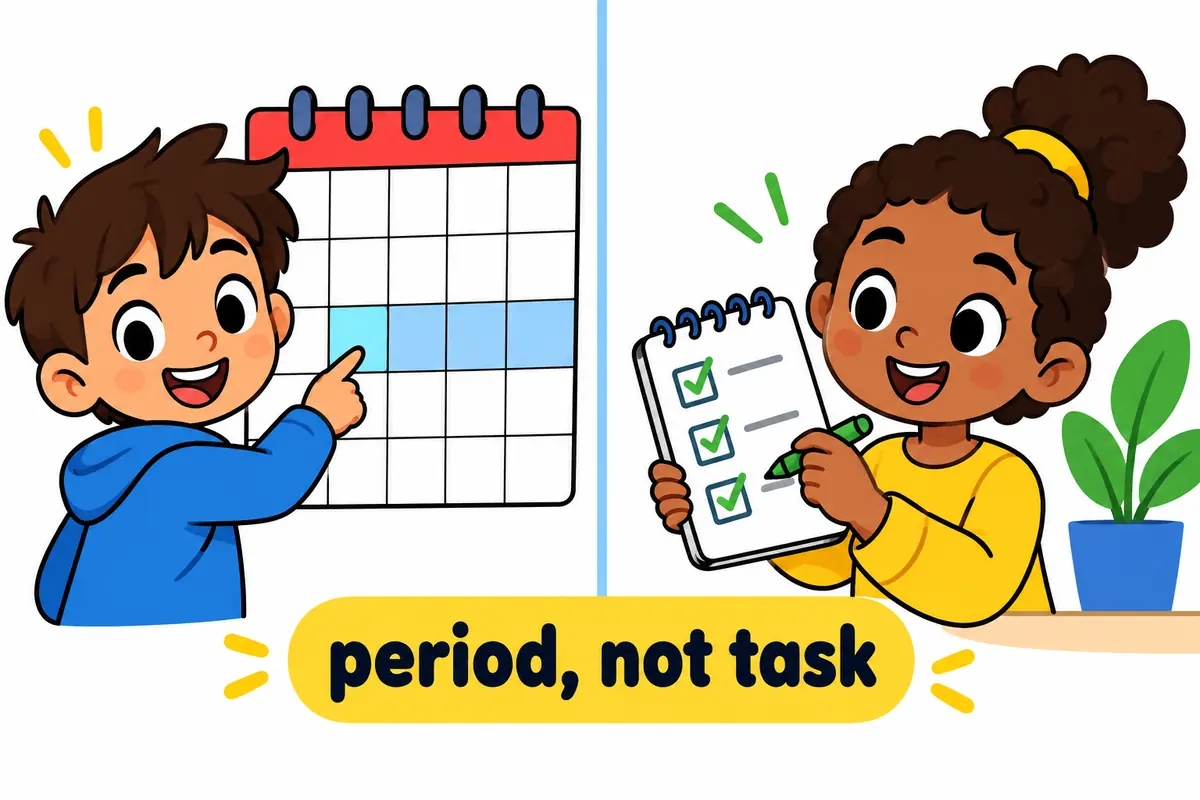
Use stint in a sentence for a bounded period of work or duty, and put a length phrase before it. Two points decide most sentences: the period has an end, and the noun is countable, so a stint as coach and two stints abroad are both standard. For time that is not work, spell is the better noun.
Frequently asked questions about stint
What does stint mean?
As a noun, stint means a fixed period spent in a job, a place or an activity, as in a two-year stint as editor. A separate and rarer verb, stint, means to give too little or be sparing, usually with on, as in do not stint on training.
Is stint a positive or negative word?
The noun is neutral and simply marks a bounded period of work, so a stint can be long and rewarding or short and unhappy. The verb is mildly negative, because it means withholding or limiting something. Context, not the noun itself, supplies the judgement.
How do you use stint in a sentence?
Put a length before the noun and then name the role with as or the place with at or in. A typical sentence reads she did a one-year stint as treasurer. The noun is countable, so it takes a or the and forms the plural stints.
What is the difference between stint and spell?
Stint usually means a period of work or duty, as in a stint as coach. Spell means a period of time of another kind, often illness, weather or rest, as in a spell in hospital. Both are bounded, but only stint carries the idea of work, and spell is commoner in British English.
A stint is a period of time during which someone works at a particular job or activity, often for a limited duration. It can also refer to a short, specific task or assignment that someone is responsible for completing within a set timeframe.
Stints can vary in length, from a few hours to several months, and may involve different types of work or projects. Often used in professional contexts, a stint can provide valuable experience, help develop new skills, or simply offer a temporary solution to fulfill a specific need.
7 Examples Of Stint Used In a Sentence For Kids
- I went for a stint in the garden picking flowers.
- She had a stint feeding the cute puppies.
- He had a fun stint playing with his friends at the park.
- Let’s have a stint drawing our favorite animals.
- We can have a stint singing songs together.
- I enjoyed my stint painting colorful pictures.
- It’s time for a stint learning new words in English.
14 Sentences with Stint Examples
- During my college days, I completed a short-term stint as a part-time tutor.
- I am planning to do a stint as an intern at a reputed company next semester.
- My friend just finished his stint as a campus ambassador for a popular brand.
- It is common for students to do a stint as volunteers during college events.
- I want to do a stint as a research assistant to gain practical experience.
- Many students opt for a stint abroad as part of their exchange program.
- I took up a stint as a content writer for an online platform to earn some extra cash.
- My roommate did a stint as a graphic designer for a startup last summer.
- During my final year, I plan to do a stint as a teaching assistant.
- After graduation, I aim to do a stint as a management trainee in a reputed company.
- Most students do a stint as event organizers for college festivals.
- My friend did a stint as a campus recruiter for a multinational company.
- I am considering applying for a stint as a social media manager for a student organization.
- During the holidays, I am thinking of doing a stint as a volunteer at an NGO.
How To Use Stint in Sentences?
Stint means a period of time spent in a particular way. When using the word stint in a sentence, it is important to consider the context in which it is being used. Here is a guide for beginners on how to use stint correctly:
-
Identify the meaning: Understand that stint refers to a specific period of time or a limited duration spent doing something.
-
Choose the right context: Make sure you are using stint correctly in your sentence. For example, “He worked at the company for a brief stint” or “She served a stint in the military.”
-
Use it in a sentence: Incorporate stint into your sentence to convey the idea of a specific time frame. For instance, “During his stint as a student, he learned valuable skills” or “She completed her stint as an intern.”
-
Be clear and concise: When using stint, be clear in expressing the limited time period or duration. Avoid ambiguity by providing specific details.
-
Practice using the word: To become more familiar with using stint in a sentence, practice writing your own sentences using the word in different contexts.
By following these guidelines, beginners can effectively use stint in a sentence to convey the idea of a defined period of time.
Conclusion
In conclusion, the examples of sentences incorporating the keyword “stint” demonstrate its versatility and usage in various contexts. From describing a short period of time to specifying a limited or temporary assignment, the word “stint” adds precision to communication. In these sentences, “stint” is employed to convey the idea of a set duration, restriction, or boundary, aiding in the clear expression of ideas.
By observing how “stint” is woven into sentences to denote timeframes or limits, one can appreciate its value in succinctly conveying the intended message. Whether used to indicate a brief interval, a specific tenure, or a constrained activity, “stint” serves as a useful tool for enhancing clarity and accuracy in written and oral communication.


