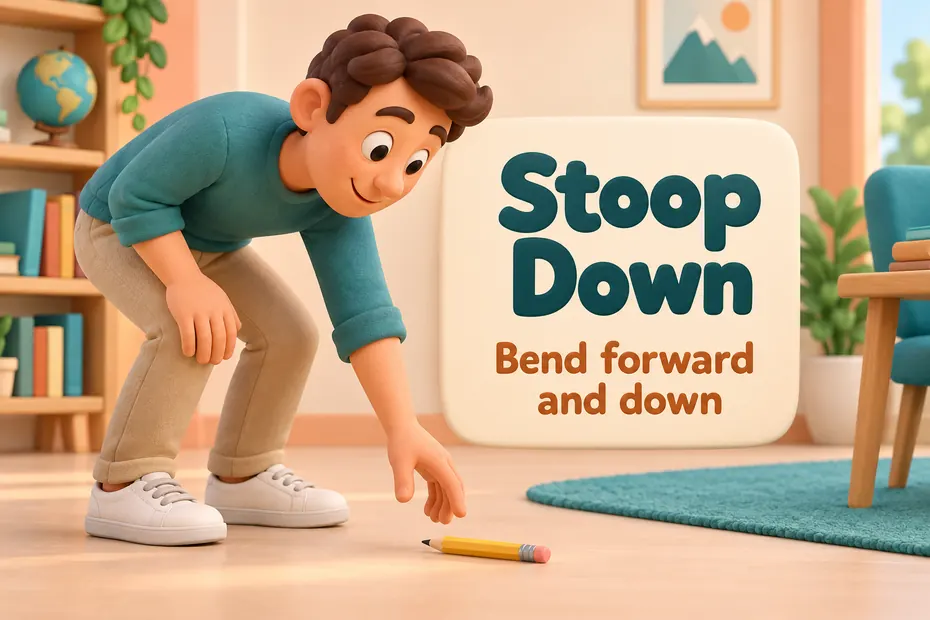
Stoop down means to bend the body forward and downward. A clear example is “She stooped down to pick up the pencil.” The expression describes physical movement. Do not confuse it with “stoop to cheating,” which means to lower your standards by doing something disapproved of, rather than bending your body.
Stoop down in a sentence: clear everyday examples
Use stoop down when a person’s upper body moves toward something lower. A dropped item, low doorway, small plant, or child can supply the context. For precise description, name the person, the movement, and its purpose: “Noah stooped down to read the label on the bottom shelf.”
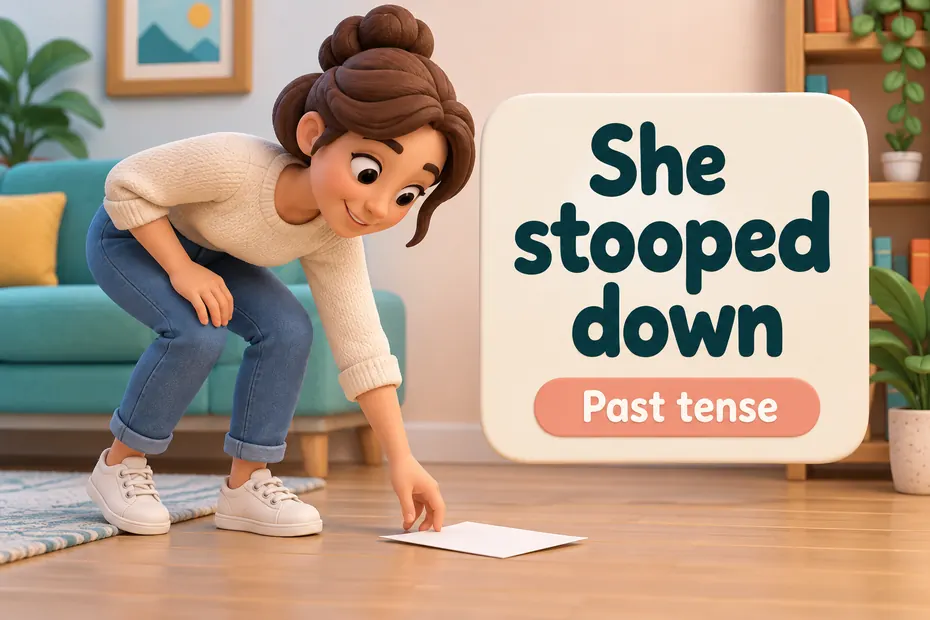
| Situation | Original sentence | What the sentence tells us |
|---|---|---|
| Dropped item | She stooped down to retrieve the coin. | The purpose is picking something up. |
| Low shelf | I stooped down to examine the books. | The books are below the speaker’s normal eye level. |
| Garden | He stooped down beside the seedlings. | The movement brings him closer to the plants. |
| Child | The teacher stooped down to hear the child. | The teacher lowers the upper body. |
| Low doorway | We had to stoop to enter the cottage. | The doorway requires a lowered posture. |
| Request | Please stoop down so I can adjust your collar. | The speaker asks for physical movement. |
Is “stoop down” correct, or is down unnecessary?
“Stoop down” is accepted English. Oxford Learner’s Dictionaries gives the pattern “stoop (down)”. You can write “She stooped to retrieve the coin” or “She stooped down to retrieve the coin.” Both communicate the movement; the second explicitly emphasizes its downward direction.
For concise prose, omit down if it adds nothing useful. For an instruction or a simple learner example, keep it when the direction helps. This is a style choice, not a rule that makes every instance of “stoop down” a grammatical error. Do not remove words mechanically without considering the sentence.
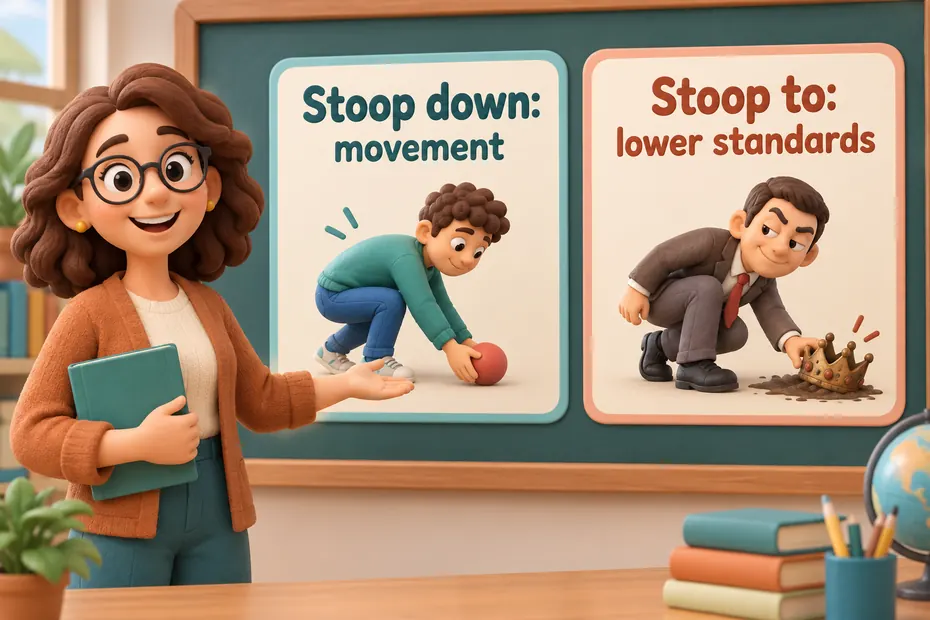
Stoop down versus stoop to
“Stoop down” normally describes movement; “stoop to” can describe lowering moral standards. Cambridge Dictionary marks the figurative expression as disapproving. “He would not stoop to cheating” means he would not resort to that behavior. No change in physical posture is implied.
The grammar after to helps you distinguish the meanings. In “She stooped down to pick up the note,” to pick explains a purpose. In “She would not stoop to lying,” to is a preposition followed by an -ing form. The sentences use different constructions even though both contain stoop and to.
“Stoop to someone’s level” is also figurative when it means adopting behavior the speaker considers beneath them. By contrast, “stoop down to the child’s eye level” can describe a physical position. Read the surrounding words rather than assuming that every use of level is an insult.
Choose stoop, crouch, squat, or kneel carefully
Stoop emphasizes the upper body bending forward and down. Crouch generally describes lowering the body with bent legs, often to stay low. Squat emphasizes deeply bent knees and a low body position. Kneel means placing one or both knees on a surface. These actions can overlap, but the words highlight different postures.
If a character drops to one knee, kneels is more precise than stoops. If a character simply leans down toward a low shelf, stoops is a useful choice. In a story, choose the word that lets the reader picture the action. These are vocabulary distinctions, not exercise or lifting instructions.
Use the regular verb forms
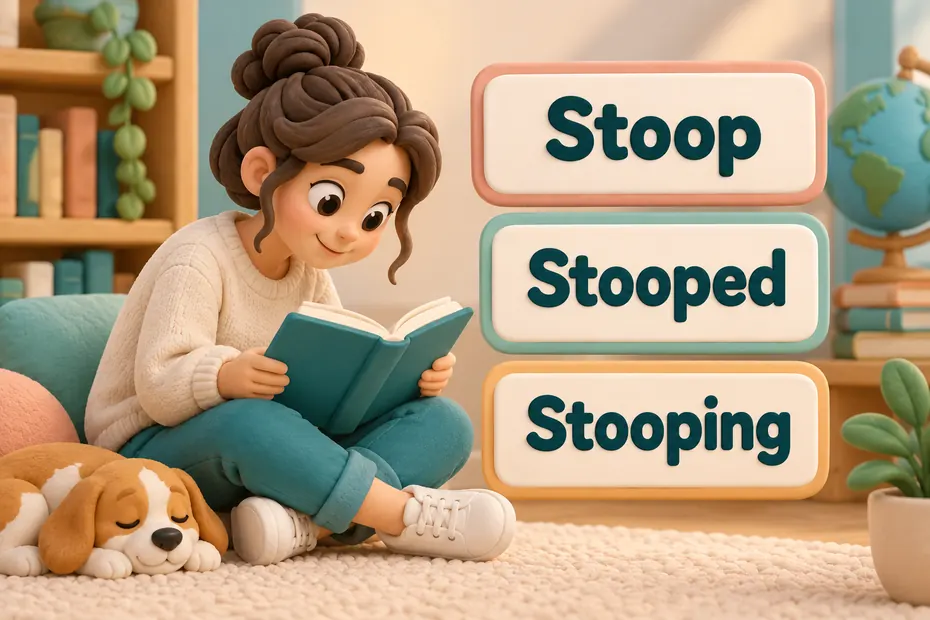
The forms are stoop, stoops, stooped, and stooping. Write “She stoops down” in the simple present and “She stooped down” in the simple past. For an action in progress, write “She is stooping down.” In the present perfect, write “She has stooped down.” Keep down separate from the verb.
- “Did he stoop down?” uses the base form after did.
- “He did not stoop down” follows the same pattern.
- “He will stoop down” uses the base form after will.
- “He stooped down yesterday” uses the past form without an auxiliary.
For practice, complete “She ___ down yesterday” and “Did she ___ down?” The answers are stooped and stoop. “Did she stooped down?” is incorrect because did already marks the past. Another common error is “stoopingdown” as one word; write “stooping down.”
Frequently asked questions
What does stoop down mean in simple English?
It means bend forward and downward. A person might stoop down to look at a flower or reach a dropped pencil. The phrase describes the movement, while a following purpose clause explains why it happens: “She stooped down to check the name on the box.”
Is stoop down the same as bow down?
They can describe similar bending movements, but bow down often suggests respect, worship, or submission. Stoop down usually gives a practical description of posture. If someone bends to retrieve a coin, “stooped down” is the clearer choice. If the action is a respectful gesture, “bowed” may fit.
Can stoop describe a person’s usual posture?
Yes. Stoop can describe standing or walking with the head and shoulders bent forward, as well as a temporary movement. “He tends to stoop” describes a usual posture; “He stooped down to inspect the box” describes a particular action. Context tells you whether the posture is habitual or momentary.
Is the stoop outside a house related to stooping down?
In American English, a stoop can be the entrance steps or a raised area outside a doorway. That is a noun meaning, distinct from the movement verb. “They sat on the stoop” describes a location; “They stooped down” describes an action. Use the sentence structure to tell them apart.

Have you ever heard the expression “stoop down”? In simple terms, to “stoop down” means to bend one’s body forward and downward.
This common phrase is often used to describe the action of lowering oneself, typically to reach something low or to show respect. Now, let’s explore how this phrase is used in various contexts and examples to better understand its significance in everyday language.
7 Examples Of Stoop Down Used In a Sentence For Kids
- Stoop down and look at the tiny ants on the ground.
- Stoop down and pick up the colorful flowers.
- Stoop down and touch the soft grass with your fingers.
- Stoop down and say hello to the friendly puppy.
- Stoop down and feel the cool water in the stream.
- Stoop down and listen to the birds chirping in the trees.
- Stoop down and watch the small caterpillar crawl on the leaf.
14 Sentences with Stoop Down Examples
- Stoop down to tie your shoelaces properly before heading to class.
- Make sure to stoop down and check under the bed for your missing textbook.
- Remember to stoop down and pick up any trash you see on campus grounds.
- Before entering the seminar hall, you may need to stoop down to go through the low doorway.
- Stoop down to examine the details of the artwork in the gallery for your art assignment.
- When browsing through library shelves, don’t forget to stoop down to see the books on the lower shelves.
- During group projects, be prepared to stoop down to listen to all team members’ ideas.
- In the cafeteria, you may need to stoop down to reach items on the bottom shelf of the fridge.
- Before taking a seat, it’s courteous to stoop down and pick up any dropped items of a fellow student.
- As part of your workout routine, you can stoop down to touch your toes for flexibility exercises.
- When playing outdoor sports, you might need to stoop down to pick up a wayward ball.
- In the computer lab, make sure to stoop down and check all the connections before starting your project.
- As you enter the auditorium, you may need to stoop down to pass through the low-hanging decorations.
- During cultural festivals on campus, it’s common to stoop down and participate in traditional dances.
How To Use Stoop Down in Sentences?
To use the word “Stoop Down” in a sentence, you are expressing the action of bending your body or lowering oneself, typically to reach or pick something up from a lower position.
Before incorporating “Stoop Down” in your sentence, consider the context in which you want to convey this action. For example, you can mention picking up a fallen object from the ground, tying your shoelaces, or examining something closely at a lower level.
Here is an example sentence using Stoop Down:
“After dropping her keys, she had to stoop down to retrieve them from under the couch.”
When constructing a sentence with “Stoop Down,” make sure to place the adverb “down” after the verb “stoop” to accurately convey the action. This combination emphasizes the act of bending or lowering oneself towards a lower point.
Additionally, it is crucial to use appropriate punctuation and capitalization to accurately represent the meaning of your sentence. Keep in mind that “Stoop Down” is a phrasal verb that conveys a specific action, so ensuring its correct usage will effectively communicate your message.
Practice incorporating “Stoop Down” into various sentences to improve your understanding and usage of this phrase. With time and practice, you will become more comfortable incorporating “Stoop Down” into your everyday vocabulary to accurately express actions involving bending or lowering yourself.
Conclusion
In conclusion, the act of stooping down involves bending one’s body downward or lowering oneself to a lower level. This action is commonly associated with picking up objects from the ground, interacting with children or pets, or showing respect. Sentences that include the phrase “stoop down” often describe physical movements, gestures of humility, or demonstrations of care and consideration. For example, one may stoop down to tie a shoelace, pet a dog, or listen to a child speak at their level.
Overall, the phrase “stoop down” is used to convey actions that require a bending or lowering of the body, whether for practical purposes or to demonstrate attentiveness and respect. By examining sentences with this phrase, we can better understand its common usage and the various contexts in which it is employed.


