Strategic in a sentence: meaning and practical examples
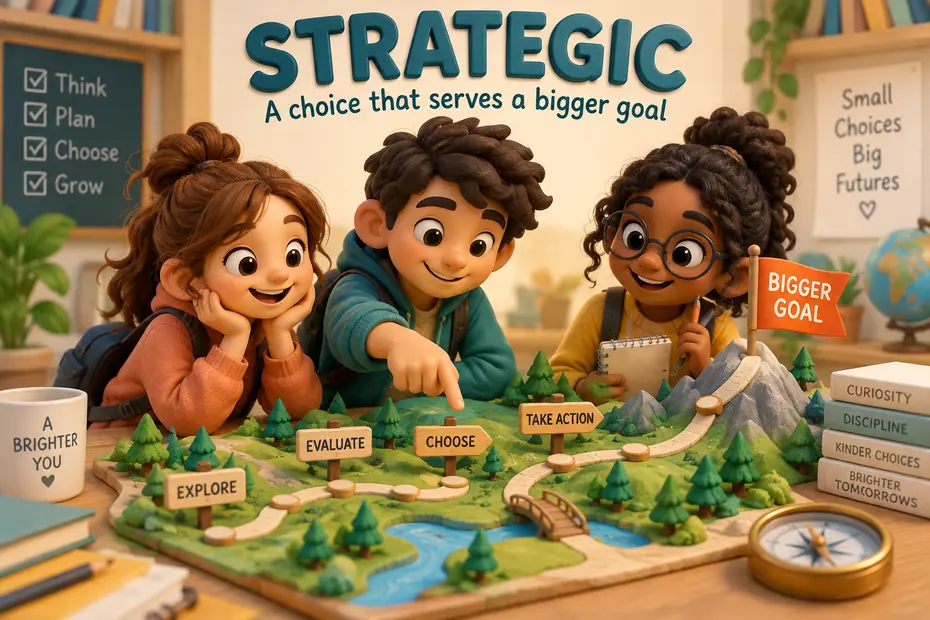
Strategic is an adjective for something that supports an overall plan, important objective, or advantageous position. For example, “The team made a strategic decision to train two substitutes before the tournament.” The word explains how a choice fits a bigger purpose, rather than merely describing something clever or successful.
- Strategic modifies nouns: strategic plan, decision, position, or partnership.
- Strategically is the related adverb: “They placed the signs strategically.”
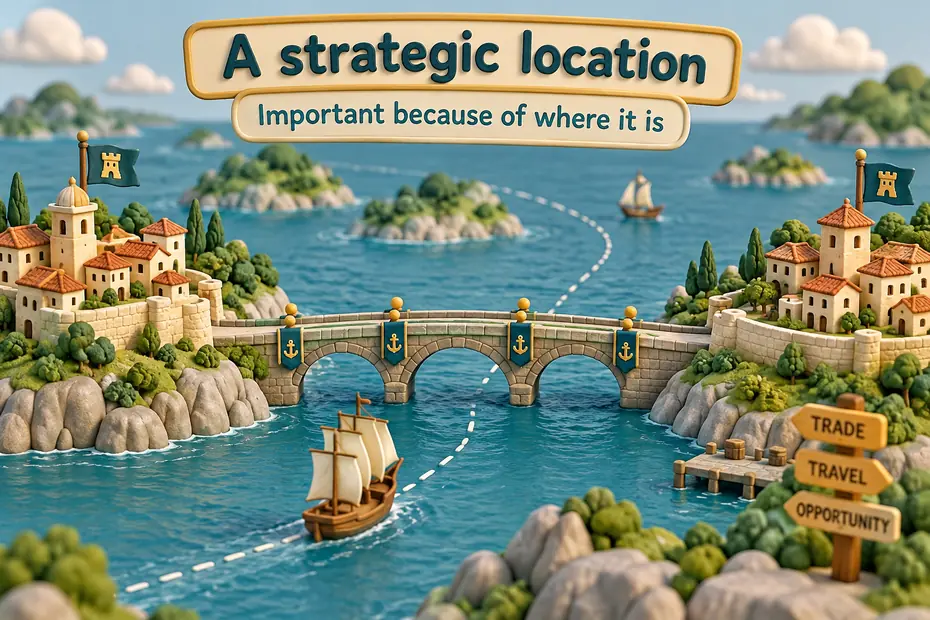
- A strategic location can be important because of its position.
- A strategic choice can fail; the adjective does not guarantee success.
- Strategy names a plan or approach; strategic describes its relationship to that plan.
Clarification for the original examples below: being strategic does not require considering every possible variable, and it does not make success certain. Some earlier combinations, such as “strategic career services,” are grammatical but vague. Name the actual decision, resource, or objective so readers can understand the connection.

How do you use strategic naturally?
Use strategic before a noun when the noun contributes to a broader aim. Alternatively, place strategic after a linking verb: “Their choice was strategic.” Both structures describe the choice; neither tells readers exactly what the plan is unless the surrounding sentence explains it.
A useful pattern is subject + verb + strategic + noun + purpose. “The library formed a strategic partnership with local schools to reach reluctant readers” is stronger than “The library did something strategic.” The purpose clause makes the relationship visible without requiring a long explanation of the entire plan.
| Pattern | Original example | What it communicates |
|---|---|---|
| Strategic + decision | Opening a repair desk was a strategic decision to retain customers. | A choice serving an objective |
| Strategic + location | The warehouse occupies a strategic location near two highways. | A useful or important position |
| Linking verb + strategic | The pause was strategic: it gave the team time to recover. | The reason behind an action |
| Verb + strategically | We scheduled the workshops strategically around exam dates. | How an action was arranged |
In ordinary writing, strategic usually sounds more formal than planned or deliberate. That register suits reports and discussions of objectives.
Strategic sentence examples in different settings
Each example explains the reason for a choice or the advantage of a position.
- The coach made a strategic substitution to protect the team’s narrow lead.
- Learning basic accounting was a strategic step toward opening her own bakery.
- The charity formed a strategic alliance with a regional food bank.
- The station has strategic importance because it connects three busy routes.
- Our strategic priority is improving access for visitors who use wheelchairs.
- The company made a strategic investment in staff training before expanding.
- A strategic retreat allowed the players to regroup rather than lose all their pieces.
- The council’s strategic plan sets out its housing goals for the next five years.
- Choosing a quieter study room was strategic because the oral exam required concentration.
- The island occupies a strategic position along the shipping route.
- The team held a strategic discussion about which customers it could serve well.
- Her silence was strategic; she waited until the other speaker finished.
The time horizon is a clue rather than an absolute rule. A five-year plan is an obvious strategic context, but a short action can also be strategic when it affects a larger objective. The substitution in the first example happens immediately yet serves the team’s overall aim of winning the match.
What is the difference between strategic and tactical?
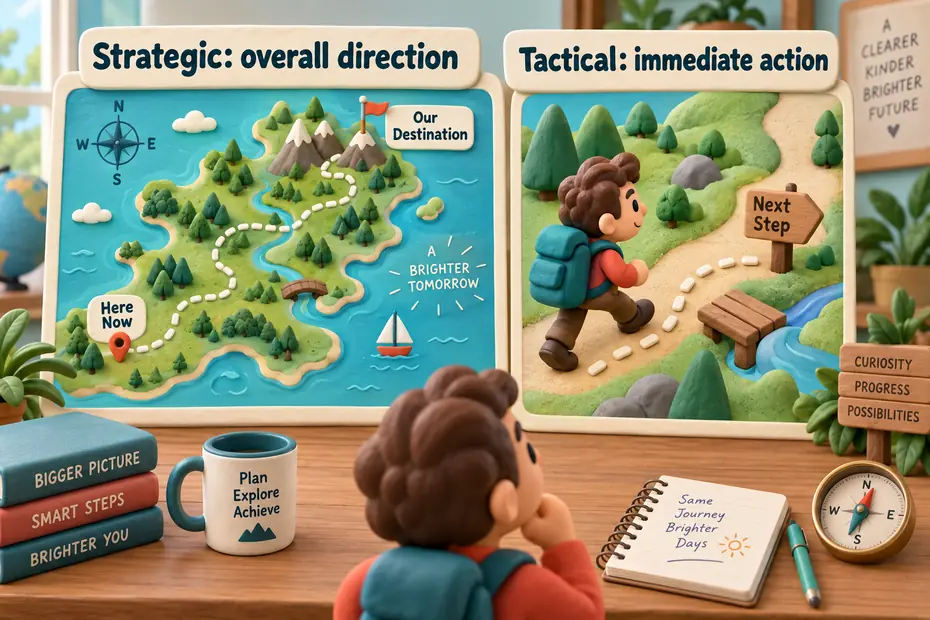
Strategic concerns overall direction or an important objective; tactical concerns actions used to carry out a plan. The two words can describe different levels of the same project. Neither is automatically better, and an action may have both tactical and strategic significance.
For a community garden, a strategic decision might be to provide affordable vegetables for nearby households. Tactical decisions could include watering at dawn and assigning volunteers to particular beds. Calling the watering schedule strategic would require explaining its connection to the bigger aim, such as conserving enough water to keep the project viable.
Do not substitute strategic for effective. “The campaign was strategic but unsuccessful” is coherent: its choices related to an overall plan, but its results disappointed. “The campaign was effective” makes a different claim about results. Similarly, “deliberate” establishes intention without necessarily establishing a broader objective.
Common mistakes when writing strategic sentences
Prefer a specific noun over a string of abstract labels. “We made a strategic decision to close the unused branch” gives readers a concrete action. “We implemented strategic optimization initiatives” hides the action, even though its grammar is possible.
Keep the adjective and adverb separate. Write “a strategic placement” but “the notices were placed strategically.” Avoid “she worked strategic,” because the sentence needs an adverb describing worked. A linking verb is different: “Her approach was strategic” correctly uses an adjective to describe approach.
Strategic can also carry a calculating tone when applied to personal behavior. “A strategic friendship” may suggest that someone befriended another person for advantage. If you mean a sincere relationship, describe its value directly rather than introducing an unintended implication. A strategic sentence should make its purpose clear without overstating what careful planning can achieve.
Frequently asked questions
Is strategic a noun?
Strategic is normally an adjective. Use strategy for the noun naming a plan or approach: “Our strategy is to reduce delivery times.” Use strategic to describe a related choice: “We made a strategic investment in delivery software.” The plural noun strategies refers to multiple plans or approaches.
Can strategic describe a place?
Yes. A strategic location or position is important for a particular purpose, such as transport, defense, or access to customers. “The clinic has a strategic location beside the bus station” explains that its position helps people reach it. The place itself does not need to make a plan.
Does strategic always mean long-term?
No. Strategic often concerns broader objectives, which frequently involve longer periods, but duration alone does not determine its meaning. A brief negotiation, timely pause, or single move can be strategic if it supports an overall plan. Explain the objective instead of assuming that a long time frame proves the label.
What is a simple alternative to strategic?
Planned, deliberate, purposeful, or important may work, depending on the sentence. None is an exact replacement in every context. “An important location” loses the specific idea of advantage for a purpose, while “a planned decision” emphasizes preparation. Choose the alternative that preserves the distinction your reader actually needs.
Dictionary references: Cambridge: strategic and Cambridge: tactical. These references establish the meanings; the teaching examples and comparisons above are original.

Have you ever wondered how to effectively plan and implement a well-thought-out approach to achieve your goals and objectives? That’s where strategic comes into play. The term “strategic” is commonly used to depict a carefully devised plan or action that is designed to achieve a desired outcome.
In various fields such as business, military, and personal development, being strategic involves making informed decisions that consider all variables and potential obstacles. By incorporating strategic thinking and tactics, individuals and organizations can navigate challenges more effectively and achieve success more efficiently.
7 Examples Of Strategic Used In a Sentence For Kids
- Strategic means making smart plans.
- We can be strategic by thinking ahead.
- Being strategic helps us reach our goals.
- Let’s make a strategic move in our game.
- It’s important to be strategic in solving problems.
- We can be strategic by working together.
- Strategic thinking can help us succeed.
14 Sentences with Strategic Examples
- Strategic planning is essential for effectively managing your time and assignments in college.
- As a college student, it is important to have a strategic approach to studying to achieve academic success.
- Developing a strategic networking plan can help you build valuable connections with professors and peers.
- Creating a strategic budget can help college students manage their finances efficiently.
- A strategic approach to choosing electives can enhance your learning experience and skillset.
- Engaging in strategic extracurricular activities can help you develop essential soft skills for your future career.
- Implementing strategic study habits, such as creating a study schedule, can improve your academic performance.
- Adopting a strategic mindset can help you navigate challenges and setbacks effectively during your college journey.
- Utilizing strategic career services and resources provided by your college can help you secure internships and job opportunities.
- Participating in strategic workshops and seminars can enhance your professional development and skill acquisition as a college student.
- Developing a strategic approach to time management can prevent burnout and improve your overall well-being in college.
- Utilizing strategic communication skills can help you build strong relationships with classmates and professors.
- Incorporating strategic collaboration with study groups can enhance your learning experience and knowledge retention.
- Implementing strategic research techniques can help you write high-quality essays and research papers for your courses.
How To Use Strategic in Sentences?
To use the word “Strategic” in a sentence, first, you need to understand its meaning. Strategic is an adjective that refers to the careful planning of actions to achieve a specific goal or outcome.
Here is an example sentence using Strategic:
– “The company developed a strategic marketing plan to reach a wider audience.”
When constructing a sentence with Strategic, it is important to consider the context in which it is being used. You can apply Strategic to various scenarios, such as business, military operations, games, or personal decision-making.
To effectively incorporate Strategic into your sentence, think about the intention behind the action and how it aligns with a larger plan. Consider using Strategic when describing calculated steps, thoughtful approaches, or well-thought-out decisions.
Here are a few more sample sentences using Strategic:
– “She devised a strategic plan to improve her productivity at work.”
– “The general made a strategic maneuver to outsmart the enemy.”
– “The chess player demonstrated strategic thinking to win the game.”
By practicing using Strategic in a variety of contexts, you can become more comfortable incorporating it into your vocabulary. Remember to think about the purpose of the action you are describing and how it fits into a larger plan when using the word Strategic in your sentences.
Conclusion
In conclusion, the examples of sentences with strategic illustrate the importance of carefully planned actions to achieve specific goals or objectives. A strategic approach involves thinking ahead, considering various aspects, and making calculated decisions to maximize success and overcome obstacles. Whether in business, warfare, or personal life, being strategic allows individuals and organizations to navigate complexity, capitalize on opportunities, and minimize risks.
By studying sentences with strategic, we gain insights into how strategic thinking can be applied in different contexts to shape outcomes and drive progress. The ability to think strategically is a valuable skill that can lead to better decision-making, improved outcomes, and long-term success in various endeavors. Understanding the power of strategic planning can empower individuals to approach challenges with foresight, creativity, and purpose.


