Struck is the past tense and a common past participle of strike. Use it for a completed impact (“The ball struck the wall”), a sudden realization (“It struck me that we were early”), or a strong impression (“I was struck by her kindness”). Write struck rather than “striked” in standard usage.
Struck in a sentence: choose the intended meaning
Start by identifying the action or experience. A physical object may strike something; a thought may strike a person; a sight may leave a strong impression. The subject and the words after struck make the meaning clear. Avoid treating every example as a literal blow.
| Meaning | Original sentence | Helpful pattern |
|---|---|---|
| Hit something | The tennis ball struck the fence. | Object + struck + target |
| Sound a clock hour | The clock struck midnight. | Clock + struck + time |
| Suddenly realize | It struck me that the tickets were for tomorrow. | It struck someone that + clause |
| Make an impression | I was struck by the painter’s use of blue. | Was/were struck by + cause |
| Seem a particular way | The explanation struck me as unlikely. | Struck someone as + description |
| Begin a conversation | We struck up a conversation on the train. | Struck up + conversation |
| Reach an agreement | The neighbors struck a deal over the shared fence. | Struck + deal/agreement |
Use strike, struck, and have struck correctly
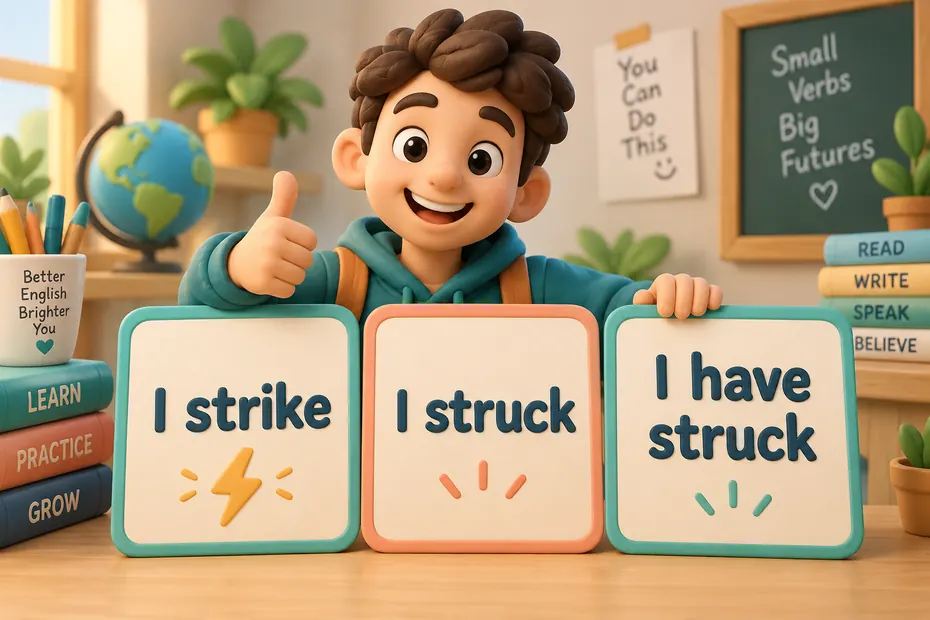
Cambridge Dictionary identifies struck as the past simple and past participle of strike. In the simple past, write “The ball struck the window.” In the present perfect, write “The ball has struck the window.” The auxiliary has changes the construction; it does not change struck to “striked.”
- Present: “The clock strikes every hour.”
- Simple past: “The clock struck ten.”
- Present perfect: “The clock has struck ten.”
- Past perfect: “The clock had struck ten before we arrived.”
- Passive: “The fence was struck by a falling branch.”
After did or did not, use the base form: “Did the ball strike the fence?” and “The ball did not strike the fence.” “Did the ball struck the fence?” repeats the past marking and is incorrect. Similarly, after will, write “will strike,” not “will struck.”
What does “it struck me that” mean?
“It struck me that” introduces a thought or realization that occurred to the speaker. “It struck me that nobody had checked the address” means the speaker suddenly noticed that omission. The sentence does not imply a physical impact. The clause after that supplies the actual thought, so include enough detail for the reader to understand it.

Compare “An idea struck me” with “It struck me that we could take the earlier train.” The first leaves the idea unspecified; the second explains it. For a straightforward alternative, write “I realized that we could take the earlier train.” The choice is stylistic, provided the meaning stays the same.
“Struck by” and “struck as” express different ideas
“Struck by” can name either a physical cause or something impressive: “The tree was struck by lightning” versus “We were struck by the silence.” Context settles the interpretation. “Struck someone as” introduces an evaluation: “Her response struck me as thoughtful.” The response seemed thoughtful to the speaker.
Keep the person in the second pattern. Write “The proposal struck me as practical,” rather than “The proposal struck as practical.” You can use an adjective, as in practical, or a noun phrase: “He struck me as a careful listener.” The pattern reports an impression, not necessarily a proven fact.
Struck versus stricken
Stricken is not the normal simple-past replacement for struck. Merriam-Webster records stricken as an adjective for someone or something afflicted or overwhelmed, and also as a past participle of strike. It appears in phrases such as grief-stricken and in some specialized contexts. For ordinary learner sentences, struck is the dependable past-tense choice.
“The clock struck twelve” is natural; “The clock stricken twelve” is not. “A grief-stricken family” is natural because the compound adjective describes a state. Do not assume that every verb with an irregular participle uses that form in the simple past. Check the construction before choosing between the two.
Correction to an older example below: “The realization struck that I needed to improve my study habits” is missing the person affected. Write “It struck me that I needed to improve my study habits,” or “The realization struck me that I needed to improve my study habits.” The first is the cleaner pattern.
Practice choosing the word form
Complete these sentences: “The branch ___ the roof yesterday”; “Did the branch ___ the roof?”; “It ___ me that we had forgotten the map”; “The roof has been ___ by a branch.” The answers are struck, strike, struck, and struck. The second needs the base form after did.
Frequently asked questions
Is struck a past-tense verb?
Yes. Struck is the standard simple past of strike: “The bell struck eight.” It is also a common past participle, used with auxiliaries in “has struck,” “had struck,” and “was struck.” The form looks the same, but its grammatical role depends on the rest of the sentence.
Can struck mean impressed?
Yes. “I was struck by the detail” can mean the detail made a strong impression on me. It does not always mean admiration; someone can be struck by an oddity, absence, or contrast. Specify what drew attention so the sentence communicates the impression instead of leaving it vague.
What does struck up mean?
In “struck up a conversation,” the phrase means began a conversation. For example, “They struck up a conversation while waiting for the bus.” Keep up because it is part of the expression. A physical-impact sentence such as “The ball struck the wall” uses the verb without that particle.
Should I write struck or striked?
Write struck for the standard past tense of strike in ordinary prose: “She struck the ball cleanly.” “Striked” is not the usual standard form. In a question with did, however, use strike: “Did she strike the ball cleanly?” The auxiliary already marks the past.

Have you ever been struck by an idea so powerful that it changed your entire outlook in an instant? The word “struck” in the English language conveys the sense of being hit or affected suddenly and strongly by something.
In grammar, a sentence with “struck” often showcases this sudden impact in action, whether it’s a physical blow or a metaphorical realization. This verb is versatile, capable of describing both literal and figurative situations where something or someone has made a strong impression or caused a significant change.
7 Examples Of Struck Used In a Sentence For Kids
- The ball struck the wall.
- I struck the bell to call everyone for lunch.
- Lightning struck the tree during the storm.
- The hammer struck the nail into the wood.
- The clock struck twelve times at midnight.
- The cat struck at the mouse with its paw.
- A brilliant idea struck me while I was playing.
14 Sentences with Struck Examples
- The importance of time management struck me when I missed a deadline for a college assignment.
- The realization struck that I needed to improve my study habits after receiving a low grade on my exam.
- A wave of inspiration struck me as I listened to a motivational speaker at a college seminar.
- The reality of budgeting expenses struck me when I ran out of money halfway through the semester.
- The fear of failure struck me as I prepared for my final exams.
- The significance of networking struck me when I missed out on a valuable internship opportunity.
- The need for better communication skills struck me during a group project where misunderstandings arose.
- The importance of self-care struck me after experiencing burnout from overcommitting to extracurricular activities.
- The value of time spent with loved ones struck me when I realized how much I missed my family and friends back home.
- The reality of competition in the job market struck me when I saw my classmates actively pursuing internships and job opportunities.
- The impact of climate change struck me during a lecture on environmental sustainability.
- The desire to make a positive impact in society struck me after volunteering at a local community service event.
- The need to improve my presentation skills struck me when I struggled to engage my classmates during a group presentation.
- The realization that self-reflection is crucial for personal growth struck me during a counseling session with a college mentor.
How To Use Struck in Sentences?
To use the word Struck in a sentence, simply follow these steps:
-
Understand the meaning of the word: Struck typically means to hit or come into contact with something forcefully. It can also refer to being affected or moved by a particular feeling or event.
-
Identify the subject and the action: When constructing a sentence with Struck, think about who or what is doing the striking and what they are striking.
-
Choose the appropriate tense: Depending on the context of your sentence, you can use Struck in the past, present, or future tense.
-
Put it all together: Once you have identified the subject, action, and tense, you can construct a sentence using Struck. For example:
- Past tense: Yesterday, lightning struck the tree, causing it to split in half.
- Present tense: The realization suddenly strikes him, leaving him speechless.
- Future tense: I worry that the reality of the situation will not have struck her until it’s too late.
-
Practice makes perfect: Try incorporating Struck into different types of sentences to become more comfortable using it in various contexts.
By following these steps and practicing with different sentence structures, you can effectively incorporate Struck into your writing and communication.
Conclusion
In conclusion, the sentences provided with the keyword “struck” highlight its versatility in conveying different meanings. Whether depicting physical impact, emotional reactions, or significant realizations, “struck” adds depth and emphasis to the sentences in which it appears. Through phrases like “struck with awe” or “struck by inspiration,” the word effectively captures moments of powerful and profound experiences, resonating with readers on an emotional level.
Overall, the examples demonstrate how the simple addition of “struck” can elevate the impact of a sentence, making it more vivid and engaging. By incorporating this versatile word, writers can effectively convey a range of emotions, actions, and insights, enriching their writing and creating a more immersive reading experience for their audience.


