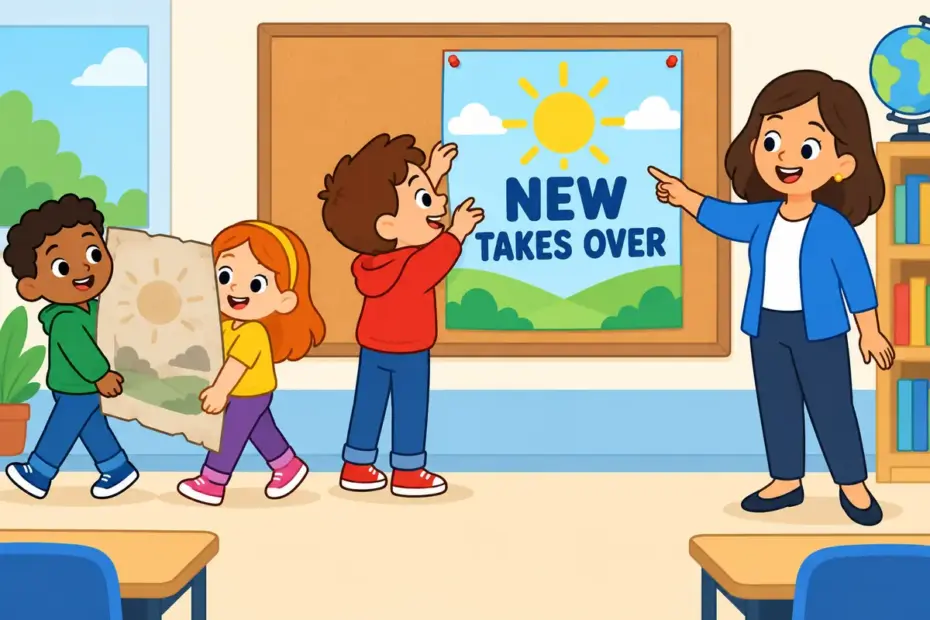
Supersede means to take the place of something older, especially as a newer or more effective version. To use supersede in a sentence, name the thing being replaced and the thing replacing it: “The new policy supersedes all earlier rules.” The verb is transitive and slightly formal.
Supersede at a glance
- Supersede is a transitive verb; its forms are supersedes, superseded, superseding and supersession.
- The two main senses are replacing something outdated and setting aside a rule in favour of a higher one.
- The usual subjects are a newer edition, a later law, a revised standard or a superior authority.
- Supersede belongs to formal, legal and technical writing rather than everyday talk.
- The commonest error is the misspelling supercede, which dictionaries do not accept.
What does supersede mean?
Supersede is a transitive verb meaning to take the place of something older, usually because the newer thing is more effective, more accurate or higher in authority. The Cambridge entry for supersede covers both the replacement sense and the legal sense in which a higher rule overrides a lower one. An item that has been pushed aside this way is often described as obsolete, though supersede itself says nothing about age.
| Sense | Plain meaning | Example sentence |
|---|---|---|
| Replace something outdated | A newer thing takes the place of an older one | The latest model supersedes the 2019 edition. |
| Override by higher authority | A higher rule cancels a lower one | Federal law supersedes the state regulation. |
| Take over a role | One person replaces another in a post | A younger deputy superseded the retiring director. |
One limitation is worth stating. Supersede reports a finished replacement, not a contest still in progress: a rival is only superseding while the outcome is open, and once the change is complete the older thing has simply been superseded. When one product merely competes with another rather than replacing it, rival or compete is the more accurate word.
How do you use supersede in a sentence?
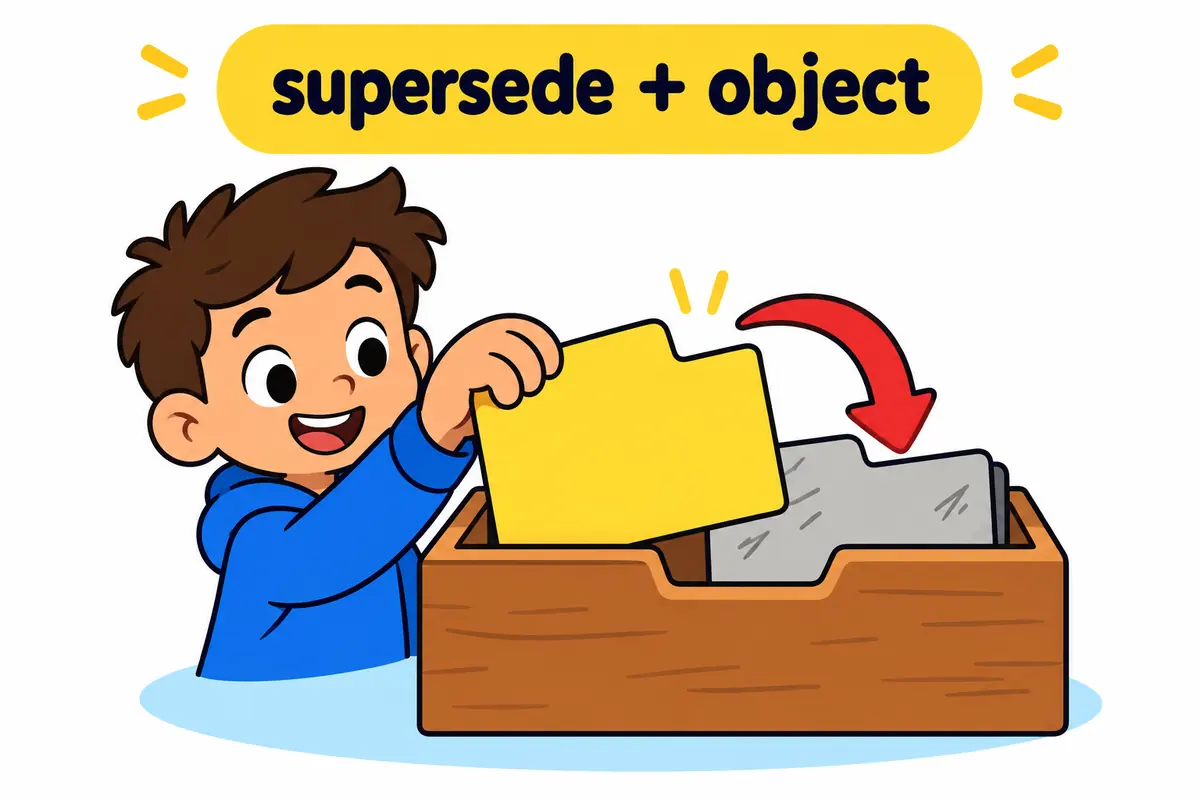
Put the new thing first and the old thing second: the replacement supersedes what it displaces. Five patterns cover most real sentences, and the passive form was superseded by is the one legal and technical writing relies on, because it throws attention onto whatever pushed the older version aside.
| Pattern | Example | What it signals |
|---|---|---|
| newer thing + supersede + older thing | Version four supersedes version three. | The subject is the replacement and the object is the old item. |
| be superseded by | The old code was superseded by the 2020 standard. | Passive names what pushed the earlier item aside. |
| rule + supersede + rule | The charter supersedes local bylaws. | A higher authority cancels a lower rule. |
| supersede + somebody | The acting chief superseded her deputy. | Rare personal use; one person takes over a role. |
| supersede + earlier work | The revised edition supersedes the first printing. | Common in publishing and manuals. |
Where a change arrives before an old rule takes effect, writers may preempt the deadline rather than supersede it, and where one item simply stands in for another the plain verb is to substitute one item for another. Supersede is narrower: it says the older thing is finished.
Supersede in a sentence: examples across contexts
Supersede changes register more than it changes meaning. The nine sentences below keep the same verb while moving from a classroom to a legal notice, and each one names both the replacement and the item it displaces.
| Context | Example sentence | Why this works |
|---|---|---|
| Classroom | The updated sheet supersedes the version in your folder. | Names both documents so the swap is unambiguous. |
| Workplace email | This guidance supersedes the interim note sent in March. | Points to the earlier item by date. |
| News report | The ruling supersedes a 2018 decision that had blocked the works. | Uses the legal sense with a clear predecessor. |
| Legal writing | Clause nine supersedes any conflicting term. | States precedence inside a contract. |
| Technical manual | Firmware 2.4 supersedes all earlier releases. | Common in documentation, where versions matter. |
| Science writing | The revised calibration supersedes the provisional figures. | Replaces provisional data with a firmer standard. |
| Conversation | The new bus route supersedes the old one from Monday. | Everyday sense of a straightforward replacement. |
| Academic prose | This interpretation supersedes the reading offered in 1995. | Marks a scholarly replacement without insult. |
| Publishing | The second edition supersedes the first and corrects its errors. | Links replacement to improvement. |
Only the news and legal sentences would look wrong in speech. Where a later stage of a process simply hands over to the next, writers often prefer succeed the previous stage, which describes a sequence rather than a formal overruling.
Supersede vs replace
Supersede and replace both describe a swap, and the difference is formality and finality. To replace a part can be a routine, neutral act; to supersede is to declare the older thing out of date or out of order, which is why laws and standards supersede rather than merely replace.
| Attribute | supersede | replace |
|---|---|---|
| Core job | Put an older thing out of use | Put a new thing in a former place |
| Formality | Formal and official | Neutral and everyday |
| What it implies | The old item is obsolete or overruled | The swap may be routine |
| Typical object | A rule, standard, edition or model | A part, battery, worker or plan |
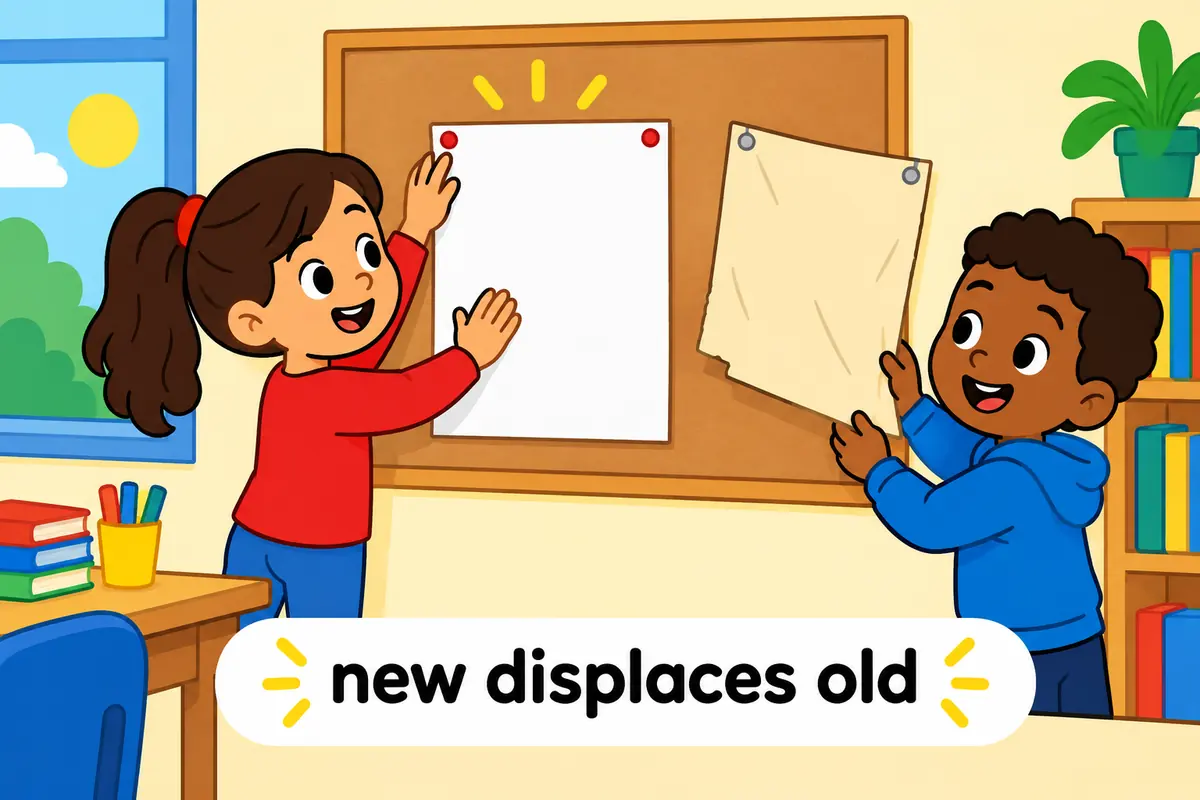
| Direction | New displaces old | New stands where old stood |
| Register | Legal, technical, editorial | General |
Verdict: choose replace for any straightforward swap, and supersede when the older thing is formally outdated or overruled, since a mere supplanting rival may win a place without ending the original.
Word forms and grammar of supersede
Supersede inflects regularly, and its noun supersession is rare but correct in legal writing. The table also lists supercede, a common misspelling that dictionaries reject because the second half of the word comes from the Latin sedere, to sit.
| Form | Part of speech | Example |
|---|---|---|
| supersede | verb, base form | New rules supersede the old ones. |
| supersedes | verb, third person singular | This version supersedes the draft. |
| superseded | verb, past and past participle | The standard was superseded in 2020. |
| superseding | verb, present participle | The superseding order arrived by email. |
| supersession | noun | The supersession of the old treaty took effect in May. |
| supercede | non-standard misspelling | Use supersede, never supercede. |
Common mistakes with supersede
- Incorrect:
The new file superceded the old one.Correct: The new file superseded the old one. Rule: The word is built on the Latin sedere, so it keeps the s. - Incorrect:
The new model superseded.Correct: The new model superseded the previous one. Rule: Supersede is transitive and needs an object. - Incorrect:
Both rules supersede each other.Correct: The later rule supersedes the earlier one. Rule: Supersede implies one thing displacing another, not a tie. - Incorrect:
He was superseded of his duties.Correct: He was relieved of his duties. Rule: Supersede takes a direct object, not of.
Practice using supersede
Work through the six items, then check the reasoning rather than only the key.
- Fill the gap: The revised syllabus ______ the one printed last year.
- Choose the better word: The mechanic (replaced / superseded) the worn brake pads.
- Correct the error: The latest firmware supercedes the older build.
- Build a sentence: use be superseded by about a paper map and a phone app.
- Spot the register: which belongs in a legal notice — this clause supersedes all prior agreements, or this clause beats the old ones?
- Rewrite with the noun: The treaty was replaced in stages. Use supersession instead.
Answers
- supersedes — the newer document displaces the older one.
- replaced — worn pads are swapped out, not formally overruled.
- The latest firmware supersedes the older build — the correct spelling keeps the s.
- Model answer: The paper map was superseded by a phone app.
- This clause supersedes all prior agreements — a legal notice is formal and exact.
- The supersession of the treaty happened in stages — the noun needs an article.
The bottom line
Use supersede in a sentence when a newer or higher thing puts an older one out of use, and name both the replacement and the item it displaces. Two nuances decide most sentences: the verb is transitive, so something is always superseded, and it claims finality rather than rivalry. For an ordinary swap, replace is the plainer and safer choice.
Frequently asked questions about supersede
Is supersede a formal word?
Supersede sits in formal, legal and technical writing, where versions, rules and standards are compared. In casual speech people usually say replace instead. Writing the app superseded the notebook in a chat message would sound stiff, while a policy document would use exactly that verb.
Can a person be superseded?
Yes, though the personal use is less common than the thing-focused one. A deputy can be superseded by a more senior appointment, meaning someone else takes the post. The usage is neutral and formal, so it suits a news report or a memo more than a friendly conversation.
Does supersede mean cancel?
Not exactly. Supersede means to take the place of something, and the older thing is set aside as a result rather than erased. A cancelled meeting simply does not happen, while a superseded rule stops applying because a new one now governs the same ground.
Why is supersede often misspelled?
Writers often spell it supercede by analogy with words such as precede and intercede. Supersede is the standard form, built on the Latin sedere, to sit, so it keeps the s in the middle. The misspelling appears in draft notes and emails, and a spell-checker will flag it.
Have you ever heard of the term “supersede” and wondered what it means exactly? “Supersede” refers to the action of replacing something or someone with something newer, more superior, or more up-to-date.
In simpler terms, when something supersedes another, it takes over its position, authority, or relevance. This term is often used when discussing how one thing surpasses or overtakes another in importance or priority.
7 Examples Of Supersede Used In a Sentence For Kids
- The new toy supersede the old one.
- A rainbow can supersede a rainy day.
- A butterfly can supersede a caterpillar.
- The sun can supersede the moon at night.
- A big smile can supersede a frown.
- A plant can supersede a seed.
- A big hug can supersede feeling sad.
14 Sentences with Supersede Examples
- It is important to note that newer research findings supersede previous theories in the field of economics.
- Always make sure to check if there have been any updated guidelines that supersede the ones in your textbooks for your computer science assignment.
- The latest edition of the academic journal supersede the older versions, so make sure you refer to the most recent one for your dissertation.
- Remember that campus policies can change over time and supersede any outdated rules, so be aware of the current regulations.
- The results of the recent survey supersede the data collected last year, indicating a shift in student preferences for extracurricular activities.
- Keep in mind that the newer edition of the textbook supersede the older ones, so make sure to use the correct version recommended by your professor.
- It is essential to keep up with the latest industry trends as they may supersede the traditional practices taught in your business management classes.
- The recommendations provided by the career services center supersede those given during your orientation, so it’s a good idea to schedule an appointment for updated advice.
- As technology advances rapidly, newer software applications may supersede the tools you are currently using for your engineering projects.
- The revised grading system implemented by the university supersede the previous one, affecting how your academic performance is evaluated.
- Always refer to the most recent edition of the style guide as it may supersede the formatting rules you have used in your English literature papers.
- The internship opportunities available this year may supersede the ones you considered last semester, so remain open to new possibilities.
- The research findings presented at the recent conference supersede the data you referenced in your social science essay, prompting a need for revision.
- The new scholarship criteria supersede the previous requirements, so make sure you meet the updated qualifications for financial aid.
How To Use Supersede in Sentences?
Supersede means to replace or take the place of something or someone previously in use. Here’s a simple guide on how to use supersede in a sentence for beginners:
-
Identify the main action or event that is replacing something else.
-
Place the word supersede in your sentence in the appropriate position to convey this replacement action.
-
For example, “The new technology will supersede the outdated model.” In this sentence, the word supersede is used to show that the new technology will replace the outdated model.
-
Another example could be, “The updated policy will supersede the old regulations.” Here, supersede is used to indicate that the new policy will take the place of the old regulations.
-
Remember that supersede is often used in formal or professional contexts, such as law, technology, or policies.
By following these simple steps, you can effectively use supersede in a sentence to convey the idea of replacing something with something else.
Conclusion
In conclusion, the term “supersede” is used when one thing takes the place of another, typically due to being more advanced or accurate. This can be seen in various contexts, such as technology replacing outdated systems, new laws superseding old regulations, or updated guidelines superseding previous protocols. Understanding when something supersedes another is essential for staying current in a rapidly evolving world.
By recognizing when one thing supersedes another, individuals and organizations can adapt and make necessary adjustments to remain relevant and efficient. Whether in the realms of law, technology, or any other field, the concept of superseding emphasizes the importance of progress and the need to evolve in order to keep up with changing circumstances.


