
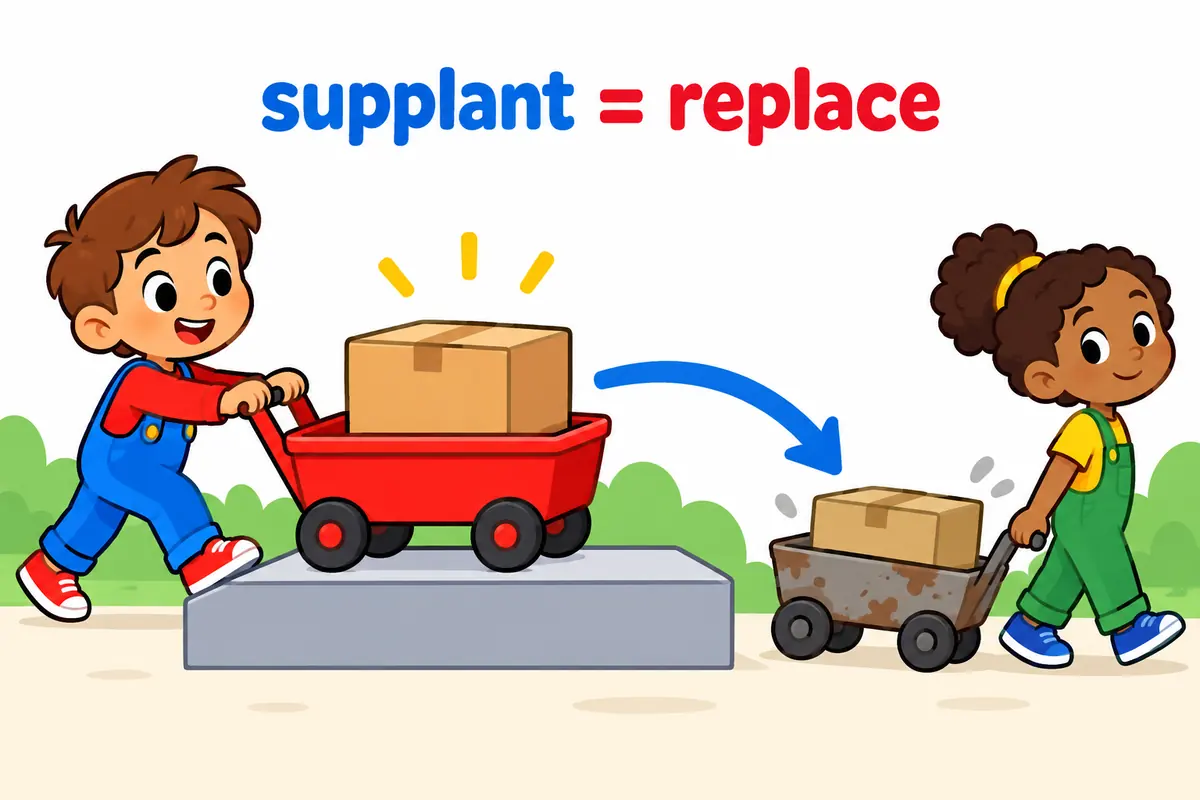
Supplant means to take the place of something or someone, usually by pushing the older one out: “Streaming slowly supplanted the DVD.” To use supplant in a sentence, make the newcomer the subject and the displaced thing the object, and keep the verb for a complete replacement rather than a temporary swap.
Supplant at a glance
- Supplant is a transitive verb; its forms are supplants, supplanted and supplanting.
- The subject is the new thing, and the object is whatever loses its place.
- It implies a complete replacement, often gradual and not always welcome.
- Typical subjects are technology, a rival, a new method or a successor.
- The commonest error is using supplant for a short-term substitution.
What does supplant mean?
Supplant is a transitive verb meaning to displace and replace something, so that the newcomer takes the other’s place. The Cambridge entry for supplant records this sense of taking the place of a rival or predecessor, and the verb usually hides a quiet contest. A temporary switch is closer to substitute, because supplant suggests the old thing does not come back.
| Sense | Plain meaning | Example sentence |
|---|---|---|
| Replace a thing | A new product pushes an older one out | Email supplanted the fax within a decade. |
| Replace a person | A successor takes over another’s position | The deputy supplanted the manager after the review. |
| Displace gradually | The old practice fades as the new one spreads | Bicycles were supplanted by cars in the city centre. |
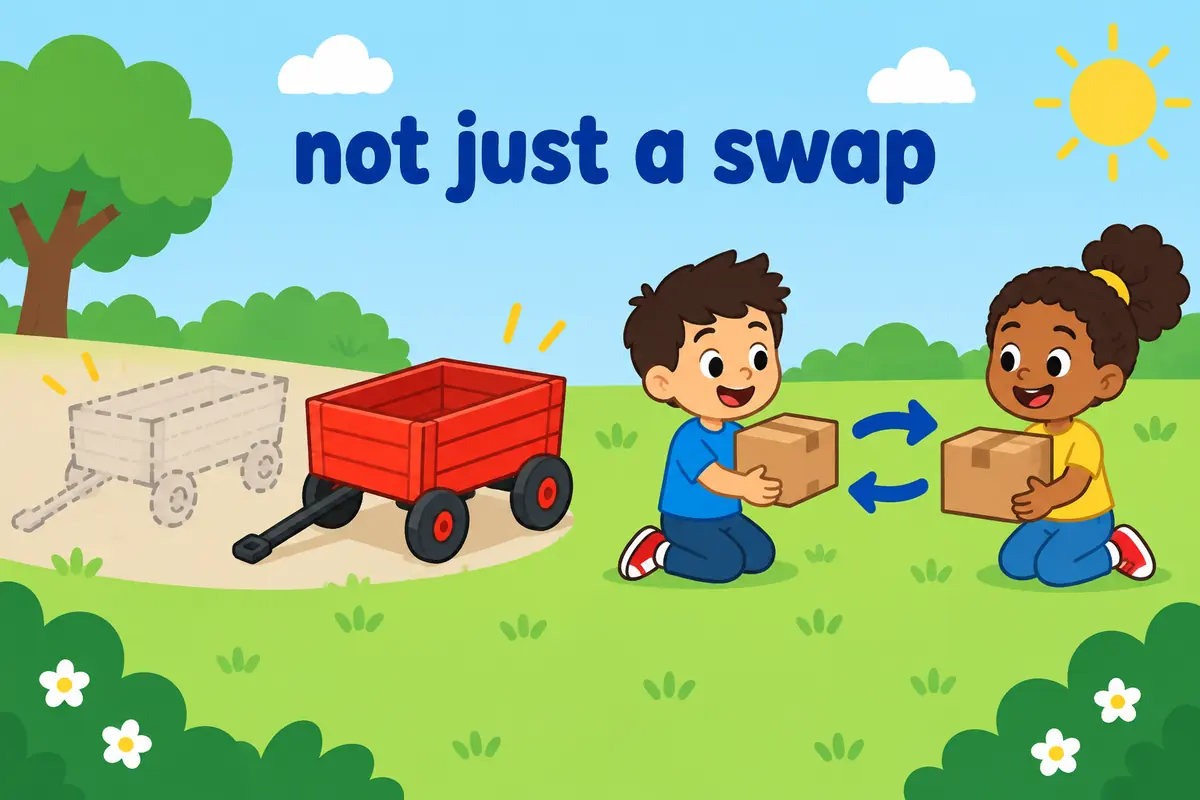
One limitation matters. Supplant is not a neutral word for change: it suggests that something was pushed aside, so it can imply rivalry or loss. For a peaceful, planned handover, replace or succeed is often fairer, and for a short-term change, substitute is the honest choice.
How do you use supplant in a sentence?
Supplant puts the winner first and the loser second, and it rarely appears in the passive. Five patterns cover nearly every sentence, and the preposition by names the force that does the displacing.
| Pattern | Example | What it signals |
|---|---|---|
| new + supplant + old | Electric cars are supplanting petrol models. | The newcomer is the subject. |
| be supplanted by | The typewriter was supplanted by the word processor. | The passive keeps the loser in focus. |
| person + supplant + person | A junior partner supplanted the founder. | Human succession or rivalry. |
| supplant + as | Streaming supplanted cable as the default. | Names the role that changed hands. |
| supplant + in | Robots supplanted workers in the paint shop. | Names the place or field. |
When the sentence needs to say what the newcomer became, supplant as is the pattern to use: it marks the old title or role, not the physical place.
Supplant in a sentence: examples across contexts
Supplant moves easily from a science report to a company memo, and the displaced thing stays concrete. The eight sentences below keep the same verb while changing the field it describes.
| Context | Example sentence | Why this works |
|---|---|---|
| Classroom | Digital maps have supplanted paper atlases in the geography room. | An everyday object shows the change clearly. |
| Workplace email | The new scheduling tool will supplant the spreadsheet by June. | Names a firm date, as a memo should. |
| News report | A rival chain supplanted the family grocer on the high street. | Puts a named rival in the subject slot. |
| Science writing | Gene editing has not supplanted traditional breeding. | The negation keeps the claim modest. |
| Legal writing | The revised statute supplanted the older rule on tenancies. | A formal replacement, stated as fact. |
| Sports commentary | A teenage striker supplanted the veteran in the starting eleven. | Human succession in one clause. |
| History essay | Railways supplanted the canal network within forty years. | A slow, large-scale substitution. |
| Conversation | My phone has completely supplanted my alarm clock. | First person usage stays casual and concrete. |
Only the last sentence uses the first person, which is a reliable signal of register: supplant in the plural and the passive belongs to reports, while the first-person singular belongs to speech.
Supplant vs replace and supersede
Supplant overlaps with replace and supersede, and it is interchangeable with neither. The table separates them on the qualities that decide a sentence.
| Attribute | supplant | replace | supersede |
|---|---|---|---|
| Core idea | Displace a rival and take its place | Put something in the place of another | Come after and set aside an older rule |
| Implied rivalry | Usually present | Absent | Sometimes present |
| Typical object | A product, person or method | Any object or part | A law, rule or agreement |
| Reversibility | Suggests the old thing will not return | Neutral about return | Suggests the old version is out of date |
| Register | Formal and journalistic | Neutral, everyday | Formal and legal |
Verdict: choose replace for a plain, neutral swap, supersede when an older rule or version is set aside, and supplant when the new thing visibly defeats the old.
Word forms and grammar of supplant
Supplant inflects regularly, and its related nouns are rare enough that writers normally reach for replacement instead. The table lists the forms in use and the one to avoid.
| Form | Part of speech | Example |
|---|---|---|
| supplant | verb, base form | New methods will supplant the old. |
| supplants | verb, third person singular | A single app supplants five tools. |
| supplanted | verb, past and past participle | The steamship supplanted sail. |
| supplanting | verb, present participle | It is supplanting older formats. |
| supplantation | noun, rare and awkward | Prefer replacement over supplantation. |
For a noun, use replacement rather than supplantation; the rare form exists but sounds forced. The verb itself is regular, so no spelling change appears in any tense.
Common mistakes with supplant
- Incorrect:
The recipe supplanted sugar with honey.Correct: The recipe replaced sugar with honey. Rule: Supplant takes the displaced thing as its object and does not license with plus a replacement. - Incorrect:
I supplanted the salt for pepper in the soup.Correct: I substituted pepper for salt in the soup. Rule: A temporary, reversible swap belongs to substitute, not supplant. - Incorrect:
The new law supplanted on the old rule.Correct: The new law supplanted the old rule. Rule: Supplant is transitive and takes no preposition before its object. - Incorrect:
The manager was supplanted to the trainee.Correct: The manager was supplanted by the trainee. Rule: In the passive, the displacing force follows by, never to.
Practice using supplant
Work through the six items, then read the reason with each answer rather than the key alone.
- Fill the gap: Touchscreens have largely ______ physical buttons on phones.
- Choose the better word: For one evening only, we (replaced / supplanted) the broken chair with a box.
- Correct the error: The digital archive supplanted with the paper records.
- Build a sentence: use be supplanted by about a horse cart and a delivery van.
- Spot the register: which belongs in a company memo — the new system supplanted the old ledger, or the new system totally pushed the old ledger aside?
- Rewrite with supersede: The revised policy supplanted the 2019 rules.
Answers
- supplanted — the buttons have lost their place permanently, which is the core sense.
- replaced — the swap lasts one evening, so it is temporary and reversible.
- The digital archive supplanted the paper records — no preposition sits before the object.
- Model answer: The horse cart was supplanted by the delivery van within a single decade.
- The new system supplanted the old ledger — a memo avoids totally and the slangy push aside.
- The revised policy superseded the 2019 rules — supersede fits a rule or agreement being set aside.
The bottom line
Use supplant in a sentence when one thing takes another’s place completely, and put the newcomer as the subject and the displaced thing as the object. Two nuances decide most uses: supplant implies rivalry and an ending, so it is wrong for a reversible swap, and the passive with by keeps the old thing in focus. When a person is forced out of office rather than replaced by a thing, oust is the sharper verb, while replace remains the plain, neutral choice.
Frequently asked questions about supplant
Is supplant a formal word?
Supplant sits in formal, journalistic and academic writing, where a change is reported rather than debated. In everyday speech most people say replace or take over. A text message would use replace, while a news feature might write that a rival chain supplanted the family grocer.
What is the difference between supplant and replace?
Replace is neutral and can describe any swap, including a temporary one. Supplant adds rivalry and finality: the new thing defeats the old and the old does not return. Replacing a flat tyre is ordinary; supplanting a rival implies a contest that was lost.
Can supplant be used in the passive voice?
Yes. The passive pattern be supplanted by is common in reports because it keeps the displaced thing at the front: the typewriter was supplanted by the word processor. The active voice would begin with the newcomer, which shifts attention to whoever or whatever did the displacing.
Does supplant need an object?
Supplant is transitive, so it always needs an object, and that object is the thing losing its place. You write the app supplanted the tool, never the app supplanted. In the passive, the object becomes the subject and the doer follows the preposition by.
Have you ever come across a word that seemed to take the place of another seamlessly? That’s the essence of the term “supplant.” Simply put, when one thing replaces or substitutes another, especially in a gradual or subtle manner, it can be said to supplant it.
In various contexts, the word “supplant” is used to describe how something new takes over the role or position of something existing. Whether in technology, business, or even nature, the concept of supplanting provides insight into the dynamic and ever-changing nature of our world.
7 Examples Of Supplant Used In a Sentence For Kids
- New toys can supplant old toys in the toy box.
- Make sure to use a pencil to supplant the broken crayon.
- Let’s choose fresh flowers to supplant the wilted ones.
- A big umbrella can supplant a small one in the rain.
- Use a clean cup to supplant the dirty one for drinking water.
- The sun can supplant the clouds and make the sky sunny.
- A soft pillow can supplant a hard pillow for a comfortable sleep.
14 Sentences with Supplant Examples
- The new study group supplanted the old one as the preferred choice among college students.
- As new technology emerges, it has the potential to supplant traditional teaching methods in the classroom.
- The introduction of online courses may supplant the need for physical textbooks in the future.
- The popularity of virtual internships has started to supplant traditional in-person internships among college students.
- A new student organization has emerged to supplant the previous one in terms of campus influence.
- Some argue that artificial intelligence may supplant certain job roles, leading to concerns for college students entering the workforce.
- The use of digital portfolios may supplant traditional resumes as the preferred way to showcase skills and experiences.
- The rise of online streaming services has supplanted the need for physical copies of movies and music among college students.
- Advanced study aids like digital flashcards and interactive quizzes are beginning to supplant traditional study methods for many students.
- E-books are starting to supplant physical textbooks in college courses, offering students a more convenient and cost-effective option.
- The convenience of online shopping has supplanted traditional retail stores as the go-to for many college students.
- Virtual reality technology has the potential to supplant traditional classroom experiences for certain subjects.
- Some argue that online networking platforms may supplant in-person networking events as the primary way for college students to connect with professionals.
- The convenience and efficiency of online banking have supplanted the need for students to visit physical bank branches.
How To Use Supplant in Sentences?
To use Supplant in a sentence, simply follow these steps:
-
Identify the word that you want to replace with Supplant in your sentence. For example, if your original sentence is “She replaced the old curtains with new ones,” you can choose to use the word Supplant instead of replaced.
-
Once you have chosen the word to replace, construct your sentence as you normally would, but with the word Supplant in place of the original word. For example, you could write “She supplanted the old curtains with new ones.”
-
Make sure that the new sentence makes sense and conveys the intended meaning. In the example above, the sentence should still clearly indicate that new curtains were put in place of the old ones.
-
Practice using the word Supplant in various sentences to become more comfortable with incorporating it into your writing.
Remember that Supplant is a verb that means to take the place of something or someone else, typically in a forceful or unwelcome way. Using this word can add variety to your writing and help you express ideas more precisely.
Conclusion
In summary, the use of “supplant” in sentences often signifies the replacement of something by something else, demonstrating a process of substitution or displacement. This word is commonly employed to describe scenarios where one thing takes the place of another, giving an indication of a transformation or override in a particular context. The verb “supplant” accurately conveys a sense of one entity overpowering another to assume its position, conveying a sense of competition or evolution in various situations.
Through sentences with “supplant,” it becomes clear how this word is used to depict the act of replacing or displacing one thing with another, illustrating a shift or change in dominance. Its usage effectively encapsulates the idea of one entity overtaking another in various scenarios, showcasing the dynamic nature of interactions where something is replaced or overridden by a different element.


