
To suss out something is to work it out gradually by observing and reasoning. To use suss out in a sentence, put the object after out or between the two words: “She sussed out the plan” or “She sussed it out.” The phrase is informal and especially common in British English.
Suss out at a glance
- Suss out is a separable phrasal verb; its forms are suss out, susses out, sussed out and sussing out.
- The particle may stay after the object or move before it: suss out the answer, or suss it out.
- The verb is transitive, so it always needs an object such as a situation, a person or a mood.
- It belongs to informal speech and British writing more than to American academic prose.
- The commonest error is stranding a pronoun after out, as in suss out it, which is never correct.
What does suss out mean?
Suss out is a phrasal verb meaning to discover or work out something by looking, listening and reasoning. It comes from suss, an old British slang shortening of suspect, and it carries the flavour of reading a situation rather than being told. The Cambridge entry for suss out gives the sense of understanding something or finding out the truth about it. Two strands are worth separating. The first is figuring out a fact: sussing out how a machine works. The second is judging a person or mood: sussing out whether a colleague is annoyed. Where you mean a neutral, American-sounding conclusion, figure out is the plainer choice, and suss out can sound distinctly British beside it. Suss out is also wrong for a snap guess, because it implies patient observation over time.
| Sense | Plain meaning | Example sentence |
|---|---|---|
| Work out a fact | Discover how or why something works | We sussed out the fault in the wiring. |
| Read a person or mood | Judge someone’s feelings or intentions | He quickly sussed out that the room was tense. |
| Assess a situation | Form a judgement before acting | Let me suss out the timetable before we book. |
How do you use suss out in a sentence?
Because suss out is separable, the two patterns are suss out + object and suss + object + out. A pronoun must go in the middle, so suss it out is right and suss out it is wrong. The particle may also strand in questions and relative clauses.
| Pattern | Example | What it signals |
|---|---|---|
| suss out + noun | She sussed out the reason for the delay. | the standard order |
| suss + noun + out | She sussed the reason out. | emphasis on the object |
| suss + pronoun + out | She sussed it out. | the only position a pronoun allows |
| suss out + wh-clause | We never sussed out who sent the letter. | a clause as the object |
| stranded particle in a question | Which route did they suss out? | the object fronted, out left behind |

Suss out in a sentence: examples across contexts
| Context | Example sentence | Why this works |
|---|---|---|
| Classroom | The class sussed out the rule from three examples. | Shows discovery by reasoning. |
| Workplace email | Can you suss out who owns this project before Friday? | Uses a wh-clause as the object. |
| News feature | Reporters slowly sussed out the pattern behind the delays. | Matches patient investigation. |
| Travel conversation | We sussed out the best route to the coast. | Keeps the tone informal. |
| Technical writing | The engineer sussed out what had tripped the alarm. | Places a clause after out. |
| Sports report | The captain sussed out the opposition’s weakest side. | Uses it for reading a situation. |
| Parenting | It took a week to suss out why the baby was unsettled. | Implies gradual observation. |
| Job interview | She sussed out the company culture in one visit. | Uses the judgment sense. |
| Casual speech | I can’t suss him out at all. | Pronoun correctly placed in the middle. |
| Business memo | We must suss out the real cause before spending more. | Keeps a neutral register. |
Suss out vs figure out
The two phrases share a meaning but not a register. Figure out travels anywhere; suss out sounds like a British speaker who has been watching and thinking.
| Attribute | Suss out | Figure out |
|---|---|---|
| Register | Informal, often British | Neutral, works anywhere |
| Method implied | Reading clues and behaviour | Any reasoning or calculation |
| Separability | Separable: suss it out | Separable: figure it out |
| Typical object | A person, a mood, a situation | A fact, a sum, a solution |
| Formality | Too casual for a contract | Accepts formal and plain contexts |
Use suss out for reading people and situations in relaxed writing, and figure out when you need a neutral verb that fits a report, a classroom or a conversation with anyone.
Word forms and grammar of suss out
| Form | Part of speech | Example |
|---|---|---|
| suss out | base phrasal verb | I need to suss out the schedule. |
| susses out | third person singular | She susses out a room in seconds. |
| sussed out | past tense and past participle | We sussed out the problem yesterday. |
| sussing out | present participle | He is sussing out the competition. |
| suss out it | non-standard order | Write suss it out, never suss out it. |
Shared-particle neighbours such as ask out behave the same way: the pronoun sits between the verb and out. The particle becomes literal in the adjective sussed, meaning well informed, but that is a different informal word and not a form of this verb. Where the emphasis is on noticing something faint, discern is the closer verb, and deduce narrows the meaning to reasoning from evidence. In a formal report, ascertain carries the same meaning without the slang.
Common mistakes with suss out
- Incorrect: I need to suss out it. Correct: I need to suss it out. Rule: a pronoun object must go between the verb and the particle.
- Incorrect: She sussed about the noise. Correct: She sussed out the noise. Rule: the phrasal verb keeps out; the base verb suss alone means something else in British slang.
- Incorrect: They susses out the plan. Correct: They suss out the plan. Rule: the third person singular adds -es, so it is susses only for he, she or it.
- Incorrect: We sussed out. Correct: We sussed out the cause. Rule: the verb is transitive and needs an object.
- Incorrect: Please suss out the solution for me. Correct in a formal report: Please determine the solution. Rule: match the register; suss out is too casual for formal writing.
Practice using suss out
- Fill in the blank: It took an hour to ____ who had left the gate open.
- Choose the better word: The committee needs to (suss out / ascertain) the true cost, and the report is formal.
- Correct the error: She sussed out it before lunch.
- Build a sentence: describe reading a friend’s mood, using suss out and a pronoun.
- Spot the register: which line fits a casual message? (a) Let’s suss out the plan. (b) Let us determine the plan.
- Fill in the blank: We never fully ____ why the machine kept stopping.
Answers
- suss out — a wh-clause is the object and follows the particle.
- ascertain — a formal report calls for the neutral, formal verb.
- She sussed it out before lunch — the pronoun must sit between sussed and out.
- I sussed him out in a minute — the pronoun is in the middle, as the grammar requires.
- Sentence (a) — suss out is informal and fits a relaxed message.
- sussed out — past tense of the phrasal verb, with the particle intact.
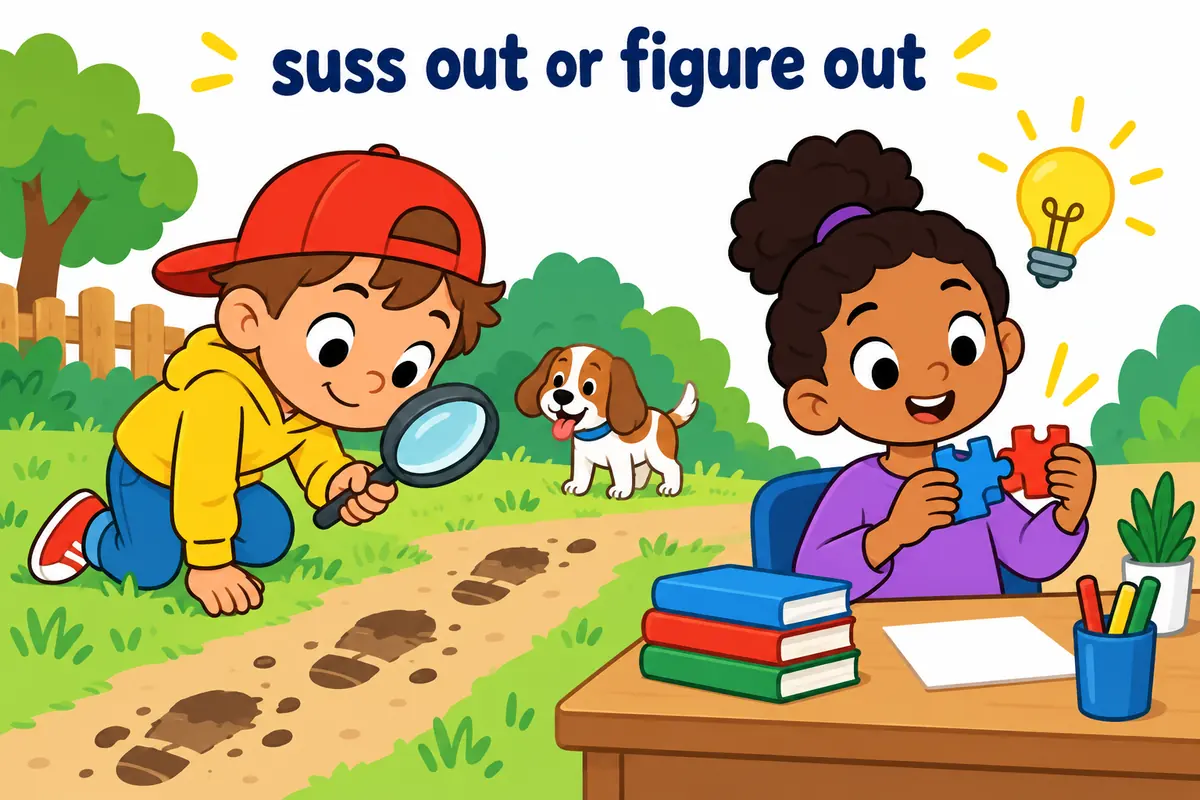
The bottom line
Suss out means to work something out by observing and reasoning, and it is a separable phrasal verb, so suss it out is right and suss out it is wrong. It sounds informal and often British, while figure out is the neutral twin. Put a pronoun in the middle, keep the particle, and reserve the phrase for relaxed writing.
Frequently asked questions about suss out
Is suss out British or American?
Suss out is strongly associated with British and Commonwealth English, where it sits comfortably in speech and journalism. American writers understand it but usually prefer figure out. The word derives from suss, an older British slang shortening of suspect, which explains the informal flavour it still carries.
Can you separate suss and out in a sentence?
Yes. Suss out is separable, so both suss out the answer and suss the answer out are correct, with the second adding a little emphasis to the object. When the object is a pronoun, separation is compulsory: write suss it out, never suss out it, because pronouns must sit between the verb and its particle.
What is the past tense of suss out?
The past tense is sussed out, and the same form serves as the past participle, as in they sussed out the cause and the cause was sussed out. The present participle is sussing out, and the third person singular is susses out, as in she susses out a room quickly.
Is suss out informal?
It is informal. Suss out suits conversation, features and internal messages but looks out of place in a contract, a legal filing or a formal report. In those settings, choose ascertain, determine or establish, which carry the same meaning without the slang background.
Ever heard of the phrase “suss out” and wondered what it means? In simple terms, when you suss something out, you are figuring it out or gaining a better understanding through observation, investigation, or analysis.
Whether you’re trying to suss out a complex problem at work or just trying to understand someone’s motives, mastering the skill of sussing out can be invaluable in various situations.
7 Examples Of Suss Out Used In a Sentence For Kids
- Can you suss out which shape comes next in the pattern?
- Let’s work together to suss out the missing number in this sequence.
- We need to suss out which color crayon matches the picture.
- Use your detective skills to suss out where the hidden treasure is.
- Try to suss out which animal is making that sound.
- Let’s play a game to suss out who can jump the farthest.
- Can you suss out which picture doesn’t belong in this group?
14 Sentences with Suss Out Examples
- Suss out the best study spots on campus for maximum productivity.
- Before exams, make sure to suss out all the important topics from your syllabus.
- Suss out which professors are the most approachable for doubts and questions.
- Suss out the most cost-effective places to eat near the college campus.
- Suss out the best group study members for efficient collaboration.
- Don’t forget to suss out the library hours for late-night study sessions.
- Suss out the extracurricular activities available to enhance your college experience.
- Suss out the most popular hangout spots for college students in the area.
- Suss out the local transportation options to make commuting easier.
- Suss out the best time to approach your professors for academic guidance.
- Suss out the upcoming internship opportunities for practical experience.
- Suss out the best online resources for additional learning materials.
- Before joining a club or society, it’s important to suss out their activities and requirements.
- Make sure to suss out the career guidance services offered by the college for future planning.
How To Use Suss Out in Sentences?
To Suss Out means to figure out, understand, or determine something, especially through careful observation or investigation. Here is a guide on how to use Suss Out in a sentence:
-
Identify the Situation: Before using Suss Out in a sentence, make sure you have a situation where you need to understand or figure something out.
-
Choose the Appropriate Context: Suss Out is typically used in informal or casual conversations. It is a more conversational way of saying “figure out.”
-
Structure the Sentence: When using Suss Out, remember that it is a phrasal verb that can be separated by other words. You can say, “I need to suss it out” or “Let’s suss out the problem.”
-
Example Sentences:
- “I need to suss out what’s causing the issue with my computer.”
- “Can you help me suss out the best way to approach this project?”
- “She was trying to suss out if he was telling the truth.”
-
Practice Using it: To feel more comfortable with Suss Out, try incorporating it into your conversations to become more familiar with its usage.
Remember, when using Suss Out, you are indicating an effort to uncover, understand, or solve something. With practice, you will become more fluent in incorporating this phrasal verb into your everyday language.
Conclusion
In conclusion, the phrase “suss out” is commonly used to mean to investigate, figure out, or understand something through observation or intuition. It is often employed in informal conversations and contexts to describe the process of gaining insight or clarity. For example, one might say they need to “suss out” a situation at work before making a decision, meaning they need to gather information or understand the details before proceeding.
Whether used in a casual discussion or a more formal setting, “suss out” can help convey the idea of analyzing or discerning something to reach a better understanding. By incorporating this versatile phrase into your vocabulary, you can effectively communicate your efforts to uncover or solve a puzzle, problem, or mystery.


