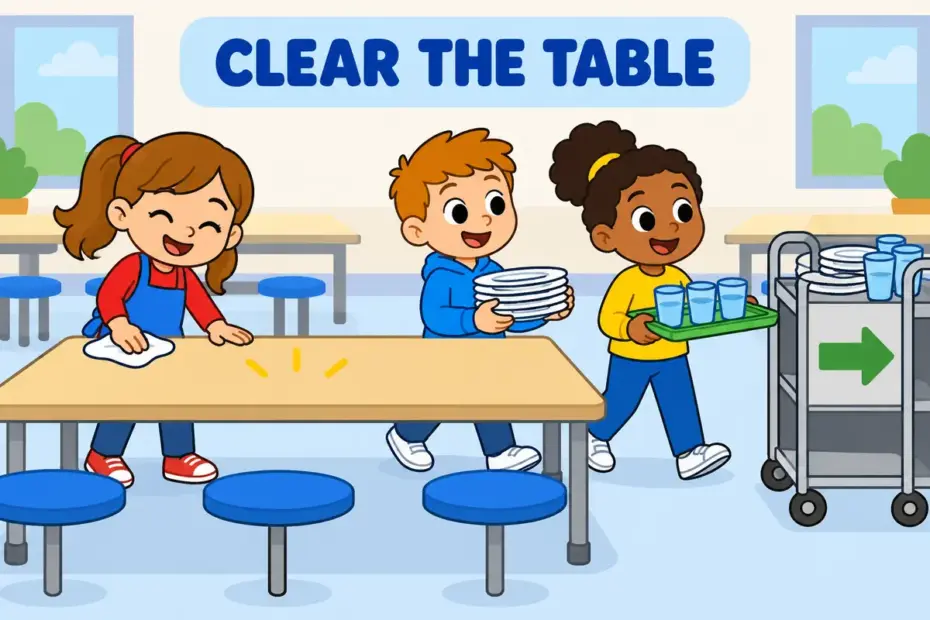
Take away means to remove something from a place, to subtract a number, or to reduce a total. To use take away in a sentence, keep the object close: “Please take away the plates” and “Take ten away from forty.” It is separable, so a pronoun sits inside: take it away, never take away it.
Take away at a glance
- Take away is a separable phrasal verb.
- It has three senses: remove from a place, subtract a number, and reduce or detract.
- The object may follow the particle or sit before it, but a pronoun must sit before.
- The noun takeaway means a main point, or food bought to eat elsewhere.
- The commonest error is placing a pronoun after the particle: take away it.
What does take away mean?
Take away is a separable phrasal verb meaning to remove something from a place, to subtract one number from another, or to reduce the value of something. The Cambridge entry for take away records the removal and subtraction senses, and the table separates all three. For a plain physical removal, remove is the one-word alternative.
| Sense | Plain meaning | Example sentence |
|---|---|---|
| Remove | Take something from a place or person | Please take away these empty glasses. |
| Subtract | Remove an amount from a total | Take away five from twelve and you get seven. |
| Detract | Reduce the value or effect of something | The constant noise took away from her speech. |
How do you use take away in a sentence?
The verb is separable, which means the object can sit either side of the particle, but a pronoun cannot follow it. The table shows the patterns and the fixed phrase take away from.
| Pattern | Example | What it signals |
|---|---|---|
| take + object + away | Take the cups away. | Object before the particle. |
| take away + object | Take away the cups. | Object after the particle; never a pronoun. |
| take + it or them + away | Take them away. | A pronoun must precede the particle. |
| take away from + object | The jeers took away from the performance. | Fixed phrase, the detract sense. |
| take + number + away from + number | Take three away from nine. | Arithmetic subtraction. |
Take away in a sentence: examples across contexts
Each row places take away where the phrase sounds natural, with a line on why it works.
| Context | Example sentence | Why this works |
|---|---|---|
| Restaurant | Could you take away these plates, please? | It is a polite removal request. |
| Maths lesson | Take away six from twenty to find the answer. | It uses the subtraction sense. |
| Workplace email | We took away the approval step to speed things up. | It removes a process step. |
| News report | Officials took away the permits after the inspection. | It describes a formal withdrawal. |
| Conversation | Here, let me take your bag away. | It uses an object before the particle. |
| Sports writing | The injury took away her best asset, her speed. | It reduces a quality rather than a thing. |
| Customer service | We can take away the delivery fee for you. | It removes a charge. |
| Music review | The muddy mix takes away from the singer’s voice. | It uses the fixed detract phrase. |
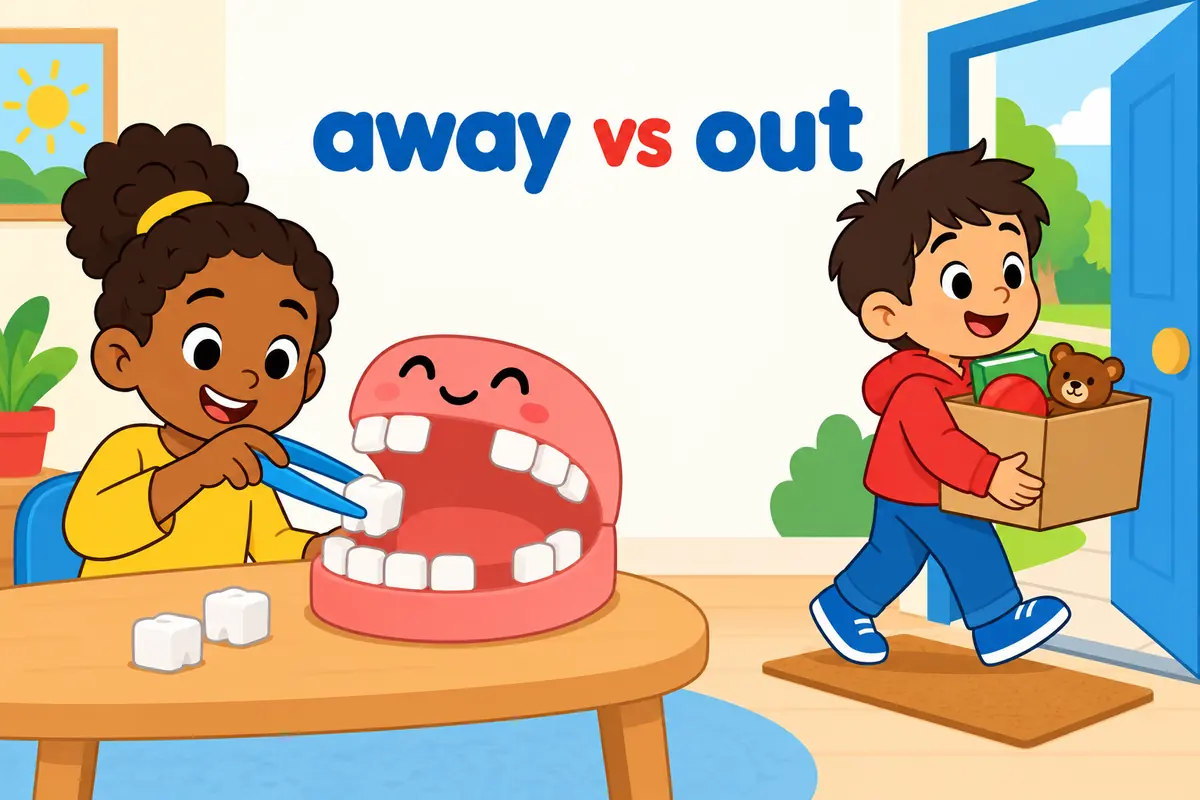
Take away vs take out
Take away and take out both involve removal, but take out points at a source or a container. The table separates them.
| Attribute | Take away | Take out |
|---|---|---|
| Core meaning | Remove and carry off | Remove from inside something |
| Focus | The thing leaves the scene | The thing leaves a container or source |
| Common objects | Plates, rubbish, a right, a fee | A tooth, a loan, the bins, a form |
| Extra senses | Subtract, detract | Invite out, destroy, obtain |
| Fixed phrase | take away from | take out on |
Choose take away when something is removed and carried off, and take out when it leaves a container, a bank or a body. Other friends of the phrase sharpen the meaning: subtract is the arithmetic verb, extract removes something with effort or precision, confiscate removes property by authority, and detract is the formal verb behind take away from.
Word forms and grammar of take away
| Form | Part of speech | Example |
|---|---|---|
| take away | verb, base | Take away the tray. |
| takes away | verb, third person | She takes away the salt. |
| took away | verb, past | They took away the signs. |
| taking away | verb, -ing | Taking away the fee helped. |
| taken away | verb, participle | The bins were taken away. |
| take away it | non-standard order | Write take it away. |
Common mistakes with take away
- Incorrect:
Please take away it.Correct: Please take it away. Rule: a pronoun object must sit between the verb and the particle. - Incorrect:
Take away five to twelve.Correct: Take away five from twelve. Rule: subtraction uses from, not to. - Incorrect:
The noise took away her speech.Correct: The noise took away from her speech. Rule: the detract sense needs the fixed phrase take away from. - Incorrect:
He took away a tooth.Correct: He took out a tooth. Rule: removing something from inside calls for take out. - Incorrect:
They take away the bins on Mondays.Correct: They take out the bins on Mondays. Rule: household collection uses take out.
Practice using take away
Try the exercises, then check the reasoned answers below.
- Fill in the blank: Please ________ the dirty dishes.
- Choose the better word: The dentist will (take away / take out) the broken tooth.
- Correct the error: The rain took away the picnic.
- Build a sentence: subtract seven from fifteen, using take away.
- Spot the register: which fits a formal letter? (a) The council took away the licence. (b) The council grabbed the licence back.
- Fill in the blank: Constant interruptions ________ from the lesson.
Answers
- take away — the dishes are removed and carried off.
- take out — a tooth is removed from inside the mouth.
- The rain took away from the picnic — the detract sense needs the fixed phrase with from.
- Take away seven from fifteen — from introduces the number being reduced.
- (a) — the neutral phrase suits a formal letter.
- take away — interruptions detract from the lesson.
The bottom line
Take away is a separable phrasal verb for removing something, subtracting a number or reducing a total. When you use take away in a sentence, keep a pronoun between the verb and the particle, and remember that subtraction needs from. Choose take out when the thing leaves a container or a body, and use the fixed phrase take away from for the detract sense. The noun takeaway keeps the ideas of a main point and food to go.
Frequently asked questions about take away
Is takeaway one word or two?
The verb is two words, take away, while the noun is usually one word, takeaway, meaning a main point or, in British English, food bought to eat elsewhere. American English often writes takeout for the food sense. Part of speech decides the spelling.
What does take away from mean?
Take away from is a fixed phrase meaning to reduce or damage the value of something. A poor sound system takes away from a good concert, and constant complaints take away from a team’s focus. The phrase always keeps from before its object.
Can take away mean subtract?
Yes. Take away is a common way to say subtract in everyday maths, as in take away three from ten. The structure is take away plus the amount, then from plus the starting number. The single verb subtract is more formal and suits written maths.
Is take away separable?
Yes, take away is separable, so the object can sit either before or after the particle, as in take the plates away or take away the plates. A pronoun, however, must sit in the middle: take them away, never take away them.
“Have you ever heard of the term ‘take away’ and wondered what it means? In the realm of communication and language, a ‘take away’ refers to a key idea or point that one can gather or learn from a conversation, discussion, or piece of information.”
In simpler terms, a ‘take away’ is the main lesson or insight that you extract from a specific situation or interaction. It typically encapsulates the most important message or understanding that you gain after processing the information presented.
7 Examples Of Take Away Used In a Sentence For Kids
- Let’s take away two apples from the basket.
- Can you take away three pencils from the desk?
- I will take away four blocks from the tower.
- How many cookies can we take away from the jar?
- Let’s take away one toy each for sharing.
- The teacher asked us to take away five marbles from the jar.
- We need to take away six candies from the jar for everyone.
14 Sentences with Take Away Examples
–Take away the stress of exams by practicing time management and study strategies.
-Don’t forget to take away some extra notes from the library before your assignment is due.
-Always remember to take away valuable learnings from each lecture you attend.
-It’s important to take away the key points from a discussion to enhance your understanding.
–Take away any distractions while you are studying to improve your focus.
-Don’t hesitate to take away some online courses to supplement your learning.
-After a class, make sure to take away any doubts by asking questions to the professor.
-Remember to take away any unnecessary clutter from your study space to create a conducive environment.
-It’s essential to take away any negative thoughts that may hinder your academic performance.
–Take away any temptations to procrastinate by creating a study schedule.
-Don’t forget to take away any insights gained from group discussions with your classmates.
-When attending workshops or seminars, ensure to take away important tips and tricks shared by the speakers.
-Always take away the feedback provided by your professors to improve your academic performance.
-In group projects, make sure to take away valuable team collaboration skills.
How To Use Take Away in Sentences?
Take Away is a versatile phrasal verb that can be used in different contexts and meanings. In a sentence, take away usually means to remove something or deduct a quantity from a total.
For example:
– “Please take away your shoes before entering the house.” (remove)
– “The waiter will take away our plates once we finish eating.” (remove)
– “If you take away 5 from 10, you are left with 5.” (deduct)
– “The teacher threatened to take away recess if the students kept misbehaving.” (remove privilege)
Remember that take away can also mean to understand or learn from a situation or experience. For instance:
– “What lesson did you take away from the team project?” (learn)
– “I hope the students take away valuable knowledge from this workshop.” (learn)
In some cases, take away can also refer to getting food from a restaurant to eat elsewhere, also known as takeout.
– “Let’s take away some pizza for dinner tonight.” (takeout)
By incorporating take away into your sentences, you can communicate the action of removal, deduction, learning, or even getting food to go.Experiment with various contexts to become comfortable using take away accurately in your everyday conversations.
Conclusion
In conclusion, the use of “take away” in sentences can communicate the act of removing or deducting something from a situation or context. Whether it involves a physical object being removed, a lesson learned, or a sense of achievement being diminished, the phrase “take away” is versatile and can convey different meanings. Examples like “The waiter will take away our empty plates” and “The main takeaway from the meeting was the need for better communication” illustrate the various ways this phrase can be applied.
By understanding the diverse ways “take away” can be used in sentences, individuals can effectively convey the idea of extraction, deduction, or key points to others. This phrase serves as a concise and clear method to communicate actions or lessons that are removed or learned from a particular situation, enhancing the clarity and impact of the message being delivered.


