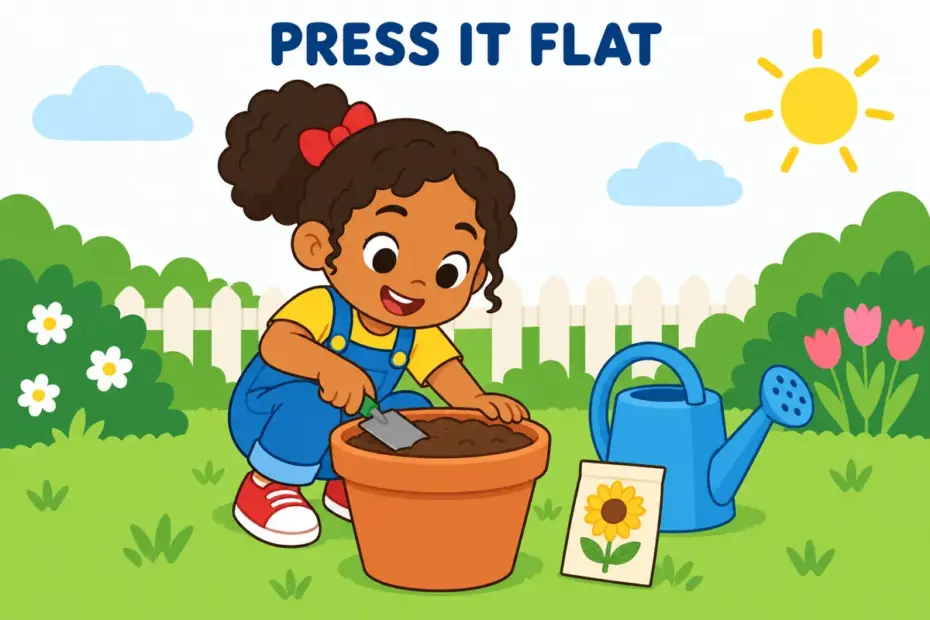
Tamp down means to press something firmly so it becomes level and compact, and, in a common figurative sense, to reduce or suppress a feeling, rumor or problem. To use tamp down in a sentence, name what is being pressed: “She tamped down the soil around the plant.”
Tamp down at a glance
- Tamp down is a phrasal verb; its forms are tamps down, tamped down and tamping down.
- The literal sense is to press a substance flat, as with soil or coffee grounds.
- The figurative sense is to reduce or suppress something unwelcome.
- It is transitive, so it always needs an object to tamp down.
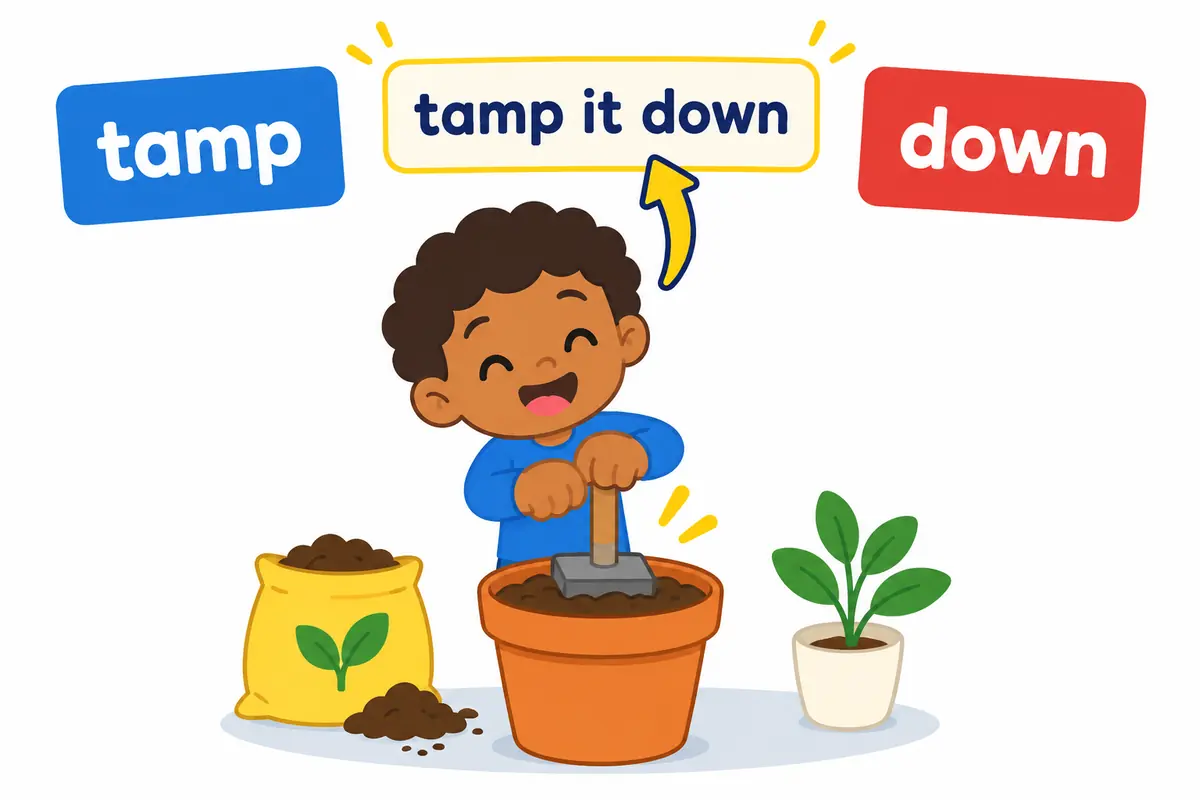
- It is separable, and a pronoun must take the middle slot: tamp it down.
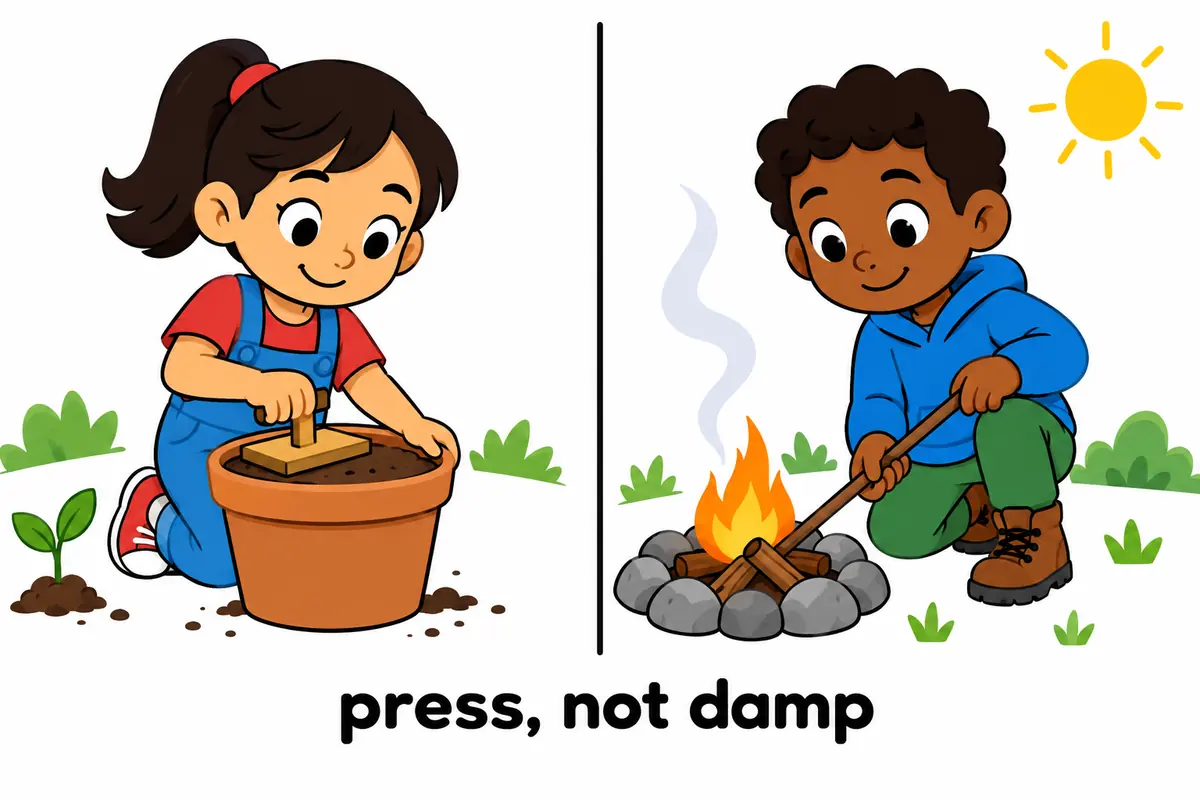
- The commonest error is confusing tamp down with damp down, which concerns a fire or a mood.
What does tamp down mean?
Tamp down is a transitive phrasal verb meaning to press a substance firmly into a flatter, denser layer, or to hold a feeling or situation back before it grows. The Cambridge entry for tamp down records the pressing sense, and the figurative use extends it to anything a writer wants to suppress a rumor. Both senses keep the image of steady downward pressure applied more than once.
| Sense | Plain meaning | Example sentence |
|---|---|---|
| Press flat | Pat a substance down into a firm layer | Tamp down the coffee before you brew it. |
| Reduce or suppress | Hold back a feeling or a problem | The bank tamped down fears of a run. |
One limitation is worth stating plainly. Tamp down implies gentle, repeated pressure that keeps something in place, so it is the wrong verb for a single heavy blow: a hammer strike bangs or levels a surface, it does not tamp it. The figurative use also stops short of destroying the feeling, because tamping only holds something down for now.
Where the aim is to keep a person from acting at all, restrain an angry crowd is a stronger and more direct choice than tamp down.
How do you use tamp down in a sentence?
Tamp down is transitive and separable, so the object may follow the whole phrase or sit between tamp and down. With a pronoun, the object must go in the middle. The table shows the patterns and where the particle may move.
| Pattern | Example | What it signals |
|---|---|---|
| tamp down + object | Tamp down the soil after planting. | The object follows the full verb. |
| tamp + object + down | Tamp the soil down after planting. | The separable form, equally correct. |
| tamp + pronoun + down | Tamp it down firmly. | A pronoun must sit between the parts. |
| tamp down + abstract noun | Officials tamped down the rumours. | The figurative sense holds something back. |
| be tamped down | Excitement was tamped down by the delay. | Passive voice keeps the feeling in focus. |
| tamp + object + down + with + tool | Tamp the grounds down with a tamper. | Names the tool that applies the pressure. |
The literal sense wants a tool or a flat hand, while the figurative sense wants a subject such as an official, a policy or a result. To compress the layers is the mechanical cousin of the literal use, describing the same density without the repeated pats.
Tamp down in a sentence: examples across contexts
Tamp down moves easily from a garden to a newsroom, because the same pressure that firms soil also calms a crowd. The ten sentences below each show whether the pressing is literal or figurative, and the last row shows the same particle down in a different verb.
| Context | Example sentence | Why this works |
|---|---|---|
| Gardening | Tamp down the earth around the new rose before watering. | The literal sense uses a firm, level surface. |
| Coffee making | Tamp down the grounds evenly for an even extraction. | A technical hobby use with a named substance. |
| News report | The minister tried to tamp down speculation about a reshuffle. | The figurative sense reduces an unwelcome story. |
| Finance writing | Higher interest rates tamped down demand for loans. | An economic effect reduces pressure. |
| Sports report | The manager tamped down talk of a crisis after one defeat. | A person manages a reaction rather than a thing. |
| Workplace email | Please tamp down expectations before the results are final. | A request to reduce over-optimism. |
| Medical writing | The treatment tamped down the inflammation within days. | A measured effect on a bodily response. |
| Community notice | Residents tamped down their worries as the river fell. | A feeling is held back by a shared action. |
| Conversation | I tamped down my nerves and opened the envelope. | The pronoun sits between tamp and down. |
| Shared particle | The union refused to back down over pay. | Same particle down, but back down means to give way. |
The final row is the useful warning: down appears in many phrasal verbs, and each carries its own meaning. Tamp down is about steady pressure, while back down is about surrendering.
Tamp down vs damp down
Tamp down and damp down are easy to mix, because they sound alike and both reduce something. Where a doubt must be ended outright, a writer may prefer to squash the last doubt, but the usual difference here is the method: tamping presses physically, while damping controls a fire or a mood.
| Attribute | tamp down | damp down |
|---|---|---|
| Core action | Press flat or hold back | Slow down or calm |
| Typical object | Soil, grounds, rumours, fears | Fire, excitement, speculation |
| Method | Repeated downward pressure | Reducing air or intensity |
| Origin of image | A tool packing a surface | Damping a stove or furnace |
| Strength | Holds something in place | Makes something burn or grow slower |
Verdict: choose tamp down when something is pressed or held firmly in check, and damp down when a fire or a rising feeling is being cooled and slowed.
Word forms and grammar of tamp down
Tamp down inflects on the verb tamp, and the particle down stays fixed. The table also lists the tool and the look-alike verb that learners confuse with tamp.
| Form | Part of speech | Example |
|---|---|---|
| tamp down | phrasal verb, base | Tamp down the soil lightly. |
| tamps down | third person singular | She tamps down each layer by hand. |
| tamped down | past and past participle | He tamped down the grounds. |
| tamping down | present participle | They are tamping down the new path. |
| a tamper | noun, a tool | The tamper packs the coffee evenly. |
| tamper with | verb, different meaning | Do not tamper with the lock. |
Keep reduce the pressure in mind as the plainer alternative to the figurative sense, because tamp down adds a picture that formal writing may not want.
Common mistakes with tamp down
- Incorrect:
Tamp down it before you plant.Correct: Tamp it down before you plant. Rule: A pronoun object must sit between tamp and down. - Incorrect:
He tamped down.Correct: He tamped down the soil. Rule: Tamp down is transitive, so the object cannot be left out. - Incorrect:
Do not tamp with the settings.Correct: Do not tamper with the settings. Rule: Tamper with means interfere, which is a different verb. - Incorrect:
The official damped down the rumours.Correct: The official tamped down the rumours. Rule: Damp down fits fire and mood, while tamp down fits rumours and pressures. - Incorrect:
The hammer tamped down the nail.Correct: The hammer drove the nail in. Rule: Tamping is gentle, repeated pressure, not a single blow.
Practice using tamp down
Work through the six items, then read the reason beside each answer rather than only the key.
- Fill the gap: After sowing, ______ the soil with the back of a rake.
- Choose the better word: Firefighters (tamped down / damped down) the blaze before it spread.
- Correct the error: Tamp down it firmly around the roots.
- Build a sentence: use tamp down about a manager calming talk of layoffs.
- Spot the register: which suits a news report — the bank tamped down fears, or the bank made people less scared?
- Rewrite with the pronoun: Tamp down the coffee grounds. Use it instead of the coffee grounds.
Answers
- tamp down — the literal sense takes the soil as its object.
- damped down — a fire is slowed by damping, not by pressing.
- Tamp it down firmly around the roots — the pronoun goes between tamp and down.
- Model answer: The manager tamped down talk of layoffs before the meeting.
- The bank tamped down fears — a report prefers the precise verb to a vague phrase.
- Tamp it down — the pronoun must sit between the two parts.
The bottom line
Use tamp down in a sentence when something is pressed into a firm layer or when a feeling, rumour or pressure is held back. Two nuances decide most sentences: the verb is transitive, so it always needs an object, and it is separable, so a pronoun goes between tamp and down. Where the target is a fire or a mood rather than a physical surface, damp down is the word you want.
Frequently asked questions about tamp down
What does tamp down mean in cooking?
In cooking, tamp down usually means pressing coffee grounds into an even, firm puck before brewing, or patting down a crumb base in a tin. The aim is a level, dense layer rather than a loose one. The same phrase applies to soil or a sandy path outside the kitchen.
Is tamp down one word or two?
It is two words, because tamp is the verb and down is its particle. The pair never takes a hyphen and never becomes a single word, even in the past tense, where it appears as tamped down. Only tamp changes form, while down stays fixed in every sentence.
Can you tamp down emotions?
Yes. Tamp down works figuratively with feelings such as fear, anger or excitement, as in she tamped down her nerves. It means to hold the feeling back rather than remove it, so the emotion may return later. Stronger words such as suppress suggest a more complete control.
Does tamp down always need an object?
Yes. Tamp down is transitive, so it always needs something to press or hold back, such as soil, grounds, fears or rumours. A sentence with no object, like he tamped down, is incomplete. The object may follow the phrase or split it, but it cannot be dropped.
When you want to moderate, suppress, or reduce something, you “tamp down” on it. This common phrase is used to describe the act of calming down emotions, lowering intensity, or minimizing the impact of a situation.
“Tamp down” can be a useful tool in communication, conflict resolution, and managing stress. By understanding how to effectively tamp down on strong emotions or conflicts, you can maintain composure and navigate challenging situations with grace.
7 Examples Of Tamp Down Used In a Sentence For Kids
- Tamp down the sand to build a strong sandcastle.
- We need to tamp down the soil to plant seeds for our garden.
- Let’s all work together to tamp down the bubble wrap to make it flat.
- Use a hammer to gently tamp down the nails into the wood.
- We should always remember to tamp down the trash before throwing it away.
- Can you help me tamp down the playdough to make it smooth?
- Make sure to tamp down the flour before measuring it for baking.
14 Sentences with Tamp Down Examples
- You can tamp down the soil before planting your seeds for better growth.
- Remember to tamp down on your expenses if you want to save money for a trip.
- It’s important to tamp down any rumors before they spread across the campus.
- Before exams, make sure to tamp down on distractions and focus on studying.
- Tamp down any negative thoughts and stay positive during difficult times.
- To avoid conflicts, try to tamp down on your emotions and communicate effectively.
- Don’t forget to tamp down on procrastination and stay ahead of your assignments.
- When organizing events, always tamp down on any potential conflicts to ensure smooth execution.
- Practice meditation to help tamp down on stress and anxiety in college.
- Before a presentation, remember to tamp down on nervousness and speak confidently.
- It’s essential to tamp down any feelings of self-doubt and believe in your capabilities.
- Make sure to tamp down on peer pressure and make decisions that align with your values.
- Tamp down on late-night snacking to maintain a healthy diet and sleep schedule.
- Remember to tamp down on social media usage and focus on productive activities.
How To Use Tamp Down in Sentences?
To use the phrase “Tamp Down” in a sentence, you can follow these guidelines:
-
Definition: Tamp Down means to reduce or lessen something, to suppress or control a particular feeling or situation.
-
Placement: The phrase “Tamp Down” is typically used with an object, where the object refers to what is being reduced or controlled. For example, “tamp down the noise,” “tamp down your emotions,” “tamp down the rebellion.”
-
Sentence Structure: When incorporating “Tamp Down” in a sentence, it is essential to place it before the object you want to reduce or suppress.
-
Example Sentences:
- “She tried to tamp down her excitement before the big surprise party.”
- “The company implemented new policies to tamp down employee turnover.”
- “It’s important to tamp down rumors before they spread too far.”
-
Alternate phrasing: If you’re struggling to use “Tamp Down” in a sentence, you can try interchangeable terms like “suppress,” “reduce,” “control,” or “lessen.”
Remember, practice makes perfect! Try using the phrase “Tamp Down” in various sentences to become more familiar with its usage and improve your overall proficiency in sentence construction.
Conclusion
In conclusion, the use of phrases like “tamp down” in communication is effective in conveying the idea of reducing or controlling something, whether it be emotions, reactions, or conflicts. By using this term, individuals can easily understand the need to calm or suppress a situation or feeling. Through sentences such as “They tried to tamp down their anger during the meeting” or “The authorities are working to tamp down the escalating tensions,” the concept of managing or diminishing intensity is clearly communicated.
These examples demonstrate the versatility of the term “tamp down” in various contexts, making it a valuable tool for expressing the idea of moderation, restraint, or containment. Incorporating this phrase into everyday language can help promote clear and concise communication when discussing efforts to control or mitigate different situations.


