Tautology is a noun for saying the same idea twice in different words, as in free gift or repeat again. To use tautology in a sentence, name the repeated idea and the phrase that carries it: “The notice calls advance planning a tautology.” The word labels the fault rather than repairing it.
Tautology at a glance
- Tautology is a noun; its adjective is tautological and its adverb is tautologically.
- The two central senses are the rhetorical repeat, as in free gift, and the logical statement that is true in every case.
- The usual patterns are a phrase is a tautology and the wording is tautological.
- Tautology belongs to formal writing about language, logic and editing rather than to casual speech.
- The commonest error is calling any emphatic repetition a tautology when only one word is repeated.
What does tautology mean?
Tautology is a noun meaning the needless restatement of one idea in two or more words, or a statement that is true under every possible interpretation. The Cambridge entry for tautology records both the everyday and the logical senses, and only the first is a writing fault. The second belongs to logic, where a sentence can be true by its form alone.
| Sense | Plain meaning | Example sentence |
|---|---|---|
| Rhetorical tautology | Two words carry a single idea | The phrase free gift is a tautology. |
| Logical tautology | A statement true under every interpretation | Either the alarm will sound or it will not, which is a logical tautology. |
| Loose use | Any obvious restatement in speech | The coach called winning is winning a tautology. |
One limitation is worth stating plainly: tautology is not the same as emphasis or rhythm. A chorus that repeats one word on purpose is repetition, and a logical tautology is a technical property of a statement rather than an insult aimed at a writer.
How do you use tautology in a sentence?
Put the phrase under discussion after the verb to be, or use the adjective tautological to describe the wording. Five patterns cover almost every real sentence, and the noun is the one that names the fault.
| Pattern | Example | What it signals |
|---|---|---|
| phrase + is a tautology | The phrase join together is a tautology. | Labels one specific repeated pair. |
| wording + is tautological | The label end result is tautological. | Uses the adjective to describe the wording. |
| a tautology of + noun | The draft suffers from a tautology of terms. | Names the fault abstractly. |
| the tautology in + noun | The tautology in safe haven is easy to miss. | Points to where the repetition sits. |
| a logical tautology | Either it rains or it does not is a logical tautology. | Marks the formal, always-true sense. |
Tautology in a sentence: examples across contexts
Tautology changes function more than it changes shape. The nine sentences below keep the same term while moving from a classroom to a legal brief, and each one shows what the label is doing.
| Context | Example sentence | Why this works |
|---|---|---|
| Classroom | The teacher circled the phrase tiny little and wrote that it is a tautology. | A concrete phrase keeps an abstract term grounded. |
| Editing note | The margin note reads: this sentence contains a tautology of terms. | Names the fault without insulting the writer. |
| News report | Critics called the promise to return back a tautology. | Reports the judgement as a quoted label. |
| Academic writing | In propositional logic, either it rains or it does not is a tautology. | Signals the technical, always-true sense. |
| Marketing review | The slogan free gift was rejected as a tautology. | Ties the label to a real piece of copy. |
| Conversation | My editor says that is a tautology, and she is right. | Informal placement of the term in speech. |
| Speechwriting | Repeating the same point is a tautology if the second clause adds nothing. | Connects the label to a test a reader can apply. |
| Grammar blog | The phrase ATM machine is often listed as a tautology. | Uses a familiar abbreviation example. |
| Legal drafting | A clause that says null and void may be defended as a tautology for clarity. | Shows the term inside technical prose. |
Tautology vs redundancy
Tautology and redundancy overlap because both waste words, but they name different faults, and an editor who confuses them gives the wrong advice.
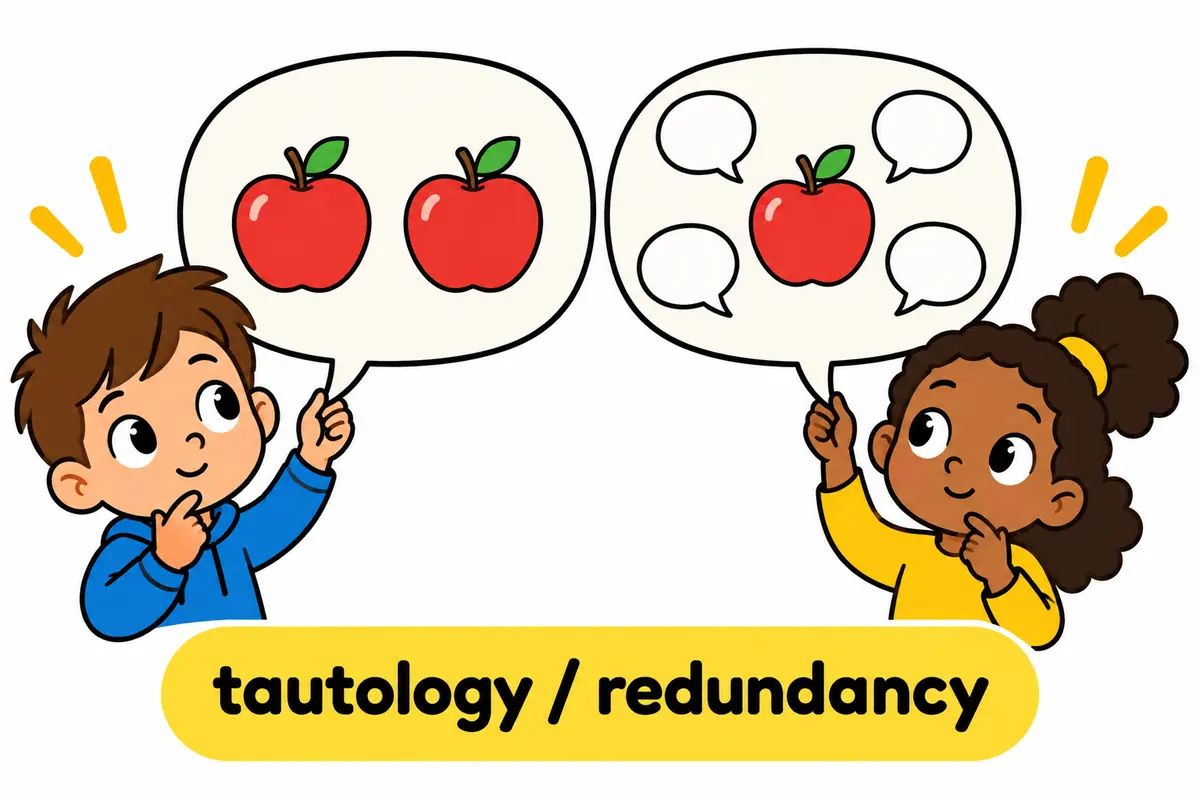
| Attribute | tautology | redundancy |
|---|---|---|
| Core idea | One idea expressed twice | Extra wording beyond what is needed |
| Typical unit | A phrase that restates itself | Any repeated or surplus element |
| Example | free gift | free gift, or a repeated sentence |
| Always a fault? | No, in logic it is a property | Usually yes in editing |
| Effect on meaning | Meaning is unchanged | Meaning is unchanged |
Verdict: choose tautology for a phrase that repeats its own idea, and redundancy for the broader habit of carrying more words than the meaning needs.
Word forms and grammar of tautology
Tautology keeps a stable family, and the adverb is the form learners build least often. Rewriting for concision usually removes the repeated idea rather than the label.
| Form | Part of speech | Example |
|---|---|---|
| tautology | noun | The phrase free gift is a tautology. |
| tautologies | noun, plural | Watch for tautologies in the first draft. |
| tautological | adjective | The wording is tautological. |
| tautologically | adverb | The clause is tautologically phrased. |
| tautologous | adjective, technical | The two definitions are logically tautologous. |
| tautologist | noun, rare | A tautologist studies statements true by form. |
Keep repetition for deliberate, effective echoes: a repeated line can be good writing, while a tautology adds no meaning at all.
Common mistakes with tautology
- Incorrect:
The team was accused of a tautology when they said the same idea with one word.Correct: The team was accused of a tautology when they said the same idea twice. Rule: A tautology needs two expressions of one idea, not a single repeated word. - Incorrect:
The phrase new innovation is a redundant tautology.Correct: The phrase new innovation is a tautology. Rule: The noun stands alone; do not stack redundant in front of it. - Incorrect:
He tautologied the same point twice.Correct: He stated a tautology by repeating the same point. Rule: Tautology is a noun, not a verb. - Incorrect:
It is a logical tautology because it repeats itself.Correct: It is a logical tautology because it is true under every interpretation. Rule: The logical sense is about truth in all cases, not about repetition.
Practice using tautology
Work through the six items, then read the reasons rather than only the answers.
- Fill the gap: The sign says PIN number, which many editors call a ______.
- Choose the better word: The repeated clause is (tautological / tautology) in structure.
- Correct the error: The sentence contains a tautology of the same word twice.
- Build a sentence: use is a tautology about the phrase cash money.
- Spot the register: which belongs in a grammar essay — either it rains or it does not is a logical tautology, or that is so tautology?
- Rewrite to remove the tautology: The final outcome happened at the end.
Answers
- tautology — the noun names the redundant pair after a determiner.
- tautological — the adjective describes the structure; the noun would not fit before in.
- The sentence repeats one idea twice, so the phrase of the same word twice mislabels it — a tautology must restate an idea, not repeat a word.
- Model answer: The phrase cash money is a tautology because money already implies cash.
- The first sentence belongs in a grammar essay — it is precise, while so tautology is not a standard collocation.
- The project ended — removing the tautology means dropping the word that repeats the meaning of the verb.
The bottom line
Use tautology in a sentence when you want to name a phrase that repeats its own idea, and make the repeated pair the object of your point. The two facts that settle most cases are these: the rhetorical sense is a writing fault, while the logical sense is a technical property that is never wrong; and repetition of a single word is not tautology at all. Where the aim is tighter prose, clarity and verbosity name the two ends of the same judgement.
Frequently asked questions about tautology
Why is free gift called a tautology?
A gift is something given freely, so free gift states one idea in two words, and editors class it as a tautology because the second word adds no meaning. Some retailers defend the phrase as emphasis, which is a marketing choice rather than a grammatical one.
Does tautology happen inside one word?
A single word cannot be a tautology, because the fault needs two expressions of one idea. The related fault inside a word is pleonasm, as in a compound that repeats part of its own meaning. When only one word repeats, call it repetition instead.
How do you fix a tautology in editing?
Read the phrase and ask what the second word adds. If the answer is nothing, delete it, so return back becomes return and end result becomes result. Keep the longer form only when a court or a customer needs the phrase for clarity.
Is every repeated phrase a tautology?
No. Repetition for rhythm or emphasis is a deliberate device, and a chorus that repeats one word is not a tautology at all. The label applies when two different words carry a single idea, as in advance planning or free gift, and only then does the term fit.
A tautology in a sentence repeats an idea without adding new information. In everyday writing, a phrase such as “It is what it is” can restate an idea for emphasis; in formal logic, a tautology is a proposition that is true under every possible truth assignment. The two meanings are related by repetition but are not interchangeable.
- Rhetoric and writing: repeated wording or meaning, sometimes accidental and sometimes deliberate.
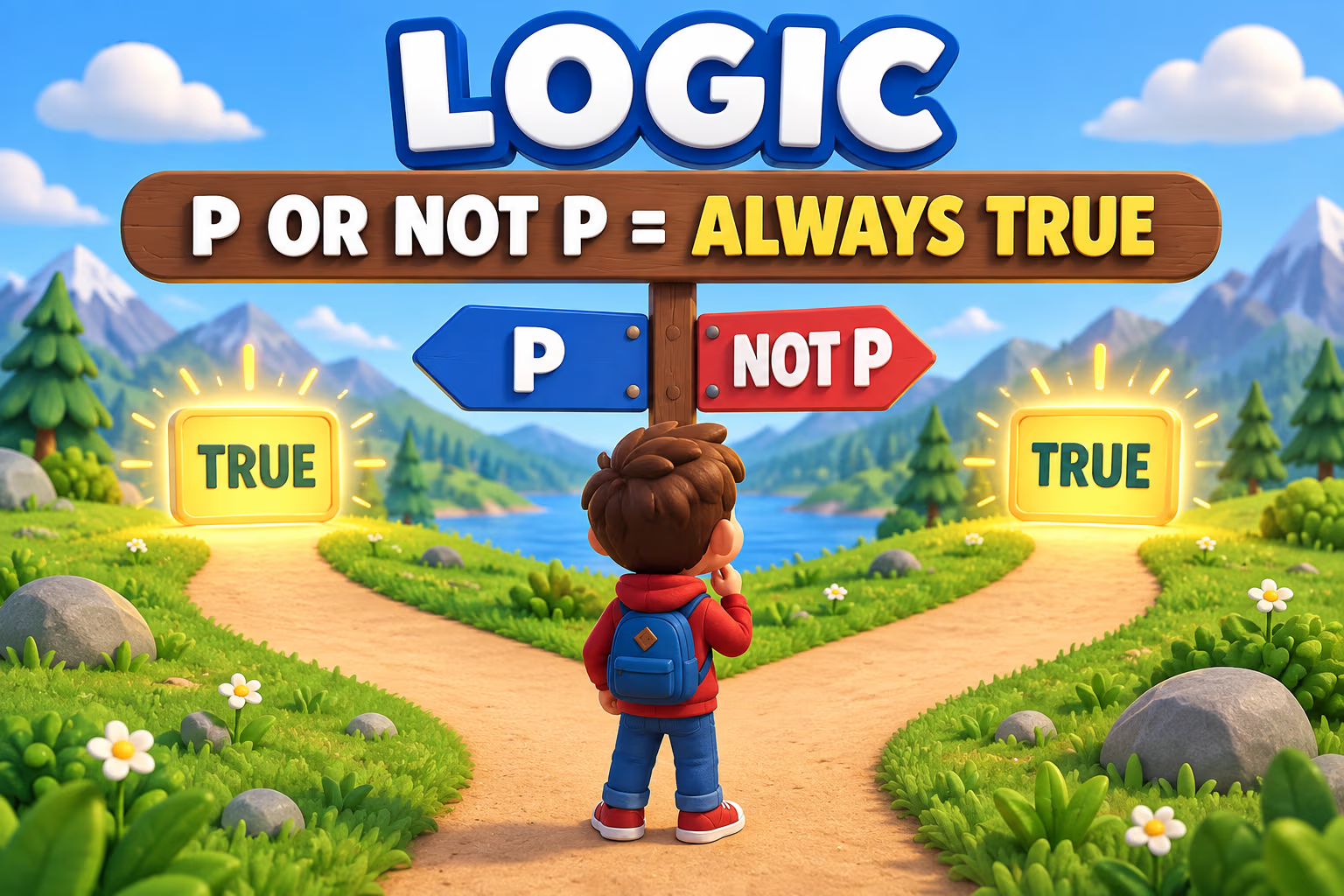
- Formal logic: a formula that is true in every case, such as P or not P in classical propositional logic.
- Editing tip: remove a repeated word only when it adds no useful meaning, emphasis, rhythm, or voice.

What does “tautology” mean?
In ordinary English, tautology often means expressing the same idea twice in different words. Cambridge Dictionary distinguishes this use from the logic meaning: in logic, a tautology is a statement that is always true. Context tells readers which sense is intended.
“The final outcome” may be called tautological because an outcome is already a result, while “It is what it is” repeats its claim in a compact form. But redundancy is not automatically a writing mistake: speakers may use repetition to show frustration, acceptance, humor, or emphasis. In logic, by contrast, the test is whether the formula stays true for every possible assignment of truth values—not whether a sentence sounds repetitive.
Rhetorical tautology vs. logical tautology
| Use | What it means | Example |
|---|---|---|
| Rhetoric or editing | Words or clauses repeat an idea, sometimes unnecessarily | “The end result was a surprise.” |
| Formal logic | A formula is true under every truth-value assignment | “P or not P” |
| Deliberate expression | Repetition gives a phrase a recognizable voice or emphasis | “It is what it is.” |
For the logic example, imagine that P means “the door is open.” Either P is true, or “not P” is true, so their inclusive “or” is true either way in classical logic. This pattern is known as the law of excluded middle. Logic systems with different assumptions can treat some principles differently, so the example is specifically a classical propositional-logic tautology.
How can you tell whether wording is tautological?
- Identify the claim. Say the sentence’s main idea in plain words.
- Check each modifier and clause. Ask whether it contributes a new fact, distinction, or qualification.
- Read it without the repeated part. If meaning and tone stay the same, the phrase may be redundant.
- Consider the audience and purpose. A repeated expression may be useful for emphasis, clarity, humor, rhythm, or a familiar idiom.
- Keep precision. Do not shorten a phrase if the “extra” word separates meanings that matter in context.
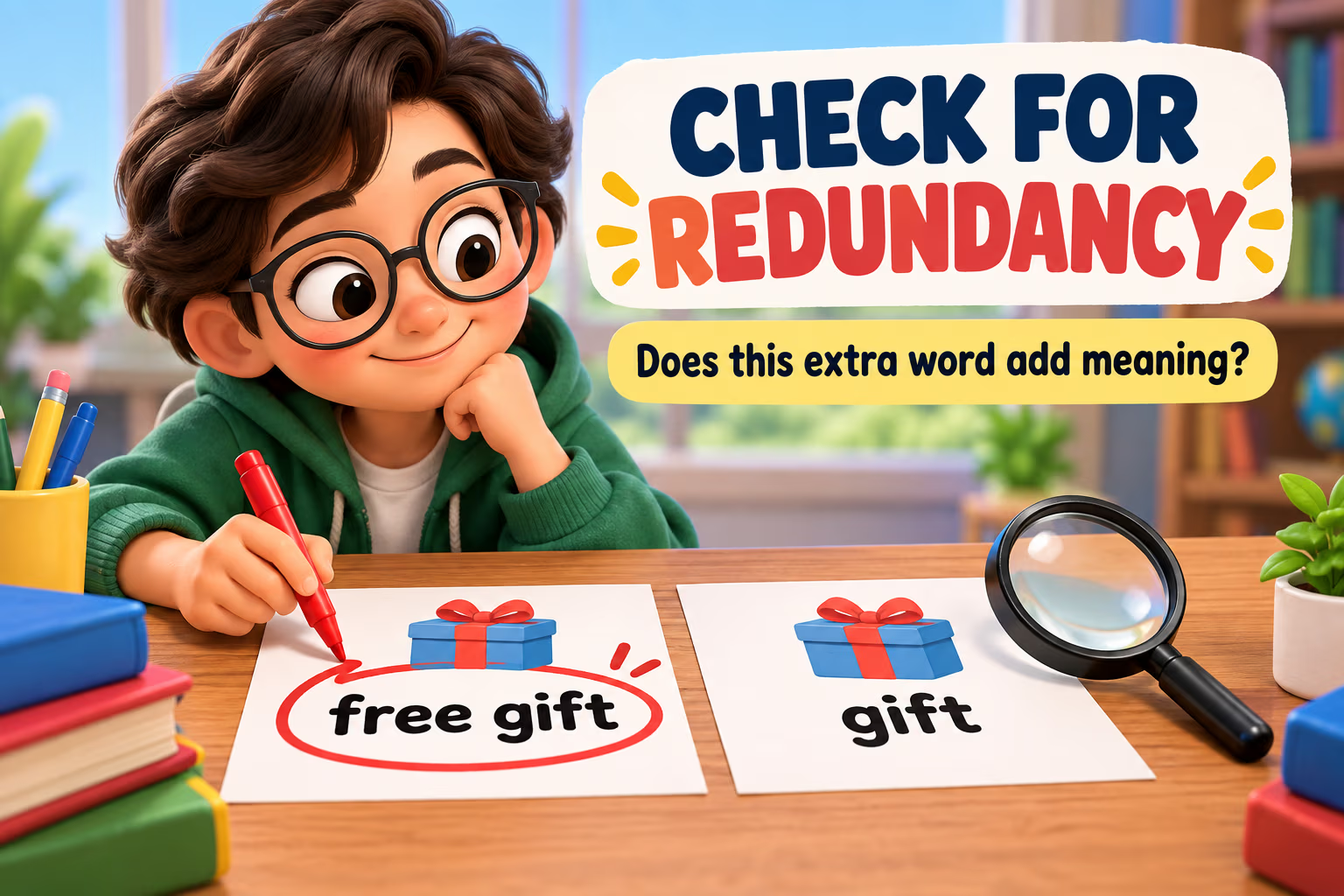
For example, free gift is often called redundant because gifts are typically given without payment. Yet a business might use “free gift” to distinguish a promotional item from a purchase with a required fee. The best edit depends on whether free changes what the reader understands.
Clear tautology examples in sentences
The first examples below show repeated meaning in ordinary language. Some are common expressions that can be deliberate; the label describes their structure, not a universal rule that they must be removed.
- “It is what it is,” she said, accepting the result without further complaint.
- The final outcome surprised the entire team.
- Each and every applicant must submit the form by Friday.
- We returned back to the station after lunch.
- The two twins chose different costumes for the parade.
- In my personal opinion, the second plan is easier to explain.
- The meeting was postponed until a later time.
- They gathered together near the entrance.
- She repeated the instructions again so everyone could hear.
- The reason is because the first file was incomplete.
- “A free gift comes with every order,” the advertisement announced.
- We made advance plans for the spring trip.
- At this point in time, the office is closed.
- The two alternatives are either tea or coffee.
- He nodded his head to show that he understood.
- The unexpected surprise delighted the children.
- The new innovation attracted attention at the fair.
- She gave a brief summary of the article.
- The end result was a stronger opening paragraph.
- “I saw it with my own eyes,” the witness insisted.
- The basic fundamentals of the game were easy to learn.
Possible edits include “the outcome surprised the team,” “every applicant,” “we returned,” or “the reason is that.” These changes reduce repetition, but the longer versions can be justified if they add contrast, stress, or a conversational tone.
When is tautology intentional?
Writers and speakers repeat meanings for effect. “It is what it is” can signal resignation; “I saw it with my own eyes” can emphasize firsthand observation; and repeated words can create humor or a memorable rhythm. In these contexts, removing the repetition may flatten the voice rather than improve it.
For a concise academic or business style, trim repeated wording when it slows the reader or obscures the point. For dialogue, advertising, poetry, jokes, and speeches, decide whether the echo serves the effect. A useful edit asks “What does this repetition do here?” rather than treating every repeated idea as an error.
Common mistakes when using “tautology”
- Calling every general truth a tautology: “The sky is blue” can be false under different weather or lighting conditions, so it is not logically true in every possible case.
- Confusing tautology with contradiction: A contradiction cannot be true in the same respect at the same time; a logical tautology cannot be false under its specified truth conditions.
- Assuming repetition is always accidental: Redundant wording may be intentional for emphasis, humor, rhythm, or voice.
- Removing words without checking meaning: “Past history” can be redundant in many contexts, but writers should preserve a modifier if it draws a relevant distinction.
- Mixing the two definitions: A repeated-sounding phrase is not automatically a truth of formal logic, and a logical tautology need not repeat the same English words.
Frequently asked questions
Is a tautology always wrong?
No. In editing, redundancy may be unnecessary, but repetition can also add emphasis, rhythm, humor, or clarity. In formal logic, “tautology” is a technical label for a formula that is always true, not a writing flaw.
Is “It is what it is” a tautology?
It is commonly described as a rhetorical tautology because it restates the same idea. People also use it idiomatically to express acceptance or resignation.
What is a simple logical tautology?
In classical propositional logic, “P or not P” is a simple example. If P is true, the first part is true; if P is false, “not P” is true.
What is the difference between tautology and redundancy?
Redundancy is the broader idea of including more than is needed. A rhetorical tautology repeats an idea and can be redundant, but some repetitions are purposeful. The exact boundary depends on context and style.
What is the difference between tautology and pleonasm?
The terms overlap in some writing guides. Pleonasm often refers to using more words or grammatical elements than necessary, while tautology commonly focuses on restating an idea. Different references draw this line differently, so explain the pattern you mean when precision matters.
Source examples and usage note
The original article below is preserved word for word. Several original child examples (“The sky is blue,” “Birds can fly,” and “Night is dark”) state claims that could be false; they are not tautologies by the formal-logic test of being true in every possible case. Some other entries describe writing advice or an example containing the word rather than demonstrating a tautology. Use the newly labeled examples above to see the distinction. The original “free gift,” “past history,” and “added bonus” examples are commonly called redundant, though whether to edit them depends on context.
Cambridge Dictionary gives both the everyday-language and logic senses of tautology. The Brigham Young University Silva Rhetoricae entry describes tautologia as repetition of an idea and explicitly distinguishes it from the logical notion. The Stanford Encyclopedia of Philosophy explains that a classical logical tautology is true under every valuation in its entry on many-valued logic.
Do you ever find yourself using unnecessary repetition when making a statement? This habit is known as a tautology, a redundant use of words that conveys the same idea twice. Tautologies often occur unintentionally and can weaken the impact of your message.
By spotting and eliminating tautologies from your writing and speech, you can make your expressions clearer, more concise, and more convincing. Understanding how to recognize and avoid tautologies will help you communicate effectively and efficiently in various contexts.
7 Examples Of Tautology Used In a Sentence For Kids
- The sky is blue, tautology.
- Birds can fly, tautology.
- Night is dark, tautology.
- Water is wet, tautology.
- Trees have leaves, tautology.
- Fish live in water, tautology.
- Stars twinkle at night, tautology.
14 Sentences with Tautology Examples
- Tautology is a concept in logic that states the same thing twice in slightly different ways.
- Understanding tautology can be helpful when learning about formal reasoning and argumentation.
- It is important for college students to recognize and avoid tautology in their academic writing to maintain clarity.
- In philosophy classes, professors often discuss the implications of tautology in different contexts.
- When preparing for exams, it’s crucial to study the definitions of terms like tautology to ensure a strong understanding.
- Some students struggle with identifying tautology in complex sentences, but practice can improve this skill.
- Professors appreciate essays that are free from tautology and demonstrate critical thinking skills.
- Group discussions can help students analyze arguments and identify instances of tautology in various texts.
- Writing tutors can provide feedback on how to eliminate tautology and improve the overall quality of essays.
- In competitive debates, debaters must be careful not to rely too heavily on tautology as it can weaken their arguments.
- Understanding the difference between tautology and contradiction is essential for students studying logic and reasoning.
- As students progress in their studies, they may encounter more complex forms of tautology that require deeper analysis.
- Learning how to identify tautology can lead to stronger persuasive writing skills and more effective communication.
- By practicing examples of tautology exercises, students can enhance their analytical abilities and critical thinking skills.
How To Use Tautology in Sentences?
Tautology is the repetition of the same meaning in different words or phrases, often resulting in redundancy. When using tautology in a sentence, it is important to be aware of how it can affect the clarity and impact of your communication.
To use tautology effectively, first identify any words or phrases in your sentence that convey the same meaning. For example, saying “free gift” is a tautology because a gift is already something given freely.
Next, consider whether the tautology adds value to your sentence. In some cases, it may be used for emphasis or to create a certain effect. For instance, saying “past history” emphasizes that the history being referred to is from a previous time period.
However, it is important to avoid using tautology in a way that makes your sentence redundant or confusing. For instance, saying “added bonus” is redundant because a bonus is already something extra.
Overall, using tautology in a sentence can be a powerful tool when used intentionally and purposefully. By being mindful of the words you choose and their meanings, you can ensure that your communication is clear and impactful.
Conclusion
In conclusion, sentences with tautology can be identified by the presence of repetitive phrases or words that convey the same meaning. These redundancies add no value to the sentence and can be streamlined for clearer communication. By avoiding tautological sentences, writers can enhance the clarity and effectiveness of their writing. It is important to strive for concise and precise language to convey ideas efficiently and engage readers more effectively. By eliminating unnecessary redundancies, writers can create more impactful and compelling content.



