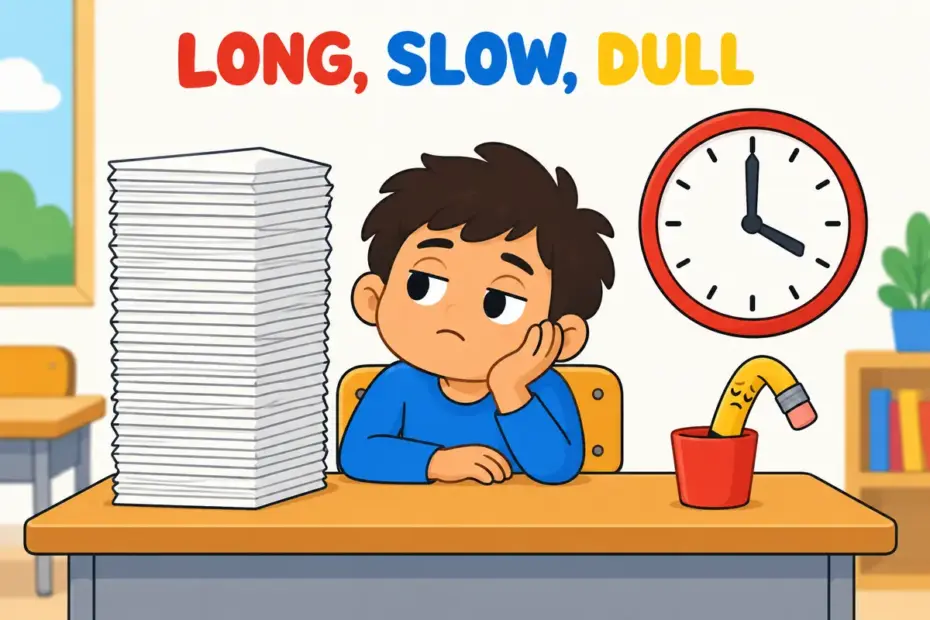
Tedious describes something that is long, slow and dull, so it bores you before it ends. To use tedious in a sentence, apply it to the task or the experience, never the person: “The tedious inventory took all afternoon.” The adjective names the quality that makes an activity feel endless.
Tedious at a glance
- Tedious is an adjective; its forms are tedious, more tedious, tediously and the noun tedium.
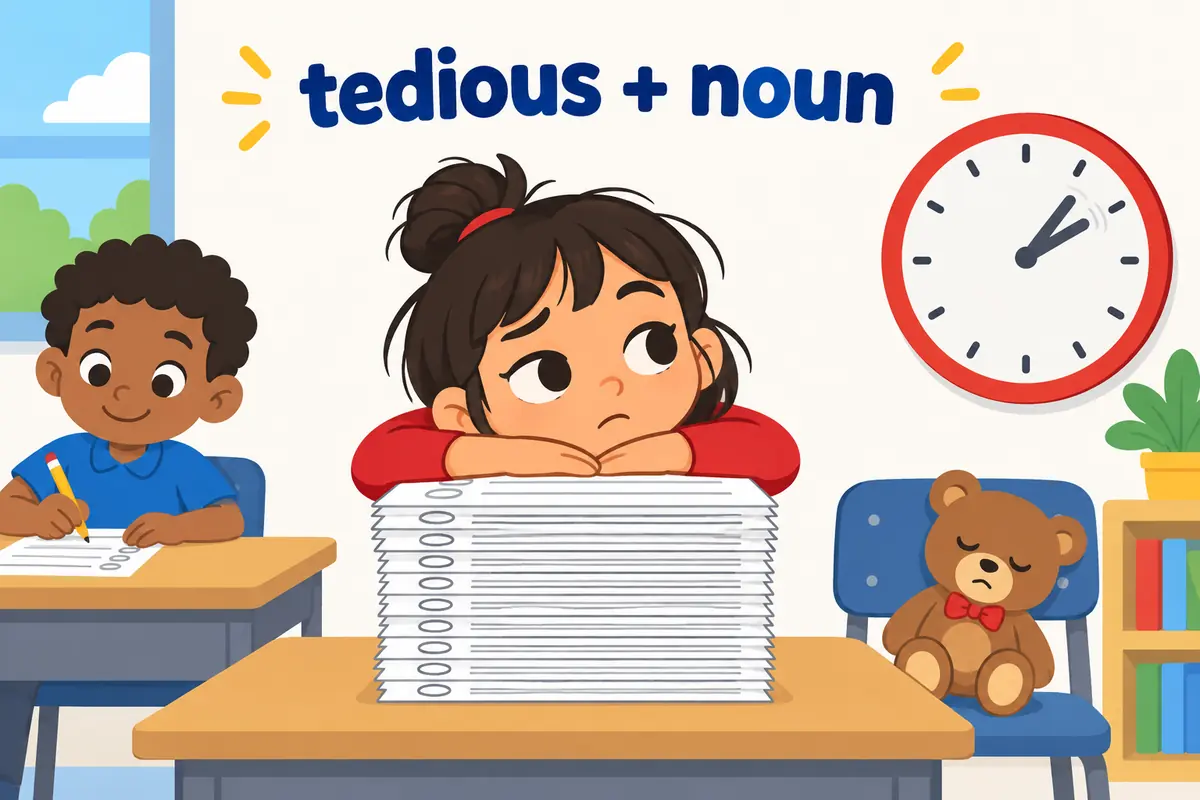
- The usual pattern is tedious + task noun, as in a tedious job or a tedious meeting.
- It also appears as it is tedious to + verb and as become or get tedious.
- Tedious describes the work or the wait, not the worker.
- The commonest error is using tedious for physical tiredness, which tiring covers better.
What does tedious mean?
Tedious is an adjective meaning long, slow and dull in a way that wearies you. The Cambridge Dictionary entry for tedious records this sense, and the table separates the facets learners meet: sheer length, dull repetition, and the tiredness the two produce. A tedious task is not necessarily hard; it is monotonous, which is why the time crawls.
| Facet | Plain meaning | Example sentence |
|---|---|---|
| Length | Goes on far longer than it needs to | The tedious drive through fog lasted five hours. |
| Repetition | Repeats the same small step again and again | Copying the numbers by hand was tedious work. |
| Weariness | Leaves you drained and bored, not harmed | The tedious meeting ended without a decision. |
One honest limitation: tedious is not a word for difficulty. A hard problem can be fascinating, and a tedious one can be easy. Calling a person tedious is a much harsher remark, because it says their company is dull, so describe the task and leave the person out. When the cause is physical tiredness rather than boredom, a laborious job is the closer word.
How do you use tedious in a sentence?
Put tedious in front of the thing that drags, or place it after a linking verb such as is or gets. The five patterns below cover almost every natural sentence.
| Pattern | Example | What it signals |
|---|---|---|
| tedious + noun | Data entry is a tedious job. | Labels the whole task as wearying. |
| it is tedious to + verb | It is tedious to enter each figure by hand. | The impersonal pattern that states the chore plainly. |
| become / get tedious | The lecture got tedious after an hour. | Shows the quality arriving over time. |
| more / most tedious | This is the most tedious form I have filled in. | Grades it against other chores. |
| tediously + verb | The speech tediously restated every clause. | The adverb describes how something was done. |
Keep the pattern impersonal when you can. The sentence it is tedious to copy these rows avoids blaming a person, while naming an individual as tedious turns a comment about a task into an insult about character.
Tedious in a sentence: examples across contexts
Tedious changes register more than meaning. The nine sentences below keep the adjective the same while moving from a classroom to a courtroom, and each one names the thing that drags.
| Context | Example sentence | Why this works |
|---|---|---|
| Classroom | The tedious worksheet repeated the same sum thirty times. | Names the chore and shows why it drags. |
| Office | Data entry is tedious, so we rotate the task each week. | Links the adjective to a real job. |
| News report | The hearing was a tedious procession of procedural motions. | Formal register with a concrete image. |
| Technical writing | Sampling is tedious but avoids costly errors. | Pairs the drawback with a purpose. |
| Conversation | The film was fine, just tedious in the middle. | The everyday linking-verb pattern. |
| Household | Ironing shirts is a tedious but necessary job. | Contrasts dullness with necessity. |
| Academic writing | The tedious coding stage consumed two months. | Applies the adjective to a research method. |
| Travel | A tedious delay at the border cost us the ferry. | Applies the adjective to a wait. |
| Sport | The final was tedious until the last ten minutes. | Shows tedious can describe an event. |
The range is wide but the logic is stable: tedious always attaches to what you endure, and the sentence usually names how long it lasts or how often it repeats.
Tedious vs boring
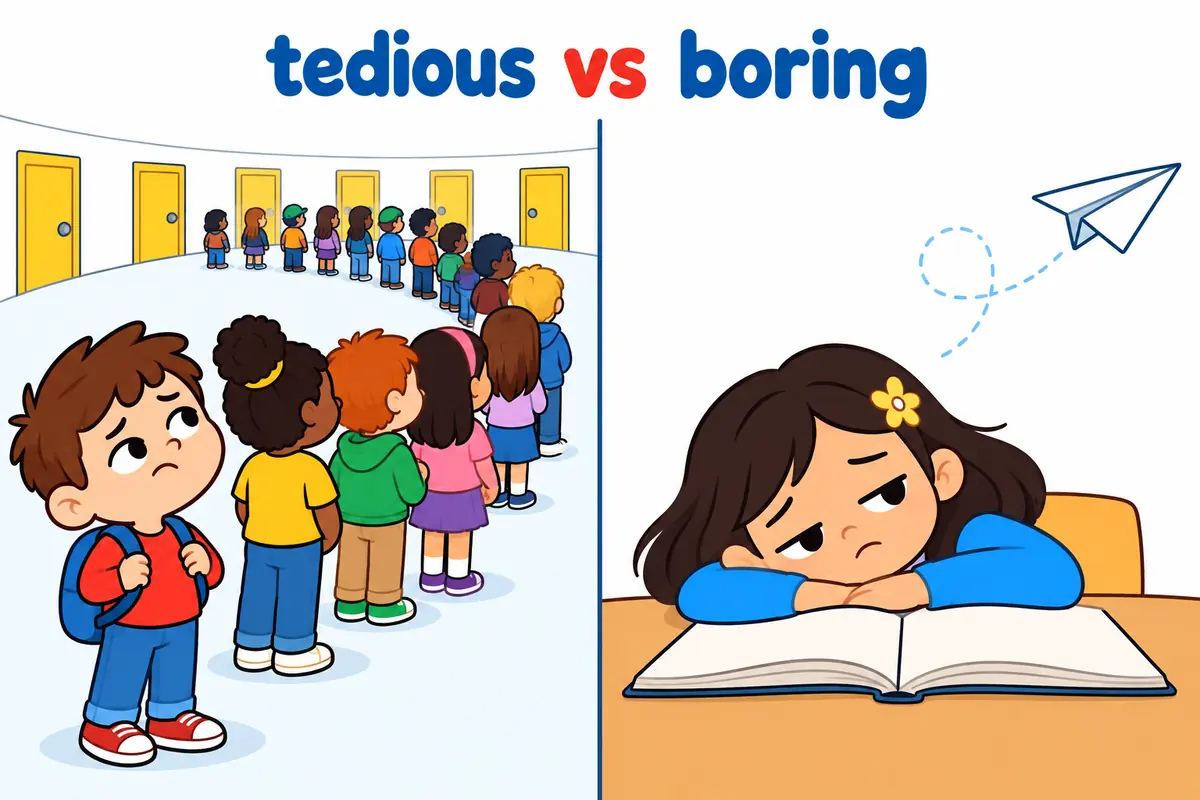
Tedious and boring overlap, and the difference is the reason behind the dullness. Tedious blames length or repetition; boring blames a plain lack of interest. The table separates them on the points that decide a sentence.
| Attribute | tedious | boring |
|---|---|---|
| Core idea | Long, slow and wearisome | Not interesting |
| Main cause | Repetition or length | Lack of interest |
| Typical subject | A task, process or wait | Anything, including people |
| Register | Slightly formal | Neutral and everyday |
| Strength | A stronger sense of drain | Milder and more common |
| What it implies | Time drags and effort tells | Attention simply drifts |
Verdict: use tedious when the length or repetition is the problem, and boring when the only problem is a lack of interest.
Word forms and grammar of tedious
Tedious inflects regularly, and its noun tedium names the dullness itself. The adverb tediously answers how something was done, which the adjective cannot do. The table also lists the invented forms learners reach for.
| Form | Part of speech | Example |
|---|---|---|
| tedious | adjective, base form | The drive was tedious. |
| more tedious | adjective, comparative | This form is more tedious than the last. |
| most tedious | adjective, superlative | That was the most tedious lecture of the term. |
| tediously | adverb | The clerk tediously checked every line. |
| tedium | noun | The tedium of the night shift wore everyone down. |
| tediosity | noun, non-standard | Avoid it; use tedium instead. |
The invented noun tediosity is the clearest sign of a learner sentence, because English has tedium already. Adding the longer ending marks the writer as unsure of the real form.
Common mistakes with tedious
- Incorrect:
I was tedious after the long walk.Correct: I was tired after the long walk. Rule: Tedious describes the activity, not your physical state. - Incorrect:
The tedious made everyone yawn.Correct: The tedium made everyone yawn. Rule: Tedious is an adjective; the noun is tedium. - Incorrect:
He is a tedious worker.Correct: He does slow, repetitive work. Rule: Calling a person tedious attacks their company; describe the work instead. - Incorrect:
The book was tedious to reading.Correct: The book was tedious to read. Rule: After tedious to, use the plain verb, not the -ing form. - Incorrect:
The devious form took two hours.Correct: The tedious form took two hours. Rule: devious means dishonest or indirect; tedious means dull and long.
Practice using tedious
Work through the six items, then read the reasoning rather than only the answer.
- Fill the gap: The ______ filing took the whole afternoon and left her yawning.
- Choose the better word: The safety video was (tedious / tiring), so half the class stopped watching.
- Correct the error: The tedious of the meeting made us restless.
- Build a sentence: use it is tedious to about copying a long list by hand.
- Spot the register: which belongs in a science report — sampling is tedious but reliable, or this was soooo tedious?
- Rewrite with the noun: The long wait was tedious. Use tedium.
Answers
- tedious — the adjective modifies the filing, which is exactly the kind of task it labels.
- tedious — the video was dull rather than physically tiring, so tiring would misstate the cause.
- The tedium of the meeting made us restless — the adjective cannot replace the noun tedium.
- Model answer: It is tedious to copy a long list by hand, so the class uses a printer instead.
- Sampling is tedious but reliable — a report states the quality plainly and avoids written-out emphasis.
- The wait brought hours of tedium — the noun compresses the dullness into a single idea.
The bottom line
Use tedious in a sentence for something long, slow and dull, and keep it on the task rather than the person. The two points that settle most sentences are these: tedious blames length or repetition while boring blames a lack of interest, and the adjective cannot describe physical tiredness, which needs tired. Where the dullness comes from sheer sameness, tiresome or monotonous can be the better fit.
Frequently asked questions about tedious
Does tedious mean difficult?
No. Tedious means long and dull, not hard. A difficult task can be exciting, and a tedious one can be very easy, such as copying addresses by hand. If the problem is effort rather than boredom, choose demanding or laborious instead of tedious.
Can a person be tedious?
Grammatically yes, but the meaning shifts and sharpens into an insult. A tedious person is dull company, which is a blunt judgement rather than a comment on work. In most writing it is safer to describe the task and say the meeting was tedious.
What is the noun form of tedious?
Tedium is the noun, meaning the state of being tedious. Write the tedium of the night shift wore everyone down, not the tedious of the night shift. A longer form, tediosity, does appear in old texts but is non-standard today and best avoided.
Is tedious a formal word?
Tedious sits slightly above everyday speech and appears often in reviews, reports and formal writing. In casual conversation most people say boring or long. It is never wrong in speech, just a little more studied than its plainer neighbours in casual talk.
Have you ever found yourself struggling to stay focused on a long and monotonous task? This feeling of boredom and repetition is what we often refer to as “tedious.”
Tedious tasks are those that are repetitive, dull, and time-consuming, making them feel almost unbearable at times. They can drain our energy and motivation, leaving us feeling uninspired and unproductive.
7 Examples Of Tedious Used In a Sentence For Kids
- Tedious means something that is boring or tiring.
- Drawing the same picture over and over can be tedious.
- Counting all the blocks in the tower can be tedious.
- Putting together a puzzle piece by piece can be tedious.
- Reading the same book every day can become tedious.
- Cleaning up toys every night can feel tedious.
- Trying to tie shoelaces can be tedious for some kids.
14 Sentences with Tedious Examples
- Tedious assignments can make college life feel overwhelming.
- Studying for exams can be a tedious process, but it is essential for good grades.
- Researching for a project can feel tedious when you have a lot of information to sort through.
- Writing long essays can be a tedious task, especially when you are short on time.
- Group projects can become tedious if there is a lack of communication among team members.
- Going through extensive reading material can seem tedious when you are tired.
- Crafting a detailed presentation can be a tedious job, but it is necessary for a successful outcome.
- Navigating the college library catalog to find specific books can be a tedious process.
- Formatting references in your assignments can be a tedious task that requires attention to detail.
- Revising your notes multiple times can be tedious, but it helps in retaining information better.
- Attending back-to-back lectures can feel tedious when you have a busy schedule.
- Solving complex math problems can be quite tedious but rewarding once you figure them out.
- Balancing extracurricular activities with academic responsibilities can make your college life a tedious juggle.
- Creating a study schedule and sticking to it can help make tedious tasks more manageable in college.
How To Use Tedious in Sentences?
Tedious is an adjective that describes something boring or uninteresting. When using this word in a sentence, it’s important to consider the context in which it is being used.
Here are some tips on how to use Tedious correctly in a sentence:
-
Identify the activity or situation that you find boring or long and drawn out. For example, “The tedious process of filling out paperwork took hours.”
-
Tedious is often used to describe tasks that require a lot of effort and time but offer little excitement or enjoyment. For instance, “The project was tedious as it involved meticulously organizing data for hours on end.”
-
It is essential to use Tedious when you want to convey a sense of monotony or dullness. For example, “The tedious lecture seemed to go on forever, making it hard to stay focused.”
-
Remember that Tedious can be used to express a negative feeling towards an activity, so be mindful of when and where you use it in a sentence.
By following these tips, you can effectively incorporate Tedious into your vocabulary to accurately describe tasks or situations that you find dull or uninteresting.
Conclusion
In conclusion, sentences that are tedious can be tiring, boring, and monotonous due to their repetitive and drawn-out nature. These kinds of sentences lack clarity, creativity, and engagement, making them difficult for readers to follow and retain information. The use of concise and straightforward language is essential to ensure that the message is effectively communicated and understood by the audience. By avoiding tedious sentences and opting for clear and concise phrases, writers can capture the reader’s attention, convey the intended message more effectively, and ultimately enhance the overall quality of their writing.


