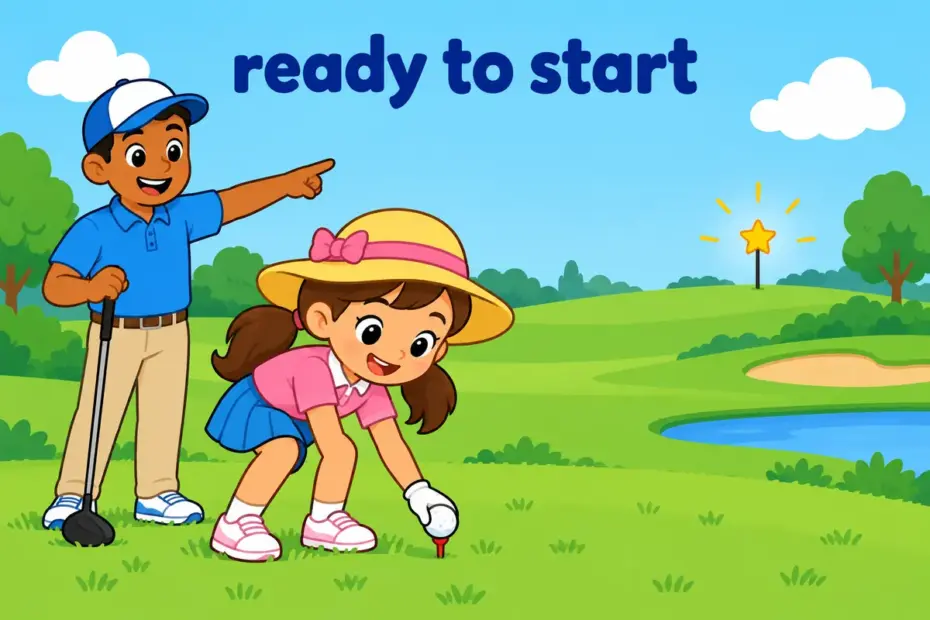
Tee up is a transitive phrasal verb meaning to prepare or arrange something so that it is ready to start, borrowed from golf, where a player tees up the ball before a stroke. In a sentence it takes an object, and a pronoun goes between the verb and the particle: “tee it up.”
Tee up at a glance
- Tee up is a transitive phrasal verb; its forms are tees up, teed up and teeing up.
- It is separable: you can write tee up the deal or tee the deal up.
- A pronoun must sit between the parts, giving tee it up, never tee up it.
- It appears with announcement, deal, meeting, vote, goal and final.
- The commonest error is dropping the object, as in the manager teed up.
What does tee up mean?
Tee up is a phrasal verb that means to set something in place so it can begin. The Cambridge entry for tee up records both the golf sense and the figurative sense of preparing an event or opportunity. A third sense covers supplying a teammate with the chance to score.
| Sense | Plain meaning | Example sentence |
|---|---|---|
| Golf | Place a ball on a tee ready to strike | She teed up the ball on the first hole. |
| Prepare or arrange | Get something ready so it can start | The manager teed up the announcement for Friday. |
| Create a chance | Set up an opportunity for someone | A short pass teed up the winning goal. |
One limitation matters. Tee up always implies that a next step follows, so it is the wrong choice when you merely mean to finish something. Where the sense is simply getting ready, prepare a report is plainer and safer.
How do you use tee up in a sentence?
The verb keeps an object in every pattern, and the object can sit either before or after the particle. The table shows the orders that are standard and the one that is not.
| Pattern | Example | What it signals |
|---|---|---|
| tee up + object | The coach teed up the final with a bold team talk. | The default order in writing. |
| tee + object + up | The coach teed the final up with a bold team talk. | Equally correct, commoner with a long object. |
| tee + pronoun + up | The coach teed it up with a bold team talk. | The only order allowed with a pronoun. |
| be + teed up | The vote is teed up for Thursday. | Passive voice, used for a planned step. |
| tee up + for + noun | The win tees up a place in the final. | Marks what the preparation leads to. |
Is tee up separable?
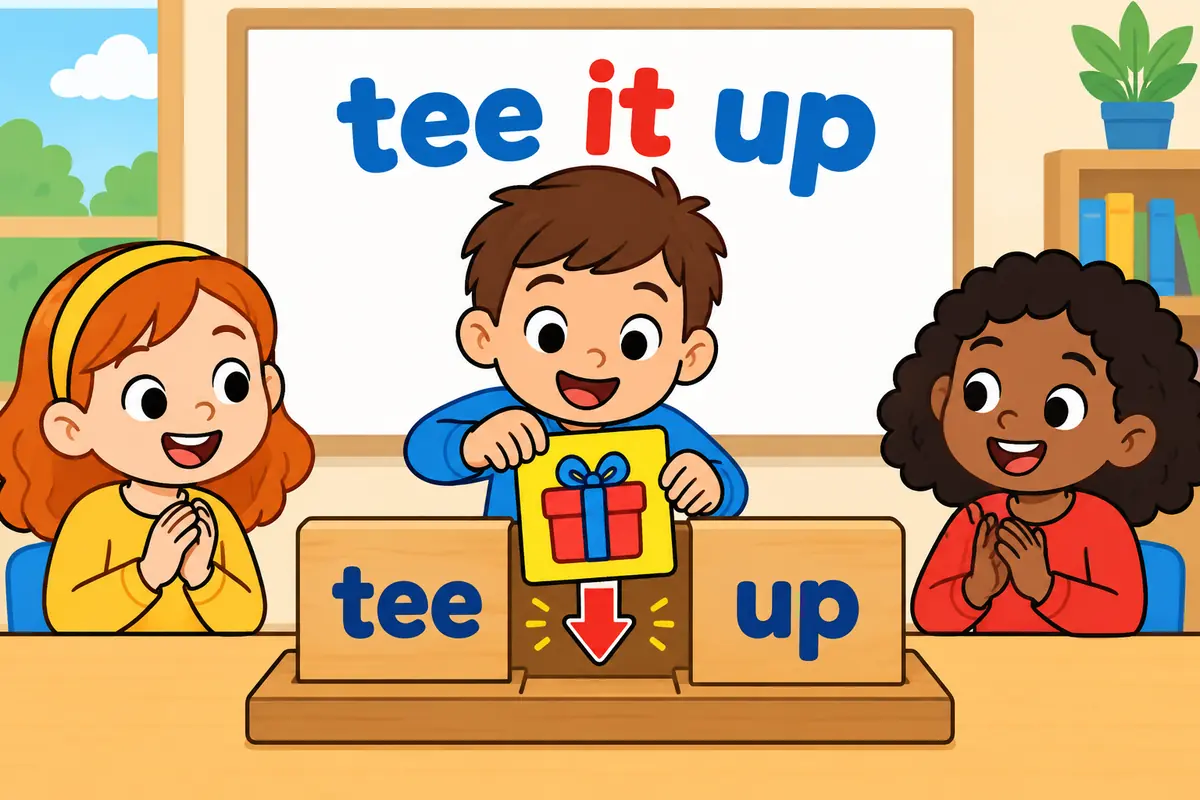
Yes. Tee up is separable, so the object may follow the particle or sit between the verb and it. The one fixed rule concerns pronouns: because tee it up keeps the pronoun tucked between the parts, the order tee up it is not used at all. When the object is a long phrase, the separated order, teed the whole arrangement up, reads more smoothly.
Tee up in a sentence: examples across contexts
The verb is informal enough for a locker room and tidy enough for a business plan. Where the sense is planning rather than sport, you might equally schedule a meeting or arrange the details.
| Context | Example sentence | Why this works |
|---|---|---|
| Golf | She teed up her ball and checked the wind. | The original sport sense, still the clearest image. |
| Workplace email | I have teed up the budget review for Tuesday. | Shows a task made ready before a deadline. |
| News report | The result tees up a rematch in the autumn. | Names the consequence that preparation unlocks. |
| Politics | Party leaders teed up the vote for the following week. | Arranges a formal step in a timetable. |
| Sports commentary | The winger teed up the striker for an easy finish. | The chance-creating sense in team sport. |
| Business writing | Good data tees up a stronger negotiation. | Treats preparation as an advantage. |
| Conversation | I teed it up with the landlord before the viewing. | The pronoun order that speech prefers. |
| Film writing | The opening scene tees up the twist that follows. | Extends the sense to narrative setup. |
| Classroom | The teacher teed up the debate with a quick question. | Potent informal verb for a lesson plan. |
Every row keeps an object, which is the pattern the verb never abandons.
Tee up vs set up
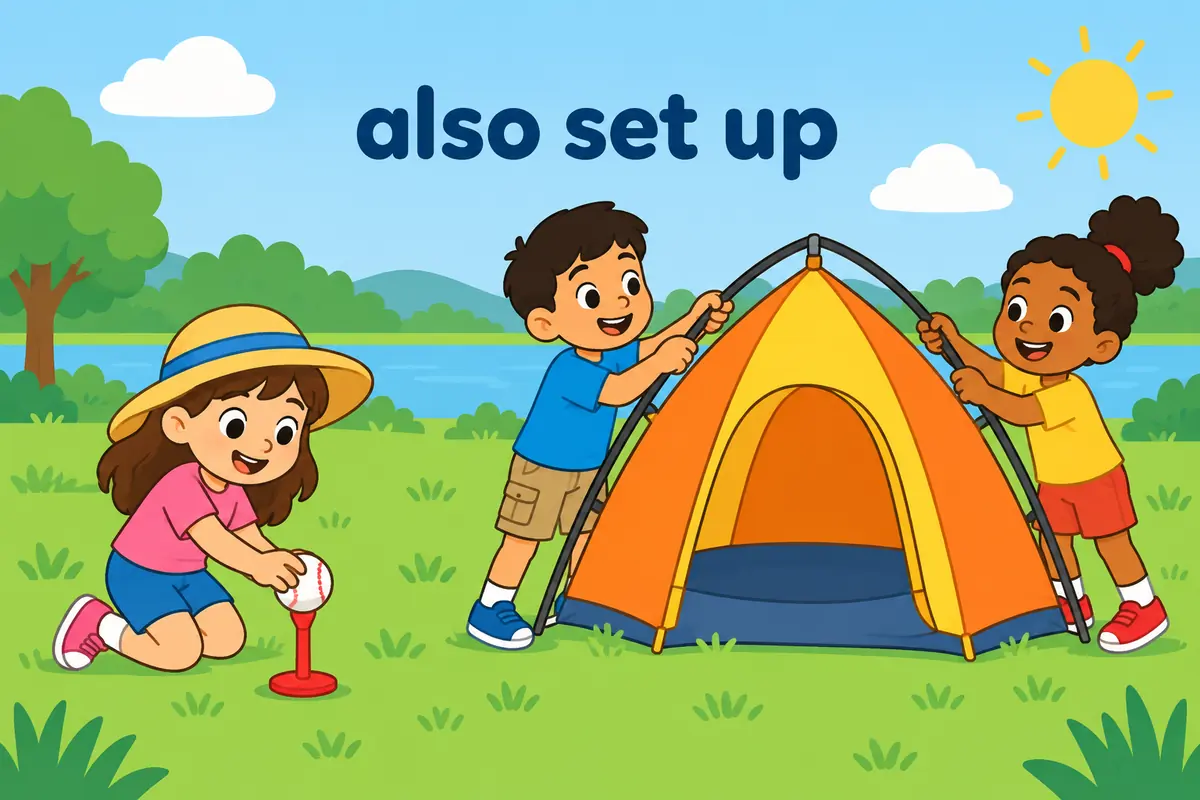
Tee up and set up both mean to get something ready, which makes them easy to swap. The difference is emphasis: set up a system stresses the work of assembling something, while tee up stresses that the pieces are now in place for a coming action.
| Attribute | tee up | set up |
|---|---|---|
| Core emphasis | Something is ready for the next step | Something is assembled or founded |
| Implied follow-up | Strong: an event must come next | Weak: the thing may simply exist |
| Register | Informal to light business | Neutral, from casual to formal |
| Separability | Separable, pronoun in the middle | Separable, pronoun in the middle |
| Typical objects | announcement, vote, goal, deal | business, account, tent, meeting |
Verdict: choose tee up when you are clearing the way for a specific next move, and set up when the task is building or founding something.
Word forms and grammar of tee up
Tee up inflects on the verb and keeps up as its particle. The same base verb with a different particle makes a different phrase, so the table keeps the forms apart.
| Form | Part of speech | Example |
|---|---|---|
| tee up | phrasal verb, base form | They tee up every match the same way. |
| tees up | phrasal verb, third person singular | A good week tees up a good month. |
| teed up | phrasal verb, past and past participle | The committee teed up the vote. |
| teeing up | phrasal verb, present participle | She is teeing up the next launch. |
| tee | noun, the small golf peg | He pushed the tee into the ground. |
| tee off | phrasal verb, different particle | They tee off at eight in the morning. |
Only the particle separates tee up from tee off, yet the two mean different things, which is why the phrase must be learned as a whole.
Common mistakes with tee up
- Incorrect:
The manager teed up it for Friday.Correct: The manager teed it up for Friday. Rule: A pronoun must sit between the verb and the particle. - Incorrect:
The team teed up before the match.Correct: The team teed up the formation before the match. Rule: The verb is transitive, so it needs an object. - Incorrect:
They tee off the deal for Monday.Correct: They tee up the deal for Monday. Rule: Tee off starts a golf round; tee up prepares something. - Incorrect:
She teed up on the meeting.Correct: She teed up the meeting. Rule: Tee up takes no preposition before its object. - Incorrect:
We teed up and waited.Correct: We teed up the plan and waited. Rule: Leaving the object out turns a clear arrangement into a fragment.
Practice using tee up
- Fill the gap: The captain ______ the final with a confident speech.
- Choose the better word: They (teed up / teed off) the round at dawn.
- Correct the error: Please tee up it before the guests arrive.
- Build a sentence: use tee up + a vote about a school council decision.
- Spot the register: which suits a business email — I have teed up the review, or I got the review all set?
- Rewrite in the passive: The coach teed up the final.
Answers
- teed up — the past form matches the captain as subject with the final as object.
- teed off — starting a round of golf is the tee-off sense.
- Please tee it up before the guests arrive — the pronoun goes between the parts.
- Model answer: The prefect teed up the vote on the new benches.
- I have teed up the review — it keeps a tidy business register.
- The final was teed up by the coach — the passive keeps the arranged event as the subject.
The bottom line
Use tee up in a sentence when something is being made ready for a specific next step, and keep an object with the verb. Two nuances decide most sentences: the phrase is separable, so a pronoun must go in the middle as tee it up, and it is not the same as tee off, which begins a golf round. Where the work is building something rather than preparing for an event, facilitate a process or set up is the safer word.
Frequently asked questions about tee up
Where does tee up come from?
Tee up grew out of golf, where a player places the ball on a small peg, the tee, before the first stroke. The physical act of making the ball ready gave the phrase its figurative meaning of preparing anything for a coming event. The golf sense remains current, so the word still carries a sporting flavour.
Can you say set up instead of tee up?
Often you can, but the emphasis shifts. Set up means to assemble or found something, while tee up means the pieces are now in place for a specific next step. A well-set-up business exists on its own; a teed-up vote is waiting for a meeting to happen.
Is tee up too informal for business writing?
Tee up sits in light business and sports writing, where a brisk, active tone is welcome, as in we have teed up the review. In a formal contract or a legal filing it would sound too casual. For those documents, prepare, arrange or schedule carries the same meaning with a flatter tone.
Does tee up always need an object?
Yes. Tee up is transitive in all its senses, so something is always teed up, whether it is a golf ball, an announcement or a chance to score. That is why the intransitive sentence the manager teed up sounds unfinished. Supply the thing being made ready, and the sentence becomes complete.
Have you ever heard the term “tee up” and wondered what it really means? In the world of sports and business, this phrase is commonly used to describe preparing or setting something in motion for the next step.
When you “tee up” something, you are essentially getting it ready or placing it in a prime position for further action. This simple expression can be applied to various scenarios where careful preparation or strategic planning is crucial for success.
7 Examples Of Tee Up Used In a Sentence For Kids
- Tee up the ball and hit it with the golf club.
- Let’s tee up the volleyball and play a game.
- We can tee up the shuttlecock for a game of badminton.
- Tee up the cricket ball and get ready to bat.
- It’s fun to tee up the basketball and shoot hoops.
- We can tee up the soccer ball and practice our kicks.
- Let’s tee up the rugby ball and pass it around.
14 Sentences with Tee Up Examples
- Tee up your study materials the night before to ensure a productive morning.
- Make sure to tee up your notes before entering the exam hall.
- Tee up your group project presentation with relevant information and visuals.
- It’s important to tee up your resume before applying for internships or jobs.
- Don’t forget to tee up your research paper with a strong thesis statement.
- Before a networking event, tee up some conversation starters to break the ice.
- Tee up your class schedule for next semester to avoid any time conflicts.
- When preparing for a debate, it’s crucial to tee up your arguments effectively.
- Tee up your extracurricular activities to showcase a well-rounded college experience.
- Prior to a job interview, make sure to tee up your responses to common questions.
- As the organizer of a college event, remember to tee up all necessary resources beforehand.
- When planning a group study session, tee up discussion points to keep everyone engaged.
- To stay on top of assignments, tee up upcoming deadlines in your planner.
- Before starting a new project, make sure to tee up a brainstorming session with your team.
How To Use Tee Up in Sentences?
Tee Up is a phrasal verb that is commonly used in golf terminology. To use it correctly in a sentence, follow these steps:
-
Identify the correct context: Make sure you are talking about golf or a related activity where “tee up” is relevant. It refers to placing a golf ball on a tee before hitting it with a club.
-
Position the phrase in the sentence: “Tee up” is typically used before mentioning an action related to hitting the ball, such as “drive,” “hit,” or “swing.”
-
Use proper grammar: When using “tee up” in a sentence, ensure the subject and verb agreement is correct. For example, “She will tee up the ball before taking her shot.”
-
Emphasize the action: The phrase “tee up” should convey the action of positioning the ball on the tee. For instance, “The golfer carefully tee up the ball before starting the round.”
-
Practice with variations: Experiment with different sentence structures and scenarios to become comfortable using “tee up” in various contexts.
Remember, using “tee up” accurately in a sentence will help you communicate effectively in discussions related to golf or other activities where the term is used. Practice incorporating this phrasal verb into your language to become more proficient in its usage.
Conclusion
In summary, the examples of sentences with “tee up” illustrated how this phrase is commonly used in various contexts to mean preparing or setting the stage for something. Whether it’s getting ready for a golf swing, organizing a meeting agenda, or laying the groundwork for a successful project, “tee up” signifies the act of making necessary arrangements beforehand. By using this versatile phrase, individuals can convey the idea of putting things in order to ensure smooth execution or to create favorable conditions for a particular activity or event.
Overall, understanding the meaning and usage of “tee up” can help improve communication effectiveness in both professional and personal settings. By incorporating this term into conversations, individuals can easily convey the readiness or preparation required for a successful outcome, making it a valuable addition to everyday language.


