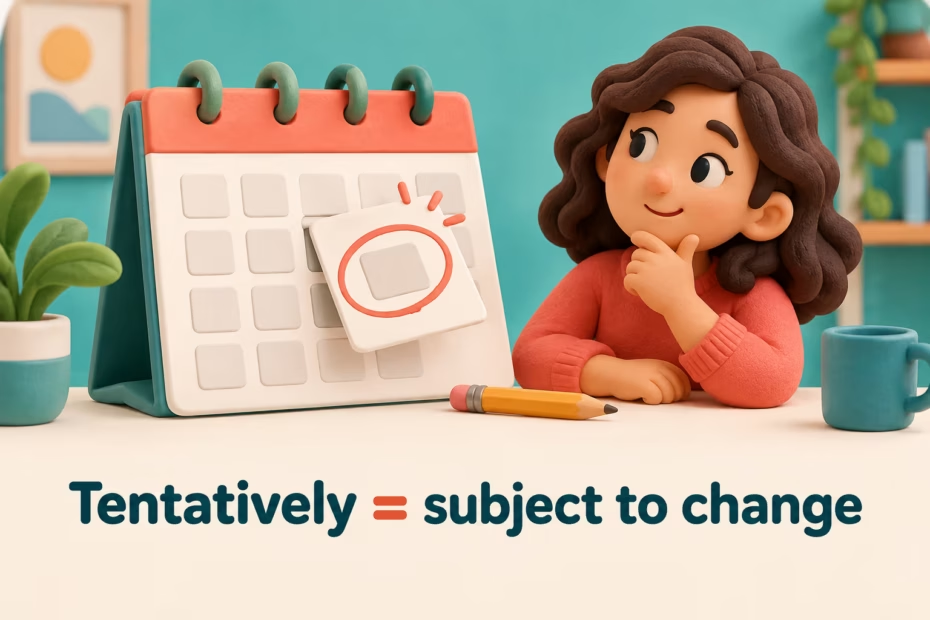
Tentatively has two related uses: a plan agreed to tentatively is provisional and may change, while a person who speaks or moves tentatively acts without confidence. Check what the adverb modifies to tell which meaning fits.
Key points
- Tentatively can mean provisionally: not final or certain because it may change.
- It can also mean hesitantly or without confidence.
- With a schedule, date, or agreement, the provisional meaning usually fits.
- With a smile, step, question, or gesture, the hesitant meaning may fit.
- The adverb modifies an action or frames a statement; context decides which sense is intended.
What Does “Tentatively” Mean?
Tentatively is an adverb formed from the adjective tentative. Oxford Learner’s Dictionaries gives two uses: something may be “not definite or certain” because it could change later, or an action may be done “not with confidence.” These meanings are related by uncertainty, but they describe different things: a plan’s status or a person’s manner.
Compare “We tentatively agreed on Tuesday” with “She tentatively asked a question.” In the first sentence, the agreement is provisional; in the second, the asking sounds hesitant. The adverb does not always mean that a person lacks confidence.
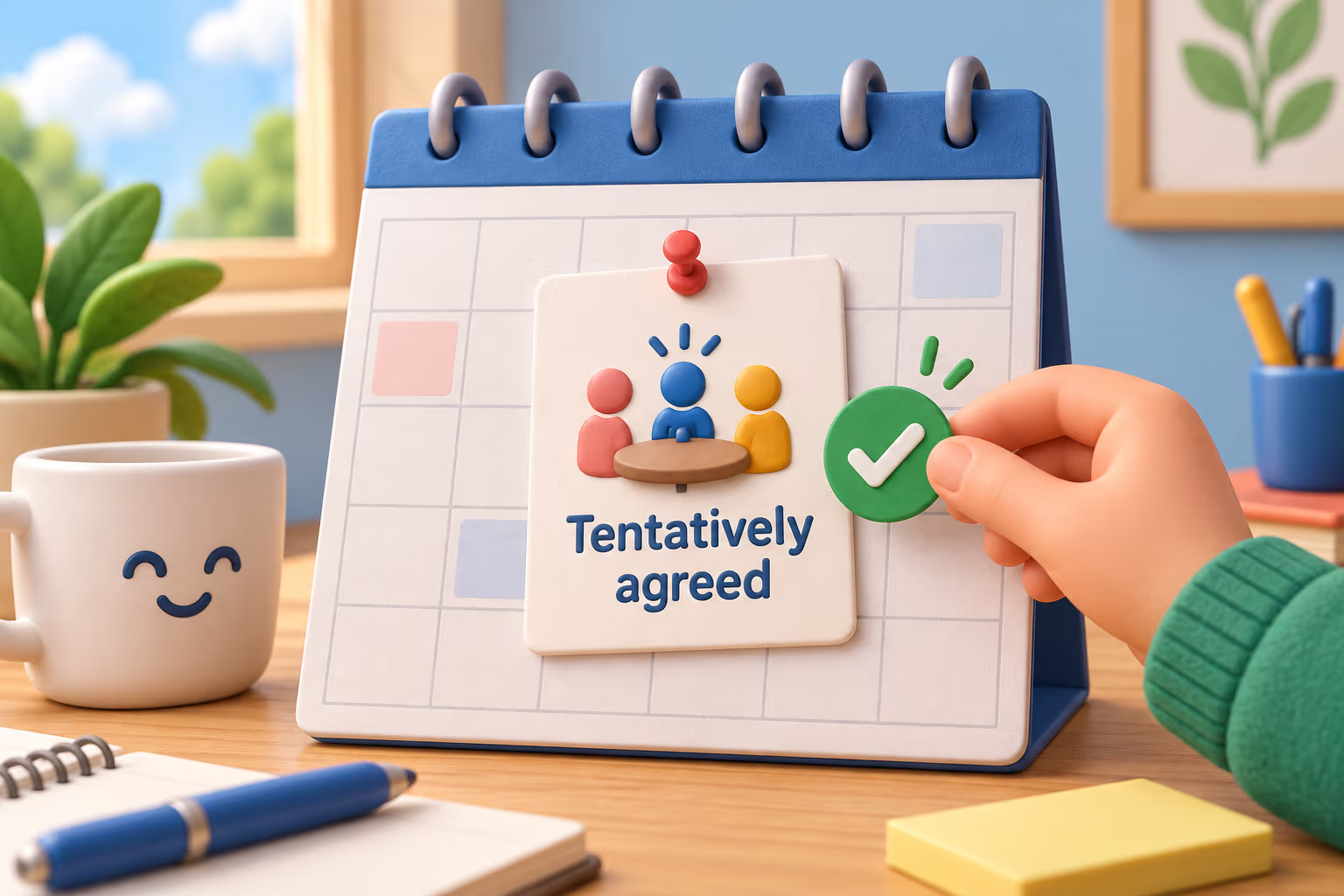
How Do You Use “Tentatively” in a Sentence?
Place tentatively near the verb or phrase it modifies. It can describe a person’s manner (“He tentatively raised his hand”) or qualify a proposal, decision, or arrangement (“The group tentatively chose a date”). If the word appears at the start, the rest of the sentence should make its scope clear.

| What it modifies | Example | Meaning |
|---|---|---|
| A schedule or date | “The workshop is tentatively set for June 12.” | The date is planned but may change. |
| An agreement or choice | “They tentatively agreed to meet online.” | They have a provisional agreement. |
| A person’s action | “Maya tentatively touched the wet paint.” | She acted cautiously or without confidence. |
| A way of speaking | “He tentatively suggested another route.” | His suggestion sounded hesitant or uncertain. |
A practical check is to ask whether the sentence is about a plan that can change or a person acting with hesitation. If neither meaning is clear, replace tentatively with a more exact phrase such as subject to confirmation, cautiously, or hesitantly.

Common Usage Mistakes
- Assuming every plan is hesitant: “The date is tentatively set” usually means the date may change, not that the person setting it lacked confidence.
- Assuming every cautious action is provisional: “She tentatively opened the box” describes her manner; it does not mean the opening is subject to later confirmation.
- Using a vague opening: In “Tentatively, we chose the route,” readers may not know whether the choice is provisional or the group felt unsure. Say “We provisionally chose the route” or “We chose the route after some hesitation.”
- Using it when a specific word is clearer: Choose provisionally for an arrangement that may change and hesitantly for an action lacking confidence.
The original article and all 26 original list items are preserved below exactly as published. Its original featured image is included inline as well.
Have you ever come across the word “tentatively” while reading a text or listening to a conversation and wondered what it really means? In simple terms, when something is done tentatively, it is done with hesitation or uncertainty.
When someone behaves tentatively, they are proceeding with caution or with a lack of firmness. This word is often used to describe actions or decisions that are made with a sense of reservation or doubt.
7 Examples Of Tentatively Used In a Sentence For Kids
- We will tentatively plan a picnic for next weekend.
- The new story time schedule is tentatively set for Mondays.
- Our class party date is tentatively scheduled for next month.
- The field trip is tentatively planned for next Friday.
- The school play rehearsals are tentatively scheduled for Thursdays.
- The spelling test is tentatively set for tomorrow.
- The science experiment is tentatively planned for next week.
14 Sentences with Tentatively Examples
- Tentatively, the final exam schedule for this semester will be released next week.
- You can tentatively plan your study group sessions for the upcoming project presentation.
- Let’s tentatively book our train tickets for the college trip during the semester break.
- Tentatively, the college fest is scheduled for the first week of March.
- You can tentatively mark your calendar for the upcoming guest lecture by a renowned professor.
- Tentatively, the deadline for submitting your research papers is extended by a week.
- You can tentatively decide on which courses to take in the upcoming academic year.
- Let’s tentatively RSVP for the career fair happening next month.
- Tentatively, the college library will be reopening for extended hours during the exam period.
- You can tentatively plan your budget for the upcoming college festival.
- Tentatively, the college hostel will resume accepting new applications for accommodation next month.
- Let’s tentatively finalize our group project presentation date with the rest of the team members.
- Tentatively, the college canteen plans to introduce a new menu next semester.
- You can tentatively schedule your meetings with professors for academic guidance and support.
How To Use Tentatively in Sentences?
Tentatively means in a hesitant, unsure or cautious manner. Here is a guide on how to use tentatively in a sentence:
-
Start your sentence with a subject, such as “She” or “He”, to establish who is taking the tentative action.
-
Introduce an action verb to describe what that person is doing tentatively. For example, “approached”, “spoke”, or “reached out”.
-
Add the adverb tentatively after the action verb to show that the action is being done in a hesitant or cautious way. For instance, “She tentatively approached the unfamiliar dog.”
-
You can also place tentatively before the action verb to emphasize the cautious nature of the action. For example, “He tentatively reached out to touch the fragile glass figurine.”
-
Make sure your sentence makes sense and clearly conveys the idea of hesitation or uncertainty in the action described.
Remember, using tentatively in a sentence adds depth to your writing by describing how an action is done with caution or uncertainty. With this guide, you can now confidently incorporate tentatively into your sentences to enhance your writing and effectively convey the intended meaning.
Conclusion
In conclusion, the examples of sentences with the word “tentatively” demonstrate the use of this adverb to express uncertainty, hesitation, or a provisional nature of an action or decision. By adding “tentatively” to a sentence, it conveys a sense of caution or reservation, indicating that the information provided may be subject to change or revision based on further developments or information. This word helps to qualify statements and acknowledge the fluidity of situations or plans, highlighting the speaker’s awareness of potential adjustments that may need to be made.
Overall, the inclusion of “tentatively” in sentences serves as a valuable linguistic tool to convey a level of flexibility and openness to adjustment, allowing for the acknowledgment of uncertainties while still moving forward with a certain degree of planning or decision-making.
Fresh Examples With “Tentatively”
These new examples make the two senses explicit; they supplement the original examples below.
- “The museum has tentatively scheduled the workshop for Saturday, pending room confirmation.”
- “After reviewing the budget, the committee tentatively approved the proposal.”
- “The hikers tentatively stepped onto the slippery bridge.”
- “She tentatively raised the idea, then waited for her colleagues’ response.”
- “The teacher tentatively penciled in Friday for the class presentation.”
- “When the puppy barked, Eli tentatively offered it a treat.”
Frequently Asked Questions
What is the difference between “tentatively” and “hesitantly”?
Hesitantly means acting with hesitation or uncertainty. Tentatively can have that meaning, but it also commonly means provisionally, as in a date or decision that may change. Use hesitantly when you mean a person’s manner and provisionally when you mean a plan’s status.
Does “tentatively scheduled” mean the event is uncertain?
It means the schedule is provisional: the date or time is planned but not definite and could change. It does not necessarily suggest that the organizer feels personally unsure.
Is “tentatively” an adverb?
Yes. Tentatively is the adverb form of tentative. It can modify an action, as in “She smiled tentatively,” or qualify an arrangement, as in “They tentatively booked the room.”
Can “tentatively” start a sentence?
Yes, but make its meaning clear: “Tentatively, the launch is planned for May” frames the launch date as provisional. If you mean someone acts with hesitation, put the adverb near that action: “Tentatively, she reached for the handle.”
Source
Oxford Learner’s Dictionaries: “tentatively” distinguishes the provisional sense from the sense “not done with confidence.”


