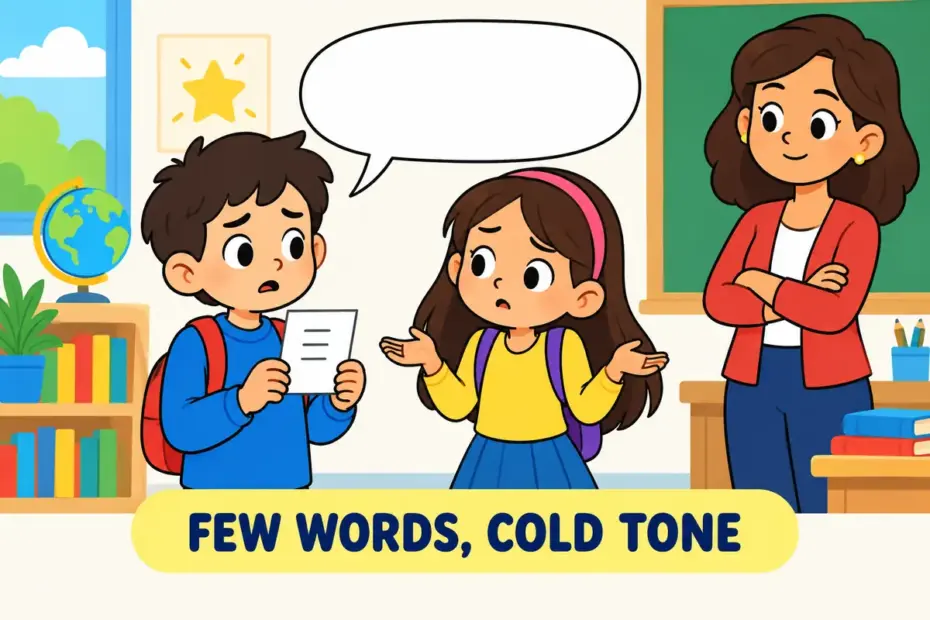
Terse means using very few words, often so few that the brevity can sound curt. To use terse in a sentence, put it before the noun it describes: “She gave a terse reply.” The adjective rarely stands alone, so natural sentences pair it with a noun such as reply, note, statement or email.
Terse at a glance
- Terse is an adjective; its forms are terser, tersest, tersely and terseness.
- Terse describes speech or writing that uses very few words, sometimes seeming impatient.
- The usual pattern is terse plus a noun, as in a terse reply or a terse statement.
- Terse belongs to written and reported speech rather than relaxed conversation.
- The commonest error is treating terse as a compliment, when it often carries a hint of coldness.
What does terse mean?
Terse is an adjective meaning using few words, sometimes in a way that seems rude or unfriendly. The Cambridge entry for terse records that double edge: the word can praise economy or criticise coldness, and the noun that follows usually decides which. A terse summary is admired, while a terse reply to a worried parent is not.
| Sense | Plain meaning | Example sentence |
|---|---|---|
| Neatly brief | Short and to the point, with no wasted words | Her terse summary covered every point. |
| Curt or cold | So brief that it sounds impatient | His terse goodbye ended the call. |
| Unwilling to expand | Answered with almost no words at all | She was terse when asked about the delay. |
One limitation is worth stating plainly. Terse does not simply mean short, and it never guarantees that a message is clear. A terse instruction can be brief and still confusing, because the word says nothing about whether the message is complete.
How do you use terse in a sentence?
Put terse directly before the noun it describes, or after the verb be to describe a whole manner: her note was terse. Five patterns cover almost every real sentence, and the preposition with is the one learners most often get wrong.
| Pattern | Example | What it signals |
|---|---|---|
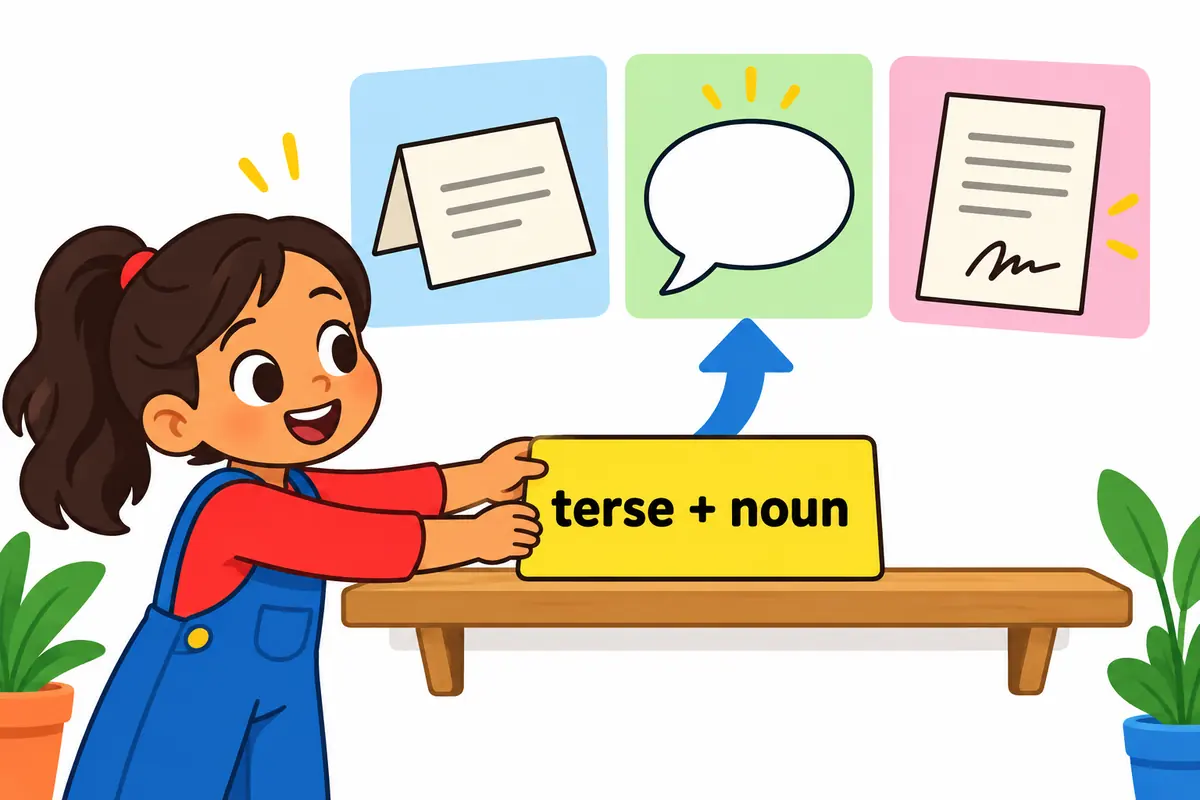
| terse + noun | The manager sent a terse email. | Attaches the brevity to a thing rather than a person. |
| be + terse | His answer was terse. | Describes the whole reply as short and closed. |
| terse + with + person | She was terse with the reporters. | Points the coldness at someone. |
| in a terse + noun | He replied in a terse tone. | Names the manner rather than the words. |
| terse + and + adjective | The note was terse and final. | Pairs brevity with a second quality. |
Writers who want to praise economy reach for concise and complete, which means short without the chill. An abrupt manner can also sound harsh, but abrupt describes timing, while terse describes length.
Terse in a sentence: examples across contexts
Terse changes scene more than it changes meaning. The nine sentences below keep the same adjective while moving from a classroom to a medical note, and each one names the short thing being described.
| Context | Example sentence | Why this works |
|---|---|---|
| Classroom | The teacher’s terse note asked for the form by Friday. | A written instruction is the natural home of the word. |
| Workplace email | Her terse reply closed the thread in two lines. | Brevity in a message that could have been longer. |
| News report | The minister issued a terse denial at noon. | Reporting favours terse before public statements. |
| Phone call | He was terse on the phone, so I assumed bad news. | Reports how speech sounded rather than what it said. |
| Literature | A terse line of dialogue can reveal a character’s mood. | Shows the word used as a judgement about style. |
| Customer service | The terse voicemail gave a number and nothing else. | Pairs the word with an impersonal recorded message. |
| Sports report | The coach gave a terse answer after the defeat. | Common where tempers are short and time is scarce. |
| Medical note | The consultant’s terse entry read review in a week. | Professional writing values economy above warmth. |
| Academic prose | A laconic footnote can point to a long debate. | The word can describe scholarly compression. |
Only the phone row describes speech outright; the rest describe writing, which is where terse does most of its work. That split is the clearest guide to using the word naturally.
Terse vs concise
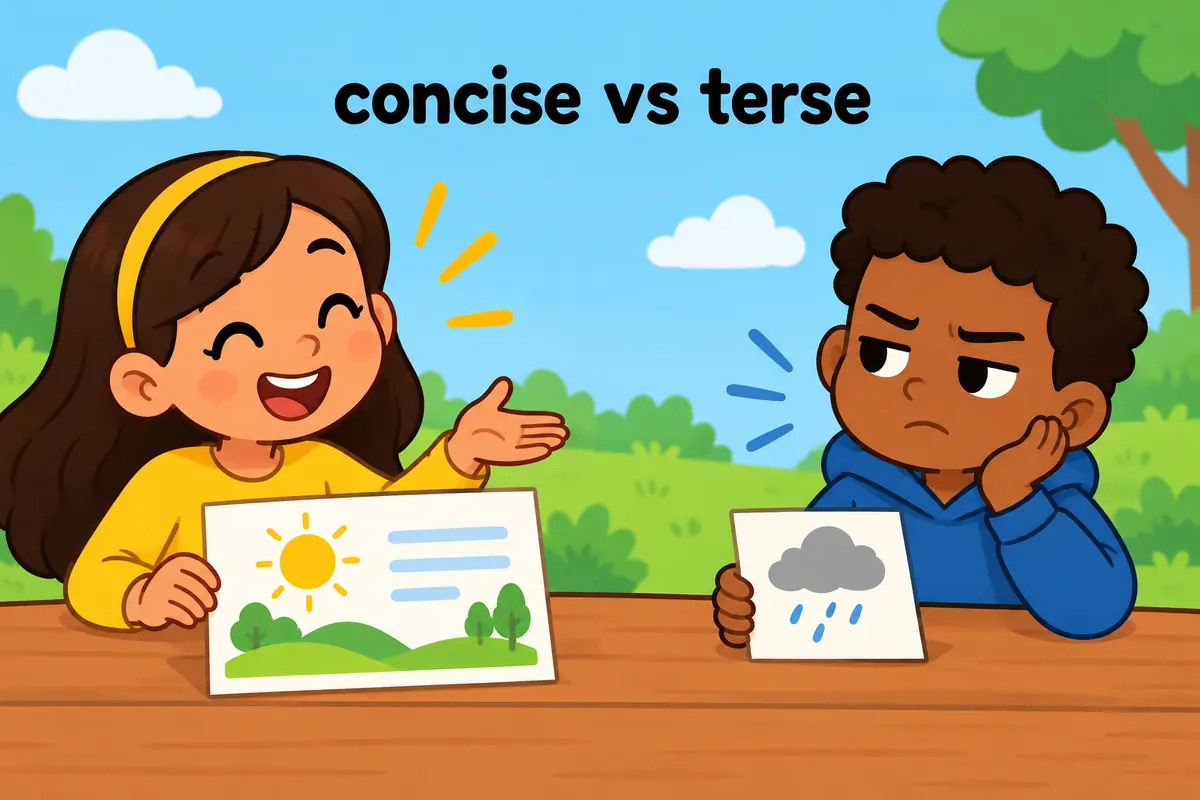
Terse and concise both describe few words, and they are not interchangeable. Concise means short and complete, while terse means short in a way that may sound cold, and the quality a reader is meant to notice decides which one fits.
| Attribute | terse | concise |
|---|---|---|
| Core meaning | Short and possibly curt | Short and complete |
| Tone | Often cold or impatient | Neutral to approving |
| Typical noun | reply, note, statement | summary, report, explanation |
| What it implies | The speaker wanted to say less | The writer said all that was needed |
| Register | Written and reported speech | Neutral, common in instructions |
| Partner word | with a person | no fixed preposition |
Verdict: choose concise to praise a short piece of writing, and terse when the shortness itself carries a chill. Where no chill is meant, brief is the safer everyday word.
Word forms and grammar of terse
Terse inflects like any short adjective, and its adverb appears often in reported speech. The table also lists the related forms that learners build by mistake.
| Form | Part of speech | Example |
|---|---|---|
| terse | adjective, base form | He sent a terse note. |
| terser | adjective, comparative | Her second email was terser. |
| tersest | adjective, superlative | That was the tersest reply of all. |
| tersely | adverb | She answered tersely and hung up. |
| terseness | noun | The terseness of the memo worried staff. |
The related adjective succinct praises the same economy without the chill, which is why style guides reach for it when brevity is a virtue rather than a rebuke.
Common mistakes with terse
- Incorrect:
She was terse on explaining the delay.Correct: She was terse about the delay. Rule: The word pairs with with a person or about a topic, never on a gerund. - Incorrect:
His terse reply was long and detailed.Correct: His brief reply was long and detailed. Rule: Terse already means few words, so it cannot describe something long. - Incorrect:
The terse of the message annoyed me.Correct: The terseness of the message annoyed me. Rule: The noun is terseness; terse is only an adjective. - Incorrect:
They were terse, friendly and warm.Correct: They were brief, friendly and warm. Rule: Terse clashes with warm because it usually implies coldness. - Incorrect:
He gave a terse to the crowd.Correct: He gave a terse statement to the crowd. Rule: As an adjective, terse needs a noun to describe. - Incorrect:
I am terse to risk.Correct: I am averse to risk. Rule: The similar-sounding averse means opposed and takes to; terse describes wordiness.
Practice using terse
Work through the six items, then check the reasoning rather than only the answer.
- Fill the gap: The principal’s ______ announcement told us only the room number.
- Choose the better word: The summary was (terse / concise) and covered every point without waste.
- Correct the error: Her terse email contained three long paragraphs.
- Build a sentence: use terse with about a tired shop assistant.
- Spot the register: which belongs in a police report — the officer was terse with journalists, or the officer was a bit short with the press?
- Combine: join the reply was four words long and it sounded cold into one sentence using terse.
Answers
- terse — the announcement gives almost no information, which fits the word.
- concise — the summary is praised for being complete, and concise carries no chill.
- Her brief email contained three long paragraphs — terse cannot describe something long.
- Model answer: The assistant was terse with the customer who kept changing her order.
- The officer was terse with journalists — a formal report avoids the casual phrase a bit short.
- Model answer: The four-word reply was terse and cold.
The bottom line
Use terse in a sentence to describe speech or writing that uses very few words, and decide first whether you mean efficient or cold. The two details that settle most sentences are the preposition and the noun: a person is terse with someone, and the word almost always describes a reply, note or statement rather than a person standing alone.
Frequently asked questions about terse
Is terse a negative word?
Often it is. Terse can praise a tight summary, but far more often it signals a reply that felt cold or impatient. If you want to describe short writing without criticising the writer, choose concise or brief instead, and save terse for moments when the shortness itself caused offence.
What part of speech is terse?
Terse is an adjective, so it describes a noun: a terse reply, a terse statement. Its adverb is tersely, as in she answered tersely, and its noun is terseness, as in the terseness of his note. It is never a verb, so there is no form such as he tersed the meeting.
Can terse describe a person?
Only loosely. When the word is applied to people it usually means the person is being brief in a specific exchange, as in she was terse with reporters. A permanently terse colleague is best described as curt or laconic, because terse normally settles on a particular reply or note rather than a whole character.
Does terse mean the same as short?
No, and the difference matters. Short simply reports length, while terse carries a judgement that the few words felt clipped or unfriendly. A short thank-you letter can be warm, but a terse thank-you note sounds grudging, even though both are brief and grammatically correct.
Would you like to communicate more effectively and concisely in your writing? The term “terse” refers to expressing ideas clearly and succinctly, often in a concise and to-the-point manner. By using terse language, you can convey your message efficiently without unnecessary elaboration.
In writing, a terse style can make your sentences impactful and memorable. It involves stripping away excessive words and getting straight to the point, leaving no room for ambiguity or confusion. Mastering the art of being terse can enhance the clarity and effectiveness of your communication, making your writing more compelling and engaging.
7 Examples Of Terse Used In a Sentence For Kids
- Terse means speaking in a few words.
- I like to keep my sentences terse.
- Can you try to make your answer more terse?
- She is known for her terse communication style.
- Let’s practice writing terse sentences together.
- It’s important to be terse when explaining things.
- Using terse language can make your point clear.
14 Sentences with Terse Examples
- Terse emails are often preferred by professors for assignments and inquiries.
- It is important to keep your answers terse and to the point in exams to save time.
- When taking notes in class, it is best to jot down terse points for better understanding later.
- Group discussions are more productive when everyone communicates in a terse manner.
- Writing a terse introduction is crucial for a well-structured essay or research paper.
- Keeping your presentation slides terse helps in keeping the audience engaged.
- Terse revision notes can be very helpful before exams for quick reviews.
- During job interviews, it is best to answer questions in a terse but confident manner.
- Writing a terse conclusion is essential to summarize your arguments effectively.
- Social media messages should be kept terse to convey your thoughts clearly.
- Using terse language in debates can help in presenting strong arguments.
- Terse feedback from peers can be valuable for improving your work.
- It is important to practice writing in a terse style to enhance your communication skills.
- Group project reports should be terse and well-organized for better readability.
How To Use Terse in Sentences?
Terse means using few words to convey something. When using terse in a sentence, make sure to keep your wording brief and to the point. For example, instead of saying “I am not able to attend the meeting because I have a doctor’s appointment,” you could say “I can’t make the meeting, doctor’s appointment.”
To effectively use terse in a sentence, focus on conveying the main message without unnecessary details. This can help make your communication clearer and more concise. Remember that being terse doesn’t mean being rude or abrupt; it is about being efficient in your language.
When incorporating terse in your writing or speaking, consider the context and audience. In formal settings, it’s important to strike a balance between being terse and being polite. In informal conversations or quick messages, being terse can help you get your point across efficiently.
Practice using terse language in everyday communication to become more comfortable with it. Reading terse writing, such as headlines or tweets, can also help you understand how to convey information succinctly.
In summary, using terse in a sentence is about keeping your language concise and clear. By focusing on the main message and avoiding unnecessary details, you can effectively communicate in a brief and efficient manner.
Conclusion
In conclusion, sentences that are terse are brief and to the point, devoid of excessive details or elaboration. They aim to convey a message or information efficiently with minimal words. The examples provided demonstrate how terseness can be effective in communication by cutting out unnecessary clutter and getting straight to the main idea.
By utilizing terse sentences, writers and speakers can make their points clearly and succinctly, ensuring that their message is easily understood by the audience. This brevity can be particularly useful in conveying important information quickly, maintaining the reader’s or listener’s attention, and enhancing overall clarity in communication.


