
In theme in a sentence, theme usually means a central idea in a story or the subject that organizes an event. In literary analysis, a topic such as courage names what a work explores; a theme sentence goes further and states what the work suggests about that topic, supported by details from the text.
Theme in a sentence at a glance
- Literary theme: a recurring idea or insight developed through characters, events, setting, and other details.
- Theme statement: a complete thought about the topic, such as “Courage can help people face fear.”
- Topic: a broad subject such as friendship; by itself, it does not explain what a story says about friendship.
- Event theme: the subject or style chosen for a party, lesson, or activity, as in “a space-themed party.”
- Usage: theme is usually a noun: “The novel’s theme is courage.”
The word has related but distinct uses. In literary analysis, theme concerns a work’s central idea or insight; for an event, a theme is the organizing subject or style. The Texas A&M University Writing Center describes literary analysis as an interpretation supported by the text, while Del Mar College’s writing center explains that a specific theme statement combines a topic with an assertion about it.
How is a theme different from a topic?
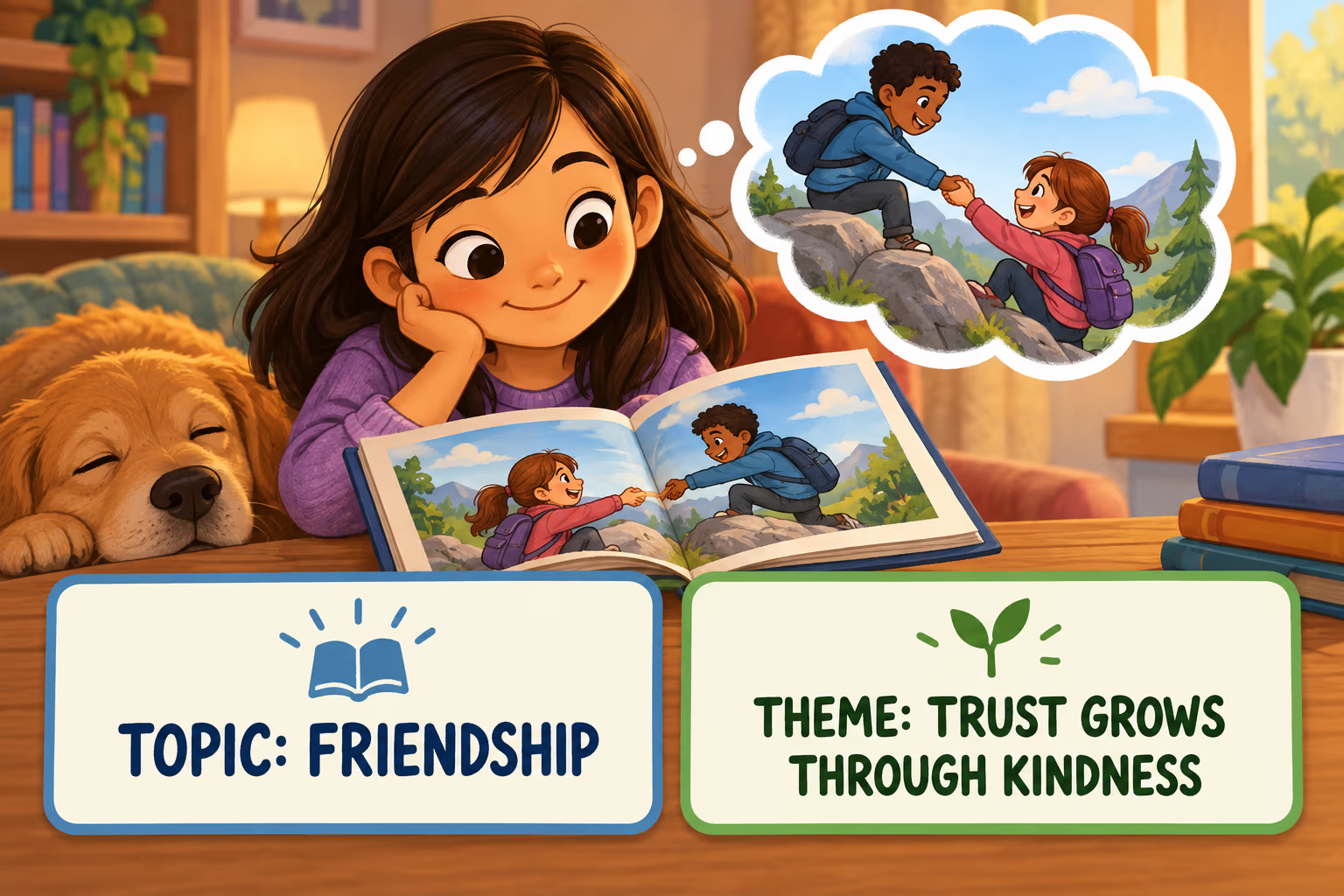
A topic is usually a word or short phrase; a theme statement says something about that topic. “Friendship” names a topic. “Trust grows when friends support one another” is a possible theme statement because it makes a complete claim that a reader can test against a story.
| Term | What it does | Example |
|---|---|---|
| Topic | Names the broad subject | Friendship |
| Theme concept | Names an idea developed in a work | Trust and friendship |
| Theme statement | States an interpretation about the idea | “Trust grows when friends support one another.” |
| Plot summary | Reports what happens | “Two friends get lost and find their way home.” |
| Party theme | Sets an event’s subject or style | “We chose space as the party theme.” |

A theme is not always a lesson or command. A story may explore an idea without telling readers what to do, and two readers may make different interpretations. A strong interpretation still needs support: it should fit the work’s repeated patterns and important details rather than depend on one isolated sentence.
How do you write a theme sentence?
To write a theme sentence, move from a broad topic to a specific, text-supported idea. A useful sentence is general enough to apply beyond a character’s name, but precise enough to show what the work suggests.
- Name a topic. Choose a recurring subject, such as courage, belonging, power, or friendship.
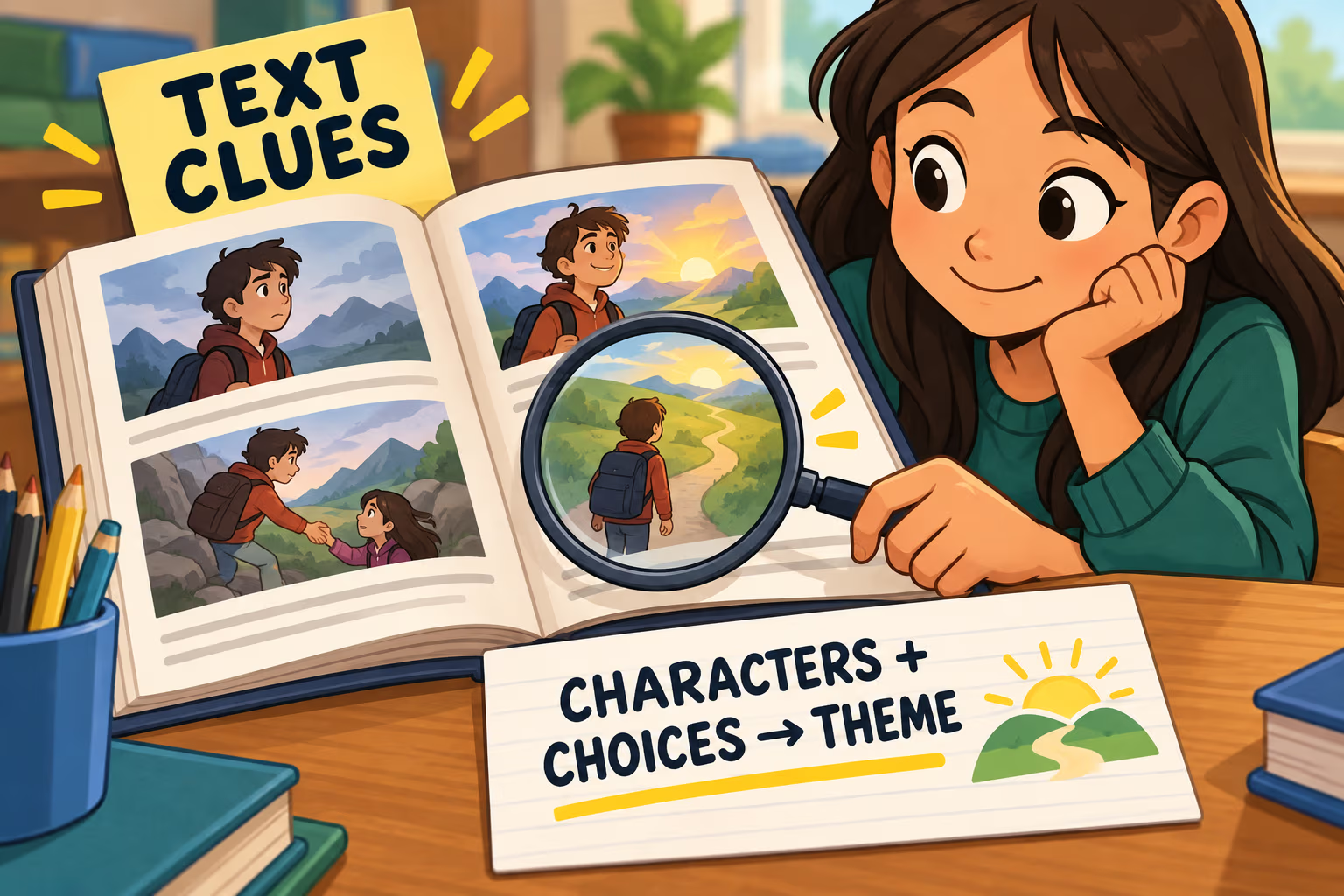
- Look for a pattern. Notice what characters repeatedly choose, what consequences follow, or what changes by the ending.
- Make a complete statement. Explain what the pattern suggests about the topic; avoid stopping at one word.
- Check it against the text. Find more than one relevant detail that supports the interpretation, and revise if important scenes do not fit.
For a story about a nervous student who eventually speaks up to correct an unfair mistake, “courage” is the topic. “Courage can help people act even when they feel afraid” is a possible theme statement. The student’s decision and its consequences are evidence; the interpretation should not claim that everyone must respond the same way.
Examples of theme in a sentence
These examples show the word theme in literary, school, and event contexts. The surrounding words tell you which sense is meant.
- “The novel’s theme is courage in the face of uncertainty.”
- “The story develops a theme of friendship through the characters’ choices.”
- “My essay explains how the theme of belonging changes near the ending.”
- “The theme of the poem is memory and loss.”
- “The teacher asked us to support our interpretation of the theme with details from the story.”
- “The school chose a space theme for its science night.”
- “We planned games and decorations around the party’s ocean theme.”
- “The podcast returns to the theme of starting over after a setback.”
- “The research paper’s topic is renewable energy; its theme is how policy shapes adoption.”
- “The novel’s theme is not stated in one sentence, so readers infer it from recurring details.”

Is theme a noun in a sentence?
Theme is generally a noun. In “The novel’s theme is courage,” it names an idea; in “The party has a space theme,” it names the event’s subject. In compounds such as theme party and theme song, the noun theme modifies another noun. The adjective thematic means relating to a theme, as in “a thematic analysis.”
How is a theme different from a thesis?
A theme is an idea or insight developed by a creative work. A thesis is the arguable main claim of an essay. A literary-analysis thesis may make a claim about a work’s theme and explain how specific choices in plot, character, setting, or language support that reading.
For example, “The story explores loyalty” names a broad theme concept. “By showing Mara keep her promise even when it costs her the prize, the story suggests that loyalty depends on action, not convenience” is a possible thesis: it makes a debatable claim and points to evidence. A summary of events alone does not establish either interpretation.
Sources: Texas A&M University Writing Center, “Analyzing Novels & Short Stories”; Del Mar College Stone Writing Center, “Theme”; Cambridge Dictionary, “theme”.
Frequently asked questions
Can a theme be one word?
A one-word label such as friendship is a useful topic or theme concept in class discussion. When writing a specific interpretation, turn that label into a complete statement about what the work suggests and support it with details from the text.
Does a theme have to teach a lesson?
No. A theme may express an observation or question rather than a moral lesson. Avoid forcing every story into a familiar rule; describe what its details support, and keep the statement limited enough to fit the work.
Can a story have more than one theme?
Yes. A story can develop several related ideas, such as friendship, responsibility, and belonging. Explain each theme with relevant evidence and show how the ideas connect, rather than listing broad topics without interpretation.
What is a simple theme sentence for kids?
A simple theme sentence might be “Friends can solve problems by helping one another.” It is clearer than “friendship” alone because it makes a complete statement. For a particular story, check that the characters’ choices and the ending support the sentence.
Use theme clearly
When using theme in a sentence, decide whether you mean a story’s idea, an event’s chosen subject, or another sense of the word. For literary analysis, turn a broad topic into a complete interpretation and support it with details; for parties and activities, name the subject or style that organizes the event.
The original examples below are preserved as published. They use theme for both a literary idea and an event’s subject, but some wording is broad or unclear. In literary analysis, “animals” or “friendship” may name a topic rather than what a story suggests about it; “theme of the party” refers to the event’s chosen subject; and “theme of a research paper” may be more precisely called its topic. Use the distinctions and examples above to choose wording that matches your meaning.
Themes are the underlying ideas or concepts that drive a story or work of art. They are the messages or emotions that the creator wants to convey to the audience. A theme can often be identified as a recurring element that appears throughout the narrative, tying everything together with a central focus. Themes can vary widely and can encompass a broad range of topics, from love and friendship to betrayal and survival. By exploring different themes within a piece of writing or artwork, we can gain a deeper understanding of the creator’s intention and the message they are trying to communicate.7 Examples Of Theme Used In a Sentence For Kids
- Theme of the story is about animals.
- Let’s draw pictures of the theme.
- The theme of the party is colors.
- We will sing songs about the theme.
- The teacher will read a book with the theme of friendship.
- Let’s play a game with the theme of numbers.
- We will have a dance with the theme of nature.
14 Sentences with Theme Examples
- Theme plays a crucial role in determining the topic of research papers for college assignments.
- Theme parties are a popular way for college students to socialize and have fun.
- When attending college events, many students try to dress according to the theme of the occasion.
- Understanding the underlying theme of literature works is important for analyzing them in college English classes.
- College cultural festivals often have a central theme around which various activities and performances are organized.
- Theme-based decorations are commonly used for college hostel room competitions.
- Many college clubs and organizations have a specific theme that guides their activities and events throughout the year.
- Students often choose a theme for their college project presentations to make them more engaging and memorable.
- Theme-based competitions like essay writing or debate are common in college extracurricular activities.
- College festivals usually have a different theme each year, chosen by the organizing committee.
- Group projects in college often revolve around a central theme that connects the various components together.
- Many college events incorporate traditional Indian cultural elements as part of their theme.
- Theme-oriented study groups can be a helpful way for college students to collaborate and prepare for exams.
- Entrepreneurship competitions in college often require students to come up with innovative business ideas that align with a specific theme.
How To Use Theme in Sentences?
Theme is the main idea or underlying meaning of a story or piece of writing. When using the word theme in a sentence, it is important to identify and convey the central message or concept of the work. Here is a helpful guide on how to use theme correctly:
Identify the main idea: Before using theme in a sentence, make sure you understand the central message or concept of the material you are referencing. This could be about love, friendship, greed, or any other overarching idea.
Incorporate the theme: When writing your sentence, include the main word theme to convey the central message of the work. For example, “The theme of the novel was the importance of family bonds.”
Provide context: It can be helpful to give some context or explanation around the theme to help the reader understand its significance. This could involve mentioning specific events, characters, or quotes that relate to the central idea.
Reflect on the impact: Consider how the theme shapes the overall meaning of the work and influences the reader’s interpretation. You can discuss how the theme adds depth and layers to the story.
By following these steps, you can effectively use the word theme in a sentence and enhance your understanding and appreciation of literature and writing.
Conclusion In conclusion, the examples of sentences with a theme throughout this article have highlighted the importance of maintaining a consistent and central idea in writing. By using a theme as a guiding element, writers can effectively convey their message and connect with their audience in a more engaging way. The cohesive nature of sentences that revolve around a theme adds depth and coherence to the overall piece, creating a more impactful and memorable reading experience. By incorporating a theme into their writing, authors can evoke emotions, provoke thought, and leave a lasting impression on their readers. Whether it’s in a novel, an essay, a speech, or any other form of writing, a well-developed theme can tie together disparate ideas and create a cohesive narrative that resonates with the audience. Writing sentences with a clear and consistent theme not only enhances the quality of the work but also invites readers to explore deeper meanings and connections within the text.

